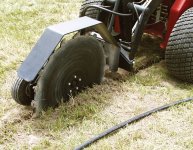
Thinking out loud

   / Thinking out loud #21  
handirifle said:
As for ease of construction, and cost, you're most likely correct. I just can't shake this idea.

This, certainly is not a heavy duty idea, it's a light duty, concept, meant for trenching narrow trenches for sprinkler lines. This is geared to compete with someone using a trenching shovel, rather than a 900 lb. Ditch Witch.

I totally understand once a concept takes hold ya get excited and the desire to see it through can keep ya up at night. I totally applaud your ingenuity and I say if you have an idea go for it. Who knows it may even work better than you think it will and that could lead to places. As the saying goes "necessity is the mother of invention"

Sometimes the necessity is just to try your own ideas. Good luck. :)7
 
   / Thinking out loud
  • Thread Starter
#22  
I hear what you're saying about the layout, and it MIGHT be possible, but it seems I always forget something, and there is no way I am trenching by hand, more than a few feet.

As for freezing, I live on the Central Coast area of California. The only long term freezing going on here, happens about once every 25 years or so. Other than that, the only freezing going on here, is in the ice makers:laughing:.

I used to live farther south, in the high desert area, and we had one year where the temps were in the low teens for over a week. My sprinkler lines were no more than 6-8" underground, and the anti siphon valves were above ground, but insulated. None of those froze, but the lines for my Doughboy pool did.

Anyway, 10-12" underground for sprinkler lines here, freezing won't be an issue.

As for the "all at once" issue, it's often a matter of getting the landscaping done in stages, and THAT is because we don't always know exactly what we want, until we're into it. not the most effecient, I know, but at least you understand my delima. If I were doing what you did (in fact I pretty much have) I'd used the biggest, fastest machine available, but that is not the case here.
 
   / Thinking out loud #23  
How deep are you looking for? You need to go deep enough to avoid getting your lines hit later. And you are supposed to call before you dig. You have new construction it sounds like so are your present phone, power, water or gas lines marked?
I kind of think if you use a stump grinder wheel. Those things can tear apart stumps dirt and rock should not be a big deal for them.
 
   / Thinking out loud #24  
These work well:

Another model, this one is easier to see the wheel in operation. They also mention wheel rpm is ~800 or so....much faster than a tiller shaft rotates.

YouTube - Kwik Trench Little Beaver Augers
:)

Other than the carbide teeth, that Little beaver trencher wheel is almost exactly what I was thinking to adapt to a tiller. Cheap and easy to build and as an occasional use thing, speed shouldn't be much of a concern.
 
   / Thinking out loud #25  
Here's another thing not to forget. Before you fill in your trenched lines take photos of everything and save them to a disk.

Rob
 
   / Thinking out loud
  • Thread Starter
#26  
The Little Beaver is interesting. Never seen one before. I suppose the wheel size really doesn't matter, just as long as it's geared for it.

This is for new/old construction. I say new/old, because there was a dilapidated old house on this site before, that we tore down to build a new home. There's all kinds of crap in the ground, but utility lines and such are not a concern. As for the lines for the new house, I ran everyone of them so I know exactly where they are, and yes, I did take pictures, before and after trenching.

As mentioned earlier, no deeper than 12", most likely 8-10". Where these are gooing, I don't expect any more digging, once I'm done. This will be for landscaping etc. I also plan on doing any yard lights etc at the same time.
 
   / Thinking out loud #27  
A cable layer wouldn't work because I use mostly sched 40 PVC for sprinkler lines. It's not flexible like that.

Renze
I was really thinking more along the lines of a smaller wheel that could be lowered to the desired depth. I agree 100% on the loss of torque with the big wheel.

I gotta think this out a bit. I think it's doable, but it needs some thought. No way do I want this to be expensive, that defeats the purpose. If it's costly I might as well rent a ditch witch.
Ok you'll use ordinary PVC... Do you get frost in your area ? Tylene hose will survive 20 years of freeze and thaw cycles so it doesnt need to be buried under the frost line, and is insensitive to earth sinks because it will give a little..

With the tiller, you can make it work if you never need a tiller again... Then you'd better throw away the tiller rotor, and put a smaller sprocket on the angle gearbox to lower the speed and increase torque. Then i'd bolt blades to a 3/4" cutting wheel. When you bolt, the blades can be replaced easily and they break when you hit a rock, even with a PTO slip clutch you can break stuff with that much momentum of the rotating mass.
Also, i feel more comfortable with rotating mass held by constant quality bolts, than by human welds.. ;)
 
   / Thinking out loud #28  
I'll throw in my 2 cents... or 2 options

Option 1
If you really want to use a tiller that you could convert back to use as a tiller, you could build an arm off the back to hold the digger wheel. Attach a chain sprocket to the wheel and to one of the tiller blade flanges. Connect them with a chain to drive the wheel. Different sized sprockets could be used to adjust the speed of the wheel if you need to.

Option 2
Since you don't have a tiller now to work with why not just build a 3 point mounting bracket and buy a right angle gearbox to mount to it. Mount the digger wheel to the gearbox shaft. Look at the power trac wheel trencher as an example (option 3 - you could also drive the digger wheel with a hydraulic motor like PT does).
 

Attachments

  • dirt-trencher.jpg
    dirt-trencher.jpg
    102.2 KB · Views: 182
   / Thinking out loud #29  
Other than the carbide teeth, that Little beaver trencher wheel is almost exactly what I was thinking to adapt to a tiller. Cheap and easy to build and as an occasional use thing, speed shouldn't be much of a concern.

Speed does matter though....even if you're not concerned about "speed" as in productivity or in feet per minute that you could dig.

The speed of the wheels on the factory-built machines has a lot to do with how well they work, just like speed with pretty much any cutting blade or device does. Think of any purpose-built machine that cuts a material it was designed to cut. Imagine a saw blade cutting a piece of wood for example. At the speed it's designed to rotate it works well. Cut that speed in half and the results are poor....if it works at all.

Wheel-type trenchers are the same in that a certain minimum speed needs to be maintained to allow the teeth to cut and clean away the soil properly, instead of the individual teeth hitting the ground and "bouncing" the machine along. Larger wheels like on this behemoth do turn slower, but the larger circumference still keeps the feet-per-minute the teeth are traveling up there where it needs to be to be effective.

images


I know the tiller sitting out in my garden has nowhere near the shaft speed the smaller wheel trenchers have, so if I were doing a project like this I'd probably take one of the engines out in the garage and start from scratch with the build....

;)
 
   / Thinking out loud #30  
Speed does matter though....even if you're not concerned about "speed" as in productivity or in feet per minute that you could dig.

The speed of the wheels on the factory-built machines has a lot to do with how well they work, just like speed with pretty much any cutting blade or device does. Think of any purpose-built machine that cuts a material it was designed to cut. Imagine a saw blade cutting a piece of wood for example. At the speed it's designed to rotate it works well. Cut that speed in half and the results are poor....if it works at all.

Wheel-type trenchers are the same in that a certain minimum speed needs to be maintained to allow the teeth to cut and clean away the soil properly, instead of the individual teeth hitting the ground and "bouncing" the machine along. Larger wheels like on this behemoth do turn slower, but the larger circumference still keeps the feet-per-minute the teeth are traveling up there where it needs to be to be effective.

images


I know the tiller sitting out in my garden has nowhere near the shaft speed the smaller wheel trenchers have, so if I were doing a project like this I'd probably take one of the engines out in the garage and start from scratch with the build....

;)

The 3PH trencher looks relatively easy to fabricate. So what's the speed of a commercial machine and what's the blade size? Once you know that you can calc FPM at the teeth and adj your PTO speed to get close to it. I have a old beat up rotary cutter that I could take the gearbox off. The box seems like the hardest part of the build. Am I wrong?
The other thing is keeping the spoils out of the ditch.

Rob
 
   / Thinking out loud #31  
Many years ago I had a summer job in SoCal installing automatic sprinkler systems (mostly) in suburban yards. We used a machine about the size of a rototiller, except that it had a couple of long, L-shaped tines that did the digging. My recollection is that it made a ditch about 2" wide by 10-12" deep. We were working in soils with very few rocks, though.
I don't know if this ditching technology is still used.
BOB
 
   / Thinking out loud #32  
So what's the speed of a commercial machine and what's the blade size? Once you know that you can calc FPM at the teeth

That second video link I posted a couple of pages back mentioned a blade speed of 800 rpm. More details and photos on their website here:

Welcome to Little Beaver Inc., Earth Drills & Augers

The blade diameter isn't mentioned, but it will cut up to 12" deep, so with the height of the teeth included it's probably about 26"-28" across and the blade has 6 tooth stations on it.

Get your tooth tip FPM speed in the ballpark and you'll be set....
 
   / Thinking out loud #33  
That second video link I posted a couple of pages back mentioned a blade speed of 800 rpm. More details and photos on their website here:

Welcome to Little Beaver Inc., Earth Drills & Augers

The blade diameter isn't mentioned, but it will cut up to 12" deep, so with the height of the teeth included it's probably about 26"-28" across and the blade has 6 tooth stations on it.

Get your tooth tip FPM speed in the ballpark and you'll be set....

It could be an interesting project. The teeth look like carbide inserts for lathes, probably C2 cemented carbides and relatively cheap. Although carbide doesn't do well on interupted cuts, I'd almost use HSS with maybe 5% cobalt. If you're not doing commercial work the teeth will most likely last a long time.

I'd say your estimate about the blade diameter is pretty close.

Rob
 
   / Thinking out loud
  • Thread Starter
#34  
OK I am liking the idea of the 3ph driven wheel digger. Seems I saw a gearbox online for like $149 or so. Wonder if I could get a used one somewhere for way less?
 
   / Thinking out loud #35  
Check out junk farm machinery. I have a couple off manure spreaders in inventory for future projects. One cost $15, the other was free for taking it off.
 
   / Thinking out loud #37  
I'm wondering if you can't run something like a middle buster or just a long 2" wide flat bar into the ground about 8 or 9 inches and drag it along.

Rob
 
Last edited:
   / Thinking out loud #38  
handirifle- in your opening post you indicated 3/4 or 1 inch pipe. I am no sprinkler expert but I do have a system and have had it for 28 years and have done all my own maintenance. I watched the installer put in my entire system and asked a lot of questions.
They recommend 1 in black poly for the main supply for residental applications. Some of the secondary pipes are 3/4 and a few that go to small heads are sometimes 1/2 inch. Make sure you understand pressure, volume and gallon per minute needs before you lay pipe.
 
   / Thinking out loud
  • Thread Starter
#39  
I'm wondering if you can't run something like a middle buster or just a long 2" wide flat bar into the ground about 8 or 9 inches and drag it along.

Rob

Yea probably could, just not nearly as exciting to think about.:thumbsup:

Oldstuf
Yup, done a LOT of sprinklers in the last 36 years. Gettn a good handle on em. Just don't like handlin the shovel so much.
 
   / Thinking out loud #40  
Yea probably could, just not nearly as exciting to think about.:thumbsup:

Oldstuf
Yup, done a LOT of sprinklers in the last 36 years. Gettn a good handle on em. Just don't like handlin the shovel so much.

That's true, all those gears turning and a carbide wheel spinning does make me salivate!
 

Tractor & Equipment Auctions

Compressor (A55973)
Compressor (A55973)
2017 Dodge Ram SLT (A55314)
2017 Dodge Ram SLT...
Adams 5T Spreader MHR (A56438)
Adams 5T Spreader...
2005 Honda Accord LX Sedan (A59231)
2005 Honda Accord...
500 BBL FRAC TANK (A58214)
500 BBL FRAC TANK...
500 BBL FRAC TANK (A58214)
500 BBL FRAC TANK...
 
Top