Welding basics for a newbie

/ Welding basics for a newbie #1  

Uncle Doug

Gold Member
Joined
Oct 19, 2008
Messages
420
Location
Dayton, TX
Tractor
Kubota L3000
What would y'all recomend for a basic welder for home/farm light welding use? Over the years I have needed a few things welded and ended up having to ask friends to do the job or haul the project to a shop for welding.

Mostly it would be very light projects. Other than shop class many years ago where I did a little stick welding I have little experance with welders.

What would be the best type of welder for home/farm use? I know there are several basic type like the AC/DC, Flux wire, Gas wire.

Which in long term be least expensive to operate considering welding supplies, electric use, etc.

What brands should be considered?

Any other must haves? Welding hood, gloves, grinders....
 
/ Welding basics for a newbie #2  
Just a suggestion, but I have an oxy-acetylene torch that I'd be in sore shape without. It lets me cut my stock pieces (plate, tube, angle) into roughly the shape of the pieces I need to weld before I do the final fit-up with the grinder.

It also it provides other service, such as:

>Preheating difficult to weld material to help avoid post-weld cracking (cast iron).
>Heating to form (bend, thin, gather) pieces for better fit.
>Heating for hammering seams that have "walked open" closed so they can be easily welded.

There are lots of tools that can do some of these tasks better, but none that can do all of them for such a small investment. Using the torch to it's full potential takes a lot of practice and goes much faster if you have some skilled instruction, so if you have a friend who knows his stuff or can take an adult-ed class you'll get your investment back in time and material saved when you start burning steel. Get a good quality torch and you will never regret the money spent.

-Jim
 
/ Welding basics for a newbie #3  
mig is probably the easiest to use, but with that comes $$$. Infact I went from a 115V mig to a 240V stick both hobart. The mig was great it just had to many years on it. For my $$$ range and needs the replacment ended up being the stick welder. If you go with a stick try 6011 for rods they seem to be the best for overall use{IMO}. I also used the torch setup as mentioned but if you do get into some heavy welding jobs you better know what your doing{not the easiest thing to use}. As for cutting metal I turned and old skill saw into my metal cutter, just had to switch to metal cutting blades. I've cut thick metal with this setup it just takes some patients, and you will end up with a nice clean cut.
 
/ Welding basics for a newbie #4  
I would recommend a MIG welder. You can get cheap ones, but would recommend you choose a name brand, primarily for parts and service. Some of the MIGs can only do flux core, the some use both types of wire, by adding a shielding gas like Argon, CO2, etc. There might be a local school that teaches welding at night classes. There are lots of books, and videos, and lots of practice will get you to the satisfaction level. So of course you have to have a helmet, gloves, chipping hammer, pliers, etc. You might need to wire up a 220 v circuit for the welder.
 
/ Welding basics for a newbie #5  
I am a dyed in the wool stick welder, but for the least frustration, look at migs that will run fluxcore as well as hardwire. Fluxcore is easy to learn, and will do nice work on heavier steel, while hardwire is great for sheetmetal. A word of caution, Mig will not work well on rust or painted surfaces. It also doesn't like breezy areas that introduce oxygen into the weld. Stick is by far the cheapest, and almost as versatile, but has a bigger learning curve. For the part time welder, go with mig, and pre-clean your dirty surfaces with a grinder. A cheap harbor fright welder will give you more frustration thinking that your the problem when the machine is at fault. I personally would go to my friends, and offer up a sixpack for some welding lessons (make sure you pick a welder that is a friend over a friend that sometimes welds.)
 
/ Welding basics for a newbie #6  
I vote stick, I've got a mig and hardly ever use it except for sheet metal, mufflers etc.

If your gonna be welding light stuff on a bench in the shop, the mig would be better. If your gonna be outside repairing an implement, go stick.

The cost of a good mig that will weld heavier metals is gonna be alot more than a decent stick.

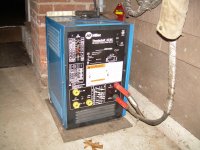
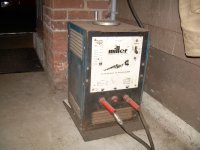
I just bought this off Graigslist for $225. it's 10 years old but was unused. Replaced the 30+ year old thunderbolt that was still buzzing, the newer one has DC now which most will tell you is a necessity.

JB.
 

Attachments

  • DSCN6098.JPG
    DSCN6098.JPG
    985.7 KB · Views: 978
  • DSCN2595.JPG
    DSCN2595.JPG
    984.1 KB · Views: 1,166
/ Welding basics for a newbie #8  
Mostly it would be very light projects. Other than shop class many years ago where I did a little stick welding I have little experance with welders.

What would be the best type of welder for home/farm use? I know there are several basic type like the AC/DC, Flux wire, Gas wire.

Which in long term be least expensive to operate considering welding supplies, electric use, etc.

What brands should be considered?

Any other must haves? Welding hood, gloves, grinders....[/QUOTE]

The best welder for home/farm use is the one you can weld the best with. You have some experience with stick welders so that would be the one I would start with. If I could only have one welder, for the things that I like to weld (mostly 3/16" and thicker steel), trailer hitches/wood stoves/ trailer frames, motorcycle rails, stuff like that, my choice would be a stick welder. I like to weld outside whenever possible. A friend of mine lost his almost new shop/garage to a smoldering welding spark. When I weld outside I don't have to worry about it. Since wire welders don't play well with wind it limits where they can be used.

The stick welder will work with electrodes that have been impropperly cared for (most home shops don't have climate controlled rod storage). The last 50 lb box of 7014 I bought has been sitting open on top of my welder for the last 15 or 20 years. It still does what I need it to do, farm welding. :D

If I leave a spool of wire sit in the same location it developes rust on the surface and doesn't feed or melt correctly because the rust insulates it from the liner of the wire welder feed cable. In Michigan we get a lot of moisture in our unheated buildings do to the drastic temperature changes. It is not kind to wire over the long term. :mad: To prolong its useful life I have to remove the spool from the wire welder and store it in the house when it is not being used. A little inconvenient but it helps.

For thin sheet metal the wire welder wins hands down.:cool:

I have both kinds, a 160 amp Clarke 220 volt wire welder that can be used with gas or flux core and I have had 3 Stick welders. My first was an old 225 amp copper wound induction cooled Westinghouse with a crank style power setting, I sold it to a friend about 25 years ago, he is still using it. I then bought a used Montgomery Wards 250 amp AC/DC with a slide type power setting. I just recently purchased another Montgomery Wards 295 amp AC only welder for $75 on Craigs list to use in one of my barns.:D

I had used one like it a couple weeks earlier at a friends house to weld some flanges on a 6 foot tiller I had bought, I was very impressed with the stability of the arc and the ease of starting.:cool:

These are all light duty consumer grade machines. They have serverd me well. I have burned up about 100 lbs of 7014 and about 50 lbs of 6011 and a small amount of nickle rod on cast iron. I have no complaints with any of them. I like the infinite power settings better than the "click" style that is used on some welders, it allows me to adjust the power to fit my welding style rather that having to adjust my welding to fit the available power. These old welders seem to never wear out and you can often find them in the $75-$100 price range.:)

I think the stick welders are a little cheaper to operate, but not by enough to make any real differnce, but if the cost is a concern then I think the stick welder will be your best choice if buying used.

As far as brands, I have only used Westinghouse/Montgomery Wards/Lincoln and a comercial 100% duty cycle Miller 250 amp AC/DC. They all work great.

I liked the auto darkening hood that I bought at Harbor Freight. It burned up in my barn fire so I am going to get another one. It make life a lot easier for those of us who don't weld frequently.
 
Last edited:
/ Welding basics for a newbie #9  
I am no welder expert, but learned on my own. Still got lots to learn though. I have the hobart 125 flux welder and it too light duty for what I been doing. Sure it works on a few light stuff, easy to do tack welds when building something, and made bunch other stuff with it. I just had to put up with the short use time and let transformer cool down before I can keep going.

I got the 125 since it was advertised as the easiest to learn. They are right, but I been doing more and more heavier stuff and been replacing parts on it alot recently this year. I replaced the tips a few times, had to replace the monocoil early this summer for a stuck wire inside, and again now for broken sheathing due to rough handling :eek: .

I agree with others to think about what you really want to do and how much welding you want to do. I may need to move up to stick in the future so thats on my to do list.

you will want to get a auto darkening helmet, I hated the hand held ones that comes with it free, and a welding shirt. I got the welding shirt over summer after being pissed from the sparks landing on my arms in the summer time and boy I love the welding shirt now.
 
/ Welding basics for a newbie #10  
There is probably not any easier weld to do than MIG/FCAW (fluxcore) when the machine is working right. There is nothing more aggravating than a MIG/FCAW machine when the wire is not feeding properly. Lots of things can go wrong with a MIG machine that will make you pull your hair out trying to figure out why it is not welding right. I used to say that a MIG welder can put more bad weld on in 5 minutes that you can grind out in 5 hours. You have contactor tips to replace, tip nozzles, wire feed liners, rollers, wire feed lubricators, and wire feed motors that can go out or need replacing./service to keep your machine operating at optimum and not too many novice welders know what to do to fix a problem with one of these machines. Your best bet for least $$$ would be an AC/DC stick rod welder or if you find a good used one, just a DC machine. YOu can find these used or new for under $400. I personally found a pristine condition 350 Amp Miller CC/CV AC/DC machine for $350 complete with leads, but dont expect to find those bargains everyday. This machine will run stick, TIG, FCAW (with a wire feeder) and SMAW(stick). The E6011 AC or E6010 DC rods are general all purpose rods that require only mild conservation, IE just keep them dry and they will last a long time. The best rod for strength and ductility for general use is a E7018 and these are made in AC or DC versions and are pretty easy to weld with in a flat position and can be used in all positions with practice. They do require heated storage or hermetically sealed containers to keep moisture out. THe flux absorbs moisture and will cause underbead cracking and hydrogen embrittlement if welded with rods that have even a few % of humidity.
Cheapest machine would be one of the Lincoln Tombstone transformer type machines which pretty much last forever and can be found for less than $200on about any Craigslist. I think they are about $300 new with AC/DC capability. You can weld anything you need with one of those and a package of E60xx rods.
 
/ Welding basics for a newbie #11  
Mig is by far the easiest to learn to use, I never had any interest in welding I always took my stuff to the pro's and let them do it, My wife noticed how much $$ I was spending in welding cost and decided to buy me a el-cheap-o
80 amp Campbell Hausfeld Mig welder for Christmas 15 years ago,I learned how to weld with it and it for sure paid for itself, although after using it for a couple years I realized I needed something a bit stronger but I am limited to a 110/115v connection, so I purchased another el-cheap-o Clark 130 amp Mig/gas welder from Northern tools, works great and for just over 400 bucks,
but after moving and building my new shop i went ahead and run 220/v so I could get a heavier duty welder, I now also have a Miller ac/dc 220/230v stick welder for the heavier welding task, it will weld up to 1/2 inch steel, after using it a couple of times I realized that stick welding really isn't that hard to learn, or I suppose i should say is an easy transission from using a Mig to a Stick welder, stick are Less expensive to use, makes a stronger weld, I can actually crank it on up and cut through 1/4inch steel with it as well,
 
/ Welding basics for a newbie #12  
Speaking of welding, good advice on autodarkening hood. I have a couple, one Speedglas that was $350 that I had for years and a Harbor Freight one for $49 that I bought last year. Both work well and the speedglas takes a battery whereas the HF one is solar powered. Invest in a good set of leather welding sleeves and or a fire resistant long sleeved welding shirt. You need to protect yourself from any UV rays from the welding. They will blister you in just a few minutes of welding like a severe sun burn. Make sure your hood gaskets are good and not light comes in around the dark lens. You can check this with a flashlight, just run it around the perimeter and look for any light shining in. Just a small amount of UV light leakage will spoil your days and nights for a couple of days with flash burned eyes. You will know if you have flash burn as all the lights start to have halos around them like when they are surrounded by fog. I also like to tie a bandana around my neck to protect my neck rather than button up the top button, most hoods leave a small area right at the bottom of your neck that will blister if not protected. Always wear good welding gloves to protect from sparks and UV on your hands also.
 
/ Welding basics for a newbie #13  
I couldn't have said it better! STICK.....You will just have to work at it longer till you get the hang of it... Welding used to be a trade unto itself until MIG came along. I gave up on it as a trade years ago. (1981) certified making $13/hr plus bennies. (2001) certified making $10.75/hr NO bennies. Thank-you NAFTA!
 
/ Welding basics for a newbie #14  
Speaking of welding, Invest in a good set of leather welding sleeves and or a fire resistant long sleeved welding shirt. You need to protect yourself from any UV rays from the welding. They will blister you in just a few minutes of welding like a severe sun burn.

Very good advice;) I am still healing from the last welding I done about a month ago, I only had pushed my shirt sleeves up to put my cloves on and the gloves come to just low of my elbows, I forgot to tuck my shirt sleeve into the gloves and my elbows got burned to a crisp, You know you dont really feel the skin on your elbows but you know they have been burnt when they start cracking open, kinda like peeling the sking from a bake potato,:cool:
 
/ Welding basics for a newbie
  • Thread Starter
#15  
Thanks for all the feedback. I finaly got the search to work here on TBN and there is a ton of info out there on welding.

I am in good with both local high school ag shops. They have done some of my repairs for me over the years and built one project for me. I may sit in on some of their shop class for a few pointers.

220 volt service is not a problem as it is already in the barn and small shop. I did electrical work for a number of years.

I do have several projects waiting, some simple that a flux wire would handle but another (old brush hog) that would take a stick or heavy duty welder to handle.
 
/ Welding basics for a newbie #16  
I bought a nice Lincoln Tombstone AC/DC on craigslist for $100. Best $100 I have spent. I am a terrible welder, and tried recently to weld some thin stuff together. That was a HUGE mess. Mig has its place for sure, especially in inexperienced hands. Moments like that I wish I had one...
 
/ Welding basics for a newbie #17  
Stick welding rule of thumb # 1 the ampere setting for a given rod is the decimal equivilant X 1000 1/8" = 125 amps 3/16" = 185, 1/4" = 250 amps. This is the starting point, probably a little hot on most welders from my expierence. about 10 amps too hot for 1/8"
 
/ Welding basics for a newbie #18  
I can never read enough welding threads. Being a beginner myself, I'll add my 'meager' input! I bought a 225 Lincoln AC/DC Stick machine. My son already had a Lincoln SP-175 wire mig. They both require 220. I like the stick, he likes the mig! He's got a Speedglas hemet, I've got the HF Autodark Chicago. Must haves: Welder, Auto-dark helmet, gloves, clamps, magnets, at least two 4-1/2 inch angle grinders, one for twisted wire wheel, and one with grinding disc. All of that's pretty cheap at HF. Lots of rod/wire a good steel bench and fireproof area to work is a big plus!
mbohunter-Your rule of thumb doesn't work for me. I'm burning 6013, 1/8" at 175-195 amps DC Neg. That's on 1/4 to 1/2 inch medium steel plate. Maybe in AC mode it would be different. Also, while DC is pretty stable with what seems like fewer sparks, note that a hot slag/spark will drop directly thorough the eyelet of your sneakers!!! ~Scotty
 
/ Welding basics for a newbie #19  
I can never read enough welding threads. Being a beginner myself, I'll add my 'meager' input! I bought a 225 Lincoln AC/DC Stick machine. My son already had a Lincoln SP-175 wire mig. They both require 220. I like the stick, he likes the mig! He's got a Speedglas hemet, I've got the HF Autodark Chicago. Must haves: Welder, Auto-dark helmet, gloves, clamps, magnets, at least two 4-1/2 inch angle grinders, one for twisted wire wheel, and one with grinding disc. All of that's pretty cheap at HF. Lots of rod/wire a good steel bench and fireproof area to work is a big plus!
mbohunter-Your rule of thumb doesn't work for me. I'm burning 6013, 1/8" at 175-195 amps DC Neg. That's on 1/4 to 1/2 inch medium steel plate. Maybe in AC mode it would be different. Also, while DC is pretty stable with what seems like fewer sparks, note that a hot slag/spark will drop directly thorough the eyelet of your sneakers!!! ~Scotty

I recommend pull on high top leather boots (no laces to catch and burn) with the levi's pulled down over the outside, because I have had hot slag melt through the top of sneakers. A vocabulary expanding experience;)

This is the little treasure I found on our local Craigs list for $75. It was only about 3 miles from my house. Welder, chipping hammer, cables, hood, one small unopened pack of 6011 and a small unopened pack of 6013. It also came with a hard cover Lincoln "how to weld" book. I think it is typical of what is available if you are not in a big hurry. I have used a friends identical welder a couple months ago and I was impressed with how good it made my welds look. When I saw it available so close to home I just had to have it.
Now I have a welder for every barn.:D:D
 

Attachments

  • welder.JPG
    welder.JPG
    518.8 KB · Views: 222
/ Welding basics for a newbie #20  
i have a lincoln tombstone welder-had it for years. it has no problem welding 1.5"plate to 1.5" plate with 3/16" 7018. i can weld rusty crap metal together all day with 6011. the only thing it doesnt do is sheet metal-just burns right through. i picked up a small 110v mig that i run fluxcore wire and it does ok on sheet metal
 

Marketplace Items

PALLET OF BRIGGS & STRATTON MOTORS W/ PACER PUMPS (A63745)
PALLET OF BRIGGS &...
2006 Cadillac GM Superior Coach 6-Door Limousine - Only 21,567 Miles (A63118)
2006 Cadillac GM...
Kuhn Axis 50.2 H-EMC-W Fertilizer Spreader (A64047)
Kuhn Axis 50.2...
2018 CATERPILLAR TL1255D TELESCOPIC FORKLIFT (A62129)
2018 CATERPILLAR...
(INOP) VOLVO A30D OFFROAD DUMP TRUCK (A60429)
(INOP) VOLVO A30D...
NISSAN 60 FORKLIFT (A63290)
NISSAN 60 FORKLIFT...
 
Top