You are using an out of date browser. It may not display this or other websites correctly.
You should upgrade or use an alternative browser.
You should upgrade or use an alternative browser.
Splitfire type logsplitter
- Thread starter picknfred
- Start date
- Views: 7678

More options
Who Replied?
/ Splitfire type logsplitter
#1

kennyd
Advertiser
Welcome to TBN Fred
Pretty much the standard sized cylinder for logsplitter's is a 4"x24".
Using the calculators HERE will help you figure out how much to expect from any cylinder as long as you know the specs of the power source (PSI and GPM) They (Surplus Center) are also a great supplier of a lot of the parts you will need.
Pretty much the standard sized cylinder for logsplitter's is a 4"x24".
Using the calculators HERE will help you figure out how much to expect from any cylinder as long as you know the specs of the power source (PSI and GPM) They (Surplus Center) are also a great supplier of a lot of the parts you will need.
Wayne County Hose
Veteran Member
- Joined
- Aug 24, 2007
- Messages
- 2,352
- Location
- Wayne County Pa.
- Tractor
- Massey Ferguson model 85, Allis-Chalmers WD-45
The cylinder Kenny mentioned is a good standard cylinder. I would do the research and see what the production units use. Because you are also splitting while retracting, the power will be less. They may use a hair larger bore cylinder, but maybe not.
rus_geek
Gold Member
This is going to require a balancing act. You want to minimize the rod size to maximize power on the return stroke, but if you go too small on the rod, it will buckle/bend under load on the extend side. Interesting dilemma...

J_J
Super Star Member
- Joined
- Sep 6, 2003
- Messages
- 18,973
- Location
- JACKSONVILLE, FL
- Tractor
- Power-Trac 1445, KUBOTA B-9200HST
Hi I am buiding a 2 way internal cylinder logsplitter and could use some advise about the type of cylinder I need
Fred
Do you mean a cylinder with a rod on both ends, or a setup that the cylinders pushes a blade through a log on the extend stroke, and also pulls a blade through a log on the return stroke. I have seen one like that somewhere, maybe YOU Tube.

LD1
Epic Contributor
YouTube - Powerhorse Log Splitter Splits Logs In Both Directions
Here is a vid of a powerhorse from northern tool that splits in both directions. It appears to use a square tube inside of another square tube, which would minimize the bending force on the rod itself.
I know it sounds like a good idea and in theory should split wood faster, but imo these are actually slower. Most logsplitters return cycle is faster than I can get another peice of wood ready to be split. So there isn't really any benefit. Also, you cannot use a 4-way of 6-way wedge with one of those. Add that to the complication of building, I think you would be better building a regular splitter with a 4.5 or 5" cylinder and a 22 or 28gpm pump. It will cycle faster than you will want to work and you can still use the 4 and 6-way wedges.
Here is a vid of a powerhorse from northern tool that splits in both directions. It appears to use a square tube inside of another square tube, which would minimize the bending force on the rod itself.
I know it sounds like a good idea and in theory should split wood faster, but imo these are actually slower. Most logsplitters return cycle is faster than I can get another peice of wood ready to be split. So there isn't really any benefit. Also, you cannot use a 4-way of 6-way wedge with one of those. Add that to the complication of building, I think you would be better building a regular splitter with a 4.5 or 5" cylinder and a 22 or 28gpm pump. It will cycle faster than you will want to work and you can still use the 4 and 6-way wedges.
I think the conventional 4"x2" 24' should be ok,,it's about 21 tons on the pull and 13 in the retract,,plenty for maplw which is what I will be burning
The premise of this splitter is the cylinder is mounted inside a length of 6"x6" 1/4" wall H.S.S tube,,the ram is conected to 7" length of 5"x 5" HSS covered with 1/4" UHMW and guides down the cycle with very little play ,,the actual axel mount is the tank,,the log stop nearest the valve is fixed ( welded) and the one at the front is bolted down,,this splitter is unbelievably fast
Fred
The premise of this splitter is the cylinder is mounted inside a length of 6"x6" 1/4" wall H.S.S tube,,the ram is conected to 7" length of 5"x 5" HSS covered with 1/4" UHMW and guides down the cycle with very little play ,,the actual axel mount is the tank,,the log stop nearest the valve is fixed ( welded) and the one at the front is bolted down,,this splitter is unbelievably fast
Fred
Last edited:
Wayne County Hose
Veteran Member
- Joined
- Aug 24, 2007
- Messages
- 2,352
- Location
- Wayne County Pa.
- Tractor
- Massey Ferguson model 85, Allis-Chalmers WD-45
I just looked at one of these and I used one a couple years ago. A 4x24 cylinder is normally what they use. If you have a couple people, they are way faster than a conventional splitter. No waiting for the wedge to retract. By yourself, not any real benefit.
SPYDERLK
Super Star Member
- Joined
- Feb 28, 2006
- Messages
- 12,621
- Location
- VA
- Tractor
- JD2010, Kubota3450,2550, Mahindra 7520 w FEL w Skid Steer QC w/Tilt Tatch, & BH, BX1500
As you know, a properly designed splitter puts no bending forces on the cyl rod. The cyl floats on 2 // pins. Unless the cyl hits against something as the rail bows there will be no bending forces other than those attributed to ram straightness issues or off center eyes. The problem I see with 2 way splitters is that the point where force is applied to the log is several inches above the place where the ram drives the wedge. This causes high back or front cocking force on the wedge assembly.YouTube - Powerhorse Log Splitter Splits Logs In Both Directions
Here is a vid of a powerhorse from northern tool that splits in both directions. It appears to use a square tube inside of another square tube, which would minimize the bending force on the rod itself.
larry

woodchuckcanuck
Silver Member
...The problem I see with 2 way splitters is that the point where force is applied to the log is several inches above the place where the ram drives the wedge.This causes high back or front cocking force on the wedge assembly.
larry
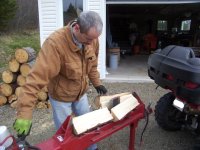
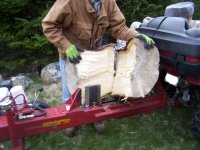
There's some truth to that however I believe with the Splitfire design, that's not an issue. The distance between the ram and that lowest contact point of the wood is only a bit more than the thickness of the square tubing that the ram sits in. The one I have will split no problem, no matter the wood.
Attachments

Wayne County Hose
Veteran Member
- Joined
- Aug 24, 2007
- Messages
- 2,352
- Location
- Wayne County Pa.
- Tractor
- Massey Ferguson model 85, Allis-Chalmers WD-45
As you know, a properly designed splitter puts no bending forces on the cyl rod.
larry
Theoretically speaking, yes. Real world speaking, fat chance. I replace more rods on log splitters than all other cylinders combined. I haven't replaced a rod yet on one of these 2 way splitters.
woodchuckcanuck
Silver Member
Its a 255.

I used one of those two way jobs , I thought it was someones idea of a joke , I have never replaced a cylinder rod on one of my splitters, most peoples trouble is they try to make the whole thing too tight and end up with a bent beam flange.
woodchuckcanuck
Silver Member
...most peoples trouble is they try to make the whole thing too tight and end up with a bent beam flange.
Well that's what you get when you try to shaft something that is too tight, you end up with a bent rod.
SPYDERLK
Super Star Member
- Joined
- Feb 28, 2006
- Messages
- 12,621
- Location
- VA
- Tractor
- JD2010, Kubota3450,2550, Mahindra 7520 w FEL w Skid Steer QC w/Tilt Tatch, & BH, BX1500
I dont understand that. The radius of the cyl must be in there somewhere. Force is applied along the centerline/axis of the cyl.There's some truth to that however I believe with the Splitfire design, that's not an issue. The distance between the ram and that lowest contact point of the wood is only a bit more than the thickness of the square tubing that the ram sits in. The one I have will split no problem, no matter the wood.
larry
woodchuckcanuck
Silver Member
I dont understand that. The radius of the cyl must be in there somewhere. Force is applied along the centerline/axis of the cyl.
larry
The distance I am referring to is from the wedge to the outside diameter of the rod.
J_J
Super Star Member
- Joined
- Sep 6, 2003
- Messages
- 18,973
- Location
- JACKSONVILLE, FL
- Tractor
- Power-Trac 1445, KUBOTA B-9200HST
The sliding tube on that splitter is what is pushing the blade. The cylinder is located inside of the inside tube. I don't think there is no way the cylinder could bend a cylinder rod.
On the 4 in cyl at 3000 psi, and 2 in shaft, the push stroke is 18 ton, and the return stroke is 14 ton. both will get the job done.
Northern Tools has a similar splitter, even a 3pt.
Those log splitter cylinders that pushes the wedge is probably the only cylinders that bend rods.
On the 4 in cyl at 3000 psi, and 2 in shaft, the push stroke is 18 ton, and the return stroke is 14 ton. both will get the job done.
Northern Tools has a similar splitter, even a 3pt.
Those log splitter cylinders that pushes the wedge is probably the only cylinders that bend rods.
Attachments

SPYDERLK
Super Star Member
- Joined
- Feb 28, 2006
- Messages
- 12,621
- Location
- VA
- Tractor
- JD2010, Kubota3450,2550, Mahindra 7520 w FEL w Skid Steer QC w/Tilt Tatch, & BH, BX1500
Theoretically speaking, yes. Real world speaking, fat chance. I replace more rods on log splitters than all other cylinders combined. I haven't replaced a rod yet on one of these 2 way splitters.
I have highlited some key words you may have missed. The common non proper design on splitters has the cyl bolted to the top of the rail or else close enuf that the cyl body touches it when the beam bows under splitting forces. This binds and bows the rod too, causing scoring and seal problems and predisposing the rod to bending. The rod is also out in the open where it can get dinged. It is no wonder you are called on to replace a lot of these. The problem of improper design remains as the cause of bending.As you know, a properly designed splitter puts no bending forces on the cyl rod. The cyl floats on 2 // pins. Unless the cyl hits against something as the rail bows there will be no bending forces other than those attributed to ram straightness issues or off center eyes. The problem I see with 2 way splitters is that the point where force is applied to the log is several inches above the place where the ram drives the wedge. This causes high back or front cocking force on the wedge assembly.
larry
The cyl inside the beam in 2 way splitters is suspended from just 2 pivot points, as it should be on all splitters. The cocking force on the wedge assembly is greater than the other design because force is applied several inches lower than where the log is. This cocking force is not a factor in rod bending because of the pivots. It just wears more on the guides of the wedge assembly.
larry
Wayne County Hose
Veteran Member
- Joined
- Aug 24, 2007
- Messages
- 2,352
- Location
- Wayne County Pa.
- Tractor
- Massey Ferguson model 85, Allis-Chalmers WD-45
I have highlited some key words you may have missed. The common non proper design on splitters has the cyl bolted to the top of the rail or else close enuf that the cyl body touches it when the beam bows under splitting forces. This binds and bows the rod too, causing scoring and seal problems and predisposing the rod to bending. The rod is also out in the open where it can get dinged. It is no wonder you are called on to replace a lot of these. The problem of improper design remains as the cause of bending.
The cyl inside the beam in 2 way splitters is suspended from just 2 pivot points, as it should be on all splitters. The cocking force on the wedge assembly is greater than the other design because force is applied several inches lower than where the log is. This cocking force is not a factor in rod bending because of the pivots. It just wears more on the guides of the wedge assembly.
larry
Larry,
I didn't miss anything, I'm not stupid. I am not an engineer, but I slept at a Holiday Inn last night. I know how these forces work. I also know that the greatest engineering minds on our planet can not design anything "proper" enough that a sufficiently talented moron can not overcome and break. I don't deal with pencil and paper, I deal with steel and wrenches.
Andy
Here are some similar links:

- Replies
- 3
- Views
- 320


