Tips on vertical posts?

/ Tips on vertical posts? #1  

ndnewbie

Member
Joined
Apr 9, 2007
Messages
42
Location
North Dakota
Tractor
Toolcat C
I am building a 140 x 70 outdoor riding arena, which will require about 40 posts. I am putting 5-6" 8' posts, 3' down into clay.

I have found that by using a 6" auger, I can save about 70% of the work involved, by not having to backfill the hole much. (Its terrible trying to backfill clay.) I just drop down a sack of quickcrete around the post. However, when digging that precise a hole, I have found it has to be exactly vertical, since there is too little play to make corrections (which is maybe why people don't do this).

As I drop the auger and drill, the reach on the arm grows, tipping the bit past vertical. I can back up to compensate, but have had difficulty getting it right. I suppose a person could put the bit a few inches in front of vertical, which I might try, after working with a plumb bob to see how far forward the arm moves.

Has anyone already solved this issue, other than using a bigger bit leaving more play? (The one situation where more play means more work.) Thanks for any thoughts.
 
/ Tips on vertical posts? #2  
not too sure i'm going to answer your question but here goes.

if i am placing posts then i'll auger the holes oversize, for what you are using i'd use a 12" auger. this allows you a bit of room to position the post in case your hole is not exact plus gives you room to ram the thing.

a quick cleanout with a post hole shovel, line your post up, put a BIT of dirt back in and ram it with the crowbar, check your post for line then probably 2/3 of the remianing dirt in, ram again then the rest of the dirt and a few taps with the crowbar.

done right you should not have any dirt left over.

it is a suprisingly quick way of placing posts.

I do not like using concrete as imho it does not hold them effectively over time. but if your clay is wet and sticky you mat not have any options.

a good way to line up your posts is to use a few sighter posts set up outside the arena - we normally use star posts like this and stand 3 or 4 in a line to use as a sighting guide. and the best way to line them up is with a pair of binoculars as it makes the posts appear to be next to each other.

place your end posts first so you do not compound your problems as you run the line. then run a string line and using a few nails get the tops of the posts all level, mark them with a crayon, a quick run round with a chainsaw to trim the height and viola - a perfect arena surround...
 
/ Tips on vertical posts? #3  
I really don't like to use concrete around wood posts, exception: on the ends of a fence, or a gate. I prefer to pack a sand and stone mix around them with a spud bar.

FYI: If you do use concrete, don't run it all the way to the top, leave about 4"-6" for dirt. This will help keep the frost from heaving them out of the ground.
 
/ Tips on vertical posts? #4  
clay packs well and holds well, it just can be messy/troublesome to repack if its too wet.
 
/ Tips on vertical posts? #5  
The relatively short boom of the toolcat makes vertical drilling a bit challenging. Can someone help you with a few holes to keep the bit vertical? Have them direct you to back up or move forward as you drill. Keep watch of how much you need to move the toolcat and watch the depth of the bit. With some practice, you will probably get good at doing it yourself. Especially with that many posts. (A vertical lift skidsteer is great for drilling vertical holes quickly.)

However, a 6" auger gives you practically no room for accurate placement of a 5-6" post in a straight line. For that size of post, I will use at least a 9" auger if tamping by hand (piece of pipe), a 12" auger if using my hydralic tamper. The hydraulic tamper requires a larger hole to get the footplate around the post on all sides. Hydraulic tampers are great. You can tamp quickly if someone slowly as dirt while another guy runs the tamper.
 
/ Tips on vertical posts?
  • Thread Starter
#6  
I'll have to look around for a hydralic tapper. What kind do you use? I am working in this amazing clay. Tapping it down into a decent sized hole requires something pretty heavy, and a whole lot of jamming. Its a major project on each hole, giving rise to my desire to dig the hole just right to fit the post. We dump in a bag of dry quick crete, because it will pour down a thin space. It eventually sucks up moisture and hardens. It should work for this purpose, even though I woudn't do it this way for fence corners.

You hit the nail on the head with the boom angle issue. I'll try practicing, or, if I find a tapper, we could go with bigger holes.

Thanks to all for the suggestions.
 
/ Tips on vertical posts? #7  
When I set posts like this, I use a 12" auger. It helps to have someone sighting the auger from the side to tell you if you need to go forward / backwards to keep it level, I can say from experience that after you do a 100 or so holes you'll be able to tell from the cab when you are drilling straight.

For a building, I have used 12" concrete 'cookies' which I drop into the hole after cleaning out, they are just round pads of concrete about 3" thick. This gives a good footing for the post to sit on. Then drop the post on top of the cookie, align it, and then backfill with pea stone, not the dirt / clay you removed from the hole. Pea stone will allow water to drain away from the wood post, so you won't have issue with heaving in the winter. The stone will settle after a while, so you will need to top off the pea stone after a year or so. It'll cost you a little extra for materials (cookies and pea stone) but the installation will go quickly, remain stable through the seasons, and give you the option of pulling out a post and re-setting it IF you make a mistake in placing it the first time. Not that I have ever needed to do that...

When setting fence posts, you don't need the cookie, just the pea stone. I wouldn't recommend filling with dirt even for line posts. Set your corners with concrete if they will have tension on them, like high-tensile wire or no-climb horse fence. For 3 or 4 rail vinyl or wood, I set the corners the same as line posts, just pea stone. Just my experience!
 
/ Tips on vertical posts? #8  
I use pea stone as well for filling and it works great. It lets water drain and will settle a little after the first year as Metrox has said but its fills quickly and easily and you really don't have to tamp it. If in tight clays as you are, I dig the hole a little deeper and drop pea stone in the bottom so any water that gets in the hole drains down below the bottom of the post instead of getting wicked up the post.

DEWFPO
 
/ Tips on vertical posts?
  • Thread Starter
#9  
You guys are great. Its 4:00, and I just found I can still get a load delivered out yet today. Thanks much!
 
/ Tips on vertical posts? #10  
I use pea stone as well for filling and it works great. It lets water drain and will settle a little after the first year as Metrox has said but its fills quickly and easily and you really don't have to tamp it. If in tight clays as you are, I dig the hole a little deeper and drop pea stone in the bottom so any water that gets in the hole drains down below the bottom of the post instead of getting wicked up the post.

DEWFPO

One problem with clay soil is, it does not drain well. Any voids will fill with water when the ground is wet. Water is going to go in. But, not out. That's why I like a sand and gravel mix. It packs tighter, leaving almost no voids, this will minimize the amount of water held in the hole.
 
/ Tips on vertical posts? #11  
interesting comments all.

i probably should've mentioned i've done about 6 years over time as a professional fencer and plenty of my handiwork still stands properly and untouched 29 years later. almost without fail i've used what comes out of the hole whatever it is, sometimes just adding a few rocks that may be handy to help things along.

frost heaving is not something i've had to deali with, we get frosts here but they don't seem to create any sort of problem.

re water in the hole, i've never noted a problem.

by extension of that logic of using stone, gravel etc if the hole is dug into clay then you've bascially just created a nice deep pond and adding stone to it will only help to ensure that water gets trapped around the post.

i usually backfill a bit proud so water runs away from the post.

hey, all good, australia is not america...
 
/ Tips on vertical posts? #12  
mouse

Like you, I just use the same dirt that came out of the hole to put back in the hole. My dad use to tell me that a well packed post hole will use all the dirt that come out. Often, I even have to find a little extra dirt. Like you, I also leave the dirt a little high around the post for water to run away.
Frost heaving is also a non-issue for me. Most of my posts are 3'-4' deep. With 2 experienced helpers, I can set an open, straight 1/2 mile of posts in a day with hydraulic auger on skidsteer and hydraulic tamper. Going around curves or through trees/brush takes much longer.
 
/ Tips on vertical posts? #13  
true, radman, too true.

if you want to speed things up try using a bunch of steel posts as sighters if you know what i mean.

I've never used a hydraulic tamper, cannot really see the need as i think hand ramming it is quick enough. the last fella i offsided for now has a pneumatic one i believe.

1 tip tho if the weather is hot, don't leave your crowbar laying on the ground... i'm guessing you guys call it a tamper or some such.

dunno whether this tiem has hit your market yet but the fencing contractors all rave about the marchant post driver. it needs lots of air. details here
 
/ Tips on vertical posts? #14  
I have seen hydraulic versions similar to the marchant post driver. For steel posts, something like that would be sweet. For me, the hydraulic version is nicer because I can run it off a skidsteer or CUT. Air driven requires another power unit.
I like the hot crowbar/tamper reminder. No matter where you live, the experiences are similar.;)

I have difficulty with curves. Getting a nice uniform arc to the fence is the time consuming task. Otherwise it is 1 post being to far in and the next too far out. :(I try marking the ground where the posts will be but after a several posts, I have to make some adjustments. I can't trust my help (nephews) to get it right. I am probably too particular. Most of my fencing is in pastures. The cows don't care how it looks but I can't stand looking at a bad fence for the next 40 years. When I was a teenager, my uncle helped us put some fence in. He didn't like tamping the holes and as a teenager, I had no issues with doing it like he did. Those posts leaned later and still remind me to this day on the value of proper post setting after 35 years.
 
/ Tips on vertical posts? #15  
uniform arcs should be simple enough using a bit of standard geometry, stuff like a string line from a central point for a semi-circle or from two points for something elliptical.
 
/ Tips on vertical posts?
  • Thread Starter
#16  
We have always put the clay back down the hole, but its an incredible job. (Part of our problem has likely always been holes that were too small.) Clearly, the posts are there to stay that way.

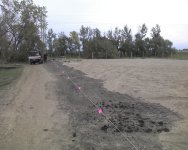
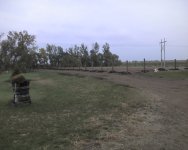
However, for a job where a little speed is required, wow, did it work wll to use the pea gravel! Wife and I put in 45 posts in day and a half. Each post will be held to the next with three 2x6 rails. I do not think they will be going anywhere. Worked out great.
 

Attachments

  • arena 1.jpg
    arena 1.jpg
    329.1 KB · Views: 183
  • area posts.jpg
    area posts.jpg
    214.4 KB · Views: 169
/ Tips on vertical posts? #17  
(Part of our problem has likely always been holes that were too small.)

i used to carry a thin 'tamping rod' for the holes where you struck that particular problem.


Each post will be held to the next with three 2x6 rails. I do not think they will be going anywhere. Worked out great.

till the horses start leaning against them... :D
 
/ Tips on vertical posts? #18  
As a General Contractor/Handyman, I get quite a few jobs to repair fences that are falling apart. With the posts, it's always the same thing. The area at around the base of the post does not drain water. When it rains, water pools up around the base of the post and over time, it will rot out. I've never seen any significant rot on the post in the ground, regardless of what's used to hold it in place. Clay, gravel or concrete. Once I pull them out, they all look fine.

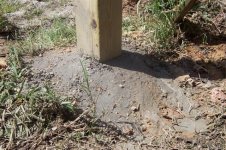
As the picture shows, this is the place where all the problems happen. If you use concrete, it is very, very important to create a slope above grade to drain away the water. If you use dirt or other materials, the same thing must be done.

I use a 12 inch auger bit when drilling holes. Even with this size bit, I need to use my clam shells to adjust some of the holes. The biggest issue that gets me is a root or underground rock that changes the direction of the bit. Sometimes, it can be pretty bad, but other times, it's just a small ajustment.

Before I start the auger, I've found that digging a small starter hole with my shovel helps allot in marking the spot to drill, and also keeping the bit in positing when it first starts. Of course, a root two inches down will ruin the best of plans!!!

I backfill with the dirt that comes out. I use the back end of my shovel and pound the dirt in layers. I shovel in some, then pound it into place. I do this until it's all in the hole and I'm building up a crown. This is actually my favorite part of putting them in.

Good luck,
Eddie
 

Attachments

  • Fence Post rotted out at the base..jpg
    Fence Post rotted out at the base..jpg
    85.8 KB · Views: 177
  • Fence Post with cement crowned..jpg
    Fence Post with cement crowned..jpg
    97.9 KB · Views: 158
/ Tips on vertical posts? #19  
uniform arcs should be simple enough using a bit of standard geometry, stuff like a string line from a central point for a semi-circle or from two points for something elliptical.

The problem is the arc is not standard. Often curves one way, straightens for a short distance, then another curve. Often I am following the edge of creek bottoms, pastures etc. It really has to be done by sight. Often I have to put some of the posts in and then make adjustments as I proceed.
 
/ Tips on vertical posts? #20  
If you use concrete, it is very, very important to create a slope above grade to drain away the water.

If you do that in Ohio, after one winter, the chances are good it will be out of the ground about 3". The wetter the ground, the better the chance the frost will pop it out.

Here, the best way is to leave the cement about 6" from the top, and finish it with dirt. This Dirt "cap" freezes first, and helps hold the post down.
 
 
Top