Wood Siding Recomendations

/ Wood Siding Recomendations #21  
Beltzington,

I don't want to whip a dead horse here, but OK, I will. I went with Hardy on my house too. My main reason was that it is fireproof. It is also stable and maintenance free. As far as appearance goes, it has a wood grain texture pressed into it so I can pretend it looks like real wood. Cool.
 
/ Wood Siding Recomendations #22  
In today's world the quality of cedar being sold is just crap.
Cement board siding is relatively easy to install but requires a few specialty tools.
First off, Irwin makes a chop saw blade designed for cement board. Secondly Hitachi has a coil nailer that is ideal in that you can adjust the depth of the nail penetration. For rips, rake cuts, or other odd ball stuff I use a DeWalt 4 1/2 grinder with a segmented masonry blade. Google "bear clips" to find a really nifty plastic clip to hold and space the siding while installing. These clips allow one person to install full 12' planks solo. A little pricey but worth it.
Merry up the cement board with Georga-pacfic "smart trim" boards and create a building with a turn of the century look. Two coats of Sherwin Williams "duration" paint and good to go.
 
/ Wood Siding Recomendations #23  
I am partial to board and batten siding myself, that is what is on my house, I love the look of it and the ease of putting it on. My house, the hay barn, horse barn both shops, chicken barn and rec building by the largest pond are all board and batten, much of it needs to be replaced so to save on wood cost I bought a Hudson bandmill. I figured I would 12k or more to redo the siding on the buildings and all told the HudsonHFE 21 Electric mill and setting it up with a concrete pad and building a 6x6 frame and trolley system ran me $3,600 total new. I have done a fair bit of board and batten siding so far, by the time I am done I will have everything resided for about 6k out of pocket and I still have the mill. It is going to take a lot longer to get all the siding done than I planned..... I keep getting distracted by the ability to cut whatever I want to build whatever I want, it is really kind of addicting....

I like board and batten because the whole design allows you put wood up before it is completely dried out mill it and slap it up. I also like the character of it even as it ages it simply gains in character. The one real draw back is that you will be replacing it about every 20 years or so, especially if you have a lot of woodpeckers around like we do.

I saw cedar mentioned and a comment about quality, you can buy cedar oil and apply it to any wood giving it much of the same long lasting qualities as cedar. All my siding is pine/fir and has been replaced twice over the last 50 years. The only change I want to make on my siding is to install rock on the bottom 3 or 4 feet of my exterior walls, I like the look and it keeps the wood well away from the soil, snow and plants.

Whatever you decide to go with, good luck and have fun....
 
/ Wood Siding Recomendations #24  
I think a lot of problem with cedar is that it's hard to install correctly. After I bought my current house, I had to replace a lot of the cedar half timbering because it was installed such that water would not fully drain from the horizontal surfaces. My contractor formed prefinished (match Anderson window color and the paint on the cedar) metal cap flashings to go over the top of the cedar timbers. You can't see them unless someone points it out but should protect the wood. A lot of work and cost though.
 
/ Wood Siding Recomendations #25  
Has anyone used the smartside product from HD instead of the T-111?
 
/ Wood Siding Recomendations #26  
Built my house in 1980. Mostly ceder with some brick. Restain every 10 years or so.
Still has that beautiful brown natural color. I did not want it to go gray.
I was expensive then, but I would do it again.
Good luck to you...

Our house was built in '82 but we didn't buy it until '08. It's Pier and Beam though you can't tell as the first floor has a wrap around concrete walkway and it's "Rockface" bricked. The master bed and bath is on the second floor (almost a stand alone look) and was cedar wrapped as all the soffit and fascia also cedar. Maybe treated once back in '82 then ignored. Talk about a mess; knot holes popped on the upstairs siding and the soffit and fascia warped and splitting. We wrapped the top in biege metal interlocking sheet and replaced all the soffit and fascia with Hardie Board and painted beige as well. Now the place looks great and fairly maintenance free except for landscape work and maintaining the gravel and caliche part of the driveway.

Had the owners maintained the cedar the problem wouldn't have been near as intense but they did nothing and in West Texas the sun and heat bakes everything during the summer months and the wind dries out everything very rapidly.
 
/ Wood Siding Recomendations #27  
Has anyone used the smartside product from HD instead of the T-111?

I like Smartside for protected areas. It's an OSB type product with a textured finish that looks like wood grain. It cuts and works the same as any other wood, but you have to be sure to seal the ends with a very good quality paint after cutting it. Just like all OSB, it does not like to get wet at the edges and over time, this is where you will have problems.

I use Hardie for my exterior stuff and Smartside for things like porch ceilings.

As for cutting Hardie, I just about every manufacture of saw blades has a Hardie blade out there now. They usually have three cutting teeth that go through the Hardie like butter. I have blades for my 7 1/4" corded saw, my 6 1/2" battery saw and a 10" blade for my table saw. Most of the time I just use the battery saw. With the right blade, it doesn't take much to cut it.

Most any coil nail gun has the ability to adjust how deep the nails go. You don't want to break or nail the lap siding too tight. Just snug.

For the trim I used to use my framing nail gun, but most of the time I had to finish off the nail with a hammer. Now I just use 3 inch deck screws for all the trim.

My parents are both in their 70's. While building their house for them, I showed them how to install the Hardie siding, and while I was out on jobs during the week, they installed almost all of it on their house. I do it by myself, but it doesn't matter how old you are, two people can do it easily.

Eddie
 
/ Wood Siding Recomendations #28  
I bought the shears that cut hardi plank like butter with no dusty mess. Just a curly cue that falls away.
 
/ Wood Siding Recomendations #29  
Built a 2500' house in '09 and used hardi lap siding, instead of cutting it I scored it with a utility knife and snapped it then took a rasp and cleaned up the egdes if need be. I like this stuff, takes paint pefectly, looks like the day I installed it and have absolute zero problems with it. No way I would use wood on the outside anything now days.
 
/ Wood Siding Recomendations
  • Thread Starter
#30  
After a considerable amount of online research I believe the cost and upkeep of wood siding is reasonable. I am going to look into some of the treated wood products some of you have recommended.
I have several friends who have used Hardi board and I have helped install hardi board and believe it is a good product but I do not believe any reasonable person would say it can look this good.

View attachment 405105
 
/ Wood Siding Recomendations #31  
I agree 100% that nothing compares to the look of real wood!!! That building is just amazing and truly something to be proud of. Sadly it wouldn't look like that very long here in East Texas with our high humidity. I've never been to Georgia, so I'm hoping your weather conditions there don't lead to mold and rot like they do here. We have several log home manufacturers in the area and rotting logs are a serious problem. I'm not expert, but from what I understand, a log home doesn't hold the value of a brick home because of the issues with upkeep and how common it is for the logs to have rot. Going with a very good quality wood and protecting it with the best products available should solve most if not all issues associated with using real wood. Wrap around porches are also really helpful in protecting the siding. If you can't do that, go with the largest eves you can with gutters will also help.

That house you posted doesn't have a porch to protect the front door. That's too bad because you really need to protect a front door from the elements. My guess is that there is rot at the threshold in less then five years.

Eddie
 
/ Wood Siding Recomendations #32  
Beltzington, I am with you that Hardie can't look that good, but you do need to balance looks/upkeep/cost. There is never a perfect solution.

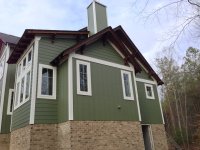
Our home is mountain-craftsman style, and we wanted a combination of siding looks/textures along with rafter tails, beams, brackets, etc. We had a good builder and spent a lot of time working out a good compromise plan. We used both horizontal lap and vertical Hardie panel. The vertical panel got PVC battens nailed on to create a board & batten look (Hardie battens were too expensive and not justified). All corner trim is PVC. Painted up, it looks very good, but of course isn't the same as real wood with stain as your photo shows.

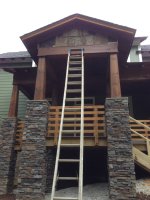
Our stained wood elements include rough-sawn white pine soffits and overhangs, stained with minwax stain and given a good coat of spar urethane. These are all out of the sun, and are holding up perfectly. Rafter tails, fly rakes, and beams/brackets are pressure treated 4x4 and 4x6 lumber with Sikkens stain/finish. They are a little more exposed, but also holding up well after 2 years.

The most exposed wood elements are porch columns, which are the same rough-sawn white pine with minwax stain and spar urethane. So far they are holding up well, but I expect they will be the first to need maintenance after a while.

We also have quarter-sawn fir floors on the porches. They got a Sherwin-Williams deck stain. On the back porch, which is protected, it's done fine. On the front porch that gets sun/rain, it failed miserably. We had to remove that finish, sand the floor, and re-coat with Cabot spar varnish (the real old fashioned stuff with turpentine). So far it is holding up exceptionally well.

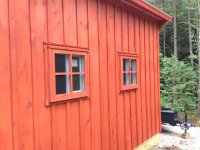
I will put a few pictures below. Will also include one of my barn at the end. This is rough-sawn white pine board/batten siding with Sherwin-Williams siding stain. no doubt, that looks way better than painted Hardie, but I am not sure I'd be brave enough to put it on my main home. Time will tell....

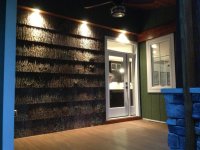
Last but not least, I included a photo of poplar-bark siding we used for accents. It looks like a million bucks. Holds up well to the elements, but cost makes it best used as an accent in our budget range.
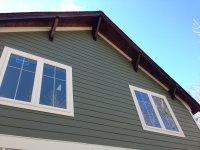
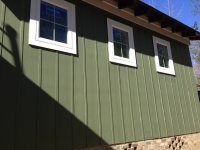
hardie1.jpg hardie2.jpg hardie3.jpg

barn.jpg

bark1.jpg bark2.jpg
 
/ Wood Siding Recomendations #33  
I agree 100% that nothing compares to the look of real wood!!! That building is just amazing and truly something to be proud of. Sadly it wouldn't look like that very long here in East Texas with our high humidity. I've never been to Georgia, so I'm hoping your weather conditions there don't lead to mold and rot like they do here. We have several log home manufacturers in the area and rotting logs are a serious problem. I'm not expert, but from what I understand, a log home doesn't hold the value of a brick home because of the issues with upkeep and how common it is for the logs to have rot. Going with a very good quality wood and protecting it with the best products available should solve most if not all issues associated with using real wood. Wrap around porches are also really helpful in protecting the siding. If you can't do that, go with the largest eves you can with gutters will also help.

That house you posted doesn't have a porch to protect the front door. That's too bad because you really need to protect a front door from the elements. My guess is that there is rot at the threshold in less then five years.

Eddie

Appling GA is near Augusta. It is plenty humid there. If the fellow is talking about his dream house up in the North Georgia mountains it is still plenty humid there. I am slowly fixing bad construction techniques I did on my barn that invited rot and termites. The house we had built has 4 doors, 3 without overhangs or porches. One door I tried to put on a storm door and ended up replacing an engineered band joist and some subfloor before I got to hanging the door back up with new trim, and a storm door to keep the weather off the door. On another door is a rotten door frame. The last door had a sill plate that pulled off. Overhang to be built on the one door that needs a new sill. The rotten door frame faces north so not much weather. It may have to wait until the mortgage is paid off next year. My wife has plans for that door to go away as part of a remodel.

What amazes me is I can see examples of rotten 100 year old houses, rotten 10 year old houses and 100+ year old houses in great shape. I suspect the 100+ year old houses in great shape has good flashing, porches and porticoes, and regular maintenance done. In the humid south nothing survives neglect for decades. Rot or termites will get a wood building.
 
/ Wood Siding Recomendations
  • Thread Starter
#34  
S219 - "Our home is mountain-craftsman style" very nice work, obvious allot of care and thought went into this home. I really like the exposed soffits I am not sure I have ever seen this on a modern house.
Question on the B&B on your barn? Boards nailed in the middle, one or both sides? Battens nailed with a single nail between the boards? Been doing allot of reading and seems the key to keeping wood siding in good shape is plan on it getting wet but insure there is airflow behind the boards and let them swell and shrink as they will.
 
/ Wood Siding Recomendations #35  
Question on the B&B on your barn? Boards nailed in the middle, one or both sides? Battens nailed with a single nail between the boards? Been doing allot of reading and seems the key to keeping wood siding in good shape is plan on it getting wet but insure there is airflow behind the boards and let them swell and shrink as they will.

We nailed the boards on the edges, so those nails are hidden by the battens. The battens got nailed with a single nail in the middle.

This was all well dried lumber, and the boards were butted up tight. In fact, the lumber was so nice, I almost think we could have skipped battens and it still would have been plenty tight.

There is a layer of house wrap behind the boards, to act as a basic vapor barrier. That is actually a good idea, as we see dramatic temperature swings and sometimes the barn will be a lot colder inside than outside. Last weekend we had one day that was near 70F with super high humidity, and there was condensation all over the place. Inside the barn was ~ 20 degrees cooler but stayed dry.

I made sure to go with 12" overhangs all around, soffit venting, and ridge venting. Those are often skipped on barns and pole barns, but in my opinion they are very important in helping the structure last a long time and preventing moisture problems.
 
/ Wood Siding Recomendations #36  
"There is a layer of house wrap behind the boards, to act as a basic vapor barrier."

If I may correct U, house wrap is designed to breathe or to let trapped vapor OUT.

Vapor barrier goes on inside warm side to keep vapor IN the house and as such needs to be well sealed at all joints* to be effective.
Whenever there is a tear in the vapor barrier you would find a patch of wet soggy insulation (or frosty on very cold days).

*a special red tape is sold for those joints.
 
/ Wood Siding Recomendations #37  
Up North you guys do it differently then we do down here. I don't know where that line is, and I've only seen them put the plastic up on the inside of a house on the TV shows. Here, we wrap the outside of the house. Some call it a moisture barrier, which it is, but in my opinion, it's primary function is to keep the wind out. You lose more energy to the outside from air penetration then anything else. If during the winter, cold air gets through your siding, sheething and into your wall cavity, it pretty much defeats what the insulation is accomplishing. When doing remodels, I often find dirt in the wall insulation where air has been getting through over the years. Dust in the air builds up in the insulation and leaves a very telling picture of what's going on.

Eddie
 
/ Wood Siding Recomendations #38  
"There is a layer of house wrap behind the boards, to act as a basic vapor barrier."

If I may correct U, house wrap is designed to breathe or to let trapped vapor OUT.

Yes, I should have said moisture barrier -- the tyvek stuff stops water/moisture from entering but won't prevent vapor from escaping.
 
/ Wood Siding Recomendations #39  
Yes, I should have said moisture barrier -- the tyvek stuff stops water/moisture from entering but won't prevent vapor from escaping.

Tyvek and Typar literature both claim water proofing (like rain) as well as breathing characteristics to let moisture out.
One lesser used barrier actually sports tiny slits or perforations to allow breathing.

From having done many home upgrades I also noticed that poly as a vapor barrier degrades Particularly noticeable if used under shingles.
I prefer a mylar based barrier that they claim resists degradation. It is also very flexible in that electric junction boxes don't tear it when installed. That material is fairly stretchy and easy to use. Bit more pricy but than you save on the red tape and installation time.

I suspect that ozone is probably what degrades the poly while under shingles it might be the asphalt or tar they use as a binder.
 
/ Wood Siding Recomendations #40  
I have a you might say bias opinion on cedar shingles for that natural long lasting wood look on a building, my son has a cedar shingle mill next door with competitive prices, check out (CK shingle.com)

Here pics. of my garage, and a pic. of shingles fresh off the mill, but it's not cedar, I used a different wood, not as good as cedar, but was free, this summer I'll finish staining them, and no one will know what wood I used. I got done shingling this past warm Dec.


Top