Why Did This Weld Fail

/ Why Did This Weld Fail #21  
that pic's worthy of child endangerment charges! :confused: WHAT THE HE## ARE YOU THINKING??? MikeD74t[/QUOTE]

That's a little harsh. He posts a lot of pics that ore not his personal stuff. You don't even know if that was his child. Even if it was, I am sure the kid did not burn 5lbs of rods. Probably just made some sparks then went on to something else.[/QUOTE]

I have to agree with that. All but 4 of the pics I have posted were not mine. When I saw that picture, I just assumed it was a pic he found on the internet, and posted for us to get a laugh. I have done that a few times.
 
/ Why Did This Weld Fail #22  
if you look at the first picture, the ram doesn't appear to have been welded exactly in the center of the clevis.

i don't think the weld was run in cold, just a poor joint design coupled with the wrong rod for the first pass.

i don't know that you should use 6010 or 6011 on that type of material... probably not.

wire feeder with er70s might have been a better choice.

also, the cross section where it broke is very small... all things being equal, more si's = more p's... more p's = more strong. for the most part (heat and material compatibility issues aside), it's all about psi.

i agree with the slow cooling thing and it is probably better to take the cyl apart first.

btw, assembly does look kind of cheap, in that the ram is not threaded on the end.
 
/ Why Did This Weld Fail #23  
that pic's worthy of child endangerment charges! :confused: WHAT THE HE## ARE YOU THINKING??? MikeD74t[/quote]

That's a little harsh. He posts a lot of pics that ore not his personal stuff. You don't even know if that was his child. Even if it was, I am sure the kid did not burn 5lbs of rods. Probably just made some sparks then went on to something else.[/quote]

Oh please, I hope he didn't think that was my kid! That would be stupidly dangerous to a child. It was supposed to be a graphic reference to child production line. Though it doesn't look like a production, so I guess I can see where someone might think it was my one pic.
But the picture is so outrageous, (that's why I used it) I doubt many would come to that conclusion.

Sorry for the confusion.


I must disagree.

To get a professional weldor to re-weld that without making a design change you would have to find one that has a sign above his door that reads IDIOT WELDING SHOP.

What big change could there be? it's a clevis welded to the end of a rod, like has been the case since there were hydraulic cylinders.

JB
 
/ Why Did This Weld Fail #24  
I think there was not enough surface area welded for the forces used on that piece. If you are going to fix it, I think you should drill as big a hole in that yoke as possible and weld in that hole, as well as around the shaft.
 
/ Why Did This Weld Fail #25  
Good fit up of the two pieces are extreemly important in high weld stress areas. Work to get the parts to fit together as best as possible. Bevel the edge to allow full penetration. Be sure to clean off any paint, oil or grease. Any contaminates will make the weld porus and not strong. Looking at your weld there was not good penetration and the weld was not hot enough. I had a similar weld break on a clevis holding a hay bale spear onto a FEL bucket. Lucky I didn't get hurt when it broke. This was a factory weld that broke not something I built or welded. It is fixed now, the right way.

When you weld this back together, be sure to extend the cylinder rod and then cover it with tape. Extending the rod will help protect the cylinder seal. Cover the rod with tape so that the weld splatter will not ruin the rod and seal.

If you are worried about it breaking again. Drill and tap a bolt hole in the clevis and also one in the rod end (may be difficult) cut threads into the rod end, fasten it with both a bold and a weld.
 
Last edited:
/ Why Did This Weld Fail #26  
What big change could there be? it's a clevis welded to the end of a rod, like has been the case since there were hydraulic cylinders.

JB

Sometimes the costs of manufacturing result in design compromises.
I agree with SandburRanch that a redesign of the cylinder end could allow a better joint design, but that would increase production costs (and end user prices) considerably.
In the aerospace industry, that cylinder end would probably be machined to better fit the clevis...or the whole assembly may be machined. Be pretty expensive though.

BTW, for all we know, this may have been a poorly executed repair weld.
 
/ Why Did This Weld Fail #27  
What big change could there be? it's a clevis welded to the end of a rod, like has been the case since there were hydraulic cylinders.

JB
For starters change the clevis design to provide a hole for the rod to go through and weld on both sides of the clevis. And to take it a step farther bevel both sides of the hole.

The people that built that just hoped it would hold until the warranty ran out.
 
/ Why Did This Weld Fail #28  
For starters change the clevis design to provide a hole for the rod to go through and weld on both sides of the clevis. And to take it a step farther bevel both sides of the hole.

The people that built that just hoped it would hold until the warranty ran out.

Well I agree with you and Roy it could be designed better, but if done right the first time, I don't think it's necessary. It's a HTL (looks like) that's rated for a few thousand pounds, holding an implement on the back of a compact tractor. Probably cost ~$150.00
Butt welds are holding our world together:)

JB
 
/ Why Did This Weld Fail #29  
Best weldors in the world don't have a chance when it comes to bad design and bad joint prep.

Hind sight is always 20/20, I would have ground a bevel on the shaft, and put three passes on it, and would have much rather, (as already mentioned) use Tig.
 
/ Why Did This Weld Fail #30  
I would put back both pieces back on machine,check, and bevel angle corectly, extend cylender to protect from heat, and tack together. Remove cylender, wrap wet rag around the base to protect seal, pre heat with torch, and I would lay a slow, heavy weave pass, on the hot side with a 7018, cover with a welding blanket let cool slow and should be fine. If have any any anti spatter nozzle gel, smear up the ram to protect from spatter.
 
/ Why Did This Weld Fail #31  
For starters change the clevis design to provide a hole for the rod to go through and weld on both sides of the clevis. And to take it a step farther bevel both sides of the hole.

The people that built that just hoped it would hold until the warranty ran out.

I like your repair idea the best, seems like some of the stronger ones are done like that?a
 
/ Why Did This Weld Fail #32  
If he can afford to lose an inch or so of throw out of the cylender. Depends on how much it extends.
 
/ Why Did This Weld Fail #33  
I am interested in hearing opinions on why this weld failed from the experienced welders. I hope the pictures have enough detail to allow a diagnose. If not, let me know and I can snap a few more pictures.

***EDIT***
Thanks for all the responses and advice. To answer a few question brought out in the thread:

This is a side link for a CAT 1 three point.
It had just a few hours of use before it failed using a Bush Hog 5 foot box blade.
It was fabricated state side by a hydraulic side link provider.
The clevis mounts at about a 14 degree angle to the ram.
No, I am not going to fix this, I will either return for refund or take to a local welding shop for repair.

What I am looking for now and from what I'm reading in the thread is this is fixable once the ram is ground to an angle so that there is 100% butt made between the clevis and the rod.

Thanks for all your input, I am not that knowledgeable on welding.

Looks like the the weld itself was done improperly. The other thing I noticed is the two pieces were not proprly prepared-need a v channel all around and the two pieces need to be butt together for maximum penetration.
 
/ Why Did This Weld Fail #34  
And was never heat treated prior to welding. The end of the ram would have been blue. Think it was poor craftmanship from the factory, topped off with a just as poor fix. If fixed correctly, it should last forever.
 
/ Why Did This Weld Fail #35  
Yes there are problems with the weld. The main problem is with the design of the side link. The OP stated that the clevis was welded on at a 14deg angle. A hyd cyl is designed to push or pull straight. With the clevice being at an angle it is flexing at the weakest point. In this case it was the weld. If the weld hadn't broke the shaft of the cyl. would have eventually. It also put side load on the packing of the cyl causing it to fail prematurly. Have you ever seen a hyd. cyl designed that way.
Bill
 
/ Why Did This Weld Fail #36  
The original weld was just too small. Look at the cross-sectional area of the break compared to everything else. It didn't matter how good the bond was, there simply wasn't enough material, not to mention it didn't even cover the entire circumference. More bevel, more penetration, more and/or bigger passes would all be in the direction of goodness.

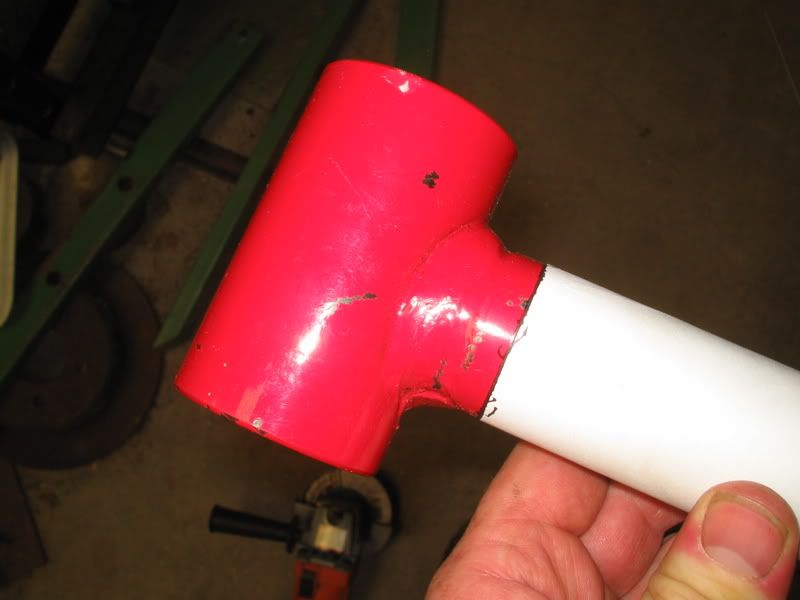
The one time I did it, it looked like this:

I had to shorten the extended rods on the 2 hydraulic cylinders I got for the stabilizers. I didn't want to ruin the blade on my big band saw so I used the hand-held. I started out by marking the cut circle with a wrapped sheet of paper and extra fine sharpie.


The band saw wouldn't touch the hard chrome so I used an air cutoff tool to cut a groove all the way around the circle.

The cut ends came out pretty good.

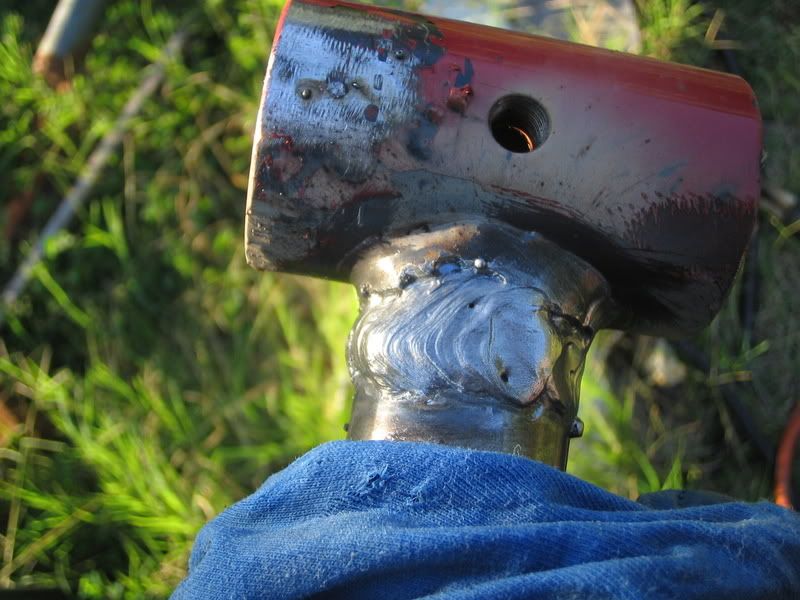
I beveled the edges and used a bent piece of welding rod as a spacer. The space helps prevent a sharp notch at the root.

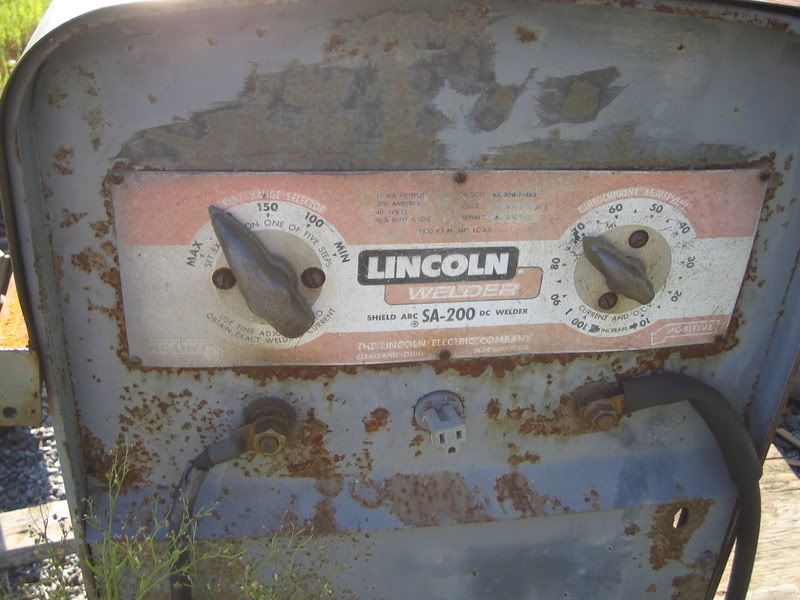
Set the SA200 on about 140 amps (DC). I decided to try out the 1/8" 7018AC rods that came in a variety pack in a screw top plastic rod can. Did a test weld to check the settings and then had at the rod end.

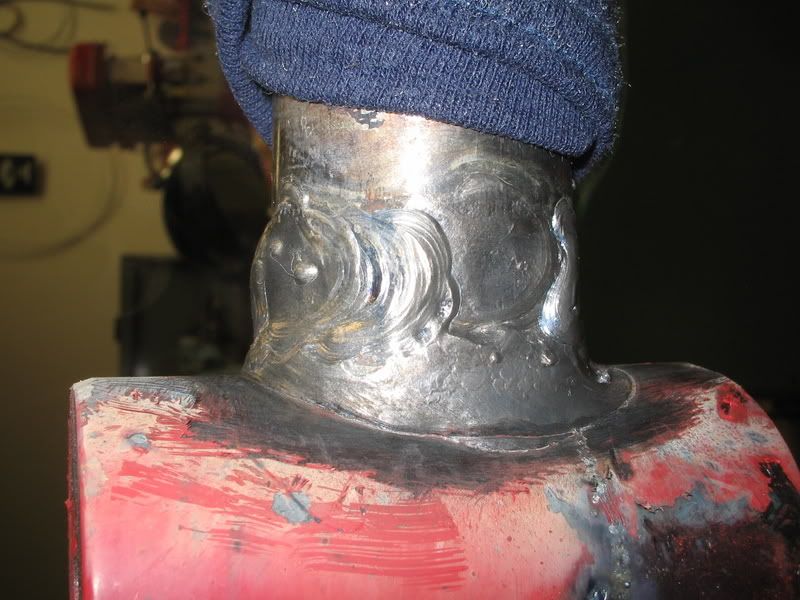
This is a good angle on an otherwise not too purdy weld. It's tough to make it look good with a series of short welds on a relatively small diameter.

Here's the second cylinder. This time I used 3/32 6011 for the root pass. It made a smaller weld and should be tougher in the notch. The rest is still 7018. That blue thing is an old WET T-SHIRT. (I have no idea what is up with that font. ::))
 
/ Why Did This Weld Fail #37  
Yes there are problems with the weld. The main problem is with the design of the side link. The OP stated that the clevis was welded on at a 14deg angle. A hyd cyl is designed to push or pull straight. With the clevice being at an angle it is flexing at the weakest point. In this case it was the weld. If the weld hadn't broke the shaft of the cyl. would have eventually. It also put side load on the packing of the cyl causing it to fail prematurly. Have you ever seen a hyd. cyl designed that way.
Bill

The angled clevis is not ideal but it may be required for clearance due to the angle of the drag link or lift arm as a compromise vs. an even longer clevis which would reduce the space available for the cylinder. Since typical loading would be in tension, the buckling failure mode should be rare. I am guessing that the cylinder seals can tolerate that much offset in the load.
 
/ Why Did This Weld Fail #38  
It was just a bad fab job, any one of us amateur welders could do a better job, regardless of design. OP says it was domestic made but probably just assembled here from outsourced parts.

Anyway, throw a weld on there like brad shows in his pics and that thing would be around till the end of time, especially in a cat 1 tilt application.

My repair would be simple, not as involved as others but I think it would hold up to it's application just fine.
Clean the parts up with grinder, put some bevel on the rod, tack opposite sides and single pass with 1/8" 7018 @ 140-150 amps. That's it, it would have to do since that's about all I'm capable of :eek:

JB
 
/ Why Did This Weld Fail #39  
I agree, its a ten minute fix! And will last forever, I have a little miller maxstar and a little yamaha generator with some dewalt cordless tools just for doing field repairs, they are a life saver.
 
/ Why Did This Weld Fail #40  
I think that a hack like myself could fix it better. I would tack and do a root pass with 6011, and do a cover pass with 7018ac. I bet my weld would be better then the one already on there (but not my much) and it would be all the way around. I am sure most people on here are much better welders then me, so take my advise with a grain of salt.
 

Marketplace Items

SEMI AUTOMATIC QUICK-CHANGER FOR MINI EXCAVATOR (A58214)
SEMI AUTOMATIC...
3PT 10' Rolling Cultivator (A60463)
3PT 10' Rolling...
2006 TRAIL KING ADVANTAGE PLUS RGN/DETACH TRAILER (A58375)
2006 TRAIL KING...
2012 ISUZU NPR CREWCAB 16FT BOX TRUCK (A59905)
2012 ISUZU NPR...
Giyi GR87 (A60463)
Giyi GR87 (A60463)
HUSQVARNA RIDING MOWER 46IN DECK (A56859)
HUSQVARNA RIDING...
 
Top