warming up in the garage and fumes question

   / warming up in the garage and fumes question #41  
I finally read all the posts. Jstpssng, post #15, hit upon yet another good answer. Put a block heater on the tractor. Put a timer on the block heater. Let it run for a couple hours before you start it. The engine oil and hydraulic oil will be warm. Start and immediately drive out for complete warm up.
 
   / warming up in the garage and fumes question #42  
Finally, my knees are begging me for a one level home. I don't want to have to walk up and down to the garage.

That's a whole different ball-o-wax that no amount of wall sealing or insulation will resolve.

My dream house that will never be built includes a semi-attached garage that is at a split level, about half way between the house and basement. There would be a ramp from the garage floor level up to the house and another from the garage down to the basement. That ramp would also have access to the outside from both the top of it and the garage. Both ramps would be wide enough to use a powered cart of some kind like a pallet jack. There would also be an elevator from the basement to the house main floor.

Hey, we all have dreams, right?
 
   / warming up in the garage and fumes question #43  
Mechanical engineer who tests engines for a living here. Don't run vehicles in your garage to warm up, ever. Start it up, and pull it outside right away.

You will have full oil pressure in the entire engine within 2 to 3 seconds after cranking. There are residual oil films on every internal component already anyway. The pistons, rings, rods, crankshaft, cams, hydraulic pumps, valves, etc - none of them will mind being gently prodded with enough power to limp the tractor out the barn/garage door. Zero damage is done. Warming up outdoors for a couple minutes before beginning any heavy work is wise, but again, you could pretty much start driving right away if you want to also. Gentle driving around is a great way to safely accelerate engine warming - and a warm engine is the goal here. As many others have said, you don't even warm up that much by cold idling. Just get to work, always gently at first.

Cold engine exhaust emissions are the most toxic and carcinogenic. You really shouldn't let those fumes collect and contaminate your indoor air and surfaces any more than is necessary. A modern tier4 with DPF is way better, but if you have an old school machine like mine, get it outdoors asap.
 
   / warming up in the garage and fumes question #44  
I壇 back the tractor outside. Driving it 20 feet isn稚 going to hurt it.

Yup. Get it outside ASAP at idle or just a tad higher. It prevents the heater from sucking in the diesel fumes into the cab where I'm going to be for a few hours.
 
   / warming up in the garage and fumes question #45  
Mechanical engineer who tests engines for a living here.

You're just the guy I want to hear from! This is in context of a warmed-up engine: My question is this: With my diesel tractors, is it better for the engine to run at reduced throttle for light work that doesn't need the RPM's? I'm not talking about dogging the engine at near-idle, but for light work that doesn't require the RPM, is it better to run the engine at say 1,500-2,000 RPM vs the full throttle 3,000 RPM?

I know some people who just run the engine at full throttle all the time, regardless of what they're doing.
 
   / warming up in the garage and fumes question #46  
You're just the guy I want to hear from! This is in context of a warmed-up engine: My question is this: With my diesel tractors, is it better for the engine to run at reduced throttle for light work that doesn't need the RPM's? I'm not talking about dogging the engine at near-idle, but for light work that doesn't require the RPM, is it better to run the engine at say 1,500-2,000 RPM vs the full throttle 3,000 RPM?

I know some people who just run the engine at full throttle all the time, regardless of what they're doing.

I run my l3800 around 1,800 for loader work and just driving around the yard..
 
   / warming up in the garage and fumes question #47  
I only get my M6040 much over 2000 if I'm doing HEAVY grading, in the summer, on the driveway. Otherwise - it's 1600 to 2000 for "around the property" chores. I don't need more power to get the job done. It's the overall tractor weight and traction the will get the job completed. As always, there are exceptions - using the Wallenstein chipper. 2160 engine rpm = 540 pto rpm.
 
   / warming up in the garage and fumes question #48  
With 50 years of working on engines I can tell you that a running a diesel at less than WOT (wide open throttle) will not hurt them. I run mine at whatever rpm is sufficient to get the work done without lugging the engine and most times it is way less than full throttle. Does it hurt to run a diesel at WOT, no, they are quite happy running there and will do it all day everyday but why waste the fuel? The only diesel that absolutely MUST be run at WOT is a 2 cycle Detroit, if it is not running against the governor it has no torque and will slobber from unburned fuel. They are a good engine for stationary use like pumps or gensets, etc..
 
   / warming up in the garage and fumes question #49  
Running at almost full rpm will keep the soot level in check. Running slow will give more regen cycles. I take my Massey for a drive to the highway and back to burn off the accumulation after a lot of fork/ loader work.
 
   / warming up in the garage and fumes question #50  
With 50 years of working on engines I can tell you that a running a diesel at less than WOT (wide open throttle) will not hurt them. I run mine at whatever rpm is sufficient to get the work done without lugging the engine and most times it is way less than full throttle. Does it hurt to run a diesel at WOT, no, they are quite happy running there and will do it all day everyday but why waste the fuel? The only diesel that absolutely MUST be run at WOT is a 2 cycle Detroit, if it is not running against the governor it has no torque and will slobber from unburned fuel. They are a good engine for stationary use like pumps or gensets, etc..

The only time that I have ever run my tractor WOT was to see what its top road speed was just out of curiosity (18mph). Other than that my highest RPM is usually PTO speed (2200). I don't lug it around but as you stated "sufficient to get the work done".
 
   / warming up in the garage and fumes question #51  
...With my diesel tractors, is it better for the engine to run at reduced throttle for light work that doesn't need the RPM's? I'm not talking about dogging the engine at near-idle, but for light work that doesn't require the RPM, is it better to run the engine at say 1,500-2,000 RPM vs the full throttle 3,000 RPM?

I know some people who just run the engine at full throttle all the time, regardless of what they're doing.

I guess I would say it depends. In general, in terms of engine health.... it doesn't really matter. There is no downside to running harder at lower RPMs, they are made for it. Sounds like you got a few good answers before I came back here to see this. On modern DPF tractors, running at higher engine speed might lessen the regen cycle frequency, but again it depends on how you are using the machine.

Almost all our diesel tractor engines make more/most power at the top end of the RPM range on your tach. So if you need that much power or ground speed, you have no choice but to rev up. But if you have sufficient power at lower engine speeds for what you are trying to do, you might as well save some revs and fuel.

I look forward to buying my next tractor and getting a Kioti linked pedal, to automatically rev the engine up and drive more like a car, and not having to constantly adjust the throttle lever based on what I'm trying to do.
 
   / warming up in the garage and fumes question #52  
I'll disagree that the tractors are making thier power at the top end,
the HP peak is usually at pto speed and the torque peak is considerably lower.
My tractor the engine HP peak is around 2400 engine rpm which is the engine rpm for the pto to be at 540,
the torque peak is at 1750 engine rpm which is also the engine speed for the economy mode on the pto.
I do considerable road travel and i can definitely feel the engine as it pulls down in rpm on hills,
on a steep grade it will start to fall off in rpm rapidly down to around 1850 rpm and then settle in and pull hard till it
pulls down to about 1700 rpm at that point if i don't down shift she will fall flat on her face quickly.
 
   / warming up in the garage and fumes question #54  
I'll disagree that the tractors are making thier power at the top end,
the HP peak is usually at pto speed and the torque peak is considerably lower.

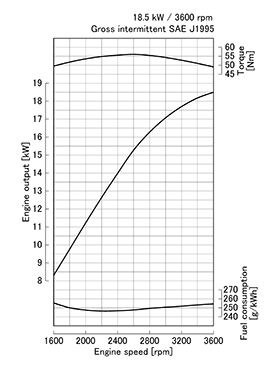
All depends on exactly what motor you have and how the manufacturer tuned it for your application. But this would be considered a very typical power curve for a CUT (Kubota) :

12_performance_curve_1.png


A quick google image search can find you many more power curve plots. Of course while power generally rises with RPM on our little diesels, how it feels and is gets to the ground in a useable way is another story. Hydro trans behavoir is a whole curve ball on top of the engine output. One thing to remember is that if you back off the rpms a bit, you are also slowing down and thus less power is required to maintain speed under your present load. So it could "feel" more powerful.

I like running at lower rpm whenever possible, to save some fuel but also just to keep the dang noise down. My Mitsubishi 3-cyl screams above ~2400 rpm.
 
   / warming up in the garage and fumes question #55  
Hopefully this forum allows links. Is this the type of flexible tubing that people were suggesting? Would 15 feet of this cause enough back pressure to be an issue for the engine?

Amazon.com: Walker (43) 1-3/4" Diameter - 25' Long Galvanized Flex Tube: Automotive

That could work. You shouldn't be adding any detrimental amount of back pressure with tubing like that, BUT, I would kinda question how fully effective it would really be. Unless you have a very tight fit on your tractor exhaust tip, plenty of fumes are going to escape into the garage still. It'll probably get kinda sooty and nasty after repeated uses. And then you have to handle it while kinda hot to get it off and in a safe place before driving the tractor out?

Seriously though, it doesn't hurt anything to just drive the tractor outside right away.
 
   / warming up in the garage and fumes question #56  
Hopefully this forum allows links. Is this the type of flexible tubing that people were suggesting? Would 15 feet of this cause enough back pressure to be an issue for the engine?

Amazon.com: Walker (43) 1-3/4" Diameter - 25' Long Galvanized Flex Tube: Automotive

I've never used Galvanized, I've used rubber exhaust hose, from the 1 ½ up to 8", I had a large coach, diesel pusher - big cat engine, I could not start it and move it quickly as it had air suspension and when the slides were out it needed to have the suspension leveled then pulled in, so it took time - an engine that size fills a 40 by 60 garage with fumes quickly the exhaust hose took care of it, I used a small one when working on the diesel generator on the coach - they work flawlessly - simple to roll up and maintain - they do not melt / overheat they are made for it - they have been used in service bays for many years - don't use them often now - but at fifteen or twenty below I'm more comfortable starting in the garage and letting it run a couple of minutes before moving it outside, there is no leaking into the garage it flows out the hose - I'll also use the hose if I'm tuning an engine etc., you can get them on the web or at your local auto-parts store, obviously; do a little research in length - ten - fifteen feet no issue longer, dependent on engine, I may install a in-line blower - you can get exit ports for doors as well as Y's for two hose connections (dual exhaust), they work......
 
   / warming up in the garage and fumes question #57  
Deezler and John0829, among others. Thanks for posting your credentials along with your advice.
 
   / warming up in the garage and fumes question #58  
I would find it a royal PITA to have to hook up a piece of exhaust hose every time I wanted to start my tractor and let it warm up in the garage. I start it gently lift my blower a couple of inches off of the ground, and move it outside the garage, and let it warm up. I guess everyone needs to do whatever makes them feel they are doing it right, but sometimes I have to wonder if we overthink stuff way too much.
 
   / warming up in the garage and fumes question #59  
so far so good, start it up in the garage for a little above idle (about 5 minutes) then pull it out of the garage and raise the rpm for about 15 minutes-no issues.

Its why I prefer to run my walk behind snowblower-no warm up time needed no matter how cold.
 
   / warming up in the garage and fumes question #60  
About that kerosene heater used indoors, or for that matter any combustion indoors that does not have outside air coming in - In addition to the CO and CO2 problems there is also an oxygen depletion problem. The combustion burns up the oxygen in the room. If you do this you should have an oxygen monitor as well.
 

Marketplace Items

Case 950 8 Row Air Planter (A61307)
Case 950 8 Row Air...
2015 Ford Escape SUV (A59231)
2015 Ford Escape...
GEARMATIC WINCH (A58214)
GEARMATIC WINCH...
2020 CATERPILLAR 299D3 SKID STEER (A60429)
2020 CATERPILLAR...
HITACHI EX550LC EXCAVATOR (A58214)
HITACHI EX550LC...
Dvorak Model 3072A Hydraulic Ironworker S/A Towable Trailer (A59228)
Dvorak Model 3072A...
 
Top