Using a power beyond steering valve without the PB function?

/ Using a power beyond steering valve without the PB function? #1  

BadDecisions

Silver Member
Joined
Sep 5, 2019
Messages
142
Location
Wittmann, AZ
Tractor
Ford 8N
Non tractor application, but it may become a tractor application depending on what happens with this valve...while I've used and repaired the hydraulics on the tractor, this is my first venture into building a system from scratch.

I converted an off road 4x4 toy to full hydraulic steering, using a Char-Lynn 291-5012-001 - 5 port, non load reaction power beyond steering valve, with a double ended balanced steering cylinder and fed it all with a stock automotive power steering pump. I used the PB valve because I had gotten a new one dirt cheap from a shop that went out of business. I initially had just plugged the PB port, found the pump got to be in excess of 400*F within 30 seconds, and had a pump failure shortly after while trying to figure out what was going on.

I did a bunch of searching, learned that the tank port is effectively blocked off when no steering input is given, and blocking the PB port made the valve a closed center. I now have the hoses from the PB and Tank ports tee'd together at the filter input, and filter output flows to reservoir tank. Pump seems happy, steering works well in garage.

1st test drive - front end is all over the road at anything above 25mph, acting as if there is extreme toe in/out. Virtually impossible to keep it running in a straight line. I've played with the alignment a bunch, and got it better, but still nowhere near "right". This isn't something that I intend to be able to run down the freeway, or on pavement at all really, but running access roads to the trails at 10mph is gonna be a bummer too.

Now I'm wondering if using a PB valve without having a need for the PB function is somehow causing an issue with all this? Is my hose routing, with the PB and tank hoses tee'd together causing a problem? Is it possible that the PB is somehow now back feeding pressure through the T port?

I had read where there is a PB sleeve that's supposed to be installed, but I also couldn't really find a clear answer on whether this is a requirement on all PB valves, or if it's needed when not using the PB function. It also doesn't look like either the PB or T port on my valve could have that sleeve added anyways, as in the ports aren't machined in a way that would provide room for a sleeve to drop down in to them. I have considered just ditching this valve, and buying a non-PB valve, but I really dislike just throwing parts at a problem without a clear understanding of why.
 
/ Using a power beyond steering valve without the PB function? #2  
<< ASE Master Tech who teaches steering/suspension/alignment for a community college.

Have you ever driven the vehicle in the same configuration without hydro steer?

When you played with the alignment a bunch, i assume you mean.. not on an alignment machine?

Regardless of how you, the driver, put steering input into the vehicle, if the vehicle won't go straight on its own then the vehicle itself (alignment etc) is creating steering forces that it probably shouldn't be.

So I would focus on making the vehicle stop trying to steer itself instead of focusing on making the steering system constantly fight off the vehicle wanting to turn, if you know what i'm saying.

Depending on how much is custom or how much has been changed on this vehicle, it's a decent chance there's something very 'off' about the alignment angles due to the suspension design, or how it's been changed from stock. Got any pics?
 
/ Using a power beyond steering valve without the PB function? #3  
Steering issues are probable alignment issues as Vigo327 states.... THE power beyond valve thing is probable a misunderstand in how valve operates Its my understanding that PB port with correct plug/valve should NOT cause valve to act as a closed center. I believe open or closed center is a function on main control valve before PB port... I am of opinion you do not have correct plug/valve in PB port... The PB port should just be to supply next valve in a a whole bunch of "series" connected valves.... IF it only valve in system or last valve in system proper PB plug should dump flow to tank port...
 
/ Using a power beyond steering valve without the PB function? #4  
The issue with jumpy steering likely has nothing to do with the orbitrol. There is a thing called "bump steer" which is the geometry of the linkage between the steering and axle. If that is dicked up bad enough, the vehicle will be all over the road.
 
/ Using a power beyond steering valve without the PB function? #5  
Simple answer is should be no issue on connecting the PB to tank since this how the steering unit would be configured without the PB option. Can you see the steering cylinder or linkage while driving? If it is moving back and forth you have a steering cylinder - system problem that could be amplified by steering linkage - alignment issues.
 
/ Using a power beyond steering valve without the PB function?
  • Thread Starter
#6  
<< ASE Master Tech who teaches steering/suspension/alignment for a community college.

Have you ever driven the vehicle in the same configuration without hydro steer?

When you played with the alignment a bunch, i assume you mean.. not on an alignment machine?

Regardless of how you, the driver, put steering input into the vehicle, if the vehicle won't go straight on its own then the vehicle itself (alignment etc) is creating steering forces that it probably shouldn't be.

So I would focus on making the vehicle stop trying to steer itself instead of focusing on making the steering system constantly fight off the vehicle wanting to turn, if you know what i'm saying.

Depending on how much is custom or how much has been changed on this vehicle, it's a decent chance there's something very 'off' about the alignment angles due to the suspension design, or how it's been changed from stock. Got any pics?

I had a feeling it was still some sort of alignment issue, but as I also don't yet have a firm understanding on the internal workings of the hydraulic issue, I also wanted to make sure I wasn't chasing my tail so to speak, and why I was questioning whether the hydraulics could be playing a part in this. It's not at all a situation of being sure that the hydraulics was absolutely the problem, and more one of "I just don't know". Hopefully that makes sense?

On an alignment machine? No..not unless you consider on jackstands, in my garage, with tape measures, levels, and angle finders a machine, lol. I've found it difficult in the past to find shops willing to work with highly modified vehicles in the first place, and then willing to deal with going outside of factory specs, as absolutely nothing in the suspension and drivetrain is anything even remotely close to factory any more.

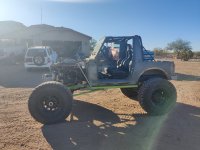
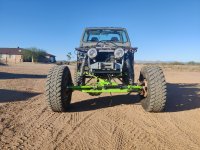
What started out as a factory 1987 Suzuki Samurai now has full size Chevy truck axles from a 1985 K20, coil overs front with double triangulated 4 link suspension, Jeep CJ leaf springs rear, running on 37x12.50R17 tires. Front axle was pushed out 14" over stock.

I still haven't yet finished out all the tubing work, axle vents, etc in these pics. But all the suspension and drivetrain is welded in solid.

View attachment 732009

View attachment 732010

I currently have the toe in set at 3/16" at the wheel lip, which I realize that toe is set in degrees, but I've done it this way for 20 some years on the other trucks, and has always worked well...Wheels are brand new, so the wheels haven't yet been chewed up, and I figured that was the best place to get repeatable measurements. Caster is currently 7* positive.

I have gone from 1/4" toe in to 1/4" toe out, 1/16" at a time trying to find a sweet spot, and settled on 3/16" as the best so far. Caster I've gone from 0* to 10* positive, again settling on 7*. I'm thinking with the much larger tires, I might just need to go past 1/4" toe in?

All of the suspension and axle work was done at the same time. I didn't have any kind of power steering on the Samurai before I did this, I knew there was no way I'd be able to deal with 37s on the factory tiny manual steering box, and bump steer would be atrocious with that 4 link anyways. I was driving the Chevy truck that the axles came out of for a while before all this, so I'm confident that the axles themselves are OK, and it's an issue with the way I set things up.

The issue with jumpy steering likely has nothing to do with the orbitrol. There is a thing called "bump steer" which is the geometry of the linkage between the steering and axle. If that is dicked up bad enough, the vehicle will be all over the road.

Bump steer doesn't exist with the full hydraulic steering. There is zero mechanical connection between the steering wheel and axle at this point. I have had bad bumpsteer on the K5 Blazer after a big lift, and stock push pull steering, as well as big lifts on Jeeps when the trackbar and drag link don't match on angles, so I know what that feels like.

Though I have been wondering if the unequal length tie rods could be causing drastic changes in toe during steering movements.

Simple answer is should be no issue on connecting the PB to tank since this how the steering unit would be configured without the PB option. Can you see the steering cylinder or linkage while driving? If it is moving back and forth you have a steering cylinder - system problem that could be amplified by steering linkage - alignment issues.

Not while driving, but I have been all over the front end looking for loose bearings, joints, heims, etc while on stands in the garage, and have none.
 

Attachments

  • IMG_20211029_155512_copy_1280x960.jpg
    IMG_20211029_155512_copy_1280x960.jpg
    899.9 KB · Views: 100
  • IMG_20211029_155614_copy_1280x960.jpg
    IMG_20211029_155614_copy_1280x960.jpg
    1.2 MB · Views: 101
Last edited:
/ Using a power beyond steering valve without the PB function? #7  
Well I really want to see those pics but it says i dont have permission for some reason..

I get you on the alignment machine thing, I am lucky to have access to one in an educational setup where something being 'a good learning opportunity' is more important than whether it makes money.

So there are a bunch of factors that cause the wheels to 'start' steering when they're rolling straight or mostly straight down the road. If you already understand caster and have tried messing around with that that's a good start and +7 sounds like a normal number for big tires like that. How are you measuring caster?

Other things that have an impact are wheel offset/backspace which basically determines how much 'leverage' a tire has to turn the knuckle on its ball joints. Pretty much all mud tires are way wider than stock tires so that alone gives the tire more leverage on the steering. You also have to move the tire outward from where a stock one would be so the wider tire doesn't rub something on the inside when turned all the way or with axle at max tilt/articulation. Not as big an issue with solid axle, but still.. big tires are usually set out further from the balljoints than stock tires. Then you have your wheel offset which can set it out even further, and all that adds up to if a big tire spaced further out hits a tiny little something, it will 'jerk' the steering system way more than a skinnier tire set closer in. There's not a way to totally cancel that effect. If one tire hits some kind of resistance and the tire on the other side doesnt, it will put a bigger force on the steering system than stock tires/wheels/offset. A little more toe in and caster like you mentioned are what we can do to partially compensate. There are other things like 'caster offset' which aren't really adjustable without precisely modifying the knuckle or the yoke on the axle.

Then you get into making the steering system itself more resistant to inputs from the tires. Any play in ball joints/tie rods etc is bad, obviously. Bigger/thicker tie rods flex less under these forces. A steering damper, which is basically a shock absorber on the steering, resists FAST movements like from a tire hitting something, but doesn't resist slow movements from the driver turning the wheel. It's hard to measure how much a steering damper is doing, but it's very hard to over-damp the steering so even running multiple steering dampers isn't usually bad, just time and money. Since you have a full hydro steer setup you COULD use the flow in and out of the steering cylinder itself to limit the speed of movement of the steering by using a restrictor in the line (since its a double acting cylinder fluid on both sides has to move to do anything so you only need to put a restrictor on one side) and see if that helps anything.

I don't know for sure if this isn't a terrible idea but there is also such a thing as a cylinder with pilot operated check valves or 'load holding valve'. It blocks the lines going into/out of the cylinder UNLESS there is pressure in one of those hoses. Basically, it means the hydraulic system can push on the cylinder, but the cylinder cannot push on the hydraulics. That would make your cylinder a solid bar any time you weren't actively steering the car. What i dont know is what is the pressure threshold they open at, because if they're only available with a fairly high pressure threshold using one as a steering cylinder might make the steering feel like it is always 'stuck' wherever it's at, until you push on it hard enough to hit that pressure and it suddenly moves. I dont know much about hydro steer so either it's already like this (unlikely), or theres a very good reason its not done (more likely). EDIT: looks like some steering valves already do that Orbital Valves - Orbital Valve Information - Hydraulic Steering Unlimited

As far as bump steer.. it doesn't exactly exist with a solid axle the way it does with IFS. Actual technical bump steer is a change in toe angle from suspension travel. The term doesn't actually mean your steering moving when you hit bumps. On a solid axle if you have cross-steer linkage where both knuckles are hooked directly to each other by one tie rod and only one knuckle has a 'drag link' going up to your gearbox, then the tie rod and the axle are parallel at all times so moving one side of the axle up and down doesn't change toe angle by itself. However, depending on your 4-link arms geometry, if the axle moves forward and backward as it goes up and down and only one side goes up or down, then one side of the axle is now forward or backward of the other side, and the car will steer a little because the entire axle rotated under the vehicle, even though the ball joints never turned. This type of thing (steering doesn't steer but entire axle changes angle) might actually be the majority of your problem, but i haven't seen your geometry and id have to wreck my brain to figure out what the geometry meant anyway so i can't say for sure. Im guessing when people 4link a front end they just stick to what's 'known good' geometry on other builds rather than building scale models or computer modeling to figure out how it's going to move.

Though I have been wondering if the unequal length tie rods could be causing drastic changes in toe during steering movements.
As long as the tie rods and the cylinder are staying parallel to the axle housing it shouldn't cause anything from hitting bumps or dips etc, but the unequal lengths might change your 'ackerman' or how much more one tire steers than the other one when you turn the wheel. Cars always have whichever tire is on the inside of a turn turned sharper than the other one, so even if the car has 0 toe when straight ahead, the wheels are not parallel when turned. The normal tie rod actually gets closer and further from the axle as steering is turned left to right, but its always a straight piece. The hydro cylinder is mounted at a fixed distance from the axle so even if you mounted it where the two tie rods were parallel when going straight, they would never stay parallel once the steering is turned, and at that point if they have different lengths they're going to change how far each wheel actually turns. But that seems like an unavoidable side effect of putting hydro steer on a car and probably lots of them are fine, so i assume it's no big deal at all. Ackerman only really has to be close to maximize tire wear on high-grip surfaces like pavement. If your on dirt most of the time it wouldn't matter much at all. I put drop spindles from a Dakota on my B250 van and now the ackerman is crazy, when im at full lock one side is turned like 15 degrees more than the other side. It doesn't even squeal and it's not killing the tires, plus my turning radius went WAY down.
 
Last edited:
/ Using a power beyond steering valve without the PB function?
  • Thread Starter
#8  
I edited the post with photos, and just added them again as attachments, rather than trying to insert them inline. It gave me problems the first time too, and I assumed it was because I was on a work computer with stupid firewall restrictions. It blocks a lot of free image hosts, free email providers, etc as spam/malware/etc. I'm a security admin and communications tech with wide open freedom on much of the corporate network, but apparently I can't be trusted to check email or look at pictures of silly cats, lol.

If you can see them now, you'll see that tire clearance is not even remotely close to an issue now, and I set up the suspension links specifically to avoid tires hitting anything at full lock. I spent a LOT of time doing the math on the 4 link to ensure that geometry issues don't crop up. Especially with things like axle rotation/pinion angle changes throughout the travel, or the amount of wheelbase change left to right.

Though obviously some changes will occur just due to the nature of a linked suspension going through an arc during compression/rebound, I just aimed to minimize it. I have a spreadsheet of all the numbers if you want to see it. Hopefully the pics show up, so you can see that I've gone well beyond just the typical suspension lift, or just copying a known OEM style 4 link. I don't know of any OEM implementation of a double triangulated 4 link front anyways.

The "bump steer" we usually see on solid axle rigs comes from big lifts on coil spring front end vehicles that end up with different angles on the drag link vs track bar. This also crops up on trucks with push/pull steering, such as full size Chevys with a solid front axle. The drag link ends up with such an extreme angle that the axle cycling through the suspension ends up causing the drag link to be pushed around, which then moves the steering around.

It was my understanding that non load reaction steering valve/orbitol that I'm running would prevent outside forces on the tires from moving them without active steering input, outside of things like slop in the wheel bearings, ball joints, etc.

The steering cylinder on the axle is mounted so that the tie rods are in a straight line as full lock left/right. At center, the cylinder is slightly ahead of where a normal tie rod would be, so that the tie rods on either end of the cylinder are angling back just a bit.
 
/ Using a power beyond steering valve without the PB function? #9  
Ok, I got confused about what was in reference to who, but i see what you meant now about bump steer.. i was already talking in the context that you dont HAVE a drag link anymore (or a track bar)..

But along those lines, have you sort of 'verified' what the side to side play of the front axle is like? As in, maybe strap/chain the axle up to the frame at ride height, jack it up from the frame or winch up to a gantry crane etc, just some way to get the front tires up without the axle holding the truck up, and just push side to side on the axle? I understand the triangulated 4 link should be handling the job now, but it also seems possible that even a good design might still have as much side to side 'play' as a less than perfect track bar, so its at least worth pushing on it to see what it really is. Even the frame end of the arm might be a slight issue. We can weld stuff to a frame and assume that's as good as it gets, but even stock vehicles sometimes crack their steering boxes off their frames and who knows how much it was deflecting in use for how long before that. Just gotta consider all the stuff that could 'give' a little.

Same thing with the steering.. seems you've already got the proper type of steering valve which should resist 'feedback' pretty well, but have you pushed on the wheel to see?

Between all the moving pieces, it could still just be an issue of 'tolerance stackup' just like death wobble often is.

As far as the caster, what happened when you went higher than 7? I've never really run into the downsides of too much caster, just worsening ride quality. I know some stock cars that go 180mph have 9*, but the trail and tire diameter and a whole bunch of other stuff plays into what that actually means between the car and the ground.

Definitely seems like you've done your homework and avoided most of the low hanging fruit problem possibilities. It looks great. (y)

Unrelated but.. at one time i had a stock samurai divorced Tcase and since they have a 1.4:1 high range iirc, for a while i was thinking about using it backwards on something as a divorced .71 overdrive box.. so read into that about my mental state what you will..
 
/ Using a power beyond steering valve without the PB function? #10  
A panhard bar might give front axle more side to side stability than the wishbone stabilizer.
 
/ Using a power beyond steering valve without the PB function?
  • Thread Starter
#11  
Ok, I got confused about what was in reference to who, but i see what you meant now about bump steer.. i was already talking in the context that you dont HAVE a drag link anymore (or a track bar)..

But along those lines, have you sort of 'verified' what the side to side play of the front axle is like? As in, maybe strap/chain the axle up to the frame at ride height, jack it up from the frame or winch up to a gantry crane etc, just some way to get the front tires up without the axle holding the truck up, and just push side to side on the axle? I understand the triangulated 4 link should be handling the job now, but it also seems possible that even a good design might still have as much side to side 'play' as a less than perfect track bar, so its at least worth pushing on it to see what it really is. Even the frame end of the arm might be a slight issue. We can weld stuff to a frame and assume that's as good as it gets, but even stock vehicles sometimes crack their steering boxes off their frames and who knows how much it was deflecting in use for how long before that. Just gotta consider all the stuff that could 'give' a little.

Same thing with the steering.. seems you've already got the proper type of steering valve which should resist 'feedback' pretty well, but have you pushed on the wheel to see?

Between all the moving pieces, it could still just be an issue of 'tolerance stackup' just like death wobble often is.

As far as the caster, what happened when you went higher than 7? I've never really run into the downsides of too much caster, just worsening ride quality. I know some stock cars that go 180mph have 9*, but the trail and tire diameter and a whole bunch of other stuff plays into what that actually means between the car and the ground.

Definitely seems like you've done your homework and avoided most of the low hanging fruit problem possibilities. It looks great. (y)

Unrelated but.. at one time i had a stock samurai divorced Tcase and since they have a 1.4:1 high range iirc, for a while i was thinking about using it backwards on something as a divorced .71 overdrive box.. so read into that about my mental state what you will..

Yep, stock Samurai 1.4:1 high range reduction, yet a paltry 2.26 low range reduction. Mine now is a 1.7 hi range, 6.5 low range. Our mental states aren't too far apart...I once spent a while attempting to figure out a way to go to a 1:1 hi range after doing the motor swap, as the freeway RPMs were just nuts with the bigger motor in it, and MPGs barely got into the double digits as a result. But ultimately, I decided to make a dedicated trail toy instead.

Side to side play - none. I've checked that several times over the build time, and yep..familiar with broken steering box mounts. My other toy is a Chevy K5 Blazer squarebody. I'm pretty sure just about all of those squarebodies ended up breaking steering boxes off eventually, lol.

Steering valve resists - yep...kept forgetting about it when I was building, and had a few WTF moments when I went to move the tires over the other direction, and couldn't figure out why I couldn't just push on the tire to move it. Then remembered why :D

Caster - I didn't feel any difference between 7* and 10*, so I just dialed it back to 7*. Biggest problem any solid axle 4WD rig when lifting them is the pinion angle. Go too far, and the front driveshaft u-joints bind when the suspension droops. Go WAY too far, and it binds at ride height. What a lot of guys end up having to do on big lifts on stock style suspension is cut the inner Cs off, then rotate them back and reweld to get a decent pinion angle and enough caster in there. I have my 4 link set up to minimize pinion angle change, so that I have less than 5* of change from full compression to full droop. Or in other words, as the suspension drops out, the axle rotates to keep the pinion pointed at the t-case output the whole time. I also have the front axle pushed out 14" from stock, and set up ride height to stay relatively low, which helps tremendously in minimizing the driveshaft angle.

Ended up getting called into work today, so I didn't have much time to play with it. Didn't have the steel on hand that I thought I did to make the alignment bars, so I did some quick and dirty tests, by dialing in all the toe-in I could just by collapsing the tie rods as much as I could, and ended up with noticeable toe in just by looking at it. Found the left/right centering of the axle was 3/4" off, and fixed that. Dialed in a noticeable amount of additional caster. Really wasn't looking for specific numbers at this point, just more of a "what happens if I throw a bunch of toe in and more caster as it?".

Result - drove a TON better. It's still wasn't "right", but it's night and day better than it was. Then a little voice in my head said to double check coilover charge pressures at this point. No idea why, but I'm glad it did. Turns out I completely forgot to charge them after installing them...oops. After putting in 200psi of nitrogen, it got better again.

It's still a bit twitchy, but definitely feels a lot more now like it's being induced somehow by how the suspension is reacting to the road surface, and not by my steering input. I was able to comfortably get it up to some decent speeds in the dirt without feeling like I was riding a real fine line with death on the other side, but pavement running is still a bit off, where keeping inside a lane is doable up to about 55mph, but hitting a bump is still unpredictable in how it's going to react. Realistically, I could call it good here, and move on, but now I'm really curious to see just how good I can get it dialed in.

One thing I did notice while testing today is that I can hear what sounds a bit like a whoosing noise in the steering valve when giving it steering input. Especially noticeable if I put just a bit of pressure on the steering wheel one way or the other, but not quite enough to start moving the tires. No idea if this is normal or not?


A panhard bar might give front axle more side to side stability than the wishbone stabilizer.

Would also be an excellent way to break things. The 4 link keeps the tires moving up and down in a straight line through the travel arc. This is inherent in a double triangulated 4 link design. Basically two opposite wishbones stacked. Lower is wide at the axle, narrow at the frame. Upper is narrow at the axle, and wide at the frame. While the tires are obviously going to see some left/right movement through articulation just on the nature of the suspension traveling in an arc, the center of the axle stays centered under the frame during all this.

A panhard bar would be attempting to force the whole axle to move in a left/right arc as well when going up and down, inducing large amounts of binding in the 4 link. Might work OK on something that only sees street miles, but would never work off road. Though there's really no point in even going with a triangulated 4 link if a panhard is also going in, and then it would be much simpler to just build out a parallel 4 link, or a 3 link.
 
Last edited:
/ Using a power beyond steering valve without the PB function? #12  
Nice work on the experimentation and getting some good results!

Glad the caster thing might have helped. Like I said, i know people say too much caster can cause a shimmy, but i've seen 9 degrees on cars that go 180mph so i dont know even think 'too much' can be achieved on stock adjustments on basically any car. Obviously once you have adjustable upper and lower arms you can crank in tons of angle but like you said, pinion angle problems.

I recently did ball joints and a gearbox on a JK wrangler to fix death wobble. The gearbox was the main culprit in my opinion but since I had to do ball joints anyway I put adjustable ones in the lower hole and cranked them to gain some caster without touching the pinion angle. I think if you do adjustable upper and lower you can get maybe 3 whole degrees of caster but an offset ball joint is a smaller ball joint offset in a stock size hole so its a strength compromise, although probably not an issue if you're running 1 ton axles on a buggy to begin with. I have never cut and rewelded an axle tube but maybe i'll have the right project to try it someday. About the mental state again.. I was thinking about cutting and welding axle tube and was thinking how i'd re-center it.. is it dumb that I had the thought to put one of my exhaust pipe expander tools in there to hold it centered up for tack welding? :ROFLMAO:

And that Tcase gearing swap sure sounds good.. I have an 87 Montero with a pathetic low range and it seems like nobody makes anything for the stock box. I put a t case doubler on a Toyota for someone else..that made me jealous too.. I really like the stock trans and have no reason to change it but that crappy low range is a real killjoy.
 
/ Using a power beyond steering valve without the PB function? #13  
Does the front end hold steering position with both wheels in the air and the steering wheel held from rotation? Engine OFF.
 
/ Using a power beyond steering valve without the PB function?
  • Thread Starter
#14  
Nice work on the experimentation and getting some good results!

About the mental state again.. I was thinking about cutting and welding axle tube and was thinking how i'd re-center it.. is it dumb that I had the thought to put one of my exhaust pipe expander tools in there to hold it centered up for tack welding? :ROFLMAO:

I think there's still plenty of room for improvement, and I also think that a lot of this just comes down to the compromises made with different types of suspension set ups. Such as this particular kind of 4 link setup comes with the benefit of insane amounts of flex or articulation, tons of side to side support, but at the potential cost of stability in the pavement department at speed. After charging the coilovers, the ride height jumped another 2" in the front, so it's starting to look like one of those wannabe prerunner trucks the kids have - jacked up sky high in the front with a saggy rear, lol. The spring rate is just way too high, and I think that's playing into this a bit as well by not allowing the suspension to do it's job properly. So I need to go get myself some lighter spring rate coils first to bring the front end back down, then it will probably just a be a Saturday afternoon's worth of playing with some different toe and caster adjustments again until I find the sweet spot.

As for the tube centering - not at all dumb. We don't all have fully stocked fab shops, and sometimes we get to make do with what we have on hand. Usually, the cut and turn is done not by cutting the tubes themselves, but actually cutting out the weld holding the inner C to the axle tube. But on some of the bigger axles, like the Dana 60 fronts, the tube to inner C and the tube to pumpkin is a VERY tight interference fit. So unless you have access to a very large hydraulic press, such as a 50ton or bigger, they ain't moving. Those axles will just laugh at the 20ton Harbor Freight press most of us have.

So they elect to cut the tube in the middle instead, turn as needed, and sleeve it when rewelding. Before I got my lathe to precisely size sleeves for this kind of stuff, my favorite way to realign tubing was to clamp a length of angle iron with the open side of the V against the tubing, across the cut line. Like this, but I added a couple worm drive hose clamps on either side as well to further secure the tubing from going out of alignment while tacking it up.

View attachment 732687
Does the front end hold steering position with both wheels in the air and the steering wheel held from rotation? Engine OFF.

Enough so that I nearly knocked it off the jackstands the first time I attempted to turn the tires after filling and bleeding the system out, thinking that the new cylinder just had a bit of stick slip to overcome, and I was kicking the sidewalls of the tires to give it enough force to do so. Took a few minutes to remember "oh yeah..non load reaction valve".

I'm actually a little torn on that one. On one hand, one of the biggest reasons I wanted to go to this type of steering was this exact feature - outside forces not allowing the steering to cycle without my input. The manual steering gearbox I was running before offered zero resistance to this, so I was constantly fighting to maintain control of the steering wheel in the rocks, always feeling like I was on the verge of breaking my hands every time the wheel got jerked around. So I like the idea of the non load reaction valve preventing this from happening.

On the other hand, I can see where the load reaction valve can aid in steering stability at speed by allowing the steering geometry to do it's job by keeping the steering centered up, but I don't know just how much force this will allow to be transferred, and I don't want to find myself back in a position of fighting to keep control of the steering again.

After all, I'm building this with off road performance as the primary goal, and if I can make it work on the pavement as well, bonus.
 

Marketplace Items

2024 PRO FABRICATION RTM-5.2K-Y REEL TRAILER (A59905)
2024 PRO...
2016 KUBOTA SVL75-2 SKID STEER (A60429)
2016 KUBOTA...
Used Landpride GR1525 Stump Grinder
Used Landpride...
2022 JOHN DEERE 744L WHEEL LOADER (A60429)
2022 JOHN DEERE...
Unused 2025 CFG Industrial MX12RX Mini Excavator (A59228)
Unused 2025 CFG...
light tower (A56857)
 
Top