
buckeyefarmer
Epic Contributor
The flat one had an amp. I think something was off inside the plastic case, it had a rattle.
Tv has strength meter. New one full signal.
Tv has strength meter. New one full signal.

Thinking about repairing the uhf, low vhf parts of my old antenna, and pointing it at stations in other direction.
Combiner to join two antennas, like this.let us know how you tie it in and if it works.

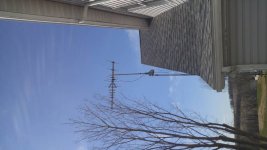

Finally got the antenna up.


Hope it works out well for you. I am still enjoying mine. Has worked fine except for one station FOX 6 out of Birmingham. I sent the following picture to the guy I bought antenna from to see if he had thoughts on getting that station better. Based on the Broadcast Frequency of that channel (second column from left) he has suggested that I raise the antenna to better receive FOX 6. I plan to give that a try. This guy deals with over the air and antennas everyday but was interested in the source of my chart, as it gives the sub channels you can expect to receive. The site for the chart is TV Broadcast Tower Locator (OTA DTv) You simply enter your address and it will retrieve a map of the TV towers around you, and the chart of channels.
That is a good site. Are you saying you are getting all of the channels shown except the channel 6?


Interesting that channel 13 at the same distance and same azmuth (bearing) is transmitting with 20 kw instead of 1000 kw and is projected to have a 12 dBm difference in signal you have marked in blue (good) yet the much more powerful signal from channel 6. Granted it is 48 meters lower in elevation, and the actual RF channel is 50 (UHF) instead of 13 (hi band VHF), but I would have thought it wouldn't have made as much difference. But I guess it does.
It's got 50 times the power?
Yep, according to the chart. 1000 KW ERP. Versus 20KW ERP. So yeah 50 times the power. Of course 50 times the power is not as much as you might think.
Lets look at the S meter on a standard communications reciever. Each S unit (if it used the old standard Collins calibration) is 6 dB
Going from 20 Kilowatts to 1000 Kilowatts is 17 dB of power increase So we are talking about almost 3 standard S units as you would see the signal on a communications receiver. So like S5 to almost S8. Or if a 20 KW signal was S9, the a 1000 KW signal would be 17 dB over S9. Those of you that have operated communications receivers hopefully this gives you some "feel" for this. Remember the dB scale is logarithmic. Those huge gains in transmitter power or antenna gain may not make as much difference on the receiver end as you at first think.

I wonder if the higher frequency is the difference. I lost all of the San Francisco stations when they moved up to UHF a few years ago. Lots of tinkering with various antennas - nothing.Interesting that channel 13 at the same distance and same azmuth (bearing) is transmitting with 20 kw instead of 1000 kw and is projected to have a 12 dBm difference in signal you have marked in blue (good) yet the much more powerful signal from channel 6. Granted it is 48 meters lower in elevation, and the actual RF channel is 50 (UHF) instead of 13 (hi band VHF), but I would have thought it wouldn't have made as much difference. But I guess it does.
I wonder if the higher frequency is the difference. I lost all of the San Francisco stations when they moved up to UHF a few years ago. Lots of tinkering with various antennas - nothing.
SF is over the horizon so apparently all my VHF reception was reflected off the atmosphere, and higher frequencies don't bounce as well.
If you click on one of the channels there's a terrain view at the bottom of the chart. See how that varies for the bad stations vs good that are in the same direction. That may help to see if height will help.
