T-Rex - my towable wood chipper

/ T-Rex - my towable wood chipper #1  

ruxu

New member
Joined
Jan 5, 2017
Messages
12
Location
Finland
Tractor
Suzuki SJ MPV
Finally!

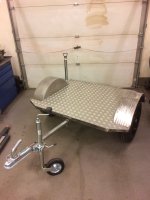
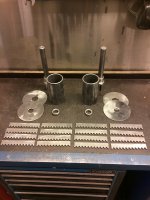
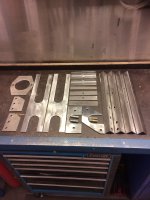
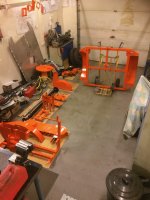
I have earlier asked here and on some other forums for advice on chipper feed hydraulics. Now I have finally got my wood chipper made ready - although I am retired it took me over 13 months. The whole project started from this,
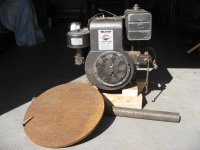
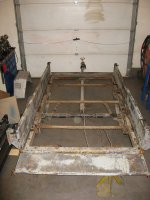
Haketintarvikkeita.jpg Kärryaihio.jpg

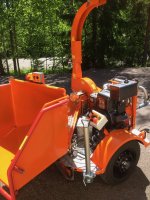
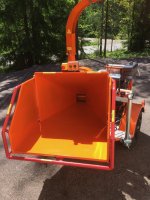
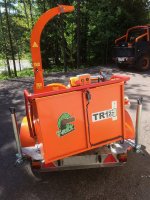
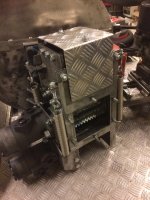
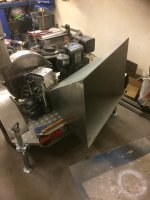
and ended up with this towable hydraulic feed chipper
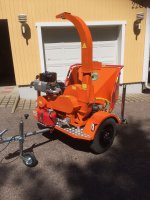
Valmis haketin 1B.jpg Valmis haketin 3B.jpg

Valmis haketin 4.jpg Valmis haketin 5B.jpg
Initially I made the chipper with manual feed but first tests showed that it did not work very well so I decided to redesign it to hydraulic feed. As I had to buy the hydraulic parts as new the whole project budget was doubled.

The chipper is powered by a 16hp Briggs&Stratton cast iron engine from 1979. The axle and frame is from a old homemade trailer from 1980. The chipping wheel diameter is 500mm and thickness 20mm and fitted with two chipping blades. The weight is about 32 kg and it rotates at 1 300 rpm. The engine axle has a centrifugal clutch with two V-belt groves with diameter 90mm. The chipping wheel pulley diameter is 180mm. The hydraulic pump with a flow of 7,4 L/min. is also driven from the chipping wheel axle.

The infeed rollers are driven by 250ccm gerotor motors. The direction of the motors are controlled by two solenoid valves. A flow divider is also fitted to make it possible to adjust the infeed roller speed. Additionally an Arduino microcontroller is via an inductive sensor fitted to read the chipper wheel speed. If too heavy load is applied and the chipper wheel speed drops below a set rpm value the microcontoller cuts voltage to the infeed roller solenoids until the chipper wheel gains enough rpm again. The chipper is capable to chip wood up to a diameter of 125mm.

The feed table edge to indeed rollers is 1 250mm to meet CE safety regulations. An infeed cutoff bar is fitted around the feed table edges. Emergency stop switches are fitted above the infeed and on the control panel. The chipper wheel housing cover is also fitted with a safety switch.

The towable chipper trailer base is re-registered as a towable machine and it is now allowed to tow it on public roads. The total weight of the chipper is 380kg.

Here are some additional pictures taken during the project.
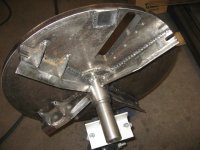
Laikka valmiina.jpg Haketinrunko koottuna.jpg

Hakettimen alusta valmiina.jpg Syöttörullien osat.jpg

Syöttörullakehikon osat.jpg Syöttörullakehikko valmiina.jpg

Syöttösuppilo heftissä.jpg Osien maalausta 2.jpg
 
/ T-Rex - my towable wood chipper #2  
Wow that is really well done. How fast does it feed?
 
/ T-Rex - my towable wood chipper #3  
Wow, that looks just like my Bear Cat Chipper. Nice work

48094820_614.jpg
 
/ T-Rex - my towable wood chipper #4  
+10 on impressive! What sort of occupation did you retire from if you don't mind my asking? From the paint to the electronics to the decals, awesome!
 
/ T-Rex - my towable wood chipper #5  
That is very well done.
 
/ T-Rex - my towable wood chipper #6  
That's some nice work, how's the engine hold under load? I used that same engine on my garden tractor puller back in the day.

Are you running the engine at the rated 3600rpm? Unless I missed something I calculated flywheel speed at 1800rpm instead of 1300
 
/ T-Rex - my towable wood chipper
  • Thread Starter
#7  
Wow that is really well done. How fast does it feed?

The maximum design feed speed is about 18,2 m/min. The flow regulator is however now set on maybe a little over half the range so it should be around 10 m/min.

There is actually four things that can be adjusted to get optimum performance,

- the engine speed - now set to about 2 700 - 2 800 rpm
- the hydraulic pressure - now set to 80 bar
- the setting of the flow regulator - now set to about 60% flow
- the Arduino micro controller feed control software - the chipper wheel runs at 1 300 rpm, too hard feed rate warning at about 1 100 rpm, feed interrupted at 1 000 rpm

As I get more experience how the chipper works I will probably adjust some of the settings.
 
Last edited:
/ T-Rex - my towable wood chipper
  • Thread Starter
#8  
Wow, that looks just like my Bear Cat Chipper. Nice work

48094820_614.jpg

Well... you now it is no use to re-invent the wheel...

When I started to design the chipper I of course looked on all available material of commercial chippers. I basically evaluated different solutions based on,

- how well will it work
- how hard is it to make with the tool limitations I have
- how much will it cost

My feed mechanism idea is certainly influenced by the Bear Cat chipper. I selected this approach because constructions that had the upper feed roller fitted to a linkage that was fitted to the infeed frame had so many parts fitted with various angles that I evaluated a little bit hard to make.

I have one question to you. How often do you grease/clean the moving upper roller frame of your Bear Cat chipper?
 
Last edited:
/ T-Rex - my towable wood chipper
  • Thread Starter
#9  
+10 on impressive! What sort of occupation did you retire from if you don't mind my asking? From the paint to the electronics to the decals, awesome!


Thank you very much!

I retired about two years ago from a position as a manager of an R&D department of a Finnish company making equipment for commercial kitchens. Even as a manager I often grabbed the tools to solve things together with my team. The painting experience is from my teenage+ years when I repaired and repainted damaged cars to get a decent daily driving vehicle. As for electronics it has been a hobby of mine all my life but also the commercial kitchen appliances almost all involved some kind of electronics. I have also done a lot of illustrations for product manuals.
 
/ T-Rex - my towable wood chipper
  • Thread Starter
#10  
That's some nice work, how's the engine hold under load? I used that same engine on my garden tractor puller back in the day.

Are you running the engine at the rated 3600rpm? Unless I missed something I calculated flywheel speed at 1800rpm instead of 1300


The idea of the chipper is basically to cut branches that are too small as firewood so that is probably everything under 40...50 mm. Cutting them doesn't affect the engine speed at all.

I have tested the chipper with some pieces of 100...110 mm wood and then the engine speed drops a little bit. During those tests that I made before the chipper was painted I did not have the Arduino micro controller feed system fitted so I don't know how the infeed would have made pauses then.

From information I have found the B&S 16hp engine has the best torque at around 2 700 rpm so I run it on that speed. Thus the cutting wheel speed is around 1 300...1 350 rpm.
 
/ T-Rex - my towable wood chipper #12  
Well... you now it is no use to re-invent the wheel...

When I started to design the chipper I of course looked on all available material of commercial chippers. I basically evaluated different solutions based on,

- how well will it work
- how hard is it to make with the tool limitations I have
- how much will it cost

My feed mechanism idea is certainly influenced by the Bear Cat chipper. I selected this approach because constructions that had the upper feed roller fitted to a linkage that was fitted to the infeed frame had so many parts fitted with various angles that I evaluated a little bit hard to make.

I have one question to you. How often do you grease/clean the moving upper roller frame of your Bear Cat chipper?

Well, I use mine primarily up at my cabin to chip up pine trees. I used it a lot for a five year period, and haven't even touched it in the past 2 years. I am in the process of building my cabin, but once that is done, I will get back to chipping some lingering piles I have. When I was using it, I would grease the entire thing about every ten hours of run time. For me that was about a weekends worth of time.

How do you run the belts off the crankshaft to the flywheel? Mine is lever operated and I stand on the lever and slowly allow the belts to spin the flywheel to match the crankshaft speed. Sometimes I get impatient and the belts start to smoke a bit from the friction. I was just wondering if you have a clutch mechanism or direct drive.
 
/ T-Rex - my towable wood chipper #13  
For comparison purposes- my Woodmaxx 8H 8" hydraulic feed chipper's maximum feed speed is 23 meters/min (75 fpm). For small brush I'd be ok with it being faster. But as it is if I'm ready to feed another branch before the last one is done, I just stack them.
 
/ T-Rex - my towable wood chipper
  • Thread Starter
#15  
Well, I use mine primarily up at my cabin to chip up pine trees. I used it a lot for a five year period, and haven't even touched it in the past 2 years. I am in the process of building my cabin, but once that is done, I will get back to chipping some lingering piles I have. When I was using it, I would grease the entire thing about every ten hours of run time. For me that was about a weekends worth of time.

How do you run the belts off the crankshaft to the flywheel? Mine is lever operated and I stand on the lever and slowly allow the belts to spin the flywheel to match the crankshaft speed. Sometimes I get impatient and the belts start to smoke a bit from the friction. I was just wondering if you have a clutch mechanism or direct drive.

Yes there is a centrifugal clutch on the engine output shaft. It engages at around 1 000 - 1 300 rpm on the engine and two V-belts is then driving the chipper cutting wheel.

I have earlier also been using a rental Wermeer 160XL chipper that has a similar lever operated drive mechanism. The belt on the Wermeer is a single belt with two V-belt sections - not two separate V-belts. It seems to work fine even on a heavily used rental chipper.
 
/ T-Rex - my towable wood chipper
  • Thread Starter
#16  
For comparison purposes- my Woodmaxx 8H 8" hydraulic feed chipper's maximum feed speed is 23 meters/min (75 fpm). For small brush I'd be ok with it being faster. But as it is if I'm ready to feed another branch before the last one is done, I just stack them.

As I had no idea how everything would work in the hydraulic feed so I wanted to stay on the safe side in order to not get disappointed with the hydraulic feed too. I just calculated that every rotation of the chipping wheel with two blades cuts ideally off 14 mm. Running at 1 300 rpm that makes 18,2 m/min. I have dimensioned the feed rollers according to this chipping capacity and also safeguarded the feed by putting in a flow regulator and a intelligent feed system. Ideally if the intelligent feed system works well I could take out the flow regulator as obsolete and use the full maximum feed speed of 18,2 m/min. The number of knives on the chipper wheel affects the maximum feed rate - my chipper has two knives, now I know I could have easily put in 3 knives and the 16hp B&S could have souped with it. Technically I could still put in 2 knives more and increase the total to 4 but then the intelligent feed system would certainly engage more frequently.

For comparison I have been using a rental Vermeer 160XL (8" capacity) several times with a max. feed rate of 49m/min. However a setting around 24 m/min seems to work best with various branch sizes. That feed rate is quite similar to your chipper.

If everything works OK in the long run and I for some reason would feel that the 18,2 m/min isn't fast enough I can slightly change the chipping wheel speed and put in a bigger volume hydraulic pump or maybe even ad two cutting knives. But what the heck - I am in no hurry, I am retired....
 
/ T-Rex - my towable wood chipper #17  
You have quite a broad set off engineering and fabrication/construction skills!! That is a pretty complicated piece of equipment you designed and built. It is great to see what can be achieved while having fun. Fantastic job and thanks for showing us what you did.

gg
 
/ T-Rex - my towable wood chipper #18  
ruxu, You'd want to set the engine RPM for maximum horsepower and not maximum torque, then adjust the gear/belt ratio to your desired flywheel RPM. By coincidence the HP/Torque curves might be peaking at the same RPM for your engine (I didn't look them up).

I also think modulating feed-rate would be better to keep the engine in the maximum HP range compared to bang-bang feed-rate which would make the engine chug thus lowering the RPM out of the maximum horsepower RPM range.
 

Marketplace Items

2844 (A58376)
2844 (A58376)
2020 Global R3 Air Street Sweeper (A56857)
2020 Global R3 Air...
Bobcat 435 FastTrack (A60462)
Bobcat 435...
UNUSED KJ K4230G-42' X 30' METAL STORAGE SHED (A60432)
UNUSED KJ...
(28) 2"X3"X33" TUBING (A60430)
(28) 2"X3"X33"...
1987 CATERPILLAR D6H HIGH TRACK CRAWLER DOZER (A52709)
1987 CATERPILLAR...
 
Top