Stick Electrode Smackdown (with video)

/ Stick Electrode Smackdown (with video) #1  

ChuckE2009

Silver Member
Joined
Jun 4, 2010
Messages
131
Hey yall!!

So, this is what I've been up to lately, I ran some welds with 6011, 6013, 7014, and 7018:

IMG_0053.jpg


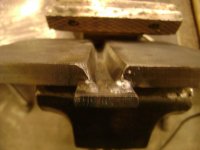
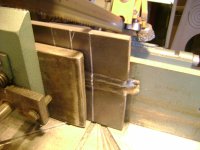
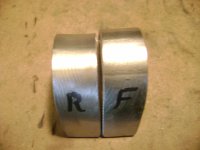
And then hammered them apart:

IMG_0055.jpg


IMG_0069.jpg


IMG_0082.jpg


Which was actually pretty fun and very stress relieving. My weakest weld was 7014, then 6013, 6011, and 7018. It honestly wasn't exactly what I was expecting, but I was really impressed with how the 7018 held up, considering I ran all these with cheap Hobart electrodes and that 7018 had been sitting out since last winter. What I don't fully understand yet, tho, is the huge difference in the performance of the 70XX electrodes, how one failed so soon and the other held up so well. I know that one is low hydgren, but is that all that made the difference? Hopefully someone can shed a little light on that...

But anyway, hope yall enjoy the video :) I made this after someone asked me about weld strenght with the different electrodes, and I thought back to last summer to a series of posts made by Shield Arc. He's a great welder and did pretty much the same test that I did, so I got his permission to copy his test and made it in video form. Thanks dude :cool:

[ame=http://www.youtube.com/watch?v=QuFbvSfsMvk]Stick Electrode Smackdown - YouTube[/ame]
 
/ Stick Electrode Smackdown (with video) #2  
List of things to look at, go back and read the manufacturer's
"As welded"
Tensile Strength, Yield Point, Charpy V-Notch Toughness, Hardness Rockwell B (avg).
 
/ Stick Electrode Smackdown (with video) #3  
Hey, I just watched your video. I'm setting here giggling like a little girl! What's with all the misses?!
 
/ Stick Electrode Smackdown (with video) #4  
Enjoyed the vid, and knew how it was going to turn out before you started swinging the hammer, but I was curious, in that I would have run the 7018 at 125 amps and the 7014 at 140 amps. I always though that 7014 needed more current than 7018..what say you?

James K0UA
 
/ Stick Electrode Smackdown (with video) #5  
Enjoyed the vid, and knew how it was going to turn out before you started swinging the hammer, but I was curious, in that I would have run the 7018 at 125 amps and the 7014 at 140 amps. I always though that 7014 needed more current than 7018..what say you?

James K0UA

Agreed. 7014 typically likes more amps than other common rods of same diameter. I would guess 140 to 145 amps on your welder for 1/8" diameter 7014. Look at manufacturers recommendations and it will verify what we are saying.
 
/ Stick Electrode Smackdown (with video) #6  
That doesnt surprise me in the least. I have been telling you guys here that 7014 is not a strong rod. Sure it runs pretty, but it is brittle and breaks easily and the hotter you run it the weaker it is. 7018 is a very ductile rod. Take one of each type of rod and bend a U shape in it, making the U on each one about the same length at the bottom of the U and start twisting it and count the turns before it breaks. The 7014 will snap first, then the 6013/ 6010 with be about the same and highest twist will be the 7018.
I may of told the tale about a small fab shop that I worked in briefly when I was a young kid of about 19 that made wire pulling equipment (Hycoloader in Lake Providence Louisiana). Their shop foreman loved the 7014 rod because it was so smooth and shiny and easy to weld with. My brother in law was working there with me at the time as there was a slow turn in the construction industry and jobs were kinda scarce, anyway, he had welded on a lug and had put about 4 passed on it with a 1/8" rod when the shop foreman who also did fitting came back and discovered that he had put the lug on in the wrong place and would have to be cut off. He went for a torch while my brother in law just picked up a 4 pound shop hammer and struck it about 4 times and on the final blow it went sailing across the shop with a clean break in the weld. I wouldnt trust that rod to hold tinker toys together, but if you folks want to keep using it because it looks pretty and easy to drag weld with, by all means carry on. Just be aware that those welds dont bend much at all before they snap and they arent as strong as the steel so there isnt any warning of impending failure.
 
/ Stick Electrode Smackdown (with video) #7  
I think it is so strange that 7014 will pass a bend test, but have next to nothing for impact quality!
Not sure if I posted these test results of a 7014 weld here or not.
 

Attachments

  • Test plate 2.jpg
    Test plate 2.jpg
    210.5 KB · Views: 287
  • Saw cut.jpg
    Saw cut.jpg
    244.4 KB · Views: 271
  • Face bend.jpg
    Face bend.jpg
    193.6 KB · Views: 269
  • Coupons 1.jpg
    Coupons 1.jpg
    181.5 KB · Views: 240
  • Coupons 2.jpg
    Coupons 2.jpg
    196.4 KB · Views: 260
/ Stick Electrode Smackdown (with video) #8  
I think it is because it is so hard that on a bend test where the coupon material can bend, the weld doesnt have to bend a lot. Most of the bending is in parent metal, whereas when you force the weld to elongate, it wont and just snaps. It has the 70 KSI tensile on straight pull, just no ductility. I havent looked up the stats on it, but I would bet it hasnt much elongation before breaking.
 
/ Stick Electrode Smackdown (with video) #9  
Looking at some literature I have from Lincoln,

Fleetweld 47, (7014)

"As Welded"
Yield point PSI. 60-73,000
Ductility - % Elong. In 2" 20-28
Charpy V-Notch Toughness Ft. Lbs. 51 at 70-degrees.


JetWeld LH-73, (7018)

"As Welded"
Yield point PSI. 60-86,000
Ductility - % Elong. In 2" 22-32
Charpy V-Notch Toughness Ft. Lbs. 20-56 at 20-degrees.
 
/ Stick Electrode Smackdown (with video) #10  
Looking at some literature I have from Lincoln,

Fleetweld 47, (7014)

"As Welded"
Yield point PSI. 60-73,000
Ductility - % Elong. In 2" 20-28
Charpy V-Notch Toughness Ft. Lbs. 51 at 70-degrees.


JetWeld LH-73, (7018)

"As Welded"
Yield point PSI. 60-86,000
Ductility - % Elong. In 2" 22-32
Charpy V-Notch Toughness Ft. Lbs. 20-56 at 20-degrees.

Sorry, I did try to google to learn more about how to interpret these but now my mind is spinning. Layman's terms anyone? :D
 
/ Stick Electrode Smackdown (with video) #12  
The tensile strength, and yield strength should be self explanatory. But here is a video on Charpy impact testing.

Charpy Impact Test on V-notch Specimen - YouTube

Thanks for the video. Makes a lot more sense watching the test in action. Seems to be a lot of variability in the Charpy test for the 7018 ....

Also, I wish they would put in units for test results. 70 degrees and 20 degrees - thought they were talking about range of motion or angle of the breakage until I realized they were talking about temperature.
 
/ Stick Electrode Smackdown (with video) #13  
BTW you can also break them apart on a hydraulic press. The positioning will be obvious and you can induce gradual failure.
 
/ Stick Electrode Smackdown (with video) #14  
I wouldnt trust that rod to hold tinker toys together...............


Well, I guess it's not for Tinker Toys. :)
But for railroads and ship building, it must be ok. :laughing:
 
/ Stick Electrode Smackdown (with video) #15  
This is certainly interesting. I've been using 7014 for almost 40 years. I've never had a weld break or even crack. I built a tractor with mostly 7014, some 7024 over 30 years ago. Weighs 7k with ballast, has 1 yd bucket on homemade FEL. I've moved lots of hard packed dirt and rocks with it. It's taken a beating. Not a single weld has cracked. So I'm very happy with 7014. I design my parts so the metal isn't bending and the welds are of adaquate size. My Sears buzz box won't run 7018, tried it long ago. Guess I'll stick with 7014.
 
/ Stick Electrode Smackdown (with video) #16  
I two use 7014 a lot, in high school I built a wood splitter using 7014, used the hydraulics on the tractor to power it. never broke a weld but did break my original beam splitting elm. that thing would really twist sometimes with elm :eek:. my last year in school i rebuilt it with a heavier beam and welded it all together with a mig, ag dept had got them new and the teachers didnt like them and said anything welded with them would stay together. :laughing: still using that splitter 25 years later.:thumbsup:
 
/ Stick Electrode Smackdown (with video) #17  
A properly designed joint helps a lot! 7014 is still a good 10000psi stronger than mild steel. It really depends on the application. Probably not good if you are weight conscious. A good weld with inferior rod is better than a poor weld with the "correct" rod.
 
/ Stick Electrode Smackdown (with video) #18  
I noticed that Lincoln carries a few different variants of 6011 and 7018 rods. What are the most common ones to use for general purpose mild steel welding?
 
/ Stick Electrode Smackdown (with video) #19  
I' am totally convinced with these inverter welders you have to find the brand of rod that works best with that machine. So far I have the best luck with Hobart's 335A 6011, ESAB's 10P 6010, and ESAB's Atom Arc 7018. With any of my old Lincoln engine drive welders, they could care less what brand rod you run with them! :confused2:
 

Marketplace Items

2000 Mack CH613 Dump Truck (A59213)
2000 Mack CH613...
2014 Dodge Ram 4500 Versalift Bucket Truck (A60352)
2014 Dodge Ram...
Red Cedar Glider Chair (A61569)
Red Cedar Glider...
500 BBL FRAC TANK (A58214)
500 BBL FRAC TANK...
New/Unused 20x30 All Steel Carport (A61166)
New/Unused 20x30...
Ford 1720 (A62177)
Ford 1720 (A62177)
 
Top