Splitter question

/ Splitter question #1  

handirifle

Veteran Member
Joined
Jul 2, 2010
Messages
1,727
Location
Central Coast of CA
Tractor
Massey Ferguson 1010
I'm not building one, I bought it. It's one I have used several times, borrowed from a neighbor, and he's finally selling it. Got it for $500. I has a horizontal shaft 5.0 HP Honda and runs great. Piston is either 1.25 or 1.5", haven't measured yet. It's a homemade/modified unit. I think it was a factory unit at some point, but the PO didn't like how it was low to the ground, so he raised it to about waist level.

The ONLY mechanical thing is it has a slight leak at the hydraulic reservoir. This tank looks like a converted 1 gal gas tank, and the leak is at one of the welded on hose fittings.

I am considering building a new reservoir, but here's my question. The motor, pump, and reservoir currently sit side by side. I have some 4x4x1/8" tubing and was thinking of using it to make a new one. Does the reservoir HAVE to sit level or above the pump? The PO raised it by adding a 12" wide "C" channel at each end. The channels stand vertically and are about 18" tall. I would like to put the tank there with the fill cap about level with the bottom of the pump.

This would cause the supply line from the tank to be about 12-16" below the pump. Will this still work? I do not know if a hydraulic pump will self prime or not, so that is my concern.

I do not want to buy a tank and I think it might turn to a real hassle to try to repair the other one. It is VERY thin metal. I would repair it by brazing if I did it, but that is my last resort. I am also concerned that the 1 gal reservoir might not be enough. I can get specifics on the cylinder but it has an estimated 18" stroke, but that's a guess.

Any help is appreciated.
 
/ Splitter question #2  
I think a one gallon tank is to small for a log splitter. Commercially made have a larger tank for their smallest models. A new for me product is on the market from JB weld. It is able to seal water,gas,and oil. Might use it instead of brazing. It even sets up under water.
 
/ Splitter question #3  
Ideally, the reservoir size should be at least equal to the pump flow in gallons per minute:

10 gpm pump = 10 gallon reservoir.

In practice, you could probably get away with half that.
 
/ Splitter question #4  
I'm no expert, but that hydraulic tank sounds really small. I think you may want to upsize the tank a bit, even if the one on it is fixable.

According to some tech manuals I found on building hydro-powered equipment, they said the reservoir should have the following characteristics:
  • a large surface area to transfer heat from the fluid to the surrounding environment
  • enough volume to let returning fluid slow down from a high entrance velocity. This lets heavier contaminants settle and air escape
  • a physical barrier (baffle) that separates fluid entering the reservoir from fluid entering the pump suction line
  • air space above the fluid to accept air that bubbles out of the fluid
  • space for hot-fluid expansion, gravity drain-back from a system during shutdown, and storage of large volumes needed intermittently during peak periods of an operating cycle

Also, the tank should have at least 10% excess capacity above and beyond the fluid it holds to allow for expansion and trapped air release.

My neighbor's 30 ton splitter has a 26 quart capacity (I borrowed it and did an oil change and tune up for him since it hadn't been run in a couple of years.) Another point of comparison -- while it's not a splitter, my wood chipper has a 5 gallon tank just to run the hydraulic infeed rollers.
 
/ Splitter question
  • Thread Starter
#5  
OK thanks. Wow this one must be really undersized. Surprised it has worked so well. I have split a lot of wood with it, in the past.

Can the tank be below the pump? I have no place to put a new tank, especially one that big, level or above the pump.
 
/ Splitter question #6  
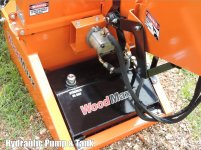
The tank on my hydraulic infeed chipper is below the pump. See pic... tank is black and pump is just above it:

Capture.JPG
 
/ Splitter question #7  
Not surprised that it worked OK for you with the small tank. The main concern with hydro fluid reservoirs is making sure that you have enough hydro oil in "reserve" to keep it at a usable temperature -- if there's enough to fill it, it will run, just without enough in reserve tank, the same oil keeps getting recycled and it never has a chance to cool down. More fluid doesn't make it work "better" just "cooler" in this particular case.

Similar to what rswyan said, I've heard reservoir size should be 2-3 times pump gpm unless there is a dedicated heat exchanger. BUT, I don't think splitters run the same way as other hydro-powered equipment -- slower stroke, fewer strokes per minute, etc., so overheating may not be that big of a problem for splitters -- I just don't know.

However, if you have to fix it anyway, I'd increase the size.
 
/ Splitter question
  • Thread Starter
#8  
OK great, that makes it easier. Another question, I have a 5 gal unused propane tank, I am thinking of converting to my new tank. Just a thought right now. IF I do use it, I will make sure any trace of propane is gone. It has sat for about 2 months so far with the valve completely removed, and upside down, since propane is heavier than air.

I would have to see how much the fittings would cost and the practicality of putting them in, leak free.
 
/ Splitter question
  • Thread Starter
#9  
Well did a little research on it, it has a 4" dia cylinder, piston I still didn't measure but it's a 1.25 or 1.5 (duh) with a 21" stroke. ENgine is 5hp Honda, pump is Norther tool 1012 11gpm 2 stage. Any idea what tonnage that equates to?
 
/ Splitter question #10  
18.849 tons - this is assuming the pump is actually putting out its rated 3000 psi.

BTW, the part you see moving in and out of the cylinder isn't the piston, it's the rod (usually, although there are cylinders where the rod is the full diameter of the piston) -

For a ballpark (close enough for most things) you take the diameter of the piston (typically about a half inch smaller than the outer diameter of the case) - divide that by 2, square it, multiply that number by 3.14 (pi), and that gives you the square inches of surface area on the piston (only for PUSH) - multiply that area by PSI of the pump, which gives you total pounds of push - then of course if you want TONS you divide by 2000.

If you need to know RETRACT tonnage, you need to find the area of the piston top as above, then do the SAME calculations for the area of the ROD - subtract rod area from piston area and multiply THAT by system pressure. The new, smaller # compensates for the loss of area caused by nothing pushing on the piston where the rod attaches.

HTH... Steve
 
/ Splitter question #11  
Hello,
When I made my log splitter, I placed the tank above the pump. I'm not sure if I read somewhere to do it that way or not......that was about 30 years ago !!!!! But it makes sense to me.....the pump will always be full of fluid because of gravity. Why make the pump pull the fluid if gravity can do the job without any effort !!! Mine has always worked great in that configuration !!!!! Maybe someone out there has better info, but I don't think anybody has answered that question for you yet !!!!

MFWD
 
/ Splitter question #12  
What you say is correct, but really not practical so as to keep a low profile.

You will probably see tank below in most log splitter configurations.

Hyd gear pumps can draw from a tank located below the pump level.
 
/ Splitter question
  • Thread Starter
#13  
Wow thanks. I'll have to keep looking at this thread to remember the formula.

I wonder if one like that would be marketed at a 20 ton? Maybe 19. Good to know though.

Back to my tank, I measured the old one and it's 3/4 gallon. Pretty small, but it has worked, especially when I didn't know any better :). I have a piece of steel tubing 4"x4" and 30" long. I calculated it at just under 1.9 gallons, internally. The actual ID is 3.75x3.75 and that was what I used to calculate my volume.

I will need to weld up the ends and add a fill tube and hose fittings. I figure a piece of 1.5" galvanized pipe with a cap would make the fill pipe and will have to locate some weld on hose fittings.
 
/ Splitter question #14  
Hello,
I would re-think on the size of your tank.....you won't be anywhere close to the rule of 1 gal. of fluid to each GPM of pump. At the very least, I wouldn't go smaller than a 5 gallon tank. That fluid really gets hot during splitting in the summer months !!! Just my 2 cents....good luck !!!!

MFWD
 
/ Splitter question #15  
You can get weld-on pipe bungs/flanges from Surplus Center ... as well as a suction strainer, if it doesn't have that either ... ;)

(BTW - Avoid welding galvanized steel ... unless you're in a very well-ventilated area ... it creates phosgene gas ... nasty stuff ... used in WWI as a poison gas)
 
/ Splitter question
  • Thread Starter
#16  
Yea am aware of the galvanized danger, but thanks. I realize the 1.8 gal is not up to the formula, but has worked a lot with 3/4 gallon tank.

What does it hurt to have smaller? This is for personal use, but when it gets used, it could be a full day affair.

I will keepp my eyes open for a larger tank. Cant afford to buy one. It was a real stretch to pat the $500 for the splitter.
 

Marketplace Items

2018 Dodge Grand Caravan SXT Van (A59231)
2018 Dodge Grand...
2018 Chevrolet Traverse SUV (A60352)
2018 Chevrolet...
MARATHON 20KW GENERATOR (A58214)
MARATHON 20KW...
TANK MANIFOLD (A55745)
2011 GROVE TMS900E TRUCK CRANE (A58214)
2011 GROVE TMS900E...
ELECTRIC GOLF CART (A58214)
ELECTRIC GOLF CART...
 
Top