Sears Tractor

/ Sears Tractor #1  

66vette

New member
Joined
Jul 28, 2014
Messages
11
Location
Greenville, OH
Tractor
Kubota L3130
I have an early 1960's Sears Suburban Garden Tractor with the 12HP Tecumseh engine. I want to convert it from points and condenser to electronic ignition for easier starting. It is hard to start in colder weather due to flooding the spark plug with gasoline fouling the plug. I have to change the plug several times before it will start. I believe with a hotter spark I would not have this problem. Anyone have any guidance into converting this old Tecumseh engine.
 
/ Sears Tractor #2  
Have you considered investigating why it's getting too much fuel? It's possible a simple float adjustment would solve your problem. It's also possible the needle on the float is either sticking or not seating properly to stop the fuel flow when the float bowl is full. If you want to go really crazy you could even consider replacing the carburetor.
 
/ Sears Tractor
  • Thread Starter
#3  
The fuel is only entering the combustion chamber when I am cranking and having full choke, tried setting choke at other positions but by then the plug is fouled with fuel. It also helps when I provide more cranking power with a car battery instead of the garden tractor battery. I believe it is not enough spark.
 
/ Sears Tractor #4  
Welcome to the forum. Neat tractor but more info would be needed. Most importantly, does this have the magneto ignition under the flywheel or ? The old belt drive starter? If you were to put a module on, it could possibly help with spark timing and quality. But are you looking at a starter that is a bit tired, lower compression or even older fuel that is contributing to your starting issue?
 
/ Sears Tractor
  • Thread Starter
#5  
It has the old belt drive starter, points and condenser readily accessible by a cover on the front of the engine. Never had the flywheel of so I don't know what is under there. I was thinking adding a module, don't know which one or what kind to have a greater spark for the sparkplug and more readily burn the gas. Put new fuel, The problem is more noticeable in cold weather. In cold weather I have to give it one shot of throttle and move the choke back and forth until it fires, if it doesn't fire I know I have saturated the sparkplug and I either have to clean by blasting by sand or install another plug. Also when it is cold (winter) it starts better when I have additional battery since it is in a unheated shed and the garden battery looses some charge in the cold weather.
 
/ Sears Tractor #7  
I grew up w/ one of these, but I just don't remember - do you also have an external, 12 volt ignition coil?
 
/ Sears Tractor
  • Thread Starter
#9  
I am going to have to take the shrouds and flywheel off to see what I have. I know it is not solid state as some of the older Tecumseh were, mine is older than that. I have to see what model Engine I have maybe that will help what electronic conversion I need and even if is available. I will post my model number tomorrow.
 
/ Sears Tractor
  • Thread Starter
#10  
Here is the Engine information:
Sears Engine Model 143-562012
Tecumseh Model HH120-120001
It is too cold to go outside to take the Flywheel off this will be a spring project. I am hoping by providing the Model numbers someone can tell me what electronic ignition to purchase and have it ready to install in the spring.
 
Last edited:
/ Sears Tractor #11  
I didn't see that exact spec. The non electronic ignition models appear to have a magneto coil that is external to the flywheel. It seems a short while back someone was looking to replace an electronic ignition for one of these that were NLA and a guy had a kit on EBay that did just that for - 200$. Just a thought here, but may be more helpful seeing as though you have points. Grab a 12 volt automotive coil from an auto parts store for cheap (~20$) and wire it for battery ignition. + would be switched (start and on) , - would run to the point /condenser terminal. Be sure to remove the lead to the existing magneto coil from that terminal. Know also that with magneto ignition, that switch lead that goes to the point set supplies a ground to kill the engine. You will need a new spark plug wire from the new coil too.

In short to just try this, the only wire that goes to the point set is the - from the new coil. You could just clip the + of the coil to the battery terminal while you what to start and run the engine. If this works out, the + wire to the coil is the one that needs to be switched 12 volts- maybe off the light position on the ignition switch or a new switch put in. This would be a cheap way to give a good hot spark. Ideally, remove the old ignition coil to prevent damage. At the very least, ground the terminal from the old coil to the points.

I'm assuming that the point gap should be set at .020" The breakers could be cleaned and reset for the most accurate timing.
 
/ Sears Tractor
  • Thread Starter
#12  
Your thinking is that the automotive coil will provide a hotter spark than the magneto. If that is the case that would be an improvement and an alternative to an electronic ignition. The optimum would be to get rid of the point and capacitor ignition and no longer having to maintain them.
 
/ Sears Tractor #13  
Your thinking is that the automotive coil will provide a hotter spark than the magneto. If that is the case that would be an improvement and an alternative to an electronic ignition. The optimum would be to get rid of the point and capacitor ignition and no longer having to maintain them.
There's already kits to do just that.

If you use an automotive coil, you'll need a way to trigger it. Tomplum's method uses the points to do that. And you'll need to reduce the voltage to it unless the new coil has a built in resistor. Otherwise, the coil will nuke itself when fed 12v or more when charging the battery. Typically, the old coils were fed battery voltage only during starting. In the run position, the coil was fed 8-10 volts through a resistor or resistor wire built into the wire harness.

YouTube has a plethora of videos to do ignition conversions on small engines. It's a lot simpler than deciding which method to use. :p
 
/ Sears Tractor #14  
What tomplum and Tinhack said. :thumbsup: On most old SGAs timing is adjusted by point gap. Adjusting by a few thou' (less) can ****** it for easier starting. 'Timing' can be way off and still run ok once warmed up, which disguises the starting issue.

Static timing can be checked with the spark plug removed and a VOM connected to the points. I learned 'how-to' in the '60s with Honda motorbikes, no timing light or flywheel TDC mark needed. Important to 'calibrate' first and make changes that can be compared to 'base'. If nothing works better, return to original setting.

If you use a std auto coil, there are 'voltage dropping resistors' to allow full-time 12v operation (Ford, Chrysler) vs the resistor wire used by GM.

Also, I add Sta-Bil to all gas cans when I bring them home. Fuel may go into mower, backhoe, or bucket truck, and not predictably with intermittent use of them. I've been get better starting, as tho' freshly pumped and IMO it's worth the $$. That doesn't seem to be a problem here but we don't always fill up same-day, and if we don't start well with fresh-pumped fuel, we'll want the advantage if it sits for weeks or months.
 
/ Sears Tractor #15  
It occurred to me too that when the old point box Briggs got a little worn, that we set the point gap back to .018 0r .019"
 
/ Sears Tractor
  • Thread Starter
#16  
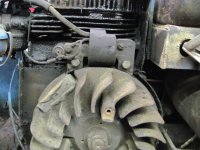
Decided this morning to start taking it apart, instead of trying to start with the small garden tractor battery I jumped it with a car battery. It started after several tries. I have now taken the shroud off and attached a picture of what I have.
IMG_1121.JPG
 
/ Sears Tractor #17  
The gap between flywheel and coil is critical. (5-10 thou' seems to work best)

Be sure to clean up the outer surface of the flywheel and faces of the coil irons. (steel wool.etc.)

If there's any contact between, we'd be lucky to get a spark at all.

If the gap is too wide, output will suffer.

btw, who hasn't seen an older lawn tractor with a car battery vs OEM-size on it. :)
 
/ Sears Tractor #18  
Is the head gasket leaking?
 
/ Sears Tractor
  • Thread Starter
#19  
The gap between flywheel and coil is critical. (5-10 thou' seems to work best)

Be sure to clean up the outer surface of the flywheel and faces of the coil irons. (steel wool.etc.)

If there's any contact between, we'd be lucky to get a spark at all.

If the gap is too wide, output will suffer.

btw, who hasn't seen an older lawn tractor with a car battery vs OEM-size on it. :)

What you are suggesting is that I retain the points and just clean everything up. That is certainly something I could try to see if I get a hotter spark. I wish I had the room for a car battery, the small garden batteries with their low amperage hours just doesn't get it especially in cold weather. I did a load test on the garden battery and it past the test.
 
/ Sears Tractor #20  
What you are suggesting is that I retain the points and just clean everything up. That is certainly something I could try to see if I get a hotter spark. I wish I had the room for a car battery, the small garden batteries with their low amperage hours just doesn't get it especially in cold weather. I did a load test on the garden battery and it past the test.

I think he meant the gap between the flywheel and the armature of the coil.

I always inserted a business card and tightened the armature down with it in place. No idea how thick they are.
 
 
Top