Satellite Internet

/ Satellite Internet #21  
Level 1 asks about the weather. If you admit it's cloudy out or raining, they wont talk to you anymore. You have to tell them the sky is clear in order to get to level 2.

They will even check the weather for your location online and call you a liar.
 
/ Satellite Internet #22  
Is there a good simple website that explains what all these options are. Dsl, cable internet, T1, ect. It's pretty much all foreign to me.

There are several good simple websites that explains what all the options are, but most of the time they never provide a good real world feel or example of what is available in your area unless you live in or near a large city.

The best thing I can advise anyone with technical questions like this, go to some of your local small businesses and ask who they use to work on their computers. When you come across someone that several businesses have mentioned as the one who keeps them in business, ask for their number and call them. They likely have the best idea of what services are available in your area as they work in the area and likely have clients with all of the available service providers.
 
/ Satellite Internet #24  
Had Wildblue (pre-Excede) here for maybe 8 years before cable was available. As Kenneth in Texas noted, it's better than dial-up but just barely. On a good day I got maybe 200-250k download speed, dropped out every time it rained/snowed, and the latency was really high--to the point that a VPN was unworkable. Some of my neighbors were able to use Wi-max or 4G, but the signal wasn't good enough here (and those who had it didn't seem to have much higher an opinion of it than I did with satellite). Don't remember what the data cap was (we never exceeded it), but it was considerably less than 10G/mo.

Dropped it like a hot potato when TWC came thru. Haven't looked back. This was right about the time they were phasing out the old service and transitioning to Excede...timing was perfect, otherwise I would have needed to buy new equipment and sign a new 1 year contract to get the "high" speed satellite. I know people like to gripe about the cable companies, but it's so much better (in every way) than the alternatives here.

My sister has Excede where she lives...says it's fast enough for what they need it for, but all the other issues remain.
 
/ Satellite Internet #25  
We had satellite internet for 3 years or so and dropped it. Just used our phones for internet the last 5 years.
 
/ Satellite Internet #26  
We had dial up for years and as soon as DSL was available we switched to Bell South and it was great, not at as fast as T1, but better than dial up and satellite. When AT&T gobbled up the baby Bells the level of service dropped immediately, but it is still better than dialup. They contracted their email to Yahoo and that made things even worse and really slowed things down, but it is the only show in town other than dial up which is pretty much useless in our heavy tech world.
 
/ Satellite Internet #27  
Is there a good simple website that explains what all these options are. Dsl, cable internet, T1, ect. It's pretty much all foreign to me.

I don't know but I'll try to give a quick summary. Sorted from best to worst:

Fiber internet: Google fiber, etc. Almost never available in rural areas. Requires fiber optics to be installed. Speeds up to 1 gigabit per second. Usually unlimited data (no data caps)

Cable internet: Seldom available in rural areas. Requires coax cable to be involved, only available where cable TV is also available. Typically speeds up to 30-50 megabits per second. Usually unlimited data though some of the scummier cable companies are starting to impose limits. Which reminds me of another drawback, you're dealing with cable companies, which have some of the lowest customer satisfaction ratings in the world.

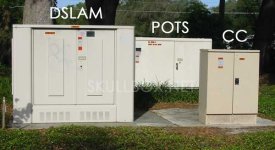
DSL: Uses existing phone lines, but does not tie up your voice line. This is the most commonly available option in rural areas, but still not widespread in rural areas, lots of gaps in coverage. You have to be within a certain distance of a DSLAM (which is a certain type of telco box, see picture below). Speeds available depend on how far you are away from the DSLAM, right next to it you might see 20 megabits per second, down to 1 or fewer megabits at the far edges (like 3-5 miles). Typical customer speeds are around 5-10 megabits per second. Typically no data limits.

WiMax/LTE: Uses cellular data services. Can be fast, over 10 megabits per second, but expensive and usually comes with data caps, the more you pay the higher the data cap. $100/month might get you a 10-20 gigabyte per month data cap. Unreliable, speeds and availability vary widely throughout the day. Usually requires a 2 year contract with the cellular carrier.

Satellite: the absolute last resort if you can't get any of the above. Usually can't be used for telecommuting because the propagation delays caused by the distance between you and the satellite mean employers' VPNs don't work. Usually with data caps. Speeds 5-10 megabits per second but usually don't provide advertised speed. Unreliable, can go out in bad weather. Often use dial-up for the upload leg. Usually requires a long-term contract

Dial-up: the worst of the worst. Speeds of about 56 Kilobits (i.e., 1/100th of a 5 megabit connection). Unacceptable for anything except simple web browsing (no graphics) or simple emailing. Runs over your phone line and ties it up while you're dialed in.

note: A DSLAM: dslam.jpg
 
Last edited:
/ Satellite Internet #28  
I don't know but I'll try to give a quick summary. Sorted from best to worst:

Fiber internet: Google fiber, etc. Almost never available in rural areas. Requires fiber optics to be installed. Speeds up to 1 gigabit per second

Cable internet: Seldom available in rural areas. Requires coax cable to be involved, only available where cable TV is also available. Typically speeds up to 30-50 megabits per second.

DSL: Uses existing phone lines, but does not tie up your voice line. This is the most commonly available option in rural areas, but still not widespread in rural areas, lots of gaps in coverage. You have to be within a certain distance of a DSLAM (which is a certain type of telco box, see picture below). Speeds available depend on how far you are away from the DSLAM, right next to it you might see 20 megabits per second, down to 1 or fewer megabits at the far edges (like 3-5 miles). Typical customer speeds are around 5-10 megabits per second.

WiMax/LTE: Uses cellular data services. Can be fast, over 10 megabits per second, but expensive and usually comes with data caps, the more you pay the higher the data cap. $100/month might get you a 10-20 gigabyte data cap. Unreliable, speeds and availability vary widely throughout the day. Usually requires a 2 year contract with the cellular carrier.

Satellite: the absolute last resort if you can't get any of the above. Usually can't be used for telecommuting because the propagation delays caused by the distance between you and the satellite mean employers' VPNs don't work. Usually with data caps. Speeds 5-10 megabits per second but usually don't provide advertised speed. Unreliable, can go out in bad weather. Often use dial-up for the upload leg. Usually requires a long-term contract

Dial-up: the worst of the worst. Speeds of about 56 Kilobits (i.e., 1/100th of a 5 megabit connection). Unacceptable for anything except simple web browsing (no graphics) or simple emailing. Runs over your phone line and ties it up while you're dialed in.

note: A DSLAM: <img src="http://www.tractorbynet.com/forums/attachment.php?attachmentid=421208"/>

Very helpful, thank you. When ever my Dishnet contract is up, I plan to try the Windstream DSL again. They don't have a long contract, so should be pain free to try them again. I know they where doing some upgrades, but don't know how much it might have helped. The information about distance to the cabinet is intresting, they did put a new one a few miles away (maybe a mile as the crow flies). I also found there is an another service that might be available, fixed wireless broad band. They advertise (on website after much searching) 720 kbps, and "unlimited bandwidth" which I assume means no data limit. They have a 2 year contract, $125 install fee, and is $35/month before tax/fees/ect.

Really seems that if they can't provide what the advertise, or keep "over selling" the lines, reducing your speed and reliability; you should be able to get out of the contract. I know they say "upto X speed", but some of this stuff is literally 10% or less than what they claim.
 
Last edited:
/ Satellite Internet #29  
I don't know but I'll try to give a quick summary. Sorted from best to worst:

Fiber internet: Google fiber, etc. Almost never available in rural areas. Requires fiber optics to be installed. Speeds up to 1 gigabit per second. Usually unlimited data (no data caps)

Cable internet: Seldom available in rural areas. Requires coax cable to be involved, only available where cable TV is also available. Typically speeds up to 30-50 megabits per second. Usually unlimited data though some of the scummier cable companies are starting to impose limits. Which reminds me of another drawback, you're dealing with cable companies, which have some of the lowest customer satisfaction ratings in the world.

DSL: Uses existing phone lines, but does not tie up your voice line. This is the most commonly available option in rural areas, but still not widespread in rural areas, lots of gaps in coverage. You have to be within a certain distance of a DSLAM (which is a certain type of telco box, see picture below). Speeds available depend on how far you are away from the DSLAM, right next to it you might see 20 megabits per second, down to 1 or fewer megabits at the far edges (like 3-5 miles). Typical customer speeds are around 5-10 megabits per second. Typically no data limits.

WiMax/LTE: Uses cellular data services. Can be fast, over 10 megabits per second, but expensive and usually comes with data caps, the more you pay the higher the data cap. $100/month might get you a 10-20 gigabyte per month data cap. Unreliable, speeds and availability vary widely throughout the day. Usually requires a 2 year contract with the cellular carrier.

Satellite: the absolute last resort if you can't get any of the above. Usually can't be used for telecommuting because the propagation delays caused by the distance between you and the satellite mean employers' VPNs don't work. Usually with data caps. Speeds 5-10 megabits per second but usually don't provide advertised speed. Unreliable, can go out in bad weather. Often use dial-up for the upload leg. Usually requires a long-term contract

Dial-up: the worst of the worst. Speeds of about 56 Kilobits (i.e., 1/100th of a 5 megabit connection). Unacceptable for anything except simple web browsing (no graphics) or simple emailing. Runs over your phone line and ties it up while you're dialed in.

note: A DSLAM: View attachment 421208

Not discussed is radio wave internet. We have an over the air radio receiver on a tower. Signal is broadcast from the ISP tower to our radio reciever. Speed is up to 10 mps. Never had an issue with upload/download speed. I work from home and my work is all internet based, as is my office phone. My wife streams entertainment.
 
/ Satellite Internet #30  
Thanks for that pic Geek. About 7 years ago, ATT had fiber optic cable run on county road 1/2 mile from my house in Georgia. Those DSLAM boxes are 1 mile. Still not connected!
 
/ Satellite Internet #31  
Not discussed is radio wave internet. We have an over the air radio receiver on a tower. Signal is broadcast from the ISP tower to our radio reciever. Speed is up to 10 mps. Never had an issue with upload/download speed. I work from home and my work is all internet based, as is my office phone. My wife streams entertainment.

It is called Fixed Wireless Internet: Fixed Wireless Internet In the United States at a Glance

Fixed wireless - Wikipedia, the free encyclopedia
 
/ Satellite Internet #32  
Satellite: the absolute last resort if you can't get any of the above. Usually can't be used for telecommuting because the propagation delays caused by the distance between you and the satellite mean employers' VPNs don't work. Usually with data caps. Speeds 5-10 megabits per second but usually don't provide advertised speed. Unreliable, can go out in bad weather. Often use dial-up for the upload leg. Usually requires a long-term contract

Do any of them do that anymore? Pretty sure that went away 15 years ago...when we got Wildblue in '04, it was 2-way thru the dish.
 
/ Satellite Internet #33  
Thanks for that pic Geek. About 7 years ago, ATT had fiber optic cable run on county road 1/2 mile from my house in Georgia. Those DSLAM boxes are 1 mile. Still not connected!

If there isn't a high enough concentration of customers per mile of line, they won't put in a tap to connect a customer or two. I have a BIG fiber backbone runs 35' from a house and can't get connected to it.
 
/ Satellite Internet #35  
The exception to the 'rule' of rural areas and fiber service, is in Vermont currently. The state is split into a couple of Telcos for hard line and cell service. We happen to be on Vtel/Vermont telephone. It provides 1Gig, (A billion bits/sec) service to all it's rural customers, and there is a bundle available for TV and phone; though for now I'm sticking to the fiber as replacement for their DSL service, which promised a lot but tended to deliver a little, due to being far from the 'switch'. As they make the underground copper pair lines obsolete, they get less and less service repairs to keep them running right.
I use Dish for TV, and because I have it, things like Netflix are available.

It is also true that in this same rural area Comcast brought cable internet availability, BUT it won't get to my house, a mile from the local highway up our dirt road. I think this is because with Vtel running fiber Comcast has no incentive to string cable in the same area. Wouldn't want them anyway; used them in CT and they are USELESS.

I can't believe how crappy the services available to most of the US really are considering our ability to do technological tasks well if we choose to. It just blows my mind that these companies, like cable companies, suck so badly at making things work for reasonable money.
 
/ Satellite Internet #36  

I didn't include fixed wireless internet because I'm not familiar with it. It sounds like a great alternative but I'm not sure that really covers a significant amount of rural ground. For example I went to the first website link and clicked on the coverage map of SkyBeam which claims to cover 13 million people Well yeah, their coverage area includes the cities of Dallas, Ft Worth, Austin, etc. Not exactly rural.

The coverage maps also don't show actual coverage, just states they operate in so it's hard to tell.

I know around here, in North Carolina, it's completely unheard of.
 
/ Satellite Internet #38  
There's at least 60-65 houses down our road. I just want some Komkast competition.

If the customers aren't close enough together and close enough to the nearest line to connect to and get them X number of customers per mile of cable strung, it isn't worth it to them. I don't see them stringing one mile of cable for less than 100 customers locally.

With only 60-65 houses; unless they are close together AND close to a connection point I'd be shocked to find any wired connections available... If those 60-65 houses are on lots larger than the standard city lot, and there is a wired connection of any sort available, it is one of the more fortunate areas...
 
/ Satellite Internet #39  
That is one advantage of Fixed Wireless, they just put a radio receiver on the roof or on a pole.
 

Marketplace Items

Bomag Trash Compactor (A59228)
Bomag Trash...
Cushman Electric Cart (A55851)
Cushman Electric...
2020 INTERNATIONAL MV607 26FT NON CDL BOX TRUCK (A59575)
2020 INTERNATIONAL...
Hydraulic Concrete Breaker Excavator Attachment (A59228)
Hydraulic Concrete...
2018 HINO CONVENTIONAL TYPE TRUCK (A55745)
2018 HINO...
2017 Freightliner Cascadia 125 T/A Sleeper Cab Truck Tractor (A59230)
2017 Freightliner...
 
Top