REAR-MOUNTED CRANE

   / REAR-MOUNTED CRANE #1  

Aussiebushman

Gold Member
Joined
Jul 31, 2008
Messages
252
Location
Jerrong, south of Oberon in NSW, Australia
Tractor
Ford 6000
G'Day from Oz

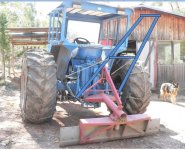
I have a jib that attaches to the 3PT linkage on my Ford 6000 but the usefulness of this is limited due to the lift height and a minor hydraulic leak causes the lift to slam up instead of raising steadily - fixing that is a job for another lifetime!

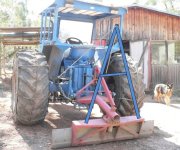
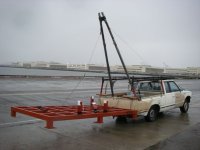
The ground here is uneven and lifting heavy objects gets awkward so Instead of building a fixed crane or gantry, an adaptation of the one in this picture seems like it could be a great solution and I have most of the bits needed including the steel and the chain block. There is no danger of the front of the tractor lifting due to the weight of the massive dozer blade holding it down.

  • The two main frames will be made of 75 X 45 mm steel RHS 3 each metres long
  • A collar will be made to bolt the two frames together at the head of the rig, control the height and hang the chain block
  • Holes will be drilled at the bottom of each side frame to swivel on the pins in the 3 pt linkage
  • The "back stay" (actually faces to the front of the tractor) will be a heavy cable running from a mounting point on one side of the tractor through an adjusting block and back to the other side - this controls the height of the frame. OR it may be easier to simply affix the head of the rig with chain that can be adjusted for length with a rated shackle .

I see the benefits of this concept being its mobility - the tractor and rig can be backed up to whatever needs lifting. The only problem I can foresee is the angle of the wire stay being too far back but I can't see an alternative other than adding a vertical "gin pole" OR running the cable right through the cab to the steel frame at the front - not desirable

Jenna (the German Shepherd in the picture) has already provided instructions but has anyone got a better idea (and I do not mean hiring a crane for a 3 hour round trip every time I want to use it).
 

Attachments

  • trsctor or truck hoist.jpg
    trsctor or truck hoist.jpg
    36.4 KB · Views: 805
  • crane_schematic.jpg
    crane_schematic.jpg
    138.5 KB · Views: 836
   / REAR-MOUNTED CRANE #2  
G'Day from Oz

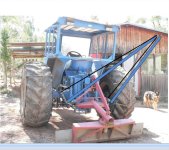
I have a jib that attaches to the 3PT linkage on my Ford 6000 but the usefulness of this is limited due to the lift height and a minor hydraulic leak causes the lift to slam up instead of raising steadily - fixing that is a job for another lifetime!

The ground here is uneven and lifting heavy objects gets awkward so Instead of building a fixed crane or gantry, an adaptation of the one in this picture seems like it could be a great solution and I have most of the bits needed including the steel and the chain block. There is no danger of the front of the tractor lifting due to the weight of the massive dozer blade holding it down.

  • The two main frames will be made of 75 X 45 mm steel RHS 3 each metres long
  • A collar will be made to bolt the two frames together at the head of the rig, control the height and hang the chain block
  • Holes will be drilled at the bottom of each side frame to swivel on the pins in the 3 pt linkage
  • The "back stay" (actually faces to the front of the tractor) will be a heavy cable running from a mounting point on one side of the tractor through an adjusting block and back to the other side - this controls the height of the frame. OR it may be easier to simply affix the head of the rig with chain that can be adjusted for length with a rated shackle .

I see the benefits of this concept being its mobility - the tractor and rig can be backed up to whatever needs lifting. The only problem I can foresee is the angle of the wire stay being too far back but I can't see an alternative other than adding a vertical "gin pole" OR running the cable right through the cab to the steel frame at the front - not desirable

Jenna (the German Shepherd in the picture) has already provided instructions but has anyone got a better idea (and I do not mean hiring a crane for a 3 hour round trip every time I want to use it).

Your plan is good.

I've got something similar.

The structure is 50X100 welded thick wall tube. The joined end is made with a pintle ring . The flat flange drilled for 18mm bolts.

The tractor end is a pair of female shackle ends (aviation discards) fitted to the ubiquitous pre-drilled draw bar .

I run a chain from the top link to the pintle ring. A come along/ power pull serves for fine lifting, else, it's just the tractor 3 pth doing the dirty.!
 
   / REAR-MOUNTED CRANE #3  
I like the idea of having a jib back there from time to time. Is there any reason you can't add a spreader bar in line with the top link and actually use a top link?
Then if you feel the need for cables use them as a truss set up, a standoff at the mid point of your booms and then just tie the cable to both ends?
 
   / REAR-MOUNTED CRANE
  • Thread Starter
#4  
You mean like this V2 schematic? Not sure I understand the benefit. It seems to me that the higher the fixing point for the chain/cable the better, but a strut in the centre would certainly help firm up the structure.

Another option would be to bolt the bottom of each post to welded plates on the top of the scraper blade instead of onto the 3 pt linkage pins - see V3 schematic. Then the rig can be left in place even when the rear blade is in use and the angle of the chains/wire stay might be better
 

Attachments

  • crane_schematic2.jpg
    crane_schematic2.jpg
    133.5 KB · Views: 328
  • crane_schematic3.jpg
    crane_schematic3.jpg
    121.6 KB · Views: 355
   / REAR-MOUNTED CRANE #5  
You mean like this V2 schematic? Not sure I understand the benefit. It seems to me that the higher the fixing point for the chain/cable the better, but a strut in the centre would certainly help firm up the structure.

Another option would be to bolt the bottom of each post to welded plates on the top of the scraper blade instead of onto the 3 pt linkage pins - see V3 schematic. Then the rig can be left in place even when the rear blade is in use and the angle of the chains/wire stay might be better

DON'T run a four sided structure! Triangles! Only Triangles.

The problem with mounting to the blade is the loss of lifting power with the distance from the lift arms, and loss of "daylight" between the load and the blade in the process.

Double negative! If you are lifting pipe, that won't matter. ;-)
 
   / REAR-MOUNTED CRANE #6  
I'd only use version 1. CalG explained why. :thumbsup: I might even put a pulley on the jib and shackle a winch to top link base. Goal, to enhance o'all range of lift, offer snatch block to reeve 2 part, and no chains or ratchet latches to bust your hands. Lift cyl will hold more than it will lift, so higher max cap, too.

Strongest bits should be the lower legs. Top legs will be under tensile vs compressive load, could even be chains with grab hooks applied to adjust jib position relative to that of 3ph arms. (Flat bar top legs can offer adjustment too, pinned thru clevis etc.)

btw, I have a 3PH 'boom', and I suggest it's less attractive that what is proposed, less stiff/secure with a load that swings from side to side, and with a single point lift that's a given. :) Also, to connect bits, instead of just punching bolt holes at pivots or anchor points, can you make bigger holes and weld in bushes/hubs? (Tack & try out right on the 3PH and weld 'er up once for good?) t o g
 
   / REAR-MOUNTED CRANE #7  
I see a number of large cranes with jibs which have this general design which gives a good angle to support the outer end of the jib.

M2PzEqF.jpg


Dave M7040
 
   / REAR-MOUNTED CRANE #8  
I see a number of large cranes with jibs which have this general design which gives a good angle to support the outer end of the jib.

M2PzEqF.jpg


Dave M7040

Dave

From an engineering standpoint, the structure makes good sense.

But practically, a little extra wall thickness at the memebers will cut the parts count to TWO!

You might figure how the economics might play out.

Plus, A simple boom stores most compactly ;-)
 
   / REAR-MOUNTED CRANE
  • Thread Starter
#9  
Interesting - It certainly overcomes the problem of where to anchor the rear cable. However, unless I'm missing something, the height of the jib is fixed relative to the ground unless the upper green line in your sketch is adjustable for length so the whole thing swivels on the lower pivot.

Raising or lowering the jib provides a distinct advantage in terms of getting it under trees.buildings etc before hooking on.

In practice, not sure your suggested arrangement is any more workable than the jib I already have. There is nothing to stop me from raising that jib to whatever height I want, then using a chain block to do the lifting. Cost of this option is NIL. BUT I have already mentioned that the 3 pt linkage slams rather than lifting smoothly - The proposed arrangement overcomes that problem because it provides the option of easily and smoothly raising/lowering the jib as well as using the chain block.
 
   / REAR-MOUNTED CRANE #10  
Thanks for at least considering my suggestion.

I saw the red line as being a cable as on the cranes. A heavy turnbuckle providing some adjustment.

I saw the top green line to be a hydraulic top link thus being easy adjustable.

Where the three black line meet, the two crane arms could be hinged to allow more compact storage.

Good luck with whatever you do and plse report back so we all benefit from your experience.

Dave M7040
 
   / REAR-MOUNTED CRANE #11  
Aussiebushman, may I ask why you have your tires on backwards with a rear blade turn to pull you may be rotating it to push, but with a large dozier blade on it is reason I am asking.

As to your jib, worked in many aspects of a company who made cranes and many did have jibs on them. One of biggest benefits of them was they allowed some offset for handling lighter lower past say a wall the boom itself would not give the reach needed. But far from an expert on some things mentioned here: have two questions, one myself would be concerned about the load you could end up on the third arm mount if hooked there and the other is could you use a 12 volt winch to life the load? Now I know a winch is not rated for lifting so take that into safety consideration. Then the jib will not be approved by any government agency either, well would not in the USA.
 
   / REAR-MOUNTED CRANE #12  
Aussiebushman, may I ask why you have your tires on backwards with a rear blade turn to pull you may be rotating it to push, but with a large dozier blade on it is reason I am asking.

That's so he could justify buying the chains (to the wife). ;)

...
could you use a 12 volt winch to life the load? Now I know a winch is not rated for lifting so take that into safety consideration. Then the jib will not be approved by any government agency either, well would not in the USA.

A small winch can lift a larger load using a multi-sheave block-&-tackle set-up. That may help you. I take it your need to lift is not for height but for positioning?

You might consider scaffold pipe rather than box-section for your arms.

Also, bear in mind, the top link is in the centre of the lower arms and will need a spreader to make a connection to the boom.

As said earlier. Triangles. Triangulate everything in all directions.

You may find an Army Surplus boom at Corrowa (sp?) this week. Or look for an old Holmes-type wrecker crane.

Oi, Oi, Oi ! :)
 
   / REAR-MOUNTED CRANE
  • Thread Starter
#14  
Thank you Dave.

Hope I did not sound dismissive about your suggestion and that my return message explained my thinking. It is always good to get alternative views/suggestions because even if not adopted they often lead to other solutions not previously considered
 
   / REAR-MOUNTED CRANE
  • Thread Starter
#15  
Just noticed more responses:

may I ask why you have your tires on backward
s

Happily my ex-wife is not involved (she took my 30' catamaran instead). The reason for the tyre direction was to create more clearance between the wheels and the tractor body so chains would clear the sides. Chains are essential due to the excess tyre wear causing them to slip on muddy ground. It was not worth the trouble to change the tires on the rims and in any case, I found info on this site that reversing the treads actually gives better grip.

One of biggest benefits of them was they allowed some offset for handling lighter lower past say a wall the boom itself would not give the reach needed
Also
I take it your need to lift is not for height but for positioning?

Precisely! A 12V winch cannot really be justified because this rig will be used only infrequently and adjustment by moving shackles on chains is simple and free. The tractor is used only on the property - never on public roads so approval is not an issue. Re load, the rig should easily lift a ton or more (the chain block is rated at 1.5 tons). Can't see 3 mm wall RHS bending but if it does, it will be easy to replace. Sure scaffold pipe will do, but I already have the steel RHS - bought for another job but not used

No one commented on my idea of mounting the arms onto the rear blade instead of onto the pins. The problem with the latter is having to make/buy much longer pins to go through the arms of the rear blade as well as the lifting frame OR remove the blade completely it to put on the lifting rig - a PITA The blade is massively constructed so I can't see any issue with support or safety
 
Last edited:
   / REAR-MOUNTED CRANE #16  
Just noticed more responses:

s


No one commented on my idea of mounting the arms onto the rear blade instead of onto the pins. The problem with the latter is having to make/buy much longer pins to go through the arms of the rear blade as well as the lifting frame OR remove the blade completely it to put on the lifting rig - a PITA The blade is massively constructed so I can't see any issue with support or safety

My thoughts re a rear blade mount.

The 3 pt hitch has no ability to hold the blade down and in some situations this may prove to be very critical. In engineering we are always trying to avoid putting hinges in a structural element. However, I am a mechanical engineer not a structural one so others may have a different opinion. The blade would in effect be a hinge since it is not restrained fully like a bulldozer blade.

Next, having the forces on your tractor applied where it is the strongest is a good idea in my mind. I would remove the lift arms and attach your crane to their mounting pins.

The top link mounting is the one area I am a bit cautious about. The supports for the crane shown in your first posts seem quite close to the crane arm itself and this is not a way to get a lot of support without a lot of stress on the tractor.

Why not a leg which you could swing out from the crane arm and it would sit on the ground with a big foot. Now to do anything to your tractor would have to lift the rear end which is not going to happen.

Having a way to transport your crane to where you want to use it could involve the top link.

When you are done perhaps it is time for a patent :)

Dave M7040
 
   / REAR-MOUNTED CRANE #17  
The reason for the tyre direction was to create more clearance between the wheels and the tractor body so chains would clear the sides. Chains are essential due to the excess tyre wear causing them to slip on muddy ground. It was not worth the trouble to change the tires on the rims and in any case, I found info on this site that reversing the treads actually gives better grip.


If you swap tires with rims left to right you can keep clearance without running them backwards. The design of the chevrons is to push loose material to the outer edge of the contact patch if the tire starts spinning...exposing more compact earth below.

I remember a show years ago talking about 2 wheel drive monster trucks that run the front chevron tires backwards because they are used only for steering and braking...which makes sense when you think about the forces involved.

I suppose running tractor tires backwards may help with flotation in super soft/muddy areas with no "bottom" to speak of, but then adding thick chains likely cancels out the direction of the tire tread in practical application.

What ever happened with the boat recovery project?
 
   / REAR-MOUNTED CRANE
  • Thread Starter
#18  
Thanks again guys

Re mounting points
The blade would in effect be a hinge since it is not restrained fully like a bulldozer blade. Next, having the forces on your tractor applied where it is the strongest is a good idea in my mind. I would remove the lift arms and attach your crane to their mounting pins.
I agree with your logic and I'll see how difficult it is to remove the arms. The alternative that I think I prefer is to use the pins on the linkage because if I do that, I can leave the rear blade in place. It is secured with Cat 2 pins that are UNDER the Cat 1 pins. By welding steel sections at about 30 degrees to the bottom end of each frame they will engage without fouling. I concede this is not as strong as you recommend but no worse than using my existing jib

Good point about the angles
The supports for the crane shown in your first posts seem quite close to the crane arm itself and this is not a way to get a lot of support without a lot of stress on the tractor.
A previous suggestion of adding a strut would help overcome that - see new sketch. The black dotted lines represent adjustable chains coupled to the top link housing that fortunately is extremely solid. By placing TWO hang points on the frame, the chain block can be moved - shown at the extreme end in the new sketch

Thanks for asking about the boat recovery. I did mention that all my potential helpers were incapacitated in one way or another so I have been on my own. My brother is coming here in a couple of weeks so he will be pressed into service - everything is ready to go
 

Attachments

  • crane_schematic4.jpg
    crane_schematic4.jpg
    169.5 KB · Views: 177
   / REAR-MOUNTED CRANE #19  
I see a number of large cranes with jibs which have this general design which gives a good angle to support the outer end of the jib.

M2PzEqF.jpg


Dave M7040

Biggest bend moment will be closest to the base, i.e. at the toplink attachment point. Extend the pull rod to the 3pt attachment point, perhaps attach the toplink to the bridge, so the hoist leans back, and adjust the angle in the boom pole accordingly.

You can adjust the ratio between lift force and height, by choosing the top link hole higher or lower.
 

Tractor & Equipment Auctions

(APPROX. 640BF) 1X6X6-16 WHITE PINE TONGUE & GROOV (A52706)
(APPROX. 640BF)...
DEUTZ MARATHON 60KW GENERATOR (A58214)
DEUTZ MARATHON...
2019 Peterbilt 520 Heil Side Loader Garbage Truck (A55973)
2019 Peterbilt 520...
2016 PETERBILT PB337 FLATBED TRUCK (A52706)
2016 PETERBILT...
2017 Ford Expedition SUV (A59231)
2017 Ford...
2013 Ditch Witch XT855 Tracked Loader (A56438)
2013 Ditch Witch...
 
Top