Pole barn project: Two questions

   / Pole barn project: Two questions #1  

rbstern

Platinum Member
Joined
May 23, 2011
Messages
751
Location
GA
Tractor
LS MT225E, Yanmar 2210
Getting ready to start my pole barn in earnest. 36x30 with 6x6 posts.

Question 1: Proximity of trees to retailing wall and rear post hole.

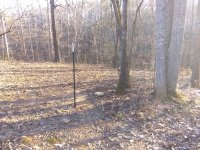
In the pic below, the fence post in the foreground represents the back right (if viewed from front of barn) pole. The fence post on the far left of the pic is the back left post. I plan to build a railroad tie retaining wall about two to three feet behind these, spanning across and beyond the wide of what will be the back of the barn. Wall will be approximately 3' high.

The two groups of hardwood trees are within about 4' and 6' of the fence post. My plan was to cut down the closer group of trees, and leave the oak on the right.

Any concerns, relative to the wall or the post hole drilling? I could move the entire barn structure and retaining wall location about 5' forward, without a signficant change in my plan. In fact, it will involve less fill. That's strictly an aesthetic consideration relative to the rest of our yard.

View attachment 684369

Question 2: Digging post holes. I have three tools for digging hole on hand. 1) Backhoe on my tractor (bucket width is 16"). 2) HF Predator powered auger with 6" bit, max digging depth about 24". 3) Shovel.

I need four foot deep holes, large enough to accomodate 6x6 posts. Obviously, the Predator auger is too limited. I could start with it, and hand dig the holes. I did that recently with a fence project. Could supplement with a manual post hole digger. But my back starts to hurt when I think about it.

Worried that I will remove too much dirt with the backhoe, even if skillfully applied.

I could splurge on an auger with 12" bit for my tractor, but I don't anticipate needing it often. I have no other pole buildings in mind that would require 6x6 posts set 4' deep. It would be an $800 piece of gear that would sit around 99.99% of it's life. Suppose I could sell it when done.

I could rent an appropriate piece of equipment (two man auger?).

I could pay someone to come with the right equipment and dig the hole.

Thoughts?
 
   / Pole barn project: Two questions #2  
I'd hire it out or get Saturday rental of skid steer or mini skid steer w/auger - no charge if used on Sunday also.
 
   / Pole barn project: Two questions #3  
You could dig them with the backhoe and use sonotubes then backfill...
 
   / Pole barn project: Two questions
  • Thread Starter
#4  
Might have a good solution to question 1: Checking with a Sunbelt rental about 25 miles from me that lists Cat 1 post hole auger for $67/day.
 
   / Pole barn project: Two questions #5  
I'd hire it out or get Saturday rental of skid steer or mini skid steer w/auger - no charge if used on Sunday also.

You must have different rental places by you. Around here 1 day rental is 8 hours on the machine's hour meter. And you can pick up at the end of the day, but it has to be returned by closing on Saturday or they charge you two days.

We dug my pole barn holes with a tractor backhoe until the tractor broke its frame after 9 holes. We rented a Kubota excavator to dig the remaining 5 holes. The excavator was much better at digging than the backhoe. Drilling was not a good option for us as CT is one big rock pit. Why do you think we have all those beautiful stone walls everywhere?
 
   / Pole barn project: Two questions #6  
For wind resistance, you really want the post holes to be neat and accurate, and in most cases in southern clay soil, you will need to backfill with dry concrete mix, as the clay spoils cannot be used for backfill. I think an auger is the best bet. If you dig the holes with a backhoe, they are going to be too large to practically backfill with concrete mix unless you have $$$.

I use a 12" auger and it's OK for 4x6 posts. For 6x6 posts it's tight. I usually drill the holes, then go back with a string and measuring tape to make sure the holes are perfectly centered. If not, I adjust with a handheld post hole digger.

The next thing to factor in is the required footing size. It will depend on the structure load and snow load, and the bearing pressure of the soil. You have to work the loads down to each post, then divide by the area of the footing. The pressure needs to be less than the soil bearing pressure. I normally design for 2000 PSF soil bearing pressure in our tidewater Virginia clay. Sometimes I can't meet that limit with a 12" diameter footing. I either need to widen the bottom of the hole (pain in the butt when it's a deep hole) or add more posts to spread the load out.
 
   / Pole barn project: Two questions
  • Thread Starter
#7  
The next thing to factor in is the required footing size. It will depend on the structure load and snow load, and the bearing pressure of the soil. You have to work the loads down to each post, then divide by the area of the footing. The pressure needs to be less than the soil bearing pressure. I normally design for 2000 PSF soil bearing pressure in our tidewater Virginia clay. Sometimes I can't meet that limit with a 12" diameter footing. I either need to widen the bottom of the hole (pain in the butt when it's a deep hole) or add more posts to spread the load out.

The soil is very hard packed red clay. I've augered holes nearby, and it's hard. I think 12" should be okay, but if the auger rental works out, and they've got a 14 or 16" bit, I'll opt for it.
 
   / Pole barn project: Two questions #8  
Strong second to renting a bobcat with an auger. I have an auger for my tractor but last summer I had 12 five foot deep footings to dig in summer-hard clay and rock. The bobcat can provide down-pressure and the oomph to dig through most of it. Here we can also rent over the weekend for the daily rate (as long as you don't go over 8hrs on the clock) which was useful as I ran into a rock layer in a few holes that I had to use a digging rod and sledge hammer to get through (and the bobcat was off the clock during that). I think it was $250, but it saved my back.
 
   / Pole barn project: Two questions #9  
If you inquire around you will likely find one or more people that dig holes flat rate depending on size,depth and soil. They generally have a skidsteer for conventional use then invest in an auger.
 
   / Pole barn project: Two questions #10  
The soil is very hard packed red clay. I've augered holes nearby, and it's hard. I think 12" should be okay, but if the auger rental works out, and they've got a 14 or 16" bit, I'll opt for it.

I don't think I have ever seen bigger than a 12" auger on typical PTO based augers (which lack downforce on a typical tractor), but skid steer units (which are powered by hydraulics and have downforce capability) come in 16" and larger sizes, and can dig pretty well. I think we used 16" pre-cast cookies on my barn and those holes were dug with a 20" skid steer unit, which made short work of it.

Surprisingly, the bearing capability of soil doesn't directly translate to the hardness. Our clay is almost impossible to dig by hand and is packed pretty hard down low, but tests at 1900-2200 PSF bearing capacity. In other parts of my property you can bust through the clay into soft sand, which is easy to dig. It tests much higher at 3000-4000 PSF bearing capacity. I think the bearing capacity is really based on the ability of the soil to easily compact and stabilize. The sand is pretty much self-compacting. Clay is difficult/impossible to compact, so it can't support as much load.
 
   / Pole barn project: Two questions #11  
When I read the OP's first post two things came to mind for me.
One was that any trees next to a building are going to be an issue sooner or later.
The second was having a retaining wall just 3 feet away from the building, to me that is just going to be a trap for leaves and debris
to gather in and cause troubles. Often around here a pole barn on un level sites is quite common I have seen many were the base was dug out
to floor level and ground contact treated lumber is used for the wall till a foot or two above the outside grade which is then backfilled to the original grade.
In effect reducing the outside wall height.
Also most of our pole barns require a concrete pad under the poles so the holes are 18-24 inch diameter with 6 inches of concrete poured and cured before the poles are set.
You can tell who didn't use footer pads in a few years the outside roof line has a wave in it from a pole or two settling.
 
   / Pole barn project: Two questions #12  
I couldn't get your link to open, so I'm just guessing about the trees. If a tree can drop a branch on a building, it will. Shade is nice from trees, but most of the time, they cause more damage then they are worth. I would remove every tree that is close to the building. A trees roots go out as far as the canopy, if you remove dirt under the canopy of the tree, you risk killing it. With some trees, just driving over the roots will kill it. Most trees take a couple of years to die, so when you are done building your barn, the tree will die the following year when it's a lot harder to remove it. In most construction, it is better to remove the trees and then plant new ones where you want them.

Railroad ties rot out from the inside and even though they still look good ten years from now, they will be full of bugs and become worthless very quickly. I would seriously consider using retaining wall blocks. They will never rot on you, and in worse case scenario that they fail, you just stack them up again and make your drainage better.

From what I know about 3 point post hole diggers on the back of a tractor, 3 feet deep is all you will get out of them. You can add an extension, but then it's hard to get the auger out and you are creating a lot more work having to take the auger off and on to install the extension. 3 feet is also about as far down as you can go with clamshells. the make a type that the handles are crossed so you can get deeper, but I've never used them and don't know how far you can go down with them.

If you absolutely have to go down 4 feet, then you will need a hydraulic auger attached to the front loader of a skid steer, or excavator. They are pretty common to rent on skid steers, I've never seen them for rent on an excavator.

The smaller you make the hole around the post, the stronger it will be. I would go 12 inches.

Dry concrete is probably fine to fill in around the posts, but I there is more strength in the concrete if you mix it first and then pour it in. Just don't add too much water. Mixing it allows all of the Portland Cement to spread through all of the concrete for maximum strength.
 
   / Pole barn project: Two questions
  • Thread Starter
#13  
Thanks for the extensive comments, gents.

Here's the tree pic again:

IMG_20210123_162944602.jpg

I can certainly remove the trees. I can also move the barn forward five or six feet.

Not sure on the wall construction. My one railroad tie wall is now ten years old, and it's 100% solid, except for a few bullet holes (backstop for a shooting berm). Could be really heavily treated ties, or they just don't see much moisture. Or maybe the microbes don't like lead? :)
 
   / Pole barn project: Two questions #14  
You must have different rental places by you. Around here 1 day rental is 8 hours on the machine's hour meter. And you can pick up at the end of the day, but it has to be returned by closing on Saturday or they charge you two days.
Around here, heavy equipment that has to be trailered, they deliver & pickup. Hour meter doesn't run when shut off setting posts - probably why weekend is just a daily rate for typical home owner rental.
 
   / Pole barn project: Two questions
  • Thread Starter
#15  
Heard back from the local rental franchise. Closest available PTO auger is 250 miles away. Best they've got for augering is a 2 man handheld unit with a 12" bit and an extension.

The search continues...
 
   / Pole barn project: Two questions #16  
Heard back from the local rental franchise. Closest available PTO auger is 250 miles away. Best they've got for augering is a 2 man handheld unit with a 12" bit and an extension.

The search continues...
They don't have a skidsteer mounted auger?
 
   / Pole barn project: Two questions
  • Thread Starter
#17  
They don't have a skidsteer mounted auger?

I asked the location manager to let me know what they had that could drill a hole 12 to 16 inches in diameter, four feet deep. The two man auger was the response I got.
 
   / Pole barn project: Two questions #18  
Where is this barn going in, where do you live? At least a third of Georgia was covered with the ocean so there is lots of sand. I live north of the fall line by 30 miles or more. I have lots of red clay, some rocks here and there and some black granite. Fortunately when I built the house and my 36x72 pole barn I did not hit any of that black granite. I graded the barn area. I marked 28 poles and used a 12" auger to dig. I think one hole was in the correct place. I hand scraped and practically redug some holes with a post hole digger with long handles and a 4 foot mark on the handles. A few months of weekend work and I had all my poles installed. 28 6x6 16 and 20 foot long 20 4x6 16 foot long. Yes the math is fuzzy as I do not remember if I dug the holes with the auger for the 4x6 at the same time I dug the 6x6 pole holes. Digging lots of holes toughened me up so tipping those poles in the holes by hand was just work. Some gravel in the bottoms of the holes before tossing the poles in. Lift the pole up and slam down a few times to compact. Measure, brace and plumb pole. Hand mix a few bags or more of concrete to set the pole. repeat again and again. i was off a 1/4inch if I recall correctly, maybe a half in on the 36 wide on one end but pretty square.

Digging holes now is easier with some soil moisture than in the middle of a draught.

A 30x36 could be just be 8-12 poles. If you do not have rocks, hand digging with a hand post hole digger is just a few days. I would find the local fence guy and have him or her dig your holes for $400 with their auger. The two man auger means you will make an enemy of a friend. Not a big fan of that tool.

The $800 auger from TSC can be sold afterwards for half price then you do not have it sitting around in your yard getting in the way.

My story of how I spent the summer of 1996 after watching some Atlanta Olympics. I think I was done by November or so. Pole Barn Building
 
   / Pole barn project: Two questions
  • Thread Starter
#19  
Where is this barn going in, where do you live? At least a third of Georgia was covered with the ocean so there is lots of sand.

N. Georgia, I-85 corridor, just before SC. Soil is firm, heavy red clay. Not much sand around here. My plan is a monitor barn. 16 poles. I'm not afraid of hand digging, if it comes to that. I'm not on a tight schedule.

Thanks for sharing the story of your build!
 
   / Pole barn project: Two questions #20  
Sounds like good building soil. Why do you have to go 4 feet down? Here in East Texas, I have red clay and 3 foot holes are plenty for posts. Nothing wrong with 4 feet, but that extra foot is going to be very difficult.

As for buying a 3 point auger, I didnt think I needed one, but I got a great deal on it when I bought my tractor, that I couldn't resist. Even though I might not use it for a year or 2, when I do have something come up, it becomes my favorite tool. My wife loved it for planting her fruit trees!!!!
 

Tractor & Equipment Auctions

2860 (A56857)
2860 (A56857)
1998 REINKE TRAILER HEAVY HAUL TRAILER (A58214)
1998 REINKE...
Massey Ferguson 4710 (A60462)
Massey Ferguson...
2018 RoGator 1100C (A61307)
2018 RoGator 1100C...
2013 FORD F250 (A60460)
2013 FORD F250...
2007 Ford F-150 Ext. Cab Pickup Truck (A59230)
2007 Ford F-150...
 
Top