Oil - Another "why" question

/ Oil - Another "why" question #21  
Yup.

5W-40 would be even better than 5W-30.

This is what I use in almost everything diesel, once the warranty has expired. Until then, I put whatever the manufacturer wants in it. After that 5W-40.

For gasoline engines, Mobil 1 EP. Over the years, the weights available have changed, but I always used the widest range available. Although there the routine is a little different. DW drives a lot for her business. Since 2004 we have gotten her a new Toyota Highlander which she has serviced at the dealer for the first 100K miles. Whatever oil they want. This takes about 4 years and she gets another one at that time. I inherit the old one. when I inherit it, I switch to Mobil 1 EP. I drive a lot less than she does, so one oil change per year that I do myself. When I get the 4 year old Highlander I pass on the older one which will typically have about 150k miles. So far, they are all still going strong. A family friend has the 2004, and while the electric windows have needed maintenance, the powertrain has been flawless. Not too bad for over 200k miles.

The 2000 F 150 still runs, although it is pushing 200k miles and has developed a lifter tick. It has had Mobli 1 all its life. As soon as the EP came out i switched to that.

Good oil is cheap compared to engine repairs. Is cheap oil as good as top price oil? I don't know, and for the price difference, I don't intend to find out.
 
/ Oil - Another "why" question #22  
I once had a motorcycle that would not start in the cold weather if I was not using the recommended cold weather oil.
The recommended summer oil was too heavy to allow the starter to spin fast enough in cold weather.
 
/ Oil - Another "why" question #23  
Not sure about this but I thought it had a lot to do with two things. Shear strength and bearing clearances.

If the load is high enough, the oil molecules will actually break (shear) and become less effective for lubricating. For example a rear end pinion gear will experience higher shear loads than a motor bearing hence 80w-90 gear lube vs 10w-30 motor oil. (There are other differences too of course between gear lube and motor oil. For example motor oil has to deal with combustion byproducts.)

The motor bearings are of the hydrodynamic type and have to be flooded with oil to work properly. They aren't "rubbing" bearings. So the viscosity would depend on the bearing clearances also. And the oil pump has to supply enough oil to the bearings in the first place. So the oil can't be too viscous.
 
/ Oil - Another "why" question #24  
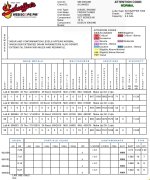
Well, if a XXw40 is better than a XXw30, my 2000 Detroit Series 60 with 540,000 miles on the factory reman sure doesn't agree. It regularly moves up to 80,000 lb of truck and cargo. Here is the last 4 oil samples from it. The three most recent are 10w30, the last on the list is a 15w40 I used previously.

Screenshot 2016-05-07_22-21-13.jpg
 
/ Oil - Another "why" question #25  
Not sure about this but I thought it had a lot to do with two things. Shear strength and bearing clearances.

If the load is high enough, the oil molecules will actually break (shear) ...

In mechanical engineering (also in rheology and tribology) shear has a different meaning than that.

...So the viscosity would depend on the bearing clearances also...

Viscosity is a property of the fluid composition and of temperature. Bearing clearances do not have any effect on viscosity. Now if you meant to say: "Recommended oil viscosity would depend on the bearing clearances also." I am in agreement.

But, and this is the part where the math gets very complex very quickly, once a viscosity improver is added to a base stock, viscosity can no longer be described with a simple number. A tensor equation is now required, analysis of even modestly complex situations requires a big computer, and our instincts are sometimes wrong.
 
/ Oil - Another "why" question #26  
In mechanical engineering (also in rheology and tribology) shear has a different meaning than that.

...So the viscosity would depend on the bearing clearances also...

Viscosity is a property of the fluid composition and of temperature. Bearing clearances do not have any effect on viscosity. Now if you meant to say: "Recommended oil viscosity would depend on the bearing clearances also." I am in agreement.

But, and this is the part where the math gets very complex very quickly, once a viscosity improver is added to a base stock, viscosity can no longer be described with a simple number. A tensor equation is now required, analysis of even modestly complex situations requires a big computer, and our instincts are sometimes wrong.
Your'e killing me! It's Saturday night.
 
/ Oil - Another "why" question #27  
And most of the time, the VI is what shears, not the oil itself.
 
/ Oil - Another "why" question #28  
I don't know anything about diesels so I can't comment on them. I thought that they produced higher shear loads. But it's pretty interesting what copperhead says. I was told by a very good mechanic that the engine bearing tolerances were tighter than they used to be due to improved manufacturing and so they needed lower viscosity oil to be able to flood the bearings.

I don't remember any auto manufacturers recommending Xw-40 oil since the 1980s. I didn't do a survey though. But all my modern vehicles, and small engines for that matter, say to use a lower viscosity. My 1993 Ford Windsor 5.8 has a sticker right on the motor that says to use 10w-30 oil. Of the six post 1990 vehicles I've owned, all have required lower viscosity than Xw-40. Spec'd out in the owners manual.

If 5w-40 is better than the other oils, then why don't any auto manufacturers recommend it?
 
/ Oil - Another "why" question
  • Thread Starter
#29  
If 5w-40 is better than the other oils, then why don't any auto manufacturers recommend it?

And down the rabbit hole we go....

This question was why I started this thread, see attached Duramax owners manual guidelines. 15w-40 is the "best" for your vehicle, however for very cold temperatures 5w-40 may be used. Both my tractor and my truck are 2006 and the tractor service guidelines do not even acknowledge 5w-40 oil exists. I have run both 15w-40 Dino and 5w-40 Synth in my truck and there was no significant difference indicated between the oil analysis.
 

Attachments

  • Chevy.JPG
    Chevy.JPG
    68.3 KB · Views: 197
/ Oil - Another "why" question #30  
I have read literally hundreds of articles and reviews on oils and still can't seem to get my brain around the logic of using a heavy weight oil for hotter outside air temps. Why would you use 10w-30 for -20F thru 100F and 15w-40 for -10F thru 120F? I understand the lower cold startup winter weight however the operating weight makes no sense to me as the engine operating temp is well over the outside temp once the engine warms up to, let's say, 180F for discussion. If 10w-30 is ok for a warm engine why recommend 15w-40? My guess is it was nothing to do with outside air temperature and more do with them hedging against the quality of chemicals used to modify the viscosity to increase the span between winter and operating weights. SO, based on this assumption my take-away is if you always use a high quality oil "Brand X" than 5w-40 is the best choice for all situations.

Anyone see this differently?
To understand the way outside temps affect an engine is really simple, just take the human body for instance, a marvelous engine in itself, it burns fuel to make heat and energy just like an internal combustion engine. SO take your human engine to the wood pile and start chopping wood when it is 40F and compare your body temp to what it is if chopping wood at 100F. You would see that you could run your human engine much longer at 40F without overheating than you can at 100F. There isn't much difference in our bodies from an engine, both require fuel, air and water for coolant and if you run out of either, your engine stops.
 
/ Oil - Another "why" question #31  
The dumbed down way I've always understood it (and I could be wrong so hopefully someone else will correct me) is that 5w40 oil is 5 weight oil that acts like 40 when at normal operating temps. To do this they add stuff to make the oil "thicker" than it really is. But those additives don't act in a linear fashion. So as the oil gets beyond it's normal range the oil doesn't continue to get "thicker". That's why your chart stops at a lower temp for the Xw30 weight oil vs the Xw40 weight oil. When the outside air temp is hotter it's assume that the internal oil temp will also be hotter. It may be a broad statement as things like oil coolers will help reduce the temps it's better to assume worse case than best case.
 
/ Oil - Another "why" question #32  
Actually, no. The number in front of the "w" is the winter flow rating and not the same as a weight rating. It is more about flow rate at a given temp. Weight rating (the number after the 'w") has to do with molecular composition and working kinematic viscosity. And it is a corresponding thing to High Temp High Shear (HTHS) rating. For instance, a typical 40w oil has a HTHS rating of around 4.5, whereas a typical 30w oil has a HTHS of around 3.7. Many confuse the cold flow rating with a weight rating.

There are some high end synthetics that can have a low cold flow rating and use no viscosity improvers to be the weight rating. A lot of high end 10w30 oils are literally a straight weight 30 oil that has a cold flow rating of 10.
 
Last edited:
/ Oil - Another "why" question #33  
To understand the way outside temps affect an engine is really simple, just take the human body for instance, a marvelous engine in itself, it burns fuel to make heat and energy just like an internal combustion engine. SO take your human engine to the wood pile and start chopping wood when it is 40F and compare your body temp to what it is if chopping wood at 100F. You would see that you could run your human engine much longer at 40F without overheating than you can at 100F. There isn't much difference in our bodies from an engine, both require fuel, air and water for coolant and if you run out of either, your engine stops.
Hi Gary, not a bad analogy!
 
/ Oil - Another "why" question #34  
The problem with the analogy (for the purposes of the oil discussion here), is that an engine operates at a controlled sustained temperature range whether the outside temp is -40F or 110F. True, the body will cool via perspiration, but that eventually runs out without replenishment and is not as effective in high humidity. Engine cooling is a totally different concept. And on HD working engines, gas or diesel, the oil is kept at approximately the same temp as the coolant flowing thru the motor. Whether my Detroit Diesel has a 40w or a 30w oil in it, whether I am hauling something in MN in the dead of winter or in TN in the heat of summer, the temp of the oil is staying within a few degrees of the coolant temperature which is controlled by thermostat. Even the oil cooler has a thermostat. And since one of oil's primary tasks within an engine is cooling, generally a lighter viscosity oil will shed heat via the cooler a little better than a higher viscosity oil. So, the idea of the thicker viscosity for hot weather is negated.

The analogy might correspond better to a air cooled engine.
 
/ Oil - Another "why" question #35  
The problem with the analogy (for the purposes of the oil discussion here), is that an engine operates at a controlled sustained temperature range whether the outside temp is -40F or 110F. ......on HD working engines, gas or diesel, the oil is kept at approximately the same temp as the coolant flowing thru the motor.

On an HD diesel with separate oil cooling thermostat, fully engineered for constant towing thermal loads, yes, I see what you are saying. But in almost every automotive or pickup engine, the oil is going to be hotter when operating in summer ambient temps vs winter. It's that simple. The oil lines, filter housing, cooler, and even the block itself are all radiating heat away. They can do this less effectively in hotter ambient temperatures. So, the oil will be thinner. Thus, thicker oil recommended for hotter ambient temperature operation... nothing really to debate here.
 
/ Oil - Another "why" question #36  
I don't know anything about diesels so I can't comment on them. I thought that they produced higher shear loads. But it's pretty interesting what copperhead says. I was told by a very good mechanic that the engine bearing tolerances were tighter than they used to be due to improved manufacturing and so they needed lower viscosity oil to be able to flood the bearings.

I don't remember any auto manufacturers recommending Xw-40 oil since the 1980s. I didn't do a survey though. But all my modern vehicles, and small engines for that matter, say to use a lower viscosity. My 1993 Ford Windsor 5.8 has a sticker right on the motor that says to use 10w-30 oil. Of the six post 1990 vehicles I've owned, all have required lower viscosity than Xw-40. Spec'd out in the owners manual.

If 5w-40 is better than the other oils, then why don't any auto manufacturers recommend it?
I don't have data to prove my theory but I think the use of xxW-30 oils in newer cars is just so they can get another MPG out of the engine so they look good to the consumer and most importantly to the FEDS mandated higher mileage cars.
I don't think it has anything to do with bearing clearances. The oil molecule is still the same size regardless of the Weight of the oil. 5W-30 and 5W-40 will have the same cold start properties which is where 99.9% of your engine wear occurs.
 
/ Oil - Another "why" question #37  
That's absolutely right, Gary. At work we ran an engine on some 0W16 oil the other day for dyno testing. It was almost clear and poured like water. Kinda freaky pouring it into the engine, but the engine didn't seem to know the difference.
 
/ Oil - Another "why" question #38  
Yes, the low weight oils such as 0W20 are used mainly for the 0.01 MPG increases it produces. It might be 0.04 MPG for all I know, but they are trying everything in the book to increase CAFE.
 
/ Oil - Another "why" question #39  
I don't have data to prove my theory but I think the use of xxW-30 oils in newer cars is just so they can get another MPG out of the engine so they look good to the consumer and most importantly to the FEDS mandated higher mileage cars.

Roger that.

I helped a lady select oil for her late model Mazda car a while back. She mentioned that she thought it need 5W30.... I had a look at her Owner's manual..... turns out that she had flipped to the page that listed the viscosity for use in Mexico.

USA spec for that car was 0W20, including Puerto Rico...... must be due to that night and day difference in climate between Puerto Rico and Mexico :rolleyes:

Rgds, D.
 
/ Oil - Another "why" question #40  
On an HD diesel with separate oil cooling thermostat, fully engineered for constant towing thermal loads, yes, I see what you are saying. But in almost every automotive or pickup engine, the oil is going to be hotter when operating in summer ambient temps vs winter. It's that simple. The oil lines, filter housing, cooler, and even the block itself are all radiating heat away. They can do this less effectively in hotter ambient temperatures. So, the oil will be thinner. Thus, thicker oil recommended for hotter ambient temperature operation... nothing really to debate here.

Oil viscosity is determined at 100C. Viscosity is not thickness. Viscosity is technically friction. Yes, oil has friction, as do all liquids. Ask Isaac Newton in the next life and he'll let you in on it. The higher the viscosity, friction is also higher, and the heat generated by the friction is higher as well as the energy expended to move a heavier oil around the engine and overcome the higher friction. What is really telling about an oil is the High Temp High Shear (HTHS) rate that it has. A typical 30w can perform equally with a 40w if it's resistance to shear is good. I have seen 15w40w oils shear more than 10w30w oils in oil samples from engines under working loads. Most of what you are talking about was important back when there were only conventional oils on the market. Modern high end conventionals, syn blends, and full synthetics with the right add packs can be very resistant to shearing so that the old methodology of needing higher viscosity oils under high load and high heat has been effectively eliminated. Even racing engines are moving to lower viscosity oils because of that.

And taking this into account, yes, the ability for lower viscosity modern oils to meet the needs of engines has provided the means to also tweak out some better fuel efficiency. Lower viscosity, less friction means better fuel economy. The OEM's and the EPA are just taking advantage of the technology that makes up modern oils. But old habits die hard. There are still those that swear by 3000 mile oil changes too.
 

Marketplace Items

Meyer 8' Snow Plow w/ Bracket (A55272)
Meyer 8' Snow Plow...
2014 Glasstream 360 SCX Twin 400R Mercury's with Triple Axle Aluminum Trailer (A59231)
2014 Glasstream...
2000 Morbark Towable Brush Chipper (A59228)
2000 Morbark...
2017 Toro Workman HDX-D Diesel Utility Cart (A59228)
2017 Toro Workman...
2017 Scag Cheetah 61in Zero Turn Commercial Mower (A59228)
2017 Scag Cheetah...
2020 DRAGON ESP 150BBL ALUMINUM (A58214)
2020 DRAGON ESP...
 
Top