Off-Grid Solar Setups

/ Off-Grid Solar Setups #1  

Got2BTru

Silver Member
Joined
Mar 29, 2013
Messages
216
Location
Verona, NY
Tractor
Mahindra 2555 HST CAB
Starting a thread as I was unintention hi-jacking another (Grid-Tied Solar) and didn't want to do that!

We purchased 32 acres 2 years ago & would *like* to start building. While I'm still figuring out the house logistics (could that be another thread?) as to whether or not to build with SIPs or another method, I've run into an issue with getting electricity to the house. Our utility company in NY is National Grid and they've tentatively given me a $25k number for running electrical from the road, 1300 feet to where we'll put the house. They won't give me a FIRM number until I have some sort of structure built on the property (which seems kinda ***-backwards to me).

With Federal, State & Local rebates I was wondering about going off grid completely with a battery system. My initial findings was that the batteries weren't even lasting 10 years, which made the setup very cost-prohibitive if I had to replace the batteries every 7 years or so. The Tesla Power Wall came out & they guarantee nothing more than 8% loss at 10 years, which would *seem* to me to mean that it should last longer.

Our current temporary house is 120 years old and we use 13,000 kwh per year or 1083 kwh per month. But that's on an OLD home with very little insulation, etc. We're hoping to build with SIPs or closed cell spray foam at the very least, so figuring that along with LED lights energy efficient appliances, a propane stove and dryer, it should all add up to considerably less usage. I'm also looking at hydronic radiant floor heating. Cooling is my biggest concern, though in CNY, we're talking all of 3-4 months and it's not run constantly.

Thoughts, issues, concerns? Anyone already doing this or looking into this?

Here's our land in case anyone is curious...the black outline is ours. I don't have a current areal picture of the driveway we put in last year, sorry!
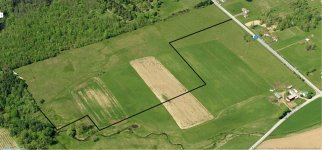
Blackmans' Corners Land Areal with lines.jpg
 
/ Off-Grid Solar Setups
  • Thread Starter
#2  
From the other thread, I found this comment interesting:

25K for 1300 ft of feed line seems to be way high. You can rent ditch witch or excavator and install a conduit by yourself and let them only pull the cable. Isn't the utility is required to provide free hookup to certain length and you pay only for the extra distance? Our house required about 500 ft of power line and transformer. Installed for free by the utility.

I was wondering if I could rent the ditch witch and do the work myself, if that would lower the cost, but I'm just not ready for that conversation yet with the utility company.
 
/ Off-Grid Solar Setups
  • Thread Starter
#3  
I'm curious..... what real world life-spans on battery banks are you seeing discussed ? I'm a few years away from setting up my bank, so haven't done the ton of reading needed to get an accurate picture....

To guarantee 92%, a company like Tesla will have some life-span margin built in, so those should perform well over time.

With a more conventional battery, it comes down to simple maintenance - clean/coat the terminals, check electrolyte levels. I typically get 10+ years out of car batteries doing that, while the average lifespan around here (zero maintenance) is more like 5 years. Any battery system will have reduced output if terminal corrosion sets in.

Given decent maintenance, I'd expect to get more than 10 years out a good quality industrial conventional battery in a stationary application. My preference would to have the batteries in higher voltage strings (say 48v), and maintain each string above a certain capacity - say 80% of original rating. That way you are not replacing the entire bank at once, and still retaining useful capacity.

Rgds, D.

I was reading other solar forums and they indicated that battery life span is the biggest (and most costly) issue / concern.
 
/ Off-Grid Solar Setups
  • Thread Starter
#4  
Battery life depends on discharge depth . A bank of 1000amp hours of batteries discharged with 250amp hr load . Will last much longer than a 300amp hr battery bank discharged with 250amp hr of load.
Most of the time short battery bank life is due to chronic under charging and chronic over discharging .

This is where I have MUCH to learn!
 
/ Off-Grid Solar Setups #5  
I think the key is where you are heading - reduce total kwh usage and limit the peak usage.
My house in sc KS we average ~ 1500kwh/month in a SIP house (timber frame with SIP walls/roof). Our peak months have been 2025 kwh (July - Sept) and min months have been 1278 kwh. During the min months we used no electricity for heating or cooling, so this is a good indication of our power consumption for "other" purposes, cooking, lighting, well pump, DHW, etc. What I don't know is how much of this use is during hrs the sun does not shine - I expect that it is considerable %.

Our house is total electric - which around here has been good as I have a total yearly bill for electricity that is less than several neighbors winter propane bill! Also their electricity bills in winter is similar to mine even though they are not using electricity for heat - we get good solar gain, use combination of mini-split and GSHP (next house will be mini-split only)

As for SIP's, I like ours, but not sure this is what I will use on the next house (yes I like building and will do it again). Key factor is cost and a desire for higher levels of r-value than what is economically viable with SIP (but it was fun going from foundation to enclosed structure in 3 days!)
 
/ Off-Grid Solar Setups
  • Thread Starter
#6  
OK, so I'll bite...what gives a higher r-value than a SIP?
 
/ Off-Grid Solar Setups #7  
OK, so I'll bite...what gives a higher r-value than a SIP?

ICFs, insulated concrete forms. Plus you get the thermal mass of the concrete and it's literally bullet proof.

Could you put a 6'x6' hunting blind up and tell them you want to run power to it. It would be a structure so that you could get a hard estimate.
 
/ Off-Grid Solar Setups #8  
What I am working on is a wall that would use double stud with deep cavity between filled with cellulose or BIB fiberglass, or a more standard 2 x 5 wall with with several inches of foam on exterior - this can provide what ever r-value you want (climate zone dependent) but at lower cost than the SIP will.

In my case I am planning to do much of the work/labor myself so buying components comes out significantly lower cost than the SIP cost and the labor to instal the SIP along with crane.
That said I do like my SIPs, so this only works if I save significant $'s.

My current house has r24 walls and r40 roof. Goal for next house is >R30 walls and ~ R55 roof - this can be done with SIP's but very costly.
 
/ Off-Grid Solar Setups #10  
I looked into that wall when building my current house - cost was a bit higher but not crazy so, but there is no near by distribution nor manufacturing site, so transport cost nixed it. I did talk with them and they do have abilities to support point loads that come from the timber frame above
 
/ Off-Grid Solar Setups #11  
One thing to look at though is any thermal bridging in the product - in NY the ground will get cold and you will need high r-value in the foundation (especially near top of walls) - the Xi+ seemed to have higher levels of insulation as well as some option to insulation the foundation as I recall.
 
/ Off-Grid Solar Setups #12  
My brother lives in Europe. His house has, I think, about 9" brick wall inside and about 6" of closed cell Styrofoam outside. Triple pain windows. Since the heat source is air/liquid heat pump he had AC put in upper rooms but that is a luxury not common in that climate. He told me that unless it gets very cold for long just the fridge and lights will keep the house reasonably warm.

Spending 25k for power feed line is quite high. They can put the transformer by their pole and you could install the 240 feed by yourself for way less money. Our PV system is about 1000ft from the connection point. I bought direct burial cable calculated for 2V drop at 100A for about 1000 USD on ebay, the disconnect and ditchwitch rental added about another 500 USD.

Battery energy storage is still immature technology. But you can store energy in example in liquid. When the house doesn't require heat or AC the heat source (presumably heat pump) could be directed to heat or chill liquid. Since heating and AC are the biggest energy users they will use stored hot/cold liquid allowing for smaller battery.
That is something I am thinking about because we don't have net metering. When we supply energy to the grid we get paid 3.5 cent and when cloud goes over the sun we are charged 11.5 cent per kWh. It would be advantages for us to limit supply energy to the grid and use stored energy when sun is not shining.

We have 100% electric house but because our PV can't be "islanded" when power grid goes down we have two propane fireplaces for heat backup.
 
/ Off-Grid Solar Setups #13  
Another approach to cutting a house's energy footprint is earth berming. A house with thick brick walls, earth berms, or one that is sealed to Passive Haus standards has virtually no air infiltration through the walls. That is as important as the R-value of the wall.

Besides cutting air infiltration to zero, earth berms replace ambient outdoor air temperatures with ground temperatures. Ground temps in winter can be 50-60 degrees warmer than air temps in northern climates.

Preventing frost penetration into the ground near the foundation is accomplished with 2-4 inches of Styrofoam sheets laid out as a apron surrounding the exterior walls--very much like a shallow frost-protected foundation is done. That can be combined with ICF walls or by using foam on the exterior of a poured concrete wall. The end result is no air infiltration, reasonable R-values for exterior walls, and a very low delta between the exterior and interior temperatures which means the rate of heat exchange between them will be very low.
 
/ Off-Grid Solar Setups #14  
Yep there are many different ways to solve this problem - your point on air-sealing is top priority (which SIPs installed properly do a very good job). Earth berm is very effective but may have esthetic issues depending on style of home.

The key for off-grid though is minimizing peak then total demand. the individual has a similar issue as the power company in that they need to build infrastructure to allow for the peak demand (and pay for it) - the individual though has considerably more control on their own homesite.
 
/ Off-Grid Solar Setups #15  
We have 100% electric house but because our PV can't be "islanded" when power grid goes down we have two propane fireplaces for heat backup.[/QUOTE]

Do you have any battery or just use the grid for backup electicity now?
 
/ Off-Grid Solar Setups #16  
An off-grid PV system just does not seem to me like a viable alternative for the area you are looking at. PV systems work OK for applications where the primary demand is cooling because their output peaks when the demand is highest. Just the opposite is true for an area like CNY where the primary demand is heating. The maximum demand comes at times like at night in the winter when the PV array output is essentially zero.
 
/ Off-Grid Solar Setups
  • Thread Starter
#17  
For heating, we're LOOKING at going strictly with hydroponic radiant floor (no HVAC) - it's a solar based system and would be really efficient.

....but that leaves me with how we cool the house for the relative little we need to in the summer.
 
/ Off-Grid Solar Setups #18  
This is the third in a series of articles about the Tesla Power Wall and batteries in general for solar systems. The battery article is near the bottom of the web page, so scroll down. There is some good introductory info on whose products and what is needed to integrate the Tesla battery into a solar pv system.

ReVision Energy ? Growing Power at Eastman's Corner, the Future of Batteries
 
/ Off-Grid Solar Setups #19  
Yep there are many different ways to solve this problem - your point on air-sealing is top priority (which SIPs installed properly do a very good job). Earth berm is very effective but may have esthetic issues depending on style of home.

The key for off-grid though is minimizing peak then total demand. the individual has a similar issue as the power company in that they need to build infrastructure to allow for the peak demand (and pay for it) - the individual though has considerably more control on their own homesite.

Very true. Earth berms do a lot to dictate the stlye of home built. If ya don't like it, and many do not, it's a non-starter. :D

We are very happy with our earth berm, passive solar house built in 2006. Except for the range propane cooktop, 45-50 gallons of propane/year for some hydroponic floor heat, and ~1.5 cords of wood, our house is all electric. Our average monthly usage is 585 kWh over the past year. That includes using our two mini-splits as needed for AC and occasionally a little heat. Obviously we aren't big electric users and it's just the wife and I. Our AC load is not very demanding in our climate which helps a lot.
 
/ Off-Grid Solar Setups #20  
I'm interested in reducing the draw so a battery system could get through the night. Example; Say I take a shower at night, I'd like the hot water heater to delay recovery until PV system is working to cover recovery rather that tax battery all night while it's running AC or heat? Same with a well pump, no need to fill cistron at night under battery. How can all that be managed. HS
 

Marketplace Items

2008 DOOSAN G25 GENERATOR (A58216)
2008 DOOSAN G25...
2020 CHEVROLET SILVERADO CREW CAB TRUCK (A59823)
2020 CHEVROLET...
(APPROX. 25) 4' X 8' X 3/4" OSB SHEETS (A52706)
(APPROX. 25) 4' X...
402 (A52706)
402 (A52706)
500 BBL FRAC TANK (A58214)
500 BBL FRAC TANK...
2018 PJ Trailers 14ft T/A End Dump Trailer (A59230)
2018 PJ Trailers...
 
Top