Moldboard plow?

/ Moldboard plow? #1  

redka

Silver Member
Joined
Feb 27, 2008
Messages
204
Location
Middle GA
Why a moldboard plow? I see that it cuts and rolls over the soil from 12"-16" deep. But why does the farmer need to do that? Just trying to learn something.
Obviously I don't farm. Been doing a few acres of food plots for a few years, using subsoiler and disk harrow. Thanks.
 
/ Moldboard plow? #2  
Why a moldboard plow? I see that it cuts and rolls over the soil from 12"-16" deep. But why does the farmer need to do that? Just trying to learn something.
Obviously I don't farm. Been doing a few acres of food plots for a few years, using subsoiler and disk harrow. Thanks.

Moldboards were one of the 1st plows going back before tractors. The plow turns the soil, burries "trash", manure, sod etc. Depending on soil type it may not be needed. I have several friends that farm and haven't used a moldboard in many years. They do have some trouble going from corn to grass only due to it's hard to burry the trash without one.

Your depth is kinda deep, at least around here it may be 8-12" deep.
 
/ Moldboard plow? #3  
Why a moldboard plow? I see that it cuts and rolls over the soil from 12"-16" deep. But why does the farmer need to do that? Just trying to learn something.
Obviously I don't farm. Been doing a few acres of food plots for a few years, using subsoiler and disk harrow. Thanks.

The 12" - 16" is the width of the plow bottom. Average depth is around half of the width. Most do not go deeper than 7- 8".

Depending on the soil type and crop rotation we still see some being used here in northern IL, an Southern, WI.

Roy
 
/ Moldboard plow?
  • Thread Starter
#4  
Thanks.
oldnslo, I had looked at some plows on sale sites out of curiosity, and they always gave measurements..I was thinking depth. Thanks for the clarification.
 
/ Moldboard plow? #5  
"Ditto" what JasG said. In addition, A moldboard plow plowing at 6-12 inches deep, in the fall or early spring before seeding, will hold moisture from rain and snow, thus build ing a bank of subsoil moisture for your crops to pull from during a dry spell in the growing season. Ken Sweet
 
/ Moldboard plow?
  • Thread Starter
#6  
"Ditto" what JasG said. In addition, A moldboard plow plowing at 6-12 inches deep, in the fall or early spring before seeding, will hold moisture from rain and snow, thus build ing a bank of subsoil moisture for your crops to pull from during a dry spell in the growing season. Ken Sweet

Thanks.
 
/ Moldboard plow? #7  
redka said:
Why a moldboard plow? I see that it cuts and rolls over the soil from 12"-16" deep. But why does the farmer need to do that? Just trying to learn something.
Obviously I don't farm. Been doing a few acres of food plots for a few years, using subsoiler and disk harrow. Thanks.

Moldboard plows are great for turning up roots, burying stuff on top the soil and creating the beginning of a seedbed. They also can lead to a hard pan in the soil, if the soil is heavy with moisture when plowed. It is not easy to moldboard plow a field and not change the contour of the land. I still have a few spots 35 years later that hold water from my early plowing, learning days.

One thing to remember on one way plows: the right tire goes in the plow furrow and the left tire goes on the unplowed ground.

That one lesson sometimes didn't take with new hired men who were plowing for the first time. One guy just made a series of ditches on 10 acres that took quite a while to fix.
 
/ Moldboard plow? #8  
Why a moldboard plow? I see that it cuts and rolls over the soil from 12"-16" deep. But why does the farmer need to do that? Just trying to learn something.
Obviously I don't farm. Been doing a few acres of food plots for a few years, using subsoiler and disk harrow. Thanks.

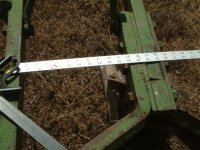
You'll see 12", 14", 16" and 18" moldboard plows. Here's my John Deere 2-14 plow- 2 plow share assemblies, 14" between the plows (i.e. the width of the furrows, or cuts, made by the plow is 14").

DSCF0046 (Small).JPG

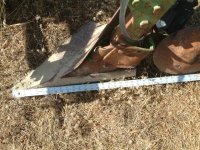
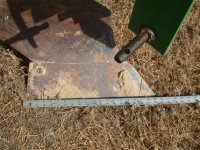
The bottom part of the plow is called the share (or plowshare) and is about 20" long on my JD plow. The share attaches to the moldboard

DSCF0047 (Small).JPG

DSCF0048 (Small).JPG
 
/ Moldboard plow? #9  
I was probably about 12 years old when I visited a cousin for a week in northern Oklahoma. My uncle was the old time farmer; 2 or 3 sows and a boar for raising hogs, probably 100 chickens, milked a dozen or so cows and used a separator to extract the cream to be sold, fed the "blue john" (milk after the cream was removed) to the hogs and chickens, had 100-150 head of beef cattle, raised, cut, baled his own hay, and his main money crop was wheat. He had 2 Case tractors and I was there when the wheat fields were being plowed to plant the wheat. Each tractor pulled a 2-bottom moldboard plow and a "section harrow" (spike harrow) was pulled on a chain behind the plows. I haven't seen a real farmer use a moldboard plow in a long time.
 
/ Moldboard plow? #10  
One thing to remember on one way plows: the right tire goes in the plow furrow and the left tire goes on the unplowed ground.

That one lesson sometimes didn't take with new hired men who were plowing for the first time. One guy just made a series of ditches on 10 acres that took quite a while to fix.

This depends on the size of the plow and also does not matter if the plow is a one way or a 2 way (Roll over or swing type). The plow will be refered to as a "in furrow", or "on-land". Usually 6 btm's and less are in furrow which yes 1 wheel is in the furrow from the last pass. These can be 3 point, semi mounted or trailed type mounts.

On-land moldboard plows none of the tractor tires are in the furrow and the ones I have seen the tractor can have duals on the furrow side of the plow due to none are in the furrow. These are usually 5 btms and larger. These can be semi, or trailed mounts.
 
/ Moldboard plow? #12  
We use a 3tm 3pth Kvernland 14" plow to turn over sod when we are replanting a hayfield. A couple years ago a neighbor found a "disc" plow at an auction that we use quite a bit. It has 3 large 24" disks mounted just like a moldboard plow and it will slice and turn over sod and does a slick job on roots, poison ivy and raspeberry bushes. What we've been doing is disc plowing a field, disc harrowing it, and planting barley or millet for a year. Then running a 3 btm plow, disc harrow, and culti packer and a brillon to replant as a hayfield.
The corn guys around us are split between min till and full till. We have a pretty short growing season and lots of rocks in the fields.
 
/ Moldboard plow? #13  
Kverneland are the bees knees as ploughs go but ploughing does not suit all soil types as here . Just far too heavy land, Although we are heavy till only ever working the top 4 inches in the fall several times and seed direct in the spring . -35 takes care of compaction .
 
/ Moldboard plow? #14  
We use a 3tm 3pth Kvernland 14" plow to turn over sod when we are replanting a hayfield. A couple years ago a neighbor found a "disc" plow at an auction that we use quite a bit. It has 3 large 24" disks mounted just like a moldboard plow and it will slice and turn over sod and does a slick job on roots, poison ivy and raspeberry bushes. What we've been doing is disc plowing a field, disc harrowing it, and planting barley or millet for a year. Then running a 3 btm plow, disc harrow, and culti packer and a brillon to replant as a hayfield.
The corn guys around us are split between min till and full till. We have a pretty short growing season and lots of rocks in the fields.

The "Disc Plow" is probably the best tool for New Ground or soil with a lot of roots. I bought this 2 10 inch Ford from a fellow that was using it in roots and he has slightly notched the blades to make it even more effective in the roots. This is the smallest Disc plow that I have seen. Ken Sweet
 

Attachments

  • ford2-discplow-furrowwheelniceback895.JPG
    ford2-discplow-furrowwheelniceback895.JPG
    80.9 KB · Views: 567
  • ford2-discplow-furrowwheelnicefront895.JPG
    ford2-discplow-furrowwheelnicefront895.JPG
    80.4 KB · Views: 381
/ Moldboard plow? #16  
We collect a few Farmall Cubs and dad has always told me of the mid mount disk plows they had for new ground as a kid. He got a new gard spot and was wanting to open it up a bit. I was in Cullman AL and on a n old equipment yard ad found one in great shape. I bought it for dad Bday for 150 bucks and cleaned it up and painted it. I was amazed when dad brought me some 3 inch gum roots he cut like butter. He also turned under my tall thick cover crop of oats. and some wild grasses and stalks that would have plugged my 2 bottom Ferguson plow.
 
/ Moldboard plow? #17  
Taylortractornut said:
We collect a few Farmall Cubs and dad has always told me of the mid mount disk plows they had for new ground as a kid. He got a new gard spot and was wanting to open it up a bit. I was in Cullman AL and on a n old equipment yard ad found one in great shape. I bought it for dad Bday for 150 bucks and cleaned it up and painted it. I was amazed when dad brought me some 3 inch gum roots he cut like butter. He also turned under my tall thick cover crop of oats. and some wild grasses and stalks that would have plugged my 2 bottom Ferguson plow.

Sure would be great to see a picture of that device. Sounds impressive.
 
/ Moldboard plow? #18  
Ken, I'm impressed most people have absolutely no idea what I'm talking about with the Disc plow. The one we use is an Atlas. And you right I've never seen a plow that can handle brushy conditions like it. Usually I get the worst case of poision ivy in the spring trying to untangle roots from a plow, but that thing just slices and dices them. Also it seems the faster you pull it the better it does. Not the best tool for rocky fields I broke one disc last year. For a moldboard plow we have to run auto resets. Or you spend as much time backing up to reset as you do driving forward.
You don't happen to have a 3 or 4 btm disc do you? Seems like they where popular for a bit in the 40s and 50s and dropped out of fashion quickly.
 
/ Moldboard plow? #19  
Ken, I'm impressed most people have absolutely no idea what I'm talking about with the Disc plow. The one we use is an Atlas. And you right I've never seen a plow that can handle brushy conditions like it. Usually I get the worst case of poision ivy in the spring trying to untangle roots from a plow, but that thing just slices and dices them. Also it seems the faster you pull it the better it does. Not the best tool for rocky fields I broke one disc last year. For a moldboard plow we have to run auto resets. Or you spend as much time backing up to reset as you do driving forward.
You don't happen to have a 3 or 4 btm disc do you? Seems like they where popular for a bit in the 40s and 50s and dropped out of fashion quickly.

This is all I have currently. Ken Sweet
 

Attachments

  • athens2-discplowscrappers-jackstandside895.JPG
    athens2-discplowscrappers-jackstandside895.JPG
    135.3 KB · Views: 350
  • fergusondiscplowfront695.JPG
    fergusondiscplowfront695.JPG
    41.3 KB · Views: 243
  • moderndiscplow5discweightboxside795.JPG
    moderndiscplow5discweightboxside795.JPG
    129.6 KB · Views: 342
/ Moldboard plow? #20  
Got to put my 2-cents worth in here since I plowed a lot of land with a 2-14 plow behind a JD tractor when I was growing up. Everybody used moldboard plows then. One man I knew made a living just sharpening plow shares for farmers.
For a person who has never plowed with a moldboard plow, but is now going to start, there are two important points: the plow must be adjusted to where each share is cutting at the same depth. Too complicated to describe here on how to adjust the plow - just stop out in the middle of the field and carefully dig with a square-point shovel, behind the plow, down to the depth of the cut of each plowshare. If you dig carefully, keeping the shovel level, you'll easily see how much is needed to adjust the plow depth-levers to get an even cut.
Second, you must be careful to establish "live furrow" (where the dirt, on the second trip through the field, is thrown up against the dirt from the first trip through the field) and the "dead furrow" (where the plow, being pulled in one direction, is up against freshly turned dirt on its left side, leaving a "ditch" type appearance in the field. It is every important that the next plowing (next year?) of the field be started by plowing a "live furrow" over the top of the old "dead furrow". This keeps the ground across the field level. And, if a real good job of plowing is done your new plowing of the field will result in the new "dead furrow" being done at the same location of the old "live furrow"
 
 
Top