jeff9366
Super Star Member
- Joined
- Jan 14, 2011
- Messages
- 12,787
- Tractor
- Kubota Tractor Loader L3560 HST+ ~~~~~~~~~~~~~ 3,700 pounds bare tractor, 5,400 pounds operating weight, 37 horsepower
I learned a lot from Farmwithjunk's posts on selecting and adjusting Moldboard/Turning Plows.
Here is a selection of Farmwithjunk's Plow posts I found useful. I copied Farmwithjunk's individual posts from T-B-N into 'Word' then pasted the consolidation back into T-B-N, therefore the posts are not in context, necessarily. This is somewhat a work in progress as T-B-N would only let me search 2,114 of Farmwithjunk's 3,773 posts in the T-B-N archive, today.
Farmwithjunk has had health issues and is not posting on T-B-N any longer.
Best Wishes, Farmwithjunk!
Re: Bottom plow for a 24 HP tractor
Originally Posted by Foton404
Coming back in to address schism's comment about plowing half as deep as the moldboard's width.
8" is pretty deep. Regardless of each moldboard's witdth, a 16" can work o.k. at 6" or 7". My early youth was spent on a Super H Farmall, about 25 hp and pulled a 2-16" pull type plow in all going. This included gumbo and hard clay soil. 25hp is enough. Traction is the problem. FWD is a must with a compact tractor.
Plows are MEANT to plow @ 1/2 the bottom width. (ie, 8" deep for a 16" bottom.) Generally there's a + or - of 1". (ie, 16" plow works well at 7" to 9" deep) 6" deep with a 16" bottom is far too shallow. That'll result in a thin ribbon of dirt that often rolls more than 180 degrees, ending up with "green side up" again.
25 HP will pull 2X16"'s with enough weight and at a VERY slow speed. Most plows designed and built after the mid 50's are "high speed plows", meant to plow at speeds above 4mph to as much as 5-1/2mph. 25 hp will not pull 2X16"'s at those speeds in anything short of peat moss or sand. The result of pulling a high speed plow at slower speeds is incomplete turning of the plowed strip. You'll end up with a ribbon of sod/dirt turned 90degrees up on its edge.
Re: please help identify this plow
Originally Posted by N80
FWJ, how do you go about setting plow depth? I've figured out by trial and error a good bit of my plows proper set up but depth still just seems like a matter of fate. I just assumed in my case that it was the level of the hardpan that determined how deep I could go.
A plow should be operated at a depth of + or - 1" of half of an individual bottom's width. (ie, 12" @ 5" to 7", 14" @ 6" to 8", etc.)
Some brands offered "deep draft" plows. John deere as an example, once the "NU" style bottom was offered, had a deep draft 16" bottom that would operate efficiently at depths of 10" to 12". You'll rarely, if EVER see those style bottoms on smaller mounted plows (3 or less bottoms).
A plow with shares in decent condition have what is called "suck". That's the plows tendency to pull itself deeper into the ground. Worn shares will reduce that suck to a point where the plow struggles to get to proper depth.
3-point hitch geometry has some effect on a plows tendency to get to a desired depth. Look at the length of a typical top link vs. the over-all length of the draft arms. They're different. Their implement ends travel in a slightly different arc. As the hitch works through it's range of motion, the plow (or whatever implement is mounted) does NOT travel in a constant plane. As the plow raises, the tail end tends to lift more than the front of the implement. (Harry Ferguson designed and intended his hitch to do just that. Reason? To improve transport clearance when implement is raised fully) . As the hitch is lowered into operating position, a plow tends to retain a slight nose-down attitude (ever so slightly) Once the draft arms become parallel with the ground, and begin to place the implement ends BELOW the end attached to the tractor, the tail end of the plow lowers more SLOWLY than the front end. That's why a plow needs to be leveled IN OPERATING POSITION, and NOT while it's raised. That raised position is almost totally irrelevent to its OPERATING position. A plow that's properly designed and fit to a specific tractor will result in the draft arms being extremely close to parallel with the ground as the plow is at it's designed operating depth.
Ideally, the tractors DRAFT CONTROL holds the plow at proper operating depth, countering the plows suck from taking it too deep. Some tractors don't have draft control. Then you're at the mercy of position control, or in some cases, a gauge wheel on the plow. That gauge wheel "unloads" the plows suck from the hitch, reducing the traction advantage of a mounted plow. That suck pulling against the draft control (or position control) gives the effect of added weight on the rear wheels, resulting in increased traction. The plow has a tendency to rotate around the hitch, placing compression on the top link, therefore downward force applied to the front end of the tractor. That is the genious behind "The Ferguson System". Instead of wasting the energy generated by the plow, it's applied to the tractive efforts of the tractor. (smaller tractor does the same work as a larger, heavier tractor)
A plow bottom in good condition works simular to an airplane wing as it slices through the air. The landslide and tailwheel (if equipped) provide a certain amount of "lift" as the share and moldboard contour provide the downward force. In a perfect world, those 2 forces should be ALMOST equal with the plow at the desired depth of operation. Set PERFECTLY, a plow should only apply a marginal amount of compression on the top link.
By the same principal, the side-to-side skew achieved with the rotational adjustment of the offset drawbar applies pressure to the landslide to counter the force of the moldboard to make the plow trail directly behind the tractor. Set properly, no stabilizer bars/sway chains/ect are needed. The plow should follow CENTERED (on the plows draft line) behind the tractor.
Have you ever stuck your hand outthe window of a fast moving car and felt the air try to make your hand move up or down as you turn your hand? When you hold your hand "just right", you feel no pressure. Much the same principal with a plow. Adjusted "just right", it tends to want to travel in the desired path, be that up and down, or, let or right.
Soil conditions will have an effect on how well a plow operates, but its SHOULDN'T be the determining factor in the operating depth.
MOST, if not ALL tractors built these days had little, IF ANY design consideration for pulling a plow. Hitch geometry may possibly be less than ideal for working with a plow. The plow itself may not be of ideal geometry for the brand of tractor. Plowing with most "modern" tractors is an exersize in compromise. With the plow oriented perfectly while at operating depth, you may or may NOT have the ideal orientation as it ENTERS the ground. (or vice/versa) You do the best you can with what you have.
Last edited by Farmwithjunk; 05-05-2008 at 07:24 AM.
Re: Proper use of draft and position controls.
Originally Posted by Kenfyoozed
I have a MF135, and want to make sure I am using the postion and draft control poroperly. The position contol rasies and lowers the implement being used, correct? While the draft keeps the implement at the proper level, say for discing? When I have both controls in the lower position. When i rasie the position lever, the draft lever raises as well. When I lower the position lever, the draft lowers as well. But I can use the draft lever independently of the position lever. I have just been keeping the position lever in "up" and using the draft lever to control the rasing and lowering of the implement. Is this the proper way? Or how should i be using these controls?
NOPE!
The 100 series Masseys use what was known as the "advanced Ferguson System draft control". It was a departure from earlier Fergusons where both levers were sometimes used at the same time. With the 135's controls, you use ONE or the OTHER, but not BOTH at the same time.
Use the position control lever to raise and lower just about every implement. Leave the draft control lever in raised position. When you're using a "soil engaging implement" such as a moldboard plow, a subsoiler, or even a disc, use the draft control lever only with the position control lever left in the raised position. The draft control lever is used ONLY when you're wanting "draft control" for your implement. In any event, you should never be using BOTH at the same time. Using the draft control lever to raise and lower heavy implements will cause the draft control "mechanics" to be working harder that they normally should be. You may even find that the draft control function won't raise loads heavy enough to be at the upper limits of the hydraulic system's capabilities. The position control function is far more capable of raising heavy loads.
Last edited by Farmwithjunk; 12-18-2007 at 09:20 PM.
Re: Proper use of draft and position controls.
Originally Posted by Kenfyoozed
OK. Thanks. I was sure I was using it wrong. I had been leaving the position lever in the raised position and then using the draft lever to raise and lower. Hopefully I didnt damage anything. I only used it this way a hand full of imes to raise and lower the height of the bush hog.
When both levers are in the raised position, and I move the position lever from raise to lower, should the draft control move as well? Mine does. I didnt know if this is a problem that needs to be addressed or maybe just a little dirty. It looked like the two levers were combined where they went inside the tractor.
No, the draft control lever shouldn't move with the position control lever. Look at both the levers. You'll see a screw with a spring tentioner on the side of each lever. Tighten the screw on the draft control lever until it creates enough "drag" to hold that lever while you move the position control lever. A turn or two on that screw should make a remarkable difference.
The two levers do in fact "combine where they go into the tractor" in a manner of speaking. The position control goes into the rear end housing via a hollow tube with the draft control entering via a round rod INSIDE that hollow tube. This is where service manuals and parts manuals are EXTEREMELY helpfull in understanding how various parts and pieces operate. The parts manual has exploded views, allowing you to see how everything is assembled. Knowing HOW somthing works helps to understand WHY it works.
I doubt you did any damage. The fact that everything is still working is a good indication there's no problems. Biggest "problem" with using the draft control to raise and lower implements not needing "draft control" is maintaining a constant operating position. It's virtually impossible to mow (with a bush hog as an example) while using draft control function to regulate cutting height. The mower would tend to move up and down quite a bit.
Re: Ford 101 Plow Operation?
Originally Posted by Eric_Phillips
I have aquired a 3 bottom Ford 101 plow. My question is about setting it up. How do I adjust the depth? What is the lever for on the font of the plow? I noticed it adjusts the relationship of the lower links, but why? Are the shears supposed to be flat on the ground side to side when I lower the plow? I assume all the shears from front to back should contact the ground at the same time. Any tips would be helpful.
That lever is called a "landing lever". It will control the plows tendency to want to move right or left. When plowing, it should run with the draft arms more or less centered. Find the center of the plow. (Plumb down from center of top link mast) On a 3X14" plow, the inside edge of the RIGHT draft link should run 14" to 15" from centerline. Adjust the drawbar right or left to get that adjustment. The inside edge of the left tire should run 25" to 25-1/2" from that same centerline. Adjust wheels to get THAT. Set right wheel to match left. That gets the "draft line" centered on the tractor. At that stage, your "load" should be just about the same on the left of center as the right of center. The landing lever adjustment will make the plow pull left or right slightly when adjusted. Some manuals will also refer to it as "width of cut" adjustment. By shifting the plow left or right, you do adjust the width of cut for the front bottom. As was already mentioned, you want the plow level left to right with the right wheels sitting on a block. Plows should be set 1/2 as much depth as width of cut per bottom (i.e. 12" plow=6" deep. 14" plow=7" deep. 16" plow= 8" deep) A 14" bottom plow needs to have a 7" block under BOTH left side wheels. (Tractor needs to be level front to back in order to get adjustments spot on) Then use the top link to adjust the plows level front to back. Coulters, if so equipped, should run 5/8" to 7/8" to the right of the leading edge of the plows "shin". They only need to penetrate the ground a few inches. Set bottom edge of coulter 3" to 4" above lowest point of share, with attention paid to coulter AXLE. It shouldn't be too close to the ground (due to worn coulters) They will drag in crop residue or sod and clog up if they're too low.
Clear on all of that?
A plow that is set just right, and is scoured clean of rust will pull MUCH easier than one that's NOT set right or rusty.
The Ford 101 plow was built by Ford at first, then produced under contract for Ford, by Oliver (White) at a later date. (If it was originally painted BLUE, it was probably made by Oliver) They are about as good as a 3-point plow can get. All the wear parts are still available. (Mostly aftermarket parts, commonly "Herschel" parts)
Re: Ford 101 Plow Operation?
Originally Posted by Eric_Phillips
You say I need to control the depth with the position control. I had to be careful because I was wearing a blister by the way I was holding the lever. But anyway I had the lever all the way down and it would still not cut much more than a couple of inches in the clay stuff. In the softer soil it would go mining for gold if I didn't keep it from going down the whole way. The shares are worn and the points are pretty round, could it just be I need new shares to get it to dig into the harder ground?
First, Shares ARE the "points". And if they're worn, a plow doesn't want to dig in. Too dry conditions make for tough plowing. The plow will tend to try and work up out of the ground at every opportunity. Try shortening the top link a turn or so. That gives the plow a little more "nose down" attitude. making it want to dig in.
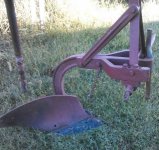
Shares form the leading edge along the bottom of the plow. Shins are the leading vertical edge. Moldboard is the curved part that "flips" the soil. Landslide is the part that runs against the furrow wall. The "frog" is the part that all those parts bolt to. Shank is the upright that connects the bottom to the frame.(Some older plows will have the shank made as an itegral part of the frame) Coulter is the disc that cuts through sod or surface trash to give a clean cut to the furrow wall. And you MIGHT have a tailwheel (AKA Rolling landslide) that takes some weight and pressure off the fixed landslide.
Re: Ford 101 Plow Operation?
Originally Posted by gayoung
Have a Ford 3 f plow. Replaced the points on it but am having major problems with the furrows not flipping over in damp soil. Have set up the plow as suggested with the left side of tractor on a block and leveling the plow. Have tried driving faster-no luck.The furrow will flip over if I plow quite deep but because soil is damp I want to only plow approx 5-6" deep. Any suggestions would be greatly appreciated.
You mention it being a 3-bottom plow.....What width bottoms?
As a rule of thumb, many (including Ford 101 bottoms) are generally designed to be operated at a depth of 1/2 their width. (ie 12" bottoms, 6" deep. 14" bottoms, 7" deep, ect...) You can get away with a slight variation from that rule, but not by much. (Of course, conditions can dictate the final "best depth") "Back in the day" most plow manufacturers offered options such as "semi-deep draft" and deep draft bottoms for plowing deeper than that "1/2 the width" rule. Staying relatively close to "spec" is MOST critical when plowing sod.
The moldboards found on the majority of Ford 101 plows were designed to plow at speeds of (between) 4 to 5 mph. Faster (by a small bit) is better than slower in this case.
Also, plows need to operate at correct plane.. (level front to rear/side to side) If the plow is used with the slightest "nose down attitude", they'll tend to bob up and down, (porpoise) not roll the furrow slice correctly, and pull with quite a bit more resistence. The point being "nose down" will suck the plow into the ground farther, then a combination of factors (properly working draft control, traction available, soil structure, ect,) will result in the plow raising to a shallower operating depth. Inconsistant depth will result in changing results as far as consistancy of how the furrow slice rolls....
Look at different brands of plow....The moldboards will have SOME difference in contour, but generally speaking, plows of different brands, yet from the same era usually have a shape that is close to the same. (with John deere moldboards showing the MOST variation from other brands....Deere plow I've used in the past weren't exceptionally gifted at plowing sod....My experience with them is they only roll sod about 90 degrees, leaving it on edge, unless you plow at break-neck speeds)) There is a narrow "window" of what works and what doesn't work so well. With a plow running (even slightly) "nose down", you throw the plow bottom's geometry off (in effect, RAISING the rear end of the moldboard relative to the leading edge of the plow) . The results may vary slightly, but you'll usually see the negative results in the form of a furrow slice that doesn't roll correctly.
Most "American" style plows weren't designed to flip dirt 180 degrees. They were actually designed to turn dirt about 125/130 degrees. In soils of decent tilth, it will turn well at those angles, usually burying surface trash. In sod, you'll get an incomplete burying of the "green". Once upon a time, plows were sold with bottoms (as an option) that were intended to plow in existing sod. They are somewhat different shape than a standard duty bottom. Adding "cover boards" (aka "trash boards") to a plow will net much better results in sod OR in conditions where there's a good deal of surface trash (ie: crop residue)
And finally, there's times where plows just don't do a consistant job of rolling dirt. THat's generally a result of soil conditions, what sort of root mass that sod hands you, and soil moisture. Wet, heavy soils just don't plow well in all instances.
I hope SOMETHING here helps.... You may just be a victim of "soil circumstances". Bottom line is, play around with depth, leveling adjustments, and speed. Note changes and apply them for best overall results. And keep in mind plowing is as much a "black art" as it is a skill. Takes practice......and experience
Last edited by Farmwithjunk; 06-02-2011 at 07:22 AM.
Plow parts!
Anyone who's tried to re-hab a moldboard plow in recent years will tell you parts are getting harder and harder to pin down. Certain models are destined for the scrap pile because they're worn out and OEM parts just aren't there any longer. Agri-Supply, Valu-Bilt, TSC, ect can still get SOME parts for SOME plows, but not consistantly or timely.
Looks like we have a place to turn after all! They've got shares, shins, moldboards, landslides, coverboards, ect!
Crescent Forge & Shovel -Tillage Tools
Re: Plow parts!
Originally Posted by CDsdad
You guys seem to know the proper names for all this stuff, so please educate the ignorant. We've got a 2 bottom turning plow. Now I think I know the moldboard is the actual big blade that turns the sod, dirt, or whatever over. What is the proper name for the point of the plow that actually cuts the ground, and how do you size them, or is size determined by the moldboard? I need 2 new points, rippers or whatever they are called. Thanks.
The "point" is properly called a SHARE, but is known simply as a "point" in some areas. That's the leading edge that cuts the BOTTOM of the furrow.
The SHIN is the leading edge that cuts the vertical wall of the furrow.
The Moldboard is that big curved "wing" that rolls the dirt over.
The landslide is the wear surface that rides against the furrow wall to make the plow run straight.
The coulter is the disc shaped item that runs in front of the shin to cut through the sod and surface crop residue.
A coverboard, or trash board is a small curved "wing" if you will that is located above the shin on SOME plows to aid in burying surface residue.
The tailwheel, or rolling landslide is exactly what and where it says.
There's a part called the FROG that attaches to the shank (or beam) that is what all those parts bolt to.
The shank, is the leg portion of the frame of the plow. Some shanks are saftey trips, with either a shear bolt OR mechanically re-settable "toggle" trips.
Let's stop with that. I can go on for ever! I love plowing and messing with old plows!
Re: Importance of coulters?
Personally, I wouldn't own a plow WITHOUT coulters. Never would, never will be without. They don't do much (if anything) to make plows pull easier.....They make 'em pull with less aggrevation though....When plowing in crop residue (ie stalks) or weeds, they cut a slit where the plow can work through rather than dragging all that residue into a heap under the plow beam. Having coulters set properly makes the difference between working correctly and not seeing any advantage. I also INSIST on coverboards (AKA "trash boards") Until recent years, I wasn't aware anyone plowed WITHOUT coulters. Where I came from, plowing without coulters would make the neighbors start talking aboutcha! (In a not so nice way!!)
Competitors in "Match Ploughing" tournaments set coulters almost as deep as the plow is operating to give furrow walls a clean, crisp, straight look. That's not as critical when you're just plowing the "back 40" for a corn crop.
Re: 3 bottom plow purchase advice
IMHO, best mounted plow ever was the Ford 101. (Note: NOT the 10-1, but 101...) Simple, rugged, still (relatively) easy to get parts, and it had adequate throat clearance so as to allow trash (ie crop residue) to clear through without plugging. Ford 101's were built for Ford by either White/Oliver or Pittsburg Plow.
Semi mounted plows typically will pull just a tick harder than a mounted plow (of same size), but not as a hard and fast rule. Semi mounted plows are a lot easier for the tractor to handle once you start getting beyond 3 bottoms.
I've owned several deere plows. Older HHS and NU bottoms tended to pull a LOT harder than other brands. (more abrupt contour of moldboard)
As mentioned, Massey made a great mounted plow, just some models tended to plug in weeds/crop residue.
Best semi mounted plow I ever used was a White plow. (Not certain of model....It's been years)
970 deere bottom plow
I have heard that I may want to use a bottom plow on some ground I want to plant vegetables on. Its been pasture ground for as long as I know, and was told that on soil like that, a tiller shouldnt be used at first.
Any help of this and what size bottom plow my 4x4 970 Deere 33hp can handle is appreciated.
Pasture ground will usually be VERY compacted. Animals compact soil to a greater degree than running heavy equipment over it. And pasture usually has animals on it even in wet weather, when soil is at it's most vulnerable (to compaction)
That said, plowing will be tough sledding......I'd stick with a single bottom plow, 2X12"'s at the very most. Growing up, I spent a LOT of hours plowing on dads tractor. 32hp Ferguson F40. It would handle 2X12"'s just fine, but 2X14"'s would stop it in its tracks in hard ground.
Re: What is the best way to break new ground?
Originally Posted by BarryC
OK good advice! So once I get the ground broken which would be better a disc harrow or rototiller? What are some of the advantages and disadvantages of each?
Far too often, a tiller will OVERwork soil....You DO NOT want soil beat into a talcum powder consistency. It can pack down tight when it gets rained on. Much depends on the soil type and structure you're dealing with. Most advice you get will be based on local soil conditions for the person giving the advice....Soil varies greatly.
In the conditions I'm used to, if you're "fall plowing", or breaking ground now for NEXT YEARS garden, you really don't want to work it beyond just breaking it until next year. It will mellow over the winter with freeze/thaw cycles. Disc it OR till it next spring before planting time. Overworking now will usually result in that compaction problem I mentioned, OR, finely worked soils will tend to wash away during the winter. Leave it rough until you're ready to plant.
As far as tillers v disc....I use BOTH. Rather I use one OR the other, depending on what I'm doing. And with the tiller, once or twice over the ground is PLENTY. Don't beat the ground into submission. And with each pass over the ground you make, regardless of what tillage choice you make, you work the soil only as deep as the tool allows, and you further compact the soil BELOW the working depth. Minimize trips across the seedbed.
What size plow?
What size plow and disk should I use with a 30 hp tractor?
Where do I begin?????
Depends....
Speed....Years ago, it was accepted that plowing speeds were something like 2 or 3 mph. Towards the late 50's early 60's, "high speed plows" came into fashion. That translates to 5MPH + or -. There are modern plows (more commonly used in Europe) that work well at speeds above 7 or 8 mph. The vast majority of 3-point "light draft" plows of 1, 2, or 3 bottoms that you'll find floating around in the used market were built in the era where "ideal" speeds were predominantly 4-1/2 to 5mph. The lions share of "economy" plows you'll find new these days are essentially copies of plows from the 60's and 70's.....(ie 5mph best speed to use)
Soil condition.....Hard clay or rocky soils won't plow like sandy, loamy bottom land.
Depth of plowing....As a rule of thumb, plows should be used at a depth of 1/2 the bottom width....ie 12" bottoms, 6".....14" bottoms, 7"....and so on. The WIDER the plow, the DEEPER it needs to operate to do the best job. With that in mind, there's a BUNCH of difference between 2X12's and 2X16's... I've seen tractors play with 3X12"'s and struggle with 2X16"'s....due mostly to soil compaction layer @ 7" or 8" that just wasn't a factor @ 6". Of course, with any "rule of thumb", there's a +/- factor....MOST plows will work fairly well 1" deeper or 1" shallower. In sod, all bets are off....EVERY experience I've had plowing sod, there's a sweet spot where depth = a good job turning and putting "green side down". Too deep and the cut doesn't roll over all the way. Too shallow and it'll throw the slice too far (as well as not working ground to a decent depth...)
Era the tractor came from....Old school thinking (pre wwII) was big heavy slow hulking tractors. 30hp on a 10,000lb slow beast would pull 3 or 4 bottoms in some instances. 30hp compact....not so much.
PTO-hp or engine-hp? I for one don't even consider engine hp a valid point of comparison. Who hooks any implement, pto OR drawbar directly to the flywheel? For the most part, farmers use pto hp as the benchmark.
A "typical" (whatever that is...) modern 30hp (pto) tractor of average weight should be able to pull 2X12" plows at a moderate speed in most conditions. 2X14"'s are a good trade off.... You can plow "shallow" for 14" bottoms @ 6", or sink 'em deep (for a 14") and work 8"+ in the right conditions. IMHO, it's a serious misjudgement to pile on weights and/or plow at ridiculously slow speeds in order to pull a plow that's essentially too big for the tractor. And, unless you're plowing hundreds of acres, there's not THAT much difference in time spent plowing with a smaller plow (at a decent speed) And THAT is easier on the tractor when all is said and done.
Plowing under ideal conditions is a piece of cake....Under tough or less than favorable conditions, it can be a black art of sorts.....
Long story short....unless there's something unusual about your "30 hp tractor", I'd recommend a 2X12, or at the largest, 2X14.....
Re: Setting up a moldboard plow
With a mounted plow, the 3-point top link SHOULD be straight in line (front to rear) with the centerline of the tractor. There is SOME leeway with that, but "in a perfect world", it should be straight.
In that same "perfect world", you set the tractor to match the plow, and NOT the other way around. Any plow has what is called the "line of draft". That is essentially the center of the work load.... That lime of draft should be centered behind the tractor, THEN, the furrow side rear wheel of the tractor should be set just to the outside of the front bottom. On a typical 2-bottom plow, that is 22" to 24" from center line to inside of rear tire sidewall.
That width changes (increases) with a 3-bottom plow (or larger)
With the majority of newer tractors having all sorts of different tire combinations, (ie R4,s turfs, ect) and the lack of adjustability of track width, SOME deviation from "the rules" may be needed to get a plow to track behind any given tractor.
As far as the offset drawbar..... The offset is there to level the plow when furrow side wheels are in the furrow. Rotating that drawbar is NOT to be used to level the plow from side to side..... That's a job for the leveling cranks on the 3-point hitch. Rotating the offset drawbar will skew the rear of the plow left or right depending on which direction the drawbar is rotated. That will put more (or less) pressure against the landslides, which will in turn make the plow want to follow left of center or right of center. (and you DO NOT use stabilizer bars/links on the 3-point hitch to hold the plow where you want it.) Skew the rear towards the furrow and the plowtends to track to the LAND side, as pressure against the landslides decreased.. Skew the rear of the plow towards the land side, and the plow will track towards the furrow side, as pressure against the landslides is increased.
If you have more than enough tractor (weight and hp) for the particular plow you're using, it's possible for a tractor to "manhandle" the plow when it isn't in proper adjustment. If you're operating anywhere near peak draft load, a plow would need to be "by the book" or else it would pull like the proverbial boat anchor.
With a well designed plow, attached to the tractor correctly, and everything in proper adjustment, and the plow glides through the ground ALMOST effortlessly. Deviate from "perfect" very far and you suddenly have a fight on your hands.
Think of a plow in the ground much the same as a rudder on a ship. If it is locked into position, the ship won't turn. A plow needs to be able to move side to side in order to allow some degree of control with the tractors steering. With a plow setting dead level when in the ground, you minimize the plows tendency to raise up out of the ground. Minimal wear on the shares is the key to "suck". (The plows natural tendency to pull itself in the ground) Too much nose down attitude, and the plow wants to keep pulling down, creating excess load on the tractor. Too short on the top link and the plow dives into the ground. Too long, and it tends to want to raise up. (or never go in the ground to adaquate depth) "Just right" with the top link and the plow pulls easily and has but a little compression on the top link, nor will it have excessive tension on the top link. And as mentioned, side to side directional control is acheived with rotation of the offset drawbar. It's just like sticking your hand out the window of a fast moving car....hold the hand flat and everything is effortless, but curve the hand and it wants to go up or down....You want the plow to pull as lightly and effortlessly as possible.
But...Since we aren't in a "perfect world", and tractors today are NOT designed with moldboard plows in mind as a primary duty, you have to make compromises with any adjustments.
Re: What am I doing wrong with my two bottom plow?
Originally Posted by hollistercody
I recently bought a new massey 1540, and have an old Ford 2 bottom plow that's probably from the '70s. I can't get the plow to cut into the ground. I've tried adjusting everything I can, but it seems like the three-point just won't push the plow in like it should. What am I doing wrong?
Odds are, if a plow doesn't want to dig in, you've probably got shares that are worn beyond service limits. As mentioned, the 3-point does NOT push the plow in the ground. The plow will (should) pull itself down (Known as "suck" in plow terminology)
Set the land side of the tractor on blocks roughly equivilent to the depth you wish to plow. THEN adjust the plow to where it's level front to rear, side to side. If it won't "suck" down then, you have EITHER worn shares OR the ground may be too dry/too hard.
Re: what am I doing wrong with my two bottom plow?
Plows are intended to run LEVEL. Setting them with much at all of a nose down attitude is absolutely the WRONG thing to do. That puts the rear bottom higher, moving less dirt, causing what is known as RIDGING. That's where you get different height's of turned furrows. Also, that'll tend to cause the plow to hunt for even greater depths, making it nearly impossible to regulate an even draft. Pointing them nose down will overcome worn shares, but at the expense of a poor looking finished plowing job.
Replace shares........
Last edited by Farmwithjunk; 06-02-2009 at 07:59 PM.
Re: what am I doing wrong with my two bottom plow?
Originally Posted by alltoys
Here are some more questions about the 2 bottom plow.
If you can't move the plow over anymore to the left so that both will lift the same amount of earth what can be done? If I could ride the level part of the ground it would be perfect but the right side of the tractor wheels fall into the groove left by the plow. I know this is supposed to happen but the nearest plow to the already cut side will only cut about 6 in. where as the other is a full 12 in. cut.
How can a person stop the sod from balling up in the plow?
Sounds as if the rear wheels are too close together. (Common issue on many compacts/subcompacts w/wide tires) Measure from centerline of tractor to inside of sidewall, right rear tire. OR Total width between sidewalls of rear tires. Then report back with that measurement. Most plow manuals for the more common 3-point plows will suggest a width between rear wheels of 52" to 54" (26" to 27" CL to sidewall) when using 2X12" plows. A couple inches LESS is workable, but much less is hard to make work.... Tends to result in EXACTLY the problem you're having.
If you're trying to plow "on land" with a plow that SHOULD be used with the tractor "in furrow", that is the root cause of the plow NOT wanting to go in the ground in the first place.
The majority of 3-point plows came equipped with "multi-purpose" moldboards. They'll do the job in most sod conditions, but can be troublesome. Coverboards (aka trashboards) and moldboard extentions help SOMETIMES.
Last edited by Farmwithjunk; 06-20-2009 at 05:49 PM.
Re: 2 bottom plow
Originally Posted by SouthernX
I'm in the market for my first 2-bottom plow also. So some of you experts jump in here and help us out. So why do they make 12" vs. 14" plows? Two inches isn't exactly a big difference. Is this just a historical artifact?
...Had a grandson tell me once I was a "historical artifact"....
Here we go....As a general rule, MOST plows are designed to plow @ a depth of 1/2 their width (+ or - 1"). (ie. 12" plows @ 6" deep, with exceptions, 5" to 7" --- A 14" plow @ 7", range from 6" to 8" ---- 16" plows @ 8" deep ranging from 7" to 9") With smaller tractors (hp & weight/available traction) tailoring a plow to the tractor can be critical. It's very easy to get "too much plow".
Plow much deeper than a specific plow is designed for and sod/plowed strip tends not to want to roll completely over. To a certain extent, wider plows don't suffer as much from not plowing as deep as they are intended, with-in reason of course.
Now, a typical 2 X 12" plow will be moving dirt 24" wide and 6" deep. A 2 X 14" plow will be moving dirt 28" wide and 7" deep. (144 sq in vs 196) Also worth considering, 3 X12" plows cut 216 sq in as opposed to a 2 X 16" plow moving 256 sq in.....so THREE bottoms moves less dirt than TWO in that case. Throw in for good measure the fact that OFTEN, the deeper you plow, the harder the soil, the harder the plow pulls. In the end, 12" plows pull easier in most conditions. You just don't get the depth with them.
12" plows roll a smaller slice of dirt/sod. Some old timeres used to say you shouldn't turn sod with a plow any bigger than 12". Bigger plows leave the surface too rough....Can't say as I always buy into that theory, but, can't argue with the old timers (although sons and grandsons often do....)
Re: Maybe I Don't Need a Plow
There's more'n one way to skin a cat..... You're correct in your thinking about loosening the ground before tilling. Hitting a rock in loose soil SHOULD be less abusive than hitting the same rock buried in solid, virgin soil. Now....How you go about breaking up the soil is open to several options. If you have the HP/traction, a chisel plow would do the job AND would help bring rocks to the surface. A field cultivator will do much the same, but in broad, general terms, field cultivators are lighter in construction than a chisel plow, not lending themselves to breaking virgin soils. Subsoilers/middlebusters will acheive much the same results as a chisel plow, but on a smaller scale. Single shank subsoilers won't "rake" rocks out of the ground like a multi-shank chisel plow though. Something else that needs to be considered is SIZE of the rocks. Smaller (baseball to football size) rocks, I'd moldboard plow, pick up rocks, run through it with a field cultivator, pick rocks again, THEN till S.L.O.W.L.Y. at a shallow depth, pick up rocks once more, till at full depth, and then one final rock picking.
Newbee turning plow question
This is my first post to the forum and I need some opinions about my tractor. I've got a kubota L2650 4X4 and I want to use it to pull a double turning plow (probably 14"). I don't have one yet. The tires on the rear are pretty wide, 20" or so. My question is will the wide tires make it hard to plow since they'll probably ride up on the side of the furrow? Would I be better off using a single wider plow?
Most 3-point mounted plows, 2-bottom or bigger, need the tractor's wheels set to have roughly 52" between sidewalls. (26" from centerline of tractor to inside of right sidewall) Otherwise, you're adjusting the plow to where it will have a difficult time following with the draft line of the plow on the centerline of the tractor, and still having the furrow side wheel in the furrow. Many compacts have a tough time fitting that criteria. (especially so with wider R4's)
There are single bottom plows made that fit compacts and subcompacts better. And with a single bottom, you can compromise the plows adjustment to fit the tractor's track width and not create a situation where the plow is difficult to pull.
More often than not, a plow will open up a furrow wider than the actual cutting width. It may cut a swath 12", 14", even 16" wide, but it moves that swath of plowed dirt several inches further than it's cutting width. I've plowed literally hundreds of acres with a tractor that has 18.4X30" rear tires and the plow I used was a 3X14". The furrow open furrow usually ended up being 18" to 20" wide. And even if you end up with an open furrow that's an inch or so narrower than tire width, not the end of the world.
Re: Let's talk plows!
Originally Posted by DMF
Spring is around the corner and I'm thinking plows...
What are the advantages of a 3-point hitch plow over a pull-type plow? Disadvantages? What brands for either type are good? Which brands of either type should I avoid?
Mounted plows take advantage of the tractor's draft control system. That nets you improved traction as well as easier pulling. Those benefits result in better fuel economy among other things. Mounted plows are much more manueverable/mobile.
The best plows were made by Oliver/White, Ford (who coincidentally contracted production of most of their plows to Oliver) and Massey Ferguson.
deere plows have traditionally pulled like a boat anchor!
Re: Let's talk plows!
Originally Posted by scott_vt
Do you consider the old Dearborn plows that were manufactured for Ford to be Ford plows ? Or not really ! Im refering to the old Dearborn I rebuilt couple of years ago.
Those older Dearborn plows were "good" plows, but not quite to the standards of the Ford 101's of later vintage. Same applies to the early Ferguson plows. The 101 was one of those designs that hit upon a "sweet spot" and just worked a lot better than average.
There's a lot more to how a plow pulls than just the contour of the moldboard. The landslide and how much drag it creates while holding the plow on course has some effect. "Throat clearance" has a little effect, especially in trashy conditions. The over-all length of the frame (which is dictated by throat clearance) can have a significant effect. Working depth and it's relationship to bottom width, compounded by the shape of the bottom is the main ingredient. In the end, it's all about how the total package works.....Some plows just "have it" while others aren't quite as good.
Personally, I'd rather take to the field with a "good plow" that's set up well in combination with a properly adjusted tractor than the "best plow" that's out of adjustement and on a tractor that isn't set up right for plowing.
Bottom Plows
I have been lurking for some time now. I have a cottage with 3 acres and I am going to attempt some landscaping and garden projects this coming year. I have a New Holland TC25D. I have around 2 acres to work and was thinking about a bottom plow. Does anyone know if my tractor will pull a 2 bottom plow or should I get a 1 bottom plow?
Re: Bottom Plows
I'm certainly no authority on the capabilities of your tractor. I'm guessing a 2-bottom plow would be a little much though. Especially so if you're wanting to break compacted pasture land. Animals can (and do) compact soil to a far greater extent than any wheeled equipment can Years of paturing can leave soil like concrete. You're looking at some of the toughest plowing conditions you're apt to encounter.
Moldboard plows CAN help. But they have their own set of limitations when it comes to reducing compaction. Typically, they'll work to a depth of 6" to 8". (+ or -) From that point on deeper, they actually can (and will) make the problem WORSE in many soil structures. Some AG engineers explain it a little different than "making it worse. They explain it by saying moldboard plows will make the difference between upper layers of soil and soil below the working depth more pronounced. Crop roots that flourish in upper soil layers hit the "plow pan" and run out of gas. But....ya gotta do what you CAN do. 8" of loose seedbed is better than NO loose seedbed.
Best option in MOST conditions is a chisel plow, OR, years of recovery time with many freeze/thaw cycles to allow natural "heaving" to break compaction. Since the latter lacks that "instant gratification" we often need, the former becomes the best option in most cases. Moldboard plows become a fair alternative to either.
Plows do their best work when you can maintain a REASONABLE ground speed. Most "modern" plows need 4 to 5mph. (Modern being a relative term. plow design has slowed since the 1960's as they see limited use in most areas nowadays, and have but a limited following. They are more popular in Europe as opposed to the US, but are loosing ground (pardon the pun) even in European markets. What I speak of as "modern" are plow designs from the 1950's through 1970's, which are typical of what is available in US markets)
So....long story short....If you have settled on a plow, I'd go with a smaller 1-bottom version that you KNOW you can maintain a reasonable speed and depth in harsh conditions.
Re: Followup; Plowing with a 30 Hp Compact Tractor
I love it! Some of these comments, that is. It's as if EVERY plow is the same. EVERY plot of dirt is the same. EVERY tractor is the same. And EVERY operator is the same.
There are plows (brand/design/model) that simply pull easier than others. That's why they're held in such high regard. Jerry mentioned the MF#66. That's an easy pulling mounted plow. So is the Ford 101. deere plows have historically pulled like someone tossed out the anchor. The primary difference is in the contour of the moldboard and angle of attack of the share. The Howse plows available these days use wear parts that are SUPPOSEDLY copies of the Ford (Pittsburg or Oliver/White built) 101. But the Howse plow pulls considerably harder than that Ford plow.
Plows designed in the 30's and 40's were intended for different speeds than plows of the 50's, 60's, and beyond. High speed in 1940 was 2-1/2 or 3 mph. High speed in 1965 was 5mph+. By the early 1960's, old logic on plowing had changed. It was found that tillage work was more efficient at higher speeds and smaller implement width. (to a point) Plow designs reflected that different thinking.
As plows went along through their evolution, they were used in different conditions. As crop science developed, and yields went up, so did crop residue. Plows had to have more "throat clearance" to handle leftover stalks. That made the plow longer in most cases. And that makes them pull harder.
Plows need to be set right in relation to the ground, and in relation to the tractor. A PROPERLY set up plow involves setting track width on the tractor to suit the plow. Commonly, people try to set the drawbar of the plow to suit the rear wheel track. In order to keep the "draft line" of the plow centered behind the tractor, it's the wheels that need to move and NOT the drawbar in many cases. Plow set-up goes way beyond simply "getting it level". If the plow isn't set right, the tractor has to man-handle the plow. Disregard the draft line being centered, and considerable effort and energy is wasted on trying to keep the tractor in a straight line rather than going forward.
Due to the simple fact that most modern tractors had ZERO engineering for use as a "plow horse", many aren't good candidates for plowing. Most compacts are shorter than the "old school" tractors built years ago. To an extent, the longer the tractor, the better it will handle a plow.
Soils vary considerably. SouNdguy mentioned the Ford adds that pictured old "N"s pulling three bottoms. Most of those old add photos were taken at the Ford Proving Grounds....In Michigan SAND. Try pulling 3X14"s in some of the clay soils around here! You wouldn't get the plow 2" in the ground before you'd run out of power AND traction. In this immediate area, back when "N"'s roamed the farm fields, it wasn't at all UNCOMMON to see them with single bottom 16" plows or at the most, 2X12"'s. Same tractors, just totally different soil conditions.
Some tractors are just better at handling heavy draft loads. Even when set up and ballasted correctly, some just don't do as well as others. A properly designed and adjusted draft control system makes the work easier, but again, some tractors just don't do as well.
And like so many things, there's a LOT more to plowing than what meets the eye. There's nothing like experience. I know a guy who spent a lot of time demonstrating tractors (for John Deere) at farm shows back in the 50's and 60's. He could make a tractor appear to have some extra HP with his technique. You golfers out there.... Ever see a big, strong, strapping young man that looked like he was killing the ball get smoked by an older golfer who simply knew how to drive the ball. It's all about technique.
For anyone who subscribes to the statement that "All men are created equal", You've never seen a group of plowmen in the same field at the same time. There are folks who just simply make it look easy. And there are those who never quite get the hang of it.
Last edited by Farmwithjunk; 09-14-2007 at 09:48 AM.
Re: Followup; Plowing with a 30 Hp Compact Tractor
Originally Posted by Soundguy
Must be a geometry issue with the plow. One thing I don't like are the steel frame members.. for some reason i like the cast ones better. I think TSC is getting it's tractor equipment from 2 supplieres, depending on how north or south they are. The plows for sale down here in florida look like cheap junk.
When Harry Ferguson designed his hitch, the length of the draft arms vs the length of the top link was engineered to allow a plow to enter the ground WITHOUT having an excessivly heavy plow. Fergusons hitch (On FERGUSON tractors... I don't know the specific measurements of the FORD-FERGUSON hitch components) used a 33" long draft arm and with the plow level at operating depth, the top link was approx. 25-1/2". As the hitch was raised or lowered, the top and bottom links travelled through a different "arch". What that did was make the tail end of the plow raise faster than the drawbar as the hitch was lifted. As the plow was lowered, it had a "nose down attitude" until it reached operating depth. That made the points of the shares dig in without all that excessive weight forcing the plow into the ground. It worked, and everyone took the success for granted.
Some of these "johnny-come-lately" plows sold these days don't take that geometry into consideration. When I had that "TSC plow", I had to lengthen the top link quite a bit more than with the Ford 101 I normally used behind my deere.
The "TSC plow" is a boat anchor. It's considerably heavier than a lot of the "great plows" of yesteryear. With all that built in weight, it still doesn't have any more built in stregnth.
I'm of the opinion the real reason why the TSC plow pulls as hard as it does is a part that you can't even see. The frog.... That's the part of the plow that the shares, shin, moldboard and landslide bolts to. The frog attaches to the lower end of the plow beam. It shapes the "bottom". I'm thinking the frog has the bottom mis-aligned just a tad bit. Combine that with the fact that the 'generic" wear parts (share/shin/moldboard/landslide) used on these plows fit extremely poor, and they just don't glide through the dirt like the good old plows made "back in the day".
The best plows I know of were mostly forged parts. (frames) Cast is too rigid and/or too brittle. Mild steel has to have too much bulk and mass to have the required strength. When Ford and Massey Ferguson went from the first generation of mounted plows to the newer designs of the mid 1950's they both dropped a lot of the cast parts in favor of forged. (i.e Ford 10-XX vs. model 101 plows) The old cast frame plows were good ones, but the forged models were better as well as less expensive to produce.
Long and short of it, these new plow "work", just not nearly as efficiently as the oldies that were designed and built back when plowing was a way of life and not a novelty like it is today.
Re: Bottom plows and Draft Control - few Q's
Originally Posted by andrewj
I have a 3 bottom Ford 101. Land is hard clay. New ground, used to be forest. My top link is set in the center hole, with the top hole and bottom hope unoccupied.
I am using draft control only and not using the position control. I am popping shear pins like crazy. If i move to the top hole nearest the detection cylinder, will it pull up quicker if i hit a root/rock? Thanks inadvance for any help.
I'm assuming you're using your Deere to plow with. Not being all that familiar with that particular tractor, I'd advise one thing about choosing which top link position to use. STICK WITH MANUFACTURERS RECOMENDATION on that pin location. Plows put the absolute most stress and strain on a draft control system of ANY implement. Stick with what is suggested as far as location of the top link. More "sensitive" settings are normally reserved for lighter draft implements (such as a row-crop cultivator....)
Now on to draft control, shear pins, and plowing.
Draft control WILL NOT prevent you from shearing pins when you hit something substancial enough to trip the plow bottoms. It takes a split instant for the draft control to react to a sudden increase in resistance. You've already hit whatever it is that's shearing the pins. Draft control doesn't anticipate a buried obstruction and raise the plow over it. That's not its function. That's why trip beam plows are used. Draft control, in it's INTENDED form, as designed by Harry FErguson (of Massey FERGUSON fame), is intended to keep a plow (or any soil engaging implement) at a steady depth, all the while making gradual movements to keep the drawbar load (measured at the 3-point hitch draft arms) at a constant load. As the draft load varies because of changing soil conditions, or variance in shape of terrain, the draft control makes those gradual movements. When draft control senses an increase in resistance, it will raise the implement SLIGHTLY and GRADUALLY to reduce the resistance, then return to the pre-set draft depth as soon as that increased resistance is passed by. . As it raises the implement, the hitch pull down on the rear of the tractor, increasing available traction just as if the tractor weighed more. The purpose of Ferguson's design was to allow a relatively small tractor to do the work of a much larger unit. It simply made tractors more efficient at handling heavy draft loads.
Shear pins (or better yet, re-set-able saftey trip beams) are intended to protect the plow and tractor from that sudden jolt when the plow strikes that "immovable object", be it a rock, a root, or whatever hidden obstruction it is. If you're shearing pins, you CAN use a harder bolt, but be ready to get slammed into the steering wheel if you do hit something hard. (BTDT, grew up pulling old solid beam plows) If it's relatively "soft" roots that are tripping the beams, you MIGHT get away with harder bolts, but you'll still get a good jolt as the tractor pulls through them. Rocks? Well, harder shear bolts might just cause you to shatter a plow share, moldboard, or even bend the plow beam. Those shearbolts are there for the protection of you and your equipment.
Here is a selection of Farmwithjunk's Plow posts I found useful. I copied Farmwithjunk's individual posts from T-B-N into 'Word' then pasted the consolidation back into T-B-N, therefore the posts are not in context, necessarily. This is somewhat a work in progress as T-B-N would only let me search 2,114 of Farmwithjunk's 3,773 posts in the T-B-N archive, today.
Farmwithjunk has had health issues and is not posting on T-B-N any longer.
Best Wishes, Farmwithjunk!
'FARMWITHJUNK' ON PLOWS
Re: Bottom plow for a 24 HP tractor
Originally Posted by Foton404
Coming back in to address schism's comment about plowing half as deep as the moldboard's width.
8" is pretty deep. Regardless of each moldboard's witdth, a 16" can work o.k. at 6" or 7". My early youth was spent on a Super H Farmall, about 25 hp and pulled a 2-16" pull type plow in all going. This included gumbo and hard clay soil. 25hp is enough. Traction is the problem. FWD is a must with a compact tractor.
Plows are MEANT to plow @ 1/2 the bottom width. (ie, 8" deep for a 16" bottom.) Generally there's a + or - of 1". (ie, 16" plow works well at 7" to 9" deep) 6" deep with a 16" bottom is far too shallow. That'll result in a thin ribbon of dirt that often rolls more than 180 degrees, ending up with "green side up" again.
25 HP will pull 2X16"'s with enough weight and at a VERY slow speed. Most plows designed and built after the mid 50's are "high speed plows", meant to plow at speeds above 4mph to as much as 5-1/2mph. 25 hp will not pull 2X16"'s at those speeds in anything short of peat moss or sand. The result of pulling a high speed plow at slower speeds is incomplete turning of the plowed strip. You'll end up with a ribbon of sod/dirt turned 90degrees up on its edge.
Re: please help identify this plow
Originally Posted by N80
FWJ, how do you go about setting plow depth? I've figured out by trial and error a good bit of my plows proper set up but depth still just seems like a matter of fate. I just assumed in my case that it was the level of the hardpan that determined how deep I could go.
A plow should be operated at a depth of + or - 1" of half of an individual bottom's width. (ie, 12" @ 5" to 7", 14" @ 6" to 8", etc.)
Some brands offered "deep draft" plows. John deere as an example, once the "NU" style bottom was offered, had a deep draft 16" bottom that would operate efficiently at depths of 10" to 12". You'll rarely, if EVER see those style bottoms on smaller mounted plows (3 or less bottoms).
A plow with shares in decent condition have what is called "suck". That's the plows tendency to pull itself deeper into the ground. Worn shares will reduce that suck to a point where the plow struggles to get to proper depth.
3-point hitch geometry has some effect on a plows tendency to get to a desired depth. Look at the length of a typical top link vs. the over-all length of the draft arms. They're different. Their implement ends travel in a slightly different arc. As the hitch works through it's range of motion, the plow (or whatever implement is mounted) does NOT travel in a constant plane. As the plow raises, the tail end tends to lift more than the front of the implement. (Harry Ferguson designed and intended his hitch to do just that. Reason? To improve transport clearance when implement is raised fully) . As the hitch is lowered into operating position, a plow tends to retain a slight nose-down attitude (ever so slightly) Once the draft arms become parallel with the ground, and begin to place the implement ends BELOW the end attached to the tractor, the tail end of the plow lowers more SLOWLY than the front end. That's why a plow needs to be leveled IN OPERATING POSITION, and NOT while it's raised. That raised position is almost totally irrelevent to its OPERATING position. A plow that's properly designed and fit to a specific tractor will result in the draft arms being extremely close to parallel with the ground as the plow is at it's designed operating depth.
Ideally, the tractors DRAFT CONTROL holds the plow at proper operating depth, countering the plows suck from taking it too deep. Some tractors don't have draft control. Then you're at the mercy of position control, or in some cases, a gauge wheel on the plow. That gauge wheel "unloads" the plows suck from the hitch, reducing the traction advantage of a mounted plow. That suck pulling against the draft control (or position control) gives the effect of added weight on the rear wheels, resulting in increased traction. The plow has a tendency to rotate around the hitch, placing compression on the top link, therefore downward force applied to the front end of the tractor. That is the genious behind "The Ferguson System". Instead of wasting the energy generated by the plow, it's applied to the tractive efforts of the tractor. (smaller tractor does the same work as a larger, heavier tractor)
A plow bottom in good condition works simular to an airplane wing as it slices through the air. The landslide and tailwheel (if equipped) provide a certain amount of "lift" as the share and moldboard contour provide the downward force. In a perfect world, those 2 forces should be ALMOST equal with the plow at the desired depth of operation. Set PERFECTLY, a plow should only apply a marginal amount of compression on the top link.
By the same principal, the side-to-side skew achieved with the rotational adjustment of the offset drawbar applies pressure to the landslide to counter the force of the moldboard to make the plow trail directly behind the tractor. Set properly, no stabilizer bars/sway chains/ect are needed. The plow should follow CENTERED (on the plows draft line) behind the tractor.
Have you ever stuck your hand outthe window of a fast moving car and felt the air try to make your hand move up or down as you turn your hand? When you hold your hand "just right", you feel no pressure. Much the same principal with a plow. Adjusted "just right", it tends to want to travel in the desired path, be that up and down, or, let or right.
Soil conditions will have an effect on how well a plow operates, but its SHOULDN'T be the determining factor in the operating depth.
MOST, if not ALL tractors built these days had little, IF ANY design consideration for pulling a plow. Hitch geometry may possibly be less than ideal for working with a plow. The plow itself may not be of ideal geometry for the brand of tractor. Plowing with most "modern" tractors is an exersize in compromise. With the plow oriented perfectly while at operating depth, you may or may NOT have the ideal orientation as it ENTERS the ground. (or vice/versa) You do the best you can with what you have.
Last edited by Farmwithjunk; 05-05-2008 at 07:24 AM.
Re: Proper use of draft and position controls.
Originally Posted by Kenfyoozed
I have a MF135, and want to make sure I am using the postion and draft control poroperly. The position contol rasies and lowers the implement being used, correct? While the draft keeps the implement at the proper level, say for discing? When I have both controls in the lower position. When i rasie the position lever, the draft lever raises as well. When I lower the position lever, the draft lowers as well. But I can use the draft lever independently of the position lever. I have just been keeping the position lever in "up" and using the draft lever to control the rasing and lowering of the implement. Is this the proper way? Or how should i be using these controls?
NOPE!
The 100 series Masseys use what was known as the "advanced Ferguson System draft control". It was a departure from earlier Fergusons where both levers were sometimes used at the same time. With the 135's controls, you use ONE or the OTHER, but not BOTH at the same time.
Use the position control lever to raise and lower just about every implement. Leave the draft control lever in raised position. When you're using a "soil engaging implement" such as a moldboard plow, a subsoiler, or even a disc, use the draft control lever only with the position control lever left in the raised position. The draft control lever is used ONLY when you're wanting "draft control" for your implement. In any event, you should never be using BOTH at the same time. Using the draft control lever to raise and lower heavy implements will cause the draft control "mechanics" to be working harder that they normally should be. You may even find that the draft control function won't raise loads heavy enough to be at the upper limits of the hydraulic system's capabilities. The position control function is far more capable of raising heavy loads.
Last edited by Farmwithjunk; 12-18-2007 at 09:20 PM.
Re: Proper use of draft and position controls.
Originally Posted by Kenfyoozed
OK. Thanks. I was sure I was using it wrong. I had been leaving the position lever in the raised position and then using the draft lever to raise and lower. Hopefully I didnt damage anything. I only used it this way a hand full of imes to raise and lower the height of the bush hog.
When both levers are in the raised position, and I move the position lever from raise to lower, should the draft control move as well? Mine does. I didnt know if this is a problem that needs to be addressed or maybe just a little dirty. It looked like the two levers were combined where they went inside the tractor.
No, the draft control lever shouldn't move with the position control lever. Look at both the levers. You'll see a screw with a spring tentioner on the side of each lever. Tighten the screw on the draft control lever until it creates enough "drag" to hold that lever while you move the position control lever. A turn or two on that screw should make a remarkable difference.
The two levers do in fact "combine where they go into the tractor" in a manner of speaking. The position control goes into the rear end housing via a hollow tube with the draft control entering via a round rod INSIDE that hollow tube. This is where service manuals and parts manuals are EXTEREMELY helpfull in understanding how various parts and pieces operate. The parts manual has exploded views, allowing you to see how everything is assembled. Knowing HOW somthing works helps to understand WHY it works.
I doubt you did any damage. The fact that everything is still working is a good indication there's no problems. Biggest "problem" with using the draft control to raise and lower implements not needing "draft control" is maintaining a constant operating position. It's virtually impossible to mow (with a bush hog as an example) while using draft control function to regulate cutting height. The mower would tend to move up and down quite a bit.
Re: Ford 101 Plow Operation?
Originally Posted by Eric_Phillips
I have aquired a 3 bottom Ford 101 plow. My question is about setting it up. How do I adjust the depth? What is the lever for on the font of the plow? I noticed it adjusts the relationship of the lower links, but why? Are the shears supposed to be flat on the ground side to side when I lower the plow? I assume all the shears from front to back should contact the ground at the same time. Any tips would be helpful.
That lever is called a "landing lever". It will control the plows tendency to want to move right or left. When plowing, it should run with the draft arms more or less centered. Find the center of the plow. (Plumb down from center of top link mast) On a 3X14" plow, the inside edge of the RIGHT draft link should run 14" to 15" from centerline. Adjust the drawbar right or left to get that adjustment. The inside edge of the left tire should run 25" to 25-1/2" from that same centerline. Adjust wheels to get THAT. Set right wheel to match left. That gets the "draft line" centered on the tractor. At that stage, your "load" should be just about the same on the left of center as the right of center. The landing lever adjustment will make the plow pull left or right slightly when adjusted. Some manuals will also refer to it as "width of cut" adjustment. By shifting the plow left or right, you do adjust the width of cut for the front bottom. As was already mentioned, you want the plow level left to right with the right wheels sitting on a block. Plows should be set 1/2 as much depth as width of cut per bottom (i.e. 12" plow=6" deep. 14" plow=7" deep. 16" plow= 8" deep) A 14" bottom plow needs to have a 7" block under BOTH left side wheels. (Tractor needs to be level front to back in order to get adjustments spot on) Then use the top link to adjust the plows level front to back. Coulters, if so equipped, should run 5/8" to 7/8" to the right of the leading edge of the plows "shin". They only need to penetrate the ground a few inches. Set bottom edge of coulter 3" to 4" above lowest point of share, with attention paid to coulter AXLE. It shouldn't be too close to the ground (due to worn coulters) They will drag in crop residue or sod and clog up if they're too low.
Clear on all of that?
A plow that is set just right, and is scoured clean of rust will pull MUCH easier than one that's NOT set right or rusty.
The Ford 101 plow was built by Ford at first, then produced under contract for Ford, by Oliver (White) at a later date. (If it was originally painted BLUE, it was probably made by Oliver) They are about as good as a 3-point plow can get. All the wear parts are still available. (Mostly aftermarket parts, commonly "Herschel" parts)
Re: Ford 101 Plow Operation?
Originally Posted by Eric_Phillips
You say I need to control the depth with the position control. I had to be careful because I was wearing a blister by the way I was holding the lever. But anyway I had the lever all the way down and it would still not cut much more than a couple of inches in the clay stuff. In the softer soil it would go mining for gold if I didn't keep it from going down the whole way. The shares are worn and the points are pretty round, could it just be I need new shares to get it to dig into the harder ground?
First, Shares ARE the "points". And if they're worn, a plow doesn't want to dig in. Too dry conditions make for tough plowing. The plow will tend to try and work up out of the ground at every opportunity. Try shortening the top link a turn or so. That gives the plow a little more "nose down" attitude. making it want to dig in.
Shares form the leading edge along the bottom of the plow. Shins are the leading vertical edge. Moldboard is the curved part that "flips" the soil. Landslide is the part that runs against the furrow wall. The "frog" is the part that all those parts bolt to. Shank is the upright that connects the bottom to the frame.(Some older plows will have the shank made as an itegral part of the frame) Coulter is the disc that cuts through sod or surface trash to give a clean cut to the furrow wall. And you MIGHT have a tailwheel (AKA Rolling landslide) that takes some weight and pressure off the fixed landslide.
Re: Ford 101 Plow Operation?
Originally Posted by gayoung
Have a Ford 3 f plow. Replaced the points on it but am having major problems with the furrows not flipping over in damp soil. Have set up the plow as suggested with the left side of tractor on a block and leveling the plow. Have tried driving faster-no luck.The furrow will flip over if I plow quite deep but because soil is damp I want to only plow approx 5-6" deep. Any suggestions would be greatly appreciated.
You mention it being a 3-bottom plow.....What width bottoms?
As a rule of thumb, many (including Ford 101 bottoms) are generally designed to be operated at a depth of 1/2 their width. (ie 12" bottoms, 6" deep. 14" bottoms, 7" deep, ect...) You can get away with a slight variation from that rule, but not by much. (Of course, conditions can dictate the final "best depth") "Back in the day" most plow manufacturers offered options such as "semi-deep draft" and deep draft bottoms for plowing deeper than that "1/2 the width" rule. Staying relatively close to "spec" is MOST critical when plowing sod.
The moldboards found on the majority of Ford 101 plows were designed to plow at speeds of (between) 4 to 5 mph. Faster (by a small bit) is better than slower in this case.
Also, plows need to operate at correct plane.. (level front to rear/side to side) If the plow is used with the slightest "nose down attitude", they'll tend to bob up and down, (porpoise) not roll the furrow slice correctly, and pull with quite a bit more resistence. The point being "nose down" will suck the plow into the ground farther, then a combination of factors (properly working draft control, traction available, soil structure, ect,) will result in the plow raising to a shallower operating depth. Inconsistant depth will result in changing results as far as consistancy of how the furrow slice rolls....
Look at different brands of plow....The moldboards will have SOME difference in contour, but generally speaking, plows of different brands, yet from the same era usually have a shape that is close to the same. (with John deere moldboards showing the MOST variation from other brands....Deere plow I've used in the past weren't exceptionally gifted at plowing sod....My experience with them is they only roll sod about 90 degrees, leaving it on edge, unless you plow at break-neck speeds)) There is a narrow "window" of what works and what doesn't work so well. With a plow running (even slightly) "nose down", you throw the plow bottom's geometry off (in effect, RAISING the rear end of the moldboard relative to the leading edge of the plow) . The results may vary slightly, but you'll usually see the negative results in the form of a furrow slice that doesn't roll correctly.
Most "American" style plows weren't designed to flip dirt 180 degrees. They were actually designed to turn dirt about 125/130 degrees. In soils of decent tilth, it will turn well at those angles, usually burying surface trash. In sod, you'll get an incomplete burying of the "green". Once upon a time, plows were sold with bottoms (as an option) that were intended to plow in existing sod. They are somewhat different shape than a standard duty bottom. Adding "cover boards" (aka "trash boards") to a plow will net much better results in sod OR in conditions where there's a good deal of surface trash (ie: crop residue)
And finally, there's times where plows just don't do a consistant job of rolling dirt. THat's generally a result of soil conditions, what sort of root mass that sod hands you, and soil moisture. Wet, heavy soils just don't plow well in all instances.
I hope SOMETHING here helps.... You may just be a victim of "soil circumstances". Bottom line is, play around with depth, leveling adjustments, and speed. Note changes and apply them for best overall results. And keep in mind plowing is as much a "black art" as it is a skill. Takes practice......and experience
Last edited by Farmwithjunk; 06-02-2011 at 07:22 AM.
Plow parts!
Anyone who's tried to re-hab a moldboard plow in recent years will tell you parts are getting harder and harder to pin down. Certain models are destined for the scrap pile because they're worn out and OEM parts just aren't there any longer. Agri-Supply, Valu-Bilt, TSC, ect can still get SOME parts for SOME plows, but not consistantly or timely.
Looks like we have a place to turn after all! They've got shares, shins, moldboards, landslides, coverboards, ect!
Crescent Forge & Shovel -Tillage Tools
Re: Plow parts!
Originally Posted by CDsdad
You guys seem to know the proper names for all this stuff, so please educate the ignorant. We've got a 2 bottom turning plow. Now I think I know the moldboard is the actual big blade that turns the sod, dirt, or whatever over. What is the proper name for the point of the plow that actually cuts the ground, and how do you size them, or is size determined by the moldboard? I need 2 new points, rippers or whatever they are called. Thanks.
The "point" is properly called a SHARE, but is known simply as a "point" in some areas. That's the leading edge that cuts the BOTTOM of the furrow.
The SHIN is the leading edge that cuts the vertical wall of the furrow.
The Moldboard is that big curved "wing" that rolls the dirt over.
The landslide is the wear surface that rides against the furrow wall to make the plow run straight.
The coulter is the disc shaped item that runs in front of the shin to cut through the sod and surface crop residue.
A coverboard, or trash board is a small curved "wing" if you will that is located above the shin on SOME plows to aid in burying surface residue.
The tailwheel, or rolling landslide is exactly what and where it says.
There's a part called the FROG that attaches to the shank (or beam) that is what all those parts bolt to.
The shank, is the leg portion of the frame of the plow. Some shanks are saftey trips, with either a shear bolt OR mechanically re-settable "toggle" trips.
Let's stop with that. I can go on for ever! I love plowing and messing with old plows!
Re: Importance of coulters?
Personally, I wouldn't own a plow WITHOUT coulters. Never would, never will be without. They don't do much (if anything) to make plows pull easier.....They make 'em pull with less aggrevation though....When plowing in crop residue (ie stalks) or weeds, they cut a slit where the plow can work through rather than dragging all that residue into a heap under the plow beam. Having coulters set properly makes the difference between working correctly and not seeing any advantage. I also INSIST on coverboards (AKA "trash boards") Until recent years, I wasn't aware anyone plowed WITHOUT coulters. Where I came from, plowing without coulters would make the neighbors start talking aboutcha! (In a not so nice way!!)
Competitors in "Match Ploughing" tournaments set coulters almost as deep as the plow is operating to give furrow walls a clean, crisp, straight look. That's not as critical when you're just plowing the "back 40" for a corn crop.
Re: 3 bottom plow purchase advice
IMHO, best mounted plow ever was the Ford 101. (Note: NOT the 10-1, but 101...) Simple, rugged, still (relatively) easy to get parts, and it had adequate throat clearance so as to allow trash (ie crop residue) to clear through without plugging. Ford 101's were built for Ford by either White/Oliver or Pittsburg Plow.
Semi mounted plows typically will pull just a tick harder than a mounted plow (of same size), but not as a hard and fast rule. Semi mounted plows are a lot easier for the tractor to handle once you start getting beyond 3 bottoms.
I've owned several deere plows. Older HHS and NU bottoms tended to pull a LOT harder than other brands. (more abrupt contour of moldboard)
As mentioned, Massey made a great mounted plow, just some models tended to plug in weeds/crop residue.
Best semi mounted plow I ever used was a White plow. (Not certain of model....It's been years)
970 deere bottom plow
I have heard that I may want to use a bottom plow on some ground I want to plant vegetables on. Its been pasture ground for as long as I know, and was told that on soil like that, a tiller shouldnt be used at first.
Any help of this and what size bottom plow my 4x4 970 Deere 33hp can handle is appreciated.
Pasture ground will usually be VERY compacted. Animals compact soil to a greater degree than running heavy equipment over it. And pasture usually has animals on it even in wet weather, when soil is at it's most vulnerable (to compaction)
That said, plowing will be tough sledding......I'd stick with a single bottom plow, 2X12"'s at the very most. Growing up, I spent a LOT of hours plowing on dads tractor. 32hp Ferguson F40. It would handle 2X12"'s just fine, but 2X14"'s would stop it in its tracks in hard ground.
Re: What is the best way to break new ground?
Originally Posted by BarryC
OK good advice! So once I get the ground broken which would be better a disc harrow or rototiller? What are some of the advantages and disadvantages of each?
Far too often, a tiller will OVERwork soil....You DO NOT want soil beat into a talcum powder consistency. It can pack down tight when it gets rained on. Much depends on the soil type and structure you're dealing with. Most advice you get will be based on local soil conditions for the person giving the advice....Soil varies greatly.
In the conditions I'm used to, if you're "fall plowing", or breaking ground now for NEXT YEARS garden, you really don't want to work it beyond just breaking it until next year. It will mellow over the winter with freeze/thaw cycles. Disc it OR till it next spring before planting time. Overworking now will usually result in that compaction problem I mentioned, OR, finely worked soils will tend to wash away during the winter. Leave it rough until you're ready to plant.
As far as tillers v disc....I use BOTH. Rather I use one OR the other, depending on what I'm doing. And with the tiller, once or twice over the ground is PLENTY. Don't beat the ground into submission. And with each pass over the ground you make, regardless of what tillage choice you make, you work the soil only as deep as the tool allows, and you further compact the soil BELOW the working depth. Minimize trips across the seedbed.
What size plow?
What size plow and disk should I use with a 30 hp tractor?
Where do I begin?????
Depends....
Speed....Years ago, it was accepted that plowing speeds were something like 2 or 3 mph. Towards the late 50's early 60's, "high speed plows" came into fashion. That translates to 5MPH + or -. There are modern plows (more commonly used in Europe) that work well at speeds above 7 or 8 mph. The vast majority of 3-point "light draft" plows of 1, 2, or 3 bottoms that you'll find floating around in the used market were built in the era where "ideal" speeds were predominantly 4-1/2 to 5mph. The lions share of "economy" plows you'll find new these days are essentially copies of plows from the 60's and 70's.....(ie 5mph best speed to use)
Soil condition.....Hard clay or rocky soils won't plow like sandy, loamy bottom land.
Depth of plowing....As a rule of thumb, plows should be used at a depth of 1/2 the bottom width....ie 12" bottoms, 6".....14" bottoms, 7"....and so on. The WIDER the plow, the DEEPER it needs to operate to do the best job. With that in mind, there's a BUNCH of difference between 2X12's and 2X16's... I've seen tractors play with 3X12"'s and struggle with 2X16"'s....due mostly to soil compaction layer @ 7" or 8" that just wasn't a factor @ 6". Of course, with any "rule of thumb", there's a +/- factor....MOST plows will work fairly well 1" deeper or 1" shallower. In sod, all bets are off....EVERY experience I've had plowing sod, there's a sweet spot where depth = a good job turning and putting "green side down". Too deep and the cut doesn't roll over all the way. Too shallow and it'll throw the slice too far (as well as not working ground to a decent depth...)
Era the tractor came from....Old school thinking (pre wwII) was big heavy slow hulking tractors. 30hp on a 10,000lb slow beast would pull 3 or 4 bottoms in some instances. 30hp compact....not so much.
PTO-hp or engine-hp? I for one don't even consider engine hp a valid point of comparison. Who hooks any implement, pto OR drawbar directly to the flywheel? For the most part, farmers use pto hp as the benchmark.
A "typical" (whatever that is...) modern 30hp (pto) tractor of average weight should be able to pull 2X12" plows at a moderate speed in most conditions. 2X14"'s are a good trade off.... You can plow "shallow" for 14" bottoms @ 6", or sink 'em deep (for a 14") and work 8"+ in the right conditions. IMHO, it's a serious misjudgement to pile on weights and/or plow at ridiculously slow speeds in order to pull a plow that's essentially too big for the tractor. And, unless you're plowing hundreds of acres, there's not THAT much difference in time spent plowing with a smaller plow (at a decent speed) And THAT is easier on the tractor when all is said and done.
Plowing under ideal conditions is a piece of cake....Under tough or less than favorable conditions, it can be a black art of sorts.....
Long story short....unless there's something unusual about your "30 hp tractor", I'd recommend a 2X12, or at the largest, 2X14.....
Re: Setting up a moldboard plow
With a mounted plow, the 3-point top link SHOULD be straight in line (front to rear) with the centerline of the tractor. There is SOME leeway with that, but "in a perfect world", it should be straight.
In that same "perfect world", you set the tractor to match the plow, and NOT the other way around. Any plow has what is called the "line of draft". That is essentially the center of the work load.... That lime of draft should be centered behind the tractor, THEN, the furrow side rear wheel of the tractor should be set just to the outside of the front bottom. On a typical 2-bottom plow, that is 22" to 24" from center line to inside of rear tire sidewall.
That width changes (increases) with a 3-bottom plow (or larger)
With the majority of newer tractors having all sorts of different tire combinations, (ie R4,s turfs, ect) and the lack of adjustability of track width, SOME deviation from "the rules" may be needed to get a plow to track behind any given tractor.
As far as the offset drawbar..... The offset is there to level the plow when furrow side wheels are in the furrow. Rotating that drawbar is NOT to be used to level the plow from side to side..... That's a job for the leveling cranks on the 3-point hitch. Rotating the offset drawbar will skew the rear of the plow left or right depending on which direction the drawbar is rotated. That will put more (or less) pressure against the landslides, which will in turn make the plow want to follow left of center or right of center. (and you DO NOT use stabilizer bars/links on the 3-point hitch to hold the plow where you want it.) Skew the rear towards the furrow and the plowtends to track to the LAND side, as pressure against the landslides decreased.. Skew the rear of the plow towards the land side, and the plow will track towards the furrow side, as pressure against the landslides is increased.
If you have more than enough tractor (weight and hp) for the particular plow you're using, it's possible for a tractor to "manhandle" the plow when it isn't in proper adjustment. If you're operating anywhere near peak draft load, a plow would need to be "by the book" or else it would pull like the proverbial boat anchor.
With a well designed plow, attached to the tractor correctly, and everything in proper adjustment, and the plow glides through the ground ALMOST effortlessly. Deviate from "perfect" very far and you suddenly have a fight on your hands.
Think of a plow in the ground much the same as a rudder on a ship. If it is locked into position, the ship won't turn. A plow needs to be able to move side to side in order to allow some degree of control with the tractors steering. With a plow setting dead level when in the ground, you minimize the plows tendency to raise up out of the ground. Minimal wear on the shares is the key to "suck". (The plows natural tendency to pull itself in the ground) Too much nose down attitude, and the plow wants to keep pulling down, creating excess load on the tractor. Too short on the top link and the plow dives into the ground. Too long, and it tends to want to raise up. (or never go in the ground to adaquate depth) "Just right" with the top link and the plow pulls easily and has but a little compression on the top link, nor will it have excessive tension on the top link. And as mentioned, side to side directional control is acheived with rotation of the offset drawbar. It's just like sticking your hand out the window of a fast moving car....hold the hand flat and everything is effortless, but curve the hand and it wants to go up or down....You want the plow to pull as lightly and effortlessly as possible.
But...Since we aren't in a "perfect world", and tractors today are NOT designed with moldboard plows in mind as a primary duty, you have to make compromises with any adjustments.
Re: What am I doing wrong with my two bottom plow?
Originally Posted by hollistercody
I recently bought a new massey 1540, and have an old Ford 2 bottom plow that's probably from the '70s. I can't get the plow to cut into the ground. I've tried adjusting everything I can, but it seems like the three-point just won't push the plow in like it should. What am I doing wrong?
Odds are, if a plow doesn't want to dig in, you've probably got shares that are worn beyond service limits. As mentioned, the 3-point does NOT push the plow in the ground. The plow will (should) pull itself down (Known as "suck" in plow terminology)
Set the land side of the tractor on blocks roughly equivilent to the depth you wish to plow. THEN adjust the plow to where it's level front to rear, side to side. If it won't "suck" down then, you have EITHER worn shares OR the ground may be too dry/too hard.
Re: what am I doing wrong with my two bottom plow?
Plows are intended to run LEVEL. Setting them with much at all of a nose down attitude is absolutely the WRONG thing to do. That puts the rear bottom higher, moving less dirt, causing what is known as RIDGING. That's where you get different height's of turned furrows. Also, that'll tend to cause the plow to hunt for even greater depths, making it nearly impossible to regulate an even draft. Pointing them nose down will overcome worn shares, but at the expense of a poor looking finished plowing job.
Replace shares........
Last edited by Farmwithjunk; 06-02-2009 at 07:59 PM.
Re: what am I doing wrong with my two bottom plow?
Originally Posted by alltoys
Here are some more questions about the 2 bottom plow.
If you can't move the plow over anymore to the left so that both will lift the same amount of earth what can be done? If I could ride the level part of the ground it would be perfect but the right side of the tractor wheels fall into the groove left by the plow. I know this is supposed to happen but the nearest plow to the already cut side will only cut about 6 in. where as the other is a full 12 in. cut.
How can a person stop the sod from balling up in the plow?
Sounds as if the rear wheels are too close together. (Common issue on many compacts/subcompacts w/wide tires) Measure from centerline of tractor to inside of sidewall, right rear tire. OR Total width between sidewalls of rear tires. Then report back with that measurement. Most plow manuals for the more common 3-point plows will suggest a width between rear wheels of 52" to 54" (26" to 27" CL to sidewall) when using 2X12" plows. A couple inches LESS is workable, but much less is hard to make work.... Tends to result in EXACTLY the problem you're having.
If you're trying to plow "on land" with a plow that SHOULD be used with the tractor "in furrow", that is the root cause of the plow NOT wanting to go in the ground in the first place.
The majority of 3-point plows came equipped with "multi-purpose" moldboards. They'll do the job in most sod conditions, but can be troublesome. Coverboards (aka trashboards) and moldboard extentions help SOMETIMES.
Last edited by Farmwithjunk; 06-20-2009 at 05:49 PM.
Re: 2 bottom plow
Originally Posted by SouthernX
I'm in the market for my first 2-bottom plow also. So some of you experts jump in here and help us out. So why do they make 12" vs. 14" plows? Two inches isn't exactly a big difference. Is this just a historical artifact?
...Had a grandson tell me once I was a "historical artifact"....
Here we go....As a general rule, MOST plows are designed to plow @ a depth of 1/2 their width (+ or - 1"). (ie. 12" plows @ 6" deep, with exceptions, 5" to 7" --- A 14" plow @ 7", range from 6" to 8" ---- 16" plows @ 8" deep ranging from 7" to 9") With smaller tractors (hp & weight/available traction) tailoring a plow to the tractor can be critical. It's very easy to get "too much plow".
Plow much deeper than a specific plow is designed for and sod/plowed strip tends not to want to roll completely over. To a certain extent, wider plows don't suffer as much from not plowing as deep as they are intended, with-in reason of course.
Now, a typical 2 X 12" plow will be moving dirt 24" wide and 6" deep. A 2 X 14" plow will be moving dirt 28" wide and 7" deep. (144 sq in vs 196) Also worth considering, 3 X12" plows cut 216 sq in as opposed to a 2 X 16" plow moving 256 sq in.....so THREE bottoms moves less dirt than TWO in that case. Throw in for good measure the fact that OFTEN, the deeper you plow, the harder the soil, the harder the plow pulls. In the end, 12" plows pull easier in most conditions. You just don't get the depth with them.
12" plows roll a smaller slice of dirt/sod. Some old timeres used to say you shouldn't turn sod with a plow any bigger than 12". Bigger plows leave the surface too rough....Can't say as I always buy into that theory, but, can't argue with the old timers (although sons and grandsons often do....)
Re: Maybe I Don't Need a Plow
There's more'n one way to skin a cat..... You're correct in your thinking about loosening the ground before tilling. Hitting a rock in loose soil SHOULD be less abusive than hitting the same rock buried in solid, virgin soil. Now....How you go about breaking up the soil is open to several options. If you have the HP/traction, a chisel plow would do the job AND would help bring rocks to the surface. A field cultivator will do much the same, but in broad, general terms, field cultivators are lighter in construction than a chisel plow, not lending themselves to breaking virgin soils. Subsoilers/middlebusters will acheive much the same results as a chisel plow, but on a smaller scale. Single shank subsoilers won't "rake" rocks out of the ground like a multi-shank chisel plow though. Something else that needs to be considered is SIZE of the rocks. Smaller (baseball to football size) rocks, I'd moldboard plow, pick up rocks, run through it with a field cultivator, pick rocks again, THEN till S.L.O.W.L.Y. at a shallow depth, pick up rocks once more, till at full depth, and then one final rock picking.
Newbee turning plow question
This is my first post to the forum and I need some opinions about my tractor. I've got a kubota L2650 4X4 and I want to use it to pull a double turning plow (probably 14"). I don't have one yet. The tires on the rear are pretty wide, 20" or so. My question is will the wide tires make it hard to plow since they'll probably ride up on the side of the furrow? Would I be better off using a single wider plow?
Most 3-point mounted plows, 2-bottom or bigger, need the tractor's wheels set to have roughly 52" between sidewalls. (26" from centerline of tractor to inside of right sidewall) Otherwise, you're adjusting the plow to where it will have a difficult time following with the draft line of the plow on the centerline of the tractor, and still having the furrow side wheel in the furrow. Many compacts have a tough time fitting that criteria. (especially so with wider R4's)
There are single bottom plows made that fit compacts and subcompacts better. And with a single bottom, you can compromise the plows adjustment to fit the tractor's track width and not create a situation where the plow is difficult to pull.
More often than not, a plow will open up a furrow wider than the actual cutting width. It may cut a swath 12", 14", even 16" wide, but it moves that swath of plowed dirt several inches further than it's cutting width. I've plowed literally hundreds of acres with a tractor that has 18.4X30" rear tires and the plow I used was a 3X14". The furrow open furrow usually ended up being 18" to 20" wide. And even if you end up with an open furrow that's an inch or so narrower than tire width, not the end of the world.
Re: Let's talk plows!
Originally Posted by DMF
Spring is around the corner and I'm thinking plows...
What are the advantages of a 3-point hitch plow over a pull-type plow? Disadvantages? What brands for either type are good? Which brands of either type should I avoid?
Mounted plows take advantage of the tractor's draft control system. That nets you improved traction as well as easier pulling. Those benefits result in better fuel economy among other things. Mounted plows are much more manueverable/mobile.
The best plows were made by Oliver/White, Ford (who coincidentally contracted production of most of their plows to Oliver) and Massey Ferguson.
deere plows have traditionally pulled like a boat anchor!
Re: Let's talk plows!
Originally Posted by scott_vt
Do you consider the old Dearborn plows that were manufactured for Ford to be Ford plows ? Or not really ! Im refering to the old Dearborn I rebuilt couple of years ago.
Those older Dearborn plows were "good" plows, but not quite to the standards of the Ford 101's of later vintage. Same applies to the early Ferguson plows. The 101 was one of those designs that hit upon a "sweet spot" and just worked a lot better than average.
There's a lot more to how a plow pulls than just the contour of the moldboard. The landslide and how much drag it creates while holding the plow on course has some effect. "Throat clearance" has a little effect, especially in trashy conditions. The over-all length of the frame (which is dictated by throat clearance) can have a significant effect. Working depth and it's relationship to bottom width, compounded by the shape of the bottom is the main ingredient. In the end, it's all about how the total package works.....Some plows just "have it" while others aren't quite as good.
Personally, I'd rather take to the field with a "good plow" that's set up well in combination with a properly adjusted tractor than the "best plow" that's out of adjustement and on a tractor that isn't set up right for plowing.
Bottom Plows
I have been lurking for some time now. I have a cottage with 3 acres and I am going to attempt some landscaping and garden projects this coming year. I have a New Holland TC25D. I have around 2 acres to work and was thinking about a bottom plow. Does anyone know if my tractor will pull a 2 bottom plow or should I get a 1 bottom plow?
Re: Bottom Plows
I'm certainly no authority on the capabilities of your tractor. I'm guessing a 2-bottom plow would be a little much though. Especially so if you're wanting to break compacted pasture land. Animals can (and do) compact soil to a far greater extent than any wheeled equipment can Years of paturing can leave soil like concrete. You're looking at some of the toughest plowing conditions you're apt to encounter.
Moldboard plows CAN help. But they have their own set of limitations when it comes to reducing compaction. Typically, they'll work to a depth of 6" to 8". (+ or -) From that point on deeper, they actually can (and will) make the problem WORSE in many soil structures. Some AG engineers explain it a little different than "making it worse. They explain it by saying moldboard plows will make the difference between upper layers of soil and soil below the working depth more pronounced. Crop roots that flourish in upper soil layers hit the "plow pan" and run out of gas. But....ya gotta do what you CAN do. 8" of loose seedbed is better than NO loose seedbed.
Best option in MOST conditions is a chisel plow, OR, years of recovery time with many freeze/thaw cycles to allow natural "heaving" to break compaction. Since the latter lacks that "instant gratification" we often need, the former becomes the best option in most cases. Moldboard plows become a fair alternative to either.
Plows do their best work when you can maintain a REASONABLE ground speed. Most "modern" plows need 4 to 5mph. (Modern being a relative term. plow design has slowed since the 1960's as they see limited use in most areas nowadays, and have but a limited following. They are more popular in Europe as opposed to the US, but are loosing ground (pardon the pun) even in European markets. What I speak of as "modern" are plow designs from the 1950's through 1970's, which are typical of what is available in US markets)
So....long story short....If you have settled on a plow, I'd go with a smaller 1-bottom version that you KNOW you can maintain a reasonable speed and depth in harsh conditions.
Re: Followup; Plowing with a 30 Hp Compact Tractor
I love it! Some of these comments, that is. It's as if EVERY plow is the same. EVERY plot of dirt is the same. EVERY tractor is the same. And EVERY operator is the same.
There are plows (brand/design/model) that simply pull easier than others. That's why they're held in such high regard. Jerry mentioned the MF#66. That's an easy pulling mounted plow. So is the Ford 101. deere plows have historically pulled like someone tossed out the anchor. The primary difference is in the contour of the moldboard and angle of attack of the share. The Howse plows available these days use wear parts that are SUPPOSEDLY copies of the Ford (Pittsburg or Oliver/White built) 101. But the Howse plow pulls considerably harder than that Ford plow.
Plows designed in the 30's and 40's were intended for different speeds than plows of the 50's, 60's, and beyond. High speed in 1940 was 2-1/2 or 3 mph. High speed in 1965 was 5mph+. By the early 1960's, old logic on plowing had changed. It was found that tillage work was more efficient at higher speeds and smaller implement width. (to a point) Plow designs reflected that different thinking.
As plows went along through their evolution, they were used in different conditions. As crop science developed, and yields went up, so did crop residue. Plows had to have more "throat clearance" to handle leftover stalks. That made the plow longer in most cases. And that makes them pull harder.
Plows need to be set right in relation to the ground, and in relation to the tractor. A PROPERLY set up plow involves setting track width on the tractor to suit the plow. Commonly, people try to set the drawbar of the plow to suit the rear wheel track. In order to keep the "draft line" of the plow centered behind the tractor, it's the wheels that need to move and NOT the drawbar in many cases. Plow set-up goes way beyond simply "getting it level". If the plow isn't set right, the tractor has to man-handle the plow. Disregard the draft line being centered, and considerable effort and energy is wasted on trying to keep the tractor in a straight line rather than going forward.
Due to the simple fact that most modern tractors had ZERO engineering for use as a "plow horse", many aren't good candidates for plowing. Most compacts are shorter than the "old school" tractors built years ago. To an extent, the longer the tractor, the better it will handle a plow.
Soils vary considerably. SouNdguy mentioned the Ford adds that pictured old "N"s pulling three bottoms. Most of those old add photos were taken at the Ford Proving Grounds....In Michigan SAND. Try pulling 3X14"s in some of the clay soils around here! You wouldn't get the plow 2" in the ground before you'd run out of power AND traction. In this immediate area, back when "N"'s roamed the farm fields, it wasn't at all UNCOMMON to see them with single bottom 16" plows or at the most, 2X12"'s. Same tractors, just totally different soil conditions.
Some tractors are just better at handling heavy draft loads. Even when set up and ballasted correctly, some just don't do as well as others. A properly designed and adjusted draft control system makes the work easier, but again, some tractors just don't do as well.
And like so many things, there's a LOT more to plowing than what meets the eye. There's nothing like experience. I know a guy who spent a lot of time demonstrating tractors (for John Deere) at farm shows back in the 50's and 60's. He could make a tractor appear to have some extra HP with his technique. You golfers out there.... Ever see a big, strong, strapping young man that looked like he was killing the ball get smoked by an older golfer who simply knew how to drive the ball. It's all about technique.
For anyone who subscribes to the statement that "All men are created equal", You've never seen a group of plowmen in the same field at the same time. There are folks who just simply make it look easy. And there are those who never quite get the hang of it.
Last edited by Farmwithjunk; 09-14-2007 at 09:48 AM.
Re: Followup; Plowing with a 30 Hp Compact Tractor
Originally Posted by Soundguy
Must be a geometry issue with the plow. One thing I don't like are the steel frame members.. for some reason i like the cast ones better. I think TSC is getting it's tractor equipment from 2 supplieres, depending on how north or south they are. The plows for sale down here in florida look like cheap junk.
When Harry Ferguson designed his hitch, the length of the draft arms vs the length of the top link was engineered to allow a plow to enter the ground WITHOUT having an excessivly heavy plow. Fergusons hitch (On FERGUSON tractors... I don't know the specific measurements of the FORD-FERGUSON hitch components) used a 33" long draft arm and with the plow level at operating depth, the top link was approx. 25-1/2". As the hitch was raised or lowered, the top and bottom links travelled through a different "arch". What that did was make the tail end of the plow raise faster than the drawbar as the hitch was lifted. As the plow was lowered, it had a "nose down attitude" until it reached operating depth. That made the points of the shares dig in without all that excessive weight forcing the plow into the ground. It worked, and everyone took the success for granted.
Some of these "johnny-come-lately" plows sold these days don't take that geometry into consideration. When I had that "TSC plow", I had to lengthen the top link quite a bit more than with the Ford 101 I normally used behind my deere.
The "TSC plow" is a boat anchor. It's considerably heavier than a lot of the "great plows" of yesteryear. With all that built in weight, it still doesn't have any more built in stregnth.
I'm of the opinion the real reason why the TSC plow pulls as hard as it does is a part that you can't even see. The frog.... That's the part of the plow that the shares, shin, moldboard and landslide bolts to. The frog attaches to the lower end of the plow beam. It shapes the "bottom". I'm thinking the frog has the bottom mis-aligned just a tad bit. Combine that with the fact that the 'generic" wear parts (share/shin/moldboard/landslide) used on these plows fit extremely poor, and they just don't glide through the dirt like the good old plows made "back in the day".
The best plows I know of were mostly forged parts. (frames) Cast is too rigid and/or too brittle. Mild steel has to have too much bulk and mass to have the required strength. When Ford and Massey Ferguson went from the first generation of mounted plows to the newer designs of the mid 1950's they both dropped a lot of the cast parts in favor of forged. (i.e Ford 10-XX vs. model 101 plows) The old cast frame plows were good ones, but the forged models were better as well as less expensive to produce.
Long and short of it, these new plow "work", just not nearly as efficiently as the oldies that were designed and built back when plowing was a way of life and not a novelty like it is today.
Re: Bottom plows and Draft Control - few Q's
Originally Posted by andrewj
I have a 3 bottom Ford 101. Land is hard clay. New ground, used to be forest. My top link is set in the center hole, with the top hole and bottom hope unoccupied.
I am using draft control only and not using the position control. I am popping shear pins like crazy. If i move to the top hole nearest the detection cylinder, will it pull up quicker if i hit a root/rock? Thanks inadvance for any help.
I'm assuming you're using your Deere to plow with. Not being all that familiar with that particular tractor, I'd advise one thing about choosing which top link position to use. STICK WITH MANUFACTURERS RECOMENDATION on that pin location. Plows put the absolute most stress and strain on a draft control system of ANY implement. Stick with what is suggested as far as location of the top link. More "sensitive" settings are normally reserved for lighter draft implements (such as a row-crop cultivator....)
Now on to draft control, shear pins, and plowing.
Draft control WILL NOT prevent you from shearing pins when you hit something substancial enough to trip the plow bottoms. It takes a split instant for the draft control to react to a sudden increase in resistance. You've already hit whatever it is that's shearing the pins. Draft control doesn't anticipate a buried obstruction and raise the plow over it. That's not its function. That's why trip beam plows are used. Draft control, in it's INTENDED form, as designed by Harry FErguson (of Massey FERGUSON fame), is intended to keep a plow (or any soil engaging implement) at a steady depth, all the while making gradual movements to keep the drawbar load (measured at the 3-point hitch draft arms) at a constant load. As the draft load varies because of changing soil conditions, or variance in shape of terrain, the draft control makes those gradual movements. When draft control senses an increase in resistance, it will raise the implement SLIGHTLY and GRADUALLY to reduce the resistance, then return to the pre-set draft depth as soon as that increased resistance is passed by. . As it raises the implement, the hitch pull down on the rear of the tractor, increasing available traction just as if the tractor weighed more. The purpose of Ferguson's design was to allow a relatively small tractor to do the work of a much larger unit. It simply made tractors more efficient at handling heavy draft loads.
Shear pins (or better yet, re-set-able saftey trip beams) are intended to protect the plow and tractor from that sudden jolt when the plow strikes that "immovable object", be it a rock, a root, or whatever hidden obstruction it is. If you're shearing pins, you CAN use a harder bolt, but be ready to get slammed into the steering wheel if you do hit something hard. (BTDT, grew up pulling old solid beam plows) If it's relatively "soft" roots that are tripping the beams, you MIGHT get away with harder bolts, but you'll still get a good jolt as the tractor pulls through them. Rocks? Well, harder shear bolts might just cause you to shatter a plow share, moldboard, or even bend the plow beam. Those shearbolts are there for the protection of you and your equipment.
Last edited: