Log splitter size

/ Log splitter size #1  

3Ts

Elite Member
Joined
May 27, 2017
Messages
2,731
Location
East Texas
Tractor
Case, Kubota, John Deere
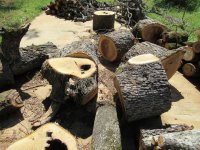
I had a big oak tree that appeared to be hollow and if it fell on it's own there could be a lot of damage. So, I had it cut down. I now have many 16" lengths of 24" rounds of white oak. They need to be split, some are from the crotch area with a large branch coming off the main trunk. I will have to have a log lift. I do have a tractor that can lift them, but maneuvering them with the tractor will be a problem so I can't count on placing them on the splitter with the tractor. So what size/tonnage/??? of splitter do I need to get? I haven't called the rental yard yet, but I need your advise to be sure I get a big enough one.
IMG_0798.jpg IMG_0799.jpg
 
/ Log splitter size #2  
rent a vertical splitter, 20 tons will be fine. You don't need to split the ugly pieces through the tough going. Just lop off the good stuff and through the crap off into the ditch.
 
/ Log splitter size #3  
My 28 ton Huskee would eat them for lunch. I've busted bigger than that. I stood it up vertical for the ones too heavy to lift and some of them took a few cracks to start breaking pieces off. It groaned and moaned a few times, but never stopped or gave me the feeling I was over taxing it.
 
/ Log splitter size #4  
"noodle" cut them with a chain saw. That's cutting along the grain. Wood cuts much faster that way than the normal cross cut. It's a quick way to get rounds into small enough sections to be picked up.

I've not had good results from a splitter in vertical mode. It takes a lot of upper body strength to muscle a round under the 'foot' and hold it there while the wedge comes down. But my legs and back are strong so I can pick up rounds or sections of rounds all day. YMMV.

Splitter "ton" ratings are usually inflated. Instead look at the cylinder bore size. Common sizes are 4", 4.5" and 5". My splitter has a 4.5" cylinder and it splits tan oak and dry Eucalyptus without trouble. I've only had a few crotches that stop it.
 
/ Log splitter size
  • Thread Starter
#5  
"noodle" cut them with a chain saw. That's cutting along the grain. Wood cuts much faster that way than the normal cross cut. It's a quick way to get rounds into small enough sections to be picked up.

I've not had good results from a splitter in vertical mode. It takes a lot of upper body strength to muscle a round under the 'foot' and hold it there while the wedge comes down. But my legs and back are strong so I can pick up rounds or sections of rounds all day. YMMV.

Splitter "ton" ratings are usually inflated. Instead look at the cylinder bore size. Common sizes are 4", 4.5" and 5". My splitter has a 4.5" cylinder and it splits tan oak and dry Eucalyptus without trouble. I've only had a few crotches that stop it.
I've read that the vertical mode is more difficult than it sounds. The upper body strength for me is an issue. I have problems with twisting and turning and looking back behind me to see how the implement is doing can be painful, I have to be very careful as to what I do. I'm also thinking of hiring some "kids" to do it, but have to consider liability.
 
/ Log splitter size #7  
I don't remember have much, if any trouble rolling rounds into place when using it vertical.


But I've slept since then.
 
/ Log splitter size #8  
I don't remember have much, if any trouble rolling rounds into place when using it vertical.


But I've slept since then.

At 15 inch length, those rounds don't need to be stood on end to burst them. Roll 'em in, down with the wedge.

Myself, I would use the wedge and sledge. But I like the exercise, even if I pay for it the day after ,(and the day after that ;-)
 
/ Log splitter size #9  
I've read that the vertical mode is more difficult than it sounds. The upper body strength for me is an issue. I have problems with twisting and turning and looking back behind me to see how the implement is doing can be painful, I have to be very careful as to what I do. I'm also thinking of hiring some "kids" to do it, but have to consider liability.

There are lots of student athletes who would jump at the chance to make a few bucks working out. You run the controls.
 
/ Log splitter size #10  
Running a log splitter in vertical mode is physically demanding work. Log splitters don’t split them in two all the time and you have to pull them back, spin the chunk and start splitting from another angle.

I have split tons of oak and they can be stringy where they don’t split clean for a splitter.

My cousin (45 years old) and I (21 at the time) had a race. I had only ever used a log splitter (35 ton) and he only ever a maul. We both cut 10+ cords a year.

He helped me split up a oak tree I dropped that could potentially fall on my mothers house with the right wind so I dropped it.

We both cut the tree into 15-18in pieces, I took the knotty wood and him the strait grain sections. After 2 hours out piles were about even and I was hustling, driving the ram as fast as the splitter would go slinging chunks of wood.

The next week I bought a maul and found out, in many cases for me the maul was easier and faster to use than running the splitter. Mainly because I could reset and swing a maul faster than spin a chunk and wait on a slow cylinder to drive a wedge. And I could bring the maul to the wood vs having to roll the wood to the splitter. I would only bring the splitter in for the knotty wood.

Two types of maul I would buy, the axe with the mechanism in the head to split the wood or those nice fiberglass handle maul with the splitting head they sell at TSC and rural king. They are light enough to swing at a good rate, I have used those heavy ones and after 10 swings I’m ready for a break lol.

I’m 29 now, I would go at it with a sharp maul first, then rent a splitter for what’s left.

20 tons will prob be fine, my cousin later bought a 20 ton splitter. I like the huskee 35 ton but lighter should be fine.
 
/ Log splitter size #11  
I've read that the vertical mode is more difficult than it sounds. The upper body strength for me is an issue. I have problems with twisting and turning and looking back behind me to see how the implement is doing can be painful, I have to be very careful as to what I do. I'm also thinking of hiring some "kids" to do it, but have to consider liability.

It helps if the foot of the splitter is flush to the ground when using in vertical mode. Either have the foot buried in soft debris, in a depression in the ground, or build a wood base that surrounds the foot. Quarter the pieces then flip it up to finish them off.
 
/ Log splitter size
  • Thread Starter
#12  
I appreciate all the input. I'll be 71 next month. In my younger years I used to split wood by hand. I have an axe, a sledge, a maul (basically a wedge on a handle) and the steel wedges. However, due to an injury I can no longer swing a sledge (or an axe). That is the method I would have preferred. I now have to use a machine to do what I used to do by hand.
 
/ Log splitter size #13  
I appreciate all the input. I'll be 71 next month. In my younger years I used to split wood by hand. I have an axe, a sledge, a maul (basically a wedge on a handle) and the steel wedges. However, due to an injury I can no longer swing a sledge (or an axe). That is the method I would have preferred. I now have to use a machine to do what I used to do by hand.

I feel your pain and we are all on the same path. If I was close by I'd help for a bag of homemade oatmeal cookies!
 
/ Log splitter size #14  
I roll everything onto a home made pallet type platform then lift level with the ram. Roll them onto the splitter and go to it. I can wrestle with big ones while standing and using the table for the drop off chunk. I had a 22 ton and seems to work fine but if it ever craps out I would get a 24+ ton.

I let big stuff sit a year or so and it seems to split a little easier plus the bark falls off better.
 
/ Log splitter size #15  
It helps if the foot of the splitter is flush to the ground when using in vertical mode. Either have the foot buried in soft debris, in a depression in the ground, or build a wood base that surrounds the foot. Quarter the pieces then flip it up to finish them off.

Mine does that.

However, due to an injury I can no longer swing a sledge (or an axe). That is the method I would have preferred.

Me and swingin' things don't get along. I got myself in the shin yesterday with a simple hand claw hammer. Ain't no chance of me even trying a maul, which would more likely maul me than the round.
 
/ Log splitter size
  • Thread Starter
#16  
I feel your pain and we are all on the same path. If I was close by I'd help for a bag of homemade oatmeal cookies!

Too bad you aren't closer. Oatmeal cookies are what I bake on a regular basis for the church. One more batch would be easy to do.
 
/ Log splitter size #17  
I've used a Huskee 22 ton splitter for Oak, Elm, Maple, Hickory, Ash, Black Locust, etc. Some have been 3' diameter trees, but most have been 2' and under. I struggle with the large stuff even when splitting vertical, but the splitter never backs down. I like the smaller splitter, which has a faster cycle speed than many larger ones, because I'd rather save time with faster cycles on 90% of my splitting which is the medium sized logs. But for vertical splitting, there have been some good threads on this site showing a platform built to surround the foot of the splitter on the ground. The most difficult part of vertical splitting is getting the log situated on that little foot end of the splitter, which is a couple inches tall. The home made platform (2'x2'x2"?) surrounds that foot and gives you a flat surface to slide or spin the large rounds. I haven't made one yet, but I get closer to doing that each year.
 
/ Log splitter size #18  
My issue is changing from horizontal to vertical. Up is bad enough. Down can cost you a finger if you lose your grip at the wrong moment. I'd like to find a way to crank it up and down.
 
/ Log splitter size #19  
My issue is changing from horizontal to vertical. Up is bad enough. Down can cost you a finger if you lose your grip at the wrong moment. I'd like to find a way to crank it up and down.

Try pivoting it with the wedge all the way down. I found that it counterbalanced it enough to make it pretty easy.
 

Marketplace Items

2012 BMW 328i Coupe (A61569)
2012 BMW 328i...
2017 FREIGHTLINER CASCADIA TANDEM AXLE SLEEPER TRUCK (A59904)
2017 FREIGHTLINER...
1999 TRANSCRAFT FLAT BED 48FT TRAILER (A59905)
1999 TRANSCRAFT...
LS XP8084 (A64126)
LS XP8084 (A64126)
EZ-GO Electric Golf Cart (A60462)
EZ-GO Electric...
2004 Chevrolet Tahoe 4x4 (MPV), VIN # 1GNEK13Z24R318274 (A61165)
2004 Chevrolet...
 
Top