LA125 Overhaul

   / LA125 Overhaul
  • Thread Starter
#21  
Well, just when I thought I had the mower finished up, I started it up and mowed a patch in front of the shop to see how it ran and mowed. At first it seemed okay, but then after a couple of minutes it started smoking blue smoke out the exhaust and missing sometimes.
I pulled it back into the shop and noticed a lot of oil on the frame behind the engine and running down onto the mower deck. When I pulled the dipstick, oil and vapor sprayed out all over because the was so much blowby in the crankcase.
Well, *****!
After I shut it down and pulled the dipstick again, the oil on it was already black as coal. Not good. 🙁
So, after mulling over what to do, I figured the engine had to come off and be checked out. I HOPE that a new set of rings, maybe a piston, and honing out the
cylinder will take care of it, but until I get it all apart, it's hard to say.
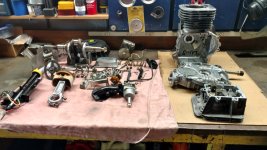
It was easy to get the engine out, only took about a half hour. Four bolts hold it to the frame, an electrical connector, starter cable, throttle cable, fuel line, remove the mower belt and finally take the bolt out of the drive pulley on the bottom and it slid right off the crankshaft. It not even that heavy, so I lugged it over and set it on the bench. Probably pull it apart tomorrow and see shat the verdict it.
 

Attachments

  • IMG_20220707_175924452 (Medium).jpg
    IMG_20220707_175924452 (Medium).jpg
    676.5 KB · Views: 165
  • IMG_20220707_175936385 (Medium).jpg
    IMG_20220707_175936385 (Medium).jpg
    732.4 KB · Views: 165
   / LA125 Overhaul #22  
Well that's an unfortunate turn of events, must say you have a great attitude!

When one get's vested in a restoration project like this one, you just have to push to the finish.
 
   / LA125 Overhaul #23  
That's frustrating, but as Carl said you've got the right attitude for this. You'll certainly have the nicest LA around when done.
 
   / LA125 Overhaul #24  
Bummer, wishing you luck that it’s not too tough to fix.

Mike
 
   / LA125 Overhaul #25  
Well, just when I thought I had the mower finished up, I started it up and mowed a patch in front of the shop to see how it ran and mowed. At first it seemed okay, but then after a couple of minutes it started smoking blue smoke out the exhaust and missing sometimes.
I pulled it back into the shop and noticed a lot of oil on the frame behind the engine and running down onto the mower deck. When I pulled the dipstick, oil and vapor sprayed out all over because the was so much blowby in the crankcase.
Well, *****!
After I shut it down and pulled the dipstick again, the oil on it was already black as coal. Not good. 🙁
So, after mulling over what to do, I figured the engine had to come off and be checked out. I HOPE that a new set of rings, maybe a piston, and honing out the
cylinder will take care of it, but until I get it all apart, it's hard to say.
It was easy to get the engine out, only took about a half hour. Four bolts hold it to the frame, an electrical connector, starter cable, throttle cable, fuel line, remove the mower belt and finally take the bolt out of the drive pulley on the bottom and it slid right off the crankshaft. It not even that heavy, so I lugged it over and set it on the bench. Probably pull it apart tomorrow and see shat the verdict it.
Hi BX
Don't rush to rip into your engine with rings etc. The oil on the frame and blow-by are the classic symptoms of a blown head gasket on that engine.
No biggie and an easy repair.
Notice that the oil on the frame (Chassis) will be coming from the breather gauze in the vacuum fuel pump in the Left Rear corner of the cowling?
That's the clue that the head gasket has blown between the cylinder and the pushrod tunnel cavity.
You'll see the blown evidence at the 3-o'clock position on the cylinder when you remove the cylinder head.

It's the common fault on this B&S engine model.
No need to open the crankcase. Just change the engine oil twice to flush it after you install a new head gasket.

Remove the engine cowel as you seem to have done.
Undo the carb mounting bolts and move the carb to the side (Don't disturb the rubber o-ring seal in the inlet manifold.
Remove rocker cover and rockers.
Note the pushrods are different so mark them upper & lower.
Undo the head bolts and prise away the cylinder head. You will immediately see the 'blow' and why it pressurises the crankcase through the pushrod tunnel.

Clean the combustion chamber and the surfaces gently.
Lots of info on the web and many 'cowboy' videos on youtube.
You can leave the exhaust pipe on since you have the engine on the bench.

Nice work on the rebuild so far.
 
   / LA125 Overhaul #26  
When re-installing the engine lock the Parking Brake pedal - This removes the tension on the transmission belt and makes the installation of the drive pulley easy.
It may be also easier for you to remove the exhaust pipe and re-fit it after the engine is mounted back on the chassis.
 
   / LA125 Overhaul
  • Thread Starter
#27  
Hi BX
Don't rush to rip into your engine with rings etc. The oil on the frame and blow-by are the classic symptoms of a blown head gasket on that engine.
No biggie and an easy repair.
Notice that the oil on the frame (Chassis) will be coming from the breather gauze in the vacuum fuel pump in the Left Rear corner of the cowling?
That's the clue that the head gasket has blown between the cylinder and the pushrod tunnel cavity.
You'll see the blown evidence at the 3-o'clock position on the cylinder when you remove the cylinder head.

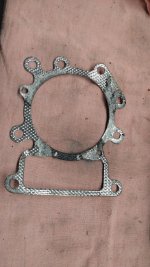
Too late! I pulled the engine apart this afternoon. The head gasket looked okay, I didn't see any area that looked blown, but I guess it could have seen leaking. I did find the two compression ring gaps were within 1/2 inch of each other and the oil ring had virtually no tension on it, which is why there was a lot of oil in the cylinder. The bore look very good, plenty of cross hatch still visible, Piston looks very good, as does to connecting rod and crank journal.
I ordered a set of rings and a gasket and seal kit this afternoon from my local JD dealer, so I should have them early next week. I spent a couple of hours cleaning up the crankcase, bottom cover and cylinder head. Also blasted and painted the rocker cover and a couple other parts that were rather rusty. Will probably get the rest of the parts all cleaned up tomorrow.
I had one small screw that holds the cooling baffle to the the bottom of the cylinder, snap off, despite tapping on it with a hammer and gently working it back and forth, so I'll work on getting that out tomorrow also.
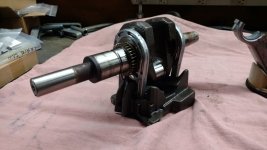
I was surprised when I got the bottom cover off the engine and saw the huge balance weight attached the the crank. I've never seen one of those before.
I'll knock the glaze off the cylinder wall and get a nice new crosshatch in it so it'll be ready to reassemble when I get the parts.

Edit: On examination of pictures I took, it does look like the head gasket was blown like you suggested. Oh well, at least now I know it will be right, and like I said, there was a lot of oil in the cylinder when I took the head off.
 

Attachments

  • IMG_20220708_150048814 (Medium).jpg
    IMG_20220708_150048814 (Medium).jpg
    616.9 KB · Views: 170
  • IMG_20220708_150001643_HDR (Medium).jpg
    IMG_20220708_150001643_HDR (Medium).jpg
    733.3 KB · Views: 171
  • IMG_20220708_145951475_HDR (Medium).jpg
    IMG_20220708_145951475_HDR (Medium).jpg
    826.8 KB · Views: 158
  • IMG_20220708_142206725_TOP (Medium).jpg
    IMG_20220708_142206725_TOP (Medium).jpg
    424.3 KB · Views: 148
  • IMG_20220708_141938740 (Medium).jpg
    IMG_20220708_141938740 (Medium).jpg
    360.4 KB · Views: 157
  • IMG_20220708_141851460 (Medium).jpg
    IMG_20220708_141851460 (Medium).jpg
    501.2 KB · Views: 177
Last edited:
   / LA125 Overhaul #28  
Wow, you got right after that. Thanks for keeping us informed. Much appreciated.
 
   / LA125 Overhaul
  • Thread Starter
#29  
When re-installing the engine lock the Parking Brake pedal - This removes the tension on the transmission belt and makes the installation of the drive pulley easy.
It may be also easier for you to remove the exhaust pipe and re-fit it after the engine is mounted back on the chassis.
Thanks for the tip, I was kinda wondering how to do that. (y)
It's the common fault on this B&S engine model.
No need to open the crankcase. Just change the engine oil twice to flush it after you install a new head gasket.
So, is there a tip to keep it from blowing again?
 
   / LA125 Overhaul #30  
So, is there a tip to keep it from blowing again?
No, not really.
The 'tip' is to recognise when it is blowing.

In your 6th photo of the cylinder cross-hatching you can see the blown area right there at 3-o'clock between the cylinder and the pushrod cavity.
Understand that this is a design issue where there is no head bolt in that area at all so clamping pressure on the gasket is reliant upon the head bolts at 1 o'clock and 5 o'clock.

That's a lot to ask for a simple compound head gasket to deal with. Inevitably, yes, it will happen again.

The telltale indication of trouble is when you begin to see oil on the area around the vacuum fuel pump at the rear of the engine cowl. In addition to the crankcase breather the additional excess pressure in the crankcase is relieved by blowing through the pulse line to the fuel pump. Eventually you begin to see oil on the chassis in the area near your left foot. (Below the fuel pump)

At that point, where oil is on the chassis you know your head gasket is a goner.

The upside is that it's a relatively simple repair in-situ. An hour, (in the field even) , at most.

The downside is that if you miss the oil-on-chassis-signal (Red Alert!) you will lose the engine through "insufficient lubrication".

Easy monitoring involves checking the dipstick every time before mowing. It's that simple.
(Most operators, however, don't bother.)

If you notice a drop in oil level on the dipstick - Where has it gone? Look for the oil on chassis...

Second - look on the crankshaft pulley in-case the lower crankshaft oil seal has failed.

When refitting the cowl to the engine take care to correctly align the 'finned edges of the dipstick tube with the grooves inside the cowl. (Practice upside down on the bench first so you can see how it sleeves together.)

Also that air-duct shield you mentioned above has two tabs that fit on the cowl.
Another pair of hands can be useful when refitting this together with the dipstick tube and a keeping it all aligned.
 
   / LA125 Overhaul
  • Thread Starter
#31  
No, not really.
The 'tip' is to recognise when it is blowing.

In your 6th photo of the cylinder cross-hatching you can see the blown area right there at 3-o'clock between the cylinder and the pushrod cavity.
Understand that this is a design issue where there is no head bolt in that area at all so clamping pressure on the gasket is reliant upon the head bolts at 1 o'clock and 5 o'clock.

That's a lot to ask for a simple compound head gasket to deal with. Inevitably, yes, it will happen again.

The telltale indication of trouble is when you begin to see oil on the area around the vacuum fuel pump at the rear of the engine cowl. In addition to the crankcase breather the additional excess pressure in the crankcase is relieved by blowing through the pulse line to the fuel pump. Eventually you begin to see oil on the chassis in the area near your left foot. (Below the fuel pump)

At that point, where oil is on the chassis you know your head gasket is a goner.

The upside is that it's a relatively simple repair in-situ. An hour, (in the field even) , at most.

The downside is that if you miss the oil-on-chassis-signal (Red Alert!) you will lose the engine through "insufficient lubrication".

Easy monitoring involves checking the dipstick every time before mowing. It's that simple.
(Most operators, however, don't bother.)

If you notice a drop in oil level on the dipstick - Where has it gone? Look for the oil on chassis...

Second - look on the crankshaft pulley in-case the lower crankshaft oil seal has failed.

When refitting the cowl to the engine take care to correctly align the 'finned edges of the dipstick tube with the grooves inside the cowl. (Practice upside down on the bench first so you can see how it sleeves together.)

Also that air-duct shield you mentioned above has two tabs that fit on the cowl.
Another pair of hands can be useful when refitting this together with the dipstick tube and a keeping it all aligned.
Thanks for the info and I agree it's a poor design with no head bolt in that area. The intake runner goes right through where it needs another one.
One Youtuber suggested giving the head gasket a coat of copper gasket sealer, which doesn't sound like a bad idea. We used to use it on some of the old engines in construction equipment that really needed the heads milled or the block decked, just to get them through the season and get fixed over the winter.
Yes, I know about the dipstick tube and shroud that goes around the cylinder, and was able to get them in place when I had the flywheel cover off before.
I got everything cleaned up this afternoon, and deglazed and crosshatched the cylinder bore. The is no wear in it that I can detect, which is amazing considering the lack of maintenance it has had.
I bead blasted and painted some parts that were pretty rusty, especially the flywheel. I looked like water had been setting on it a lot, it was rusted pretty badly but cleaned up pretty well. Even the mag coil was rusted badly and the metal got blasted and painted.
Drilled out the broken screw on the under side of the cylinder and had to tap it 10-24 to get it cleaned up.
When I ordered parts for the engine, I couldn't read the engine model number off the rocker cover because it was rusted so bad. I could see a few really vague parts of a couple of numbers, but that was it, but it looks like the LA125 only used a few models that had the same internals.
One thing that I cant believe on the engine is that the only lower thrust surface on the crank is the toothed side of the gear that drives the camshaft. there is so little surface there. I know that's the way it goes, because I can see the witness marks on the other side where it presses against the eccentric that the balance weight runs on.
I think after I get back together and give it back to my niece, I'll make it a point of checking on it a couple of times in the summer, and pick it up every fall and check it out and service it. I've put too much time and money into it to let go to pot again.
 

Attachments

  • IMG_20220709_141631145_HDR (Medium).jpg
    IMG_20220709_141631145_HDR (Medium).jpg
    743.2 KB · Views: 159
  • IMG_20220709_122440890 (Medium).jpg
    IMG_20220709_122440890 (Medium).jpg
    806.2 KB · Views: 157
Last edited:
   / LA125 Overhaul #32  
They really should have a fire ring style gasket on these. They have increased the torque to 250 inch pounds and updated the torque sequence a while back. You shouldn't use a dressing of any kind. Clean up is king. I do them all the time and it takes me an hour and a half.
 
   / LA125 Overhaul
  • Thread Starter
#33  
They really should have a fire ring style gasket on these. They have increased the torque to 250 inch pounds and updated the torque sequence a while back. You shouldn't use a dressing of any kind. Clean up is king. I do them all the time and it takes me an hour and a half.
Okay, that's good information.
What's the tightening sequence, I haven't been able to find a diagram that shows it.
 
   / LA125 Overhaul #34  
I hate to disagree with tom P, but you really should use a gasket sealant on that. They make gasket sealant for a reason.

Also run a file over the head and cylinder mating surfaces to make sure that they are flat. Check the head carefully. If you run the file over the head in the area where the gasket failed and the file does not pick up the surface in that area, I suggest that you use a metal flat plate with sandpaper on it to get the warpage out of the head.

Richard
 
   / LA125 Overhaul
  • Thread Starter
#35  
I hate to disagree with tom P, but you really should use a gasket sealant on that. They make gasket sealant for a reason.

Also run a file over the head and cylinder mating surfaces to make sure that they are flat. Check the head carefully. If you run the file over the head in the area where the gasket failed and the file does not pick up the surface in that area, I suggest that you use a metal flat plate with sandpaper on it to get the warpage out of the head.

Richard
I have a big flat mill file I might try on the head

I was thinking about using a flat plate and some sandpaper on the head and block mating surfaces to make sure they are flat.

Anyone know what the torque is on the case half bolts?
 
   / LA125 Overhaul #36  
I wouldn't use a file.
I'd put some wet/dry sandpaper placed on a glass plate. And use light oil or water with 220 grit paper.

Something like this video shows.
 
   / LA125 Overhaul #37  
I have a big flat mill file I might try on the head

I was thinking about using a flat plate and some sandpaper on the head and block mating surfaces to make sure they are flat.

Anyone know what the torque is on the case half bolts?
220" #s
 
   / LA125 Overhaul #38  
I hate to disagree with tom P, but you really should use a gasket sealant on that. They make gasket sealant for a reason.

Also run a file over the head and cylinder mating surfaces to make sure that they are flat. Check the head carefully. If you run the file over the head in the area where the gasket failed and the file does not pick up the surface in that area, I suggest that you use a metal flat plate with sandpaper on it to get the warpage out of the head.

Richard
It would be interesting to hear your take on this. What would you use? Bear in mind that this is a grafoil head gasket. I saw someone somewhere was making them out of copper? Is this a better idea ?
 
   / LA125 Overhaul
  • Thread Starter
#39  
While pondering the head gasket sealing problem, I remembered how some racing engine builders o-ringed the tops of the blocks and laid a soft copper wire in the groove to help clamp and seal the head gasket. Sounds like a possible solution for these engines unless someone comes out with a real head gasket with a fire ring seal instead of just stamping them out of a sheet of material.
If I had a mill, I would seriously consider making a fixture to hold the block to do that. There are also grooving tools available, but at over $300 I'll try something cheaper for now.
 
   / LA125 Overhaul #40  
The OEM gasket has a slight embossment, but yes an actual fire ring should do the trick.
 

Marketplace Items

Toyota 7FGCU25 5,000 LB Cushion Tire Forklift (A59228)
Toyota 7FGCU25...
2018 FREIGHTLINER M2 FORESTRY UTILITY BUCKET TRUCK (A59823)
2018 FREIGHTLINER...
Meyer 8' Snow Plow w/ Bracket (A55272)
Meyer 8' Snow Plow...
FUTURE 60" PALLET FORK (A60432)
FUTURE 60" PALLET...
2019 FORD F-150 STX CREW CAB TRUCK (A59823)
2019 FORD F-150...
2014 International Maxxforce DT (A53317)
2014 International...
 
Top