Full Frame

/ Full Frame #1  

EhM8

Bronze Member
Joined
Apr 11, 2008
Messages
59
Here in Australia, John Deere have recently released the 5020 series full frame designed tractors, which seems to be the smaller version of the 6020 series. I have the impression that the 5020 tractors in the US might be a different model, I am not sure. Anyway, reading the John Deere speel about the full frame design, it sounds pretty good.

The main advantage I see is to the manufacturing side of things, being able to assemble tractors using a modular approach, thus allowing for more combinations of transmissions and engines. One advantage they claim is that the frame takes the load off of the transmission and engine housings, and enables tractors to therefore be made lighter. I am not sure this is a great thing with lighter tractors in the 50-100hp, because for loader and farm work, you usually want a bit more weight rather than less. Having a bolt on frame in some of the sticky, clay country we have around here, to my mind might also provide a few more nooks and crannies for mud to get caked in, but that is only a minor thing.

What I am wondering is why if this is such a good and cost effective way to make tractors, why haven't the other tractor companies copied it, and why wasn't it done before? It seems a pretty obvious idea, so why did they start making tractors with load bearing transmission and engine housings in the first place instead of having a frame?
 
/ Full Frame
  • Thread Starter
#2  
Hmm, I can't seem to find the US equivalent of the 5020 series on the US John Deere site, so here is the Australian page with the 5020 tractor for those who wonder what I am talking about

5020 Series Full Frame Tractors

These tractors are made in germany apparently.
 
/ Full Frame #3  
I was reading some discussion on this recently. The JD techs were saying it has increased the cost of clutch replacment due to increased tear-down time.

Valtra-Valmet I believe have a full frame too but you don't need to strip the frame I understand for a lot of repairs. I've heard there is a short stub shaft between engine (donk) and tranny you can remove to drop the bellhousing and get at the clutch.
 
/ Full Frame #4  
EhM8 said:
Here in Australia, John Deere have recently released the 5020 series full frame designed tractors, which seems to be the smaller version of the 6020 series. I have the impression that the 5020 tractors in the US might be a different model, I am not sure. Anyway, reading the John Deere speel about the full frame design, it sounds pretty good.

The main advantage I see is to the manufacturing side of things, being able to assemble tractors using a modular approach, thus allowing for more combinations of transmissions and engines. One advantage they claim is that the frame takes the load off of the transmission and engine housings, and enables tractors to therefore be made lighter. I am not sure this is a great thing with lighter tractors in the 50-100hp, because for loader and farm work, you usually want a bit more weight rather than less. Having a bolt on frame in some of the sticky, clay country we have around here, to my mind might also provide a few more nooks and crannies for mud to get caked in, but that is only a minor thing.

What I am wondering is why if this is such a good and cost effective way to make tractors, why haven't the other tractor companies copied it, and why wasn't it done before? It seems a pretty obvious idea, so why did they start making tractors with load bearing transmission and engine housings in the first place instead of having a frame?

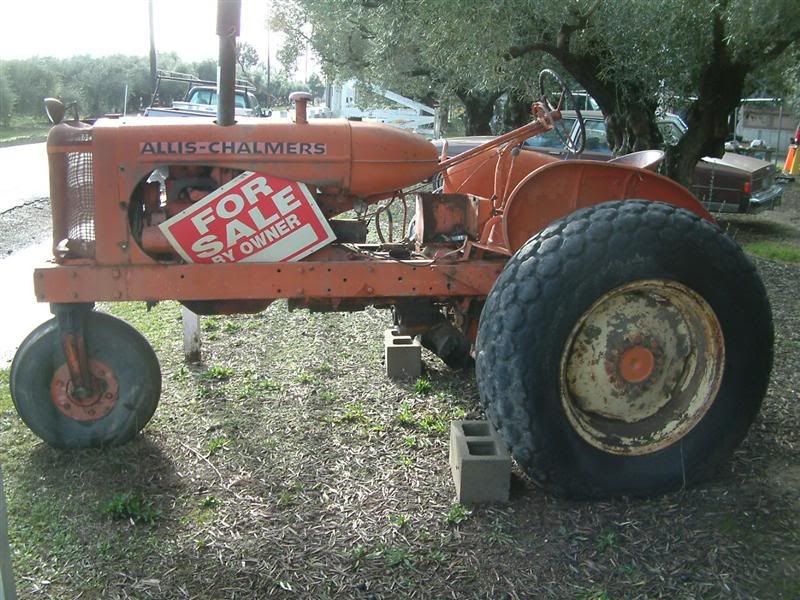
Don't know if this one qualifies as "full-frame", but the old Allis Chalmers WD has a lot of frame under it

ACWDtractor.jpg
 
/ Full Frame #5  
I've always heard of WD's but never seen one, that a heck of a long wheelbase!
 
/ Full Frame #6  
slowzuki said:
I've always heard of WD's but never seen one, that a heck of a long wheelbase!

Yep, the wide-front WDs had the frame sticking out in front of the radiator. The narrow front and 3-wheelers had a little different arrangement.

DSCF0009Medium.jpg


DSCF0005Medium-1.jpg


One of my neighbors has this WD for sale. I'm partial to the wide front version--not as tippy as the narrow front types.
 
/ Full Frame
  • Thread Starter
#7  
slowzuki said:
I was reading some discussion on this recently. The JD techs were saying it has increased the cost of clutch replacment due to increased tear-down time.

Valtra-Valmet I believe have a full frame too but you don't need to strip the frame I understand for a lot of repairs. I've heard there is a short stub shaft between engine (donk) and tranny you can remove to drop the bellhousing and get at the clutch.

It is probably a good thing then that most of them probably come with wet clutches then, but that is something I hadn't thought of. It's be simpler to attach an loader to one of these tractors, but yeah, a lot more bolts if you had to pull it down. Think I read that the Valtra tractors use the fuel tank as a structural component or something.
 
/ Full Frame
  • Thread Starter
#8  
flusher said:
Don't know if this one qualifies as "full-frame", but the old Allis Chalmers WD has a lot of frame under it

ACWDtractor.jpg

There you go. I knew it must have been done before at some stage.
 
/ Full Frame #9  
Old tractors all had a riveted frame, to hang a marine diesel to, and some shafts and chain sprockets.. Henry Ford and Harry Ferguson took the approach of integrating the engine into the frame, to make them stiffer and build cheaper.

The major disadvantage is that you need an engine, specifically designed as a tractor engine (to be able to be of structural support to the tractor) because an automotive engine doesnt have the reinforcements.
A tractor engine is often too heavy for on-road use. That was the concession that Case had to make when they chose to co-develope their new engine line with Cummins, back in 1981. Because an engine designed to be used as a tractor frame part, would be too heavy and uneconomical to fit a Dodge truck, they went with a light industrial style engine block, which meant that Case had to use a front frame.

On the other hand, when the frame structure is integrated into the engine, the engine is generally stiffer and would deform less during operation.


The only advantage i see in the JD frames, is that its easier to mount a side arm ditch mower, front loader or front 3pt hitch. Because the frame rails are at a wider spacing, they provide more lateral strength than bare engine and gearbox castings, which will need an additional subframe with rear axlebars.


Old fergies came in 2 varieties: Those with, and those without front frame. I think it had to do with it having the Standard, or the Perkins engine.
 
/ Full Frame #10  
OH and Valtra:

Valtra uses a different approach: They use not the engine BLOCK as an integrated frame part, but the OIL SUMP as integrated frame part. This means that it takes advantage of both strategies: With a sheetmetal sump, they have a light industrial engine, and with the heavy cast sump, they have an engine integrated to the frame.

Valtra uses a very short and compact transmission, located under the drivers seat. Its only just over a yard long.
The engine and transmission are coupled by a welded fuel tank (which is also a structural frame part)
Because of this, Valtra can offer the same tractor with different wheelbases, and weight distribution ratios ( 50/50 for field tractors, 40/60 for utility loader tractors)
 
/ Full Frame
  • Thread Starter
#11  
Renze said:
Old tractors all had a riveted frame, to hang a marine diesel to, and some shafts and chain sprockets.. Henry Ford and Harry Ferguson took the approach of integrating the engine into the frame, to make them stiffer and build cheaper.

The major disadvantage is that you need an engine, specifically designed as a tractor engine (to be able to be of structural support to the tractor) because an automotive engine doesnt have the reinforcements.
A tractor engine is often too heavy for on-road use. That was the concession that Case had to make when they chose to co-develope their new engine line with Cummins, back in 1981. Because an engine designed to be used as a tractor frame part, would be too heavy and uneconomical to fit a Dodge truck, they went with a light industrial style engine block, which meant that Case had to use a front frame.

On the other hand, when the frame structure is integrated into the engine, the engine is generally stiffer and would deform less during operation.


The only advantage i see in the JD frames, is that its easier to mount a side arm ditch mower, front loader or front 3pt hitch. Because the frame rails are at a wider spacing, they provide more lateral strength than bare engine and gearbox castings, which will need an additional subframe with rear axlebars.


Old fergies came in 2 varieties: Those with, and those without front frame. I think it had to do with it having the Standard, or the Perkins engine.

Yes, I've seen plenty of tractors that have the front frame. Both the Belarus and the old Inter I had, had the frame on the front. That is something I forgot to mention that the full frame provides an attachment point. I have the Case that has the additional frame that goes back to the rear added with the loader. As you often need the extra weight with a smaller tractor anyway, this isn't a big issue for me. I will maybe consider either a JXU80 or a JD 5020 series full-frame tractor made in germany as my next tractor purchase, but I don't think the full-frame will be the deciding factor. CNH seem to be sticking with Cummins still - seems a few of their Iveco engines are actually cummins design - I wonder if when Iveco makes them if they are strengthening the engine block. I noticed though my neighbours CVX had Sisu Diesel stamped on the engine.
 
/ Full Frame #12  
Just one thing to check will be the front wheel track width. Usually the frame tractors need a wider track to allow the same turning circle as a tracor with a stressed block. The frame does make loader mounting easier, but it does come at a cost of track width. This may or may not be an issue for you in your application. If your in vineyard or row crop work, you will need to consider this. If your in a normal ag situation, then it won't be so much of an issue. Have you looked at any other brands other than JD and Case? You will find most of the Perkins powered tractors in that power range will have a stressed block. Best of luck with your purchase.
 
/ Full Frame
  • Thread Starter
#13  
Trac-Tech said:
Just one thing to check will be the front wheel track width. Usually the frame tractors need a wider track to allow the same turning circle as a tracor with a stressed block. The frame does make loader mounting easier, but it does come at a cost of track width. This may or may not be an issue for you in your application. If your in vineyard or row crop work, you will need to consider this. If your in a normal ag situation, then it won't be so much of an issue. Have you looked at any other brands other than JD and Case? You will find most of the Perkins powered tractors in that power range will have a stressed block. Best of luck with your purchase.

I run a livestock enterprise - so it is direct drilling legumes into grass country and experimenting with this pasture cropping thing that is developing here. I have a ROPS tractor at the moment, and most of the time I prefer it to having a cab, but now I am boom spraying a bit, and one of the chemical they use in pasture cropping is Sprayseed, it would probably be a bit healthier to have a cab. Locally, we only have CNH, JD and Kobota dealers. The New Holland Dealer had McCormick for a while, but doesn't seem to be stocking them anymore. What are the four cylinder perkins like on fuel, do you know? They seem to be making power at lower revs than the equivalent Iveco/Cummins engines in the CNH tractors.
 
/ Full Frame #14  
Renze said:
The only advantage i see in the JD frames, is that its easier to mount a side arm ditch mower, front loader or front 3pt hitch. Because the frame rails are at a wider spacing, they provide more lateral strength than bare engine and gearbox castings, which will need an additional subframe with rear axlebars.


Old fergies came in 2 varieties: Those with, and those without front frame. I think it had to do with it having the Standard, or the Perkins engine.

My 1964 MF-135 with the Perkins diesel has the typical arrangement with engine serving as tractor frame. Make removing the oil pan a real job since that pan is a heavy casting insteady of a lightweight sheet metal part.
 
/ Full Frame #15  
Frame vs no frame is probably a combination of engineering requirements vs cost. Most small, newer tractors have no frames, with some exceptions. On midsize, there are mostly straight frames MFWD tractors but some no frame tractors. Also on the midsize the blocks and tranies are short in overall wheelbase and can manage without frames if the components are engineered strong enough. On current, larger ag tractors, the frames are "sculpted" to allow the large MFWD front wheels to get closer to the engine for better turning radius. The sculpted frames curve in toward the engine and have become popular in the past 10 years. Usually made of cast iron. The higher HP large ag tractors are longer, heavier, can have dual MFWDs and require frames that seem massive. They also are often fitted with 500-750 gallon saddle tanks for spraying or liquid fertilizer application. These are also mounted on the frames between the front and rear tires and/or on the front of the tractor. These can add several thousand lbs of additional wt. Bouncing through a field results in a lot of stress on the frames and the mounting brackets are thick steel. Our 600 total gallon saddle tanks have cracked the 1" thick mounting plates in the past.
 
/ Full Frame #16  
Where abouts are you located? There have been a few changes in the McCormick network here in Aus. If you would rather pm me, I can check out the nearest dealer from you. As far as fuel economy goes from the Perkins 1104T engine, I believe that you will find it very comparable with other brands.
The reality is that there are some brands that are heavier on fuel and some that are more misery, but they aren't that far away from one another.
Anyway, if there is any more I can do for you, either let me know from here or drop me a pm.
All the best & cheers.
 
/ Full Frame #17  
EhM8 said:
I noticed though my neighbours CVX had Sisu Diesel stamped on the engine.

Your neighbours CVX is a rebadged Steyr- an Austrian brand which was taken over by Case in 1996. Later, Case was taken over by NH to form CNH

Steyr has worked with Valtra/Valmet/Sisu, and in the 80's also with Deutz.
The Case IH CVX was sold as 9000 CVT series by Steyr, and were developed before 1996 when Steyr was using mostly Sisu engines, and purchased their bigger models from Valmet (Which Valmet had being built at the French Massey Ferguson plant in Beauvais, with their own cab but MF dynashift rear end: MF also used sisu/valmet engines since that era)
 
/ Full Frame #18  
It looks like a cross between our old 6020 Series and the new 6030 Series-great Tractors, and we have never touched a Clutch in one of those due to them being a multi-disc, oil bathed unit.

Great Tractors, we sell a lot of them. As for the Frame desing, it is nothing really new-CIH has used it, but it does take the stress off of the Engine Block and Transmission Case-
 
/ Full Frame #19  
Looking over some other machines, almost anything with a loader gets plate rails from nose to cab anyways so it isn't a huge change. Strange enough on my little kubota, no plate on the front but braces from the mounts back like some old loaders.
 

Marketplace Items

New/Unused 1in ALR Impact Wrench (A61166)
New/Unused 1in ALR...
New/Unused Landhonor Grapple Bucket (A61166)
New/Unused...
2015 Komatsu HM400 (A61166)
2015 Komatsu HM400...
DRAGON 500 BBL ACID TANK (A58214)
DRAGON 500 BBL...
Redirective Crash Cushion Guardrail (A61568)
Redirective Crash...
(6) SALT BLOCK HOLDER (A62131)
(6) SALT BLOCK...
 
Top