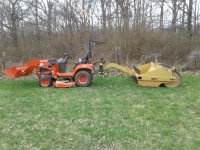
Field and Road Roller in the works

   / Field and Road Roller in the works #1  

Darryle

Silver Member
Joined
May 2, 2020
Messages
160
Location
Weatherford, Texas
Tractor
John Deere
I have several places in the pasture that hold water because of compaction, the problem has existed for as long as anyone can remember. The issue is that the fields are rutted up, rough and hard to maintain. There is a substantial amount of native grasses for grazing and about 15 acres of coastal bermuda that will become our hay and wintering grazing pasture.

I have subsoiled almost the entire 31 acres, some twice since I couldn't get the penetration I wanted on the first pass. I am also in the first stages of designing(trying to figure out what shape and how many spikes I will need for maximum penetration) and parts gathering for a rolling spike aerator. That will be a seperate thread.

I want to make this place as no till as possible while maintaining healthy soils and grasses. The aerator will also have an electric broadcast spreader because I want to sow wildflowers in the spring and fall since we just purchased the first two 7 frame Flow Hives, with plans to add several more.

I wanted a field roller that could do double duty as a compactor for the ranch road. The tank I purchased is approximately 54" long and 44" in diameter. I have calculated it out and I think it is 500/525 gallons. There is no plate on it, I can see where it was though. It is heavy enough that my little 3032e struggled to pick it up to load on the trailer, in fact it became a game of walking it on the trailer and off again when I got it home. I purchased the 2" cold rolled bar stock for the axle, 3" x 3" 1/4" wall square tubing for the frame and tongue and 2 2" pillow block bearings. I am going to fill it with sand versus water for the additional weight. If I calculated the volume right, that puts the ballast at approximately 6200lbs.

Pic of the unmolested tank

full-25419-238261-roller.jpg


More to come.
 
   / Field and Road Roller in the works #3  
Looks like a used propane tank. There are probably residual propane fumes in there. Are you going to drill a hole for the axle?
 
   / Field and Road Roller in the works #5  
Fill that thing full of water to push all fumes out before doing anything with it! Doesn't take much to go wrong. If you have some high temperature hose that you could get exhaust from a gas engine into it would also work. Just need to displace the residual fumes. Great idea and have seen 100 gal tanks used as rollers.
 
   / Field and Road Roller in the works
  • Thread Starter
#6  
It was a propane tank, the valves had been removed prior to me getting it. The guy I bought it from had it for close to 5 yrs and it was open when he got it. There is no residual smell of mercaptan.

I have a carbide hole saw that I will use to make the holes for the axle.
 
   / Field and Road Roller in the works #7  
Fill that thing full of water to push all fumes out before doing anything with it! Doesn't take much to go wrong. If you have some high temperature hose that you could get exhaust from a gas engine into it would also work. Just need to displace the residual fumes. Great idea and have seen 100 gal tanks used as rollers.

Exhaust gas is also explosive.
 
   / Field and Road Roller in the works #9  
It was a propane tank, the valves had been removed prior to me getting it. The guy I bought it from had it for close to 5 yrs and it was open when he got it. There is no residual smell of mercaptan. I have a carbide hole saw that I will use to make the holes for the axle.

While welding in the oil patch, first thing we were taught was to not weld on any old tank. Enough flammable materials would leach out of the steel to make it explosive no matter how many years ago it was last used.. As others have suggested, it needs to be filled with something like Co2 or H2O to keep it from gathering whatever flammable materials and making it unsafe to work on. Personally I'd just fill it with water.
 
   / Field and Road Roller in the works #10  
Have cut a few propane tanks, always fill with water. Leave the water in. Angle grinder with a thin blade, plan your cuts.
 
   / Field and Road Roller in the works
  • Thread Starter
#11  
It's going to be tough, the axle is going to go all the way thru the tank. I have rigid all steel casters to make me a roller so I can find center. Once I have center, I am going to use a carbide hole saw to make the holes for the axle. It's going to be tough to weld the axle in if I have water leaking out around the axle.

I was planning on using sand for the ballast, I am wondering if sand would mitigate any chance of explosion or expansion? I am honestly not worried, the last two guys who had it for a couple of years each, had left it open to the atmosphere, the first guy pulled all the valves.

I need someone else to calculate the volume to make sure I have the weight correct. Tank is 36" in diameter and overall it is 63" long, center section is 45" to the center of the cap welds and the caps are 8 1/2" deep from the center of the weld.

Thanks Darryle
 
   / Field and Road Roller in the works #12  
Water is just to purge for the initial cut. Once the cuts are made, drain and good to go.
 
   / Field and Road Roller in the works #13  
You have 3 parts to your roller: a dome 36" diameter at the base and 8.5" tall (not a hemisphere), a cylinder 36" diameter 45" long, and another dome. Since the dome is a small slice off of a bigger ball, we have to figure the radius of the bigger ball. Then can add all the pieces together.

First, need radius of the tank end domes:
R = (r^2 + h^2) / 2* h
R = 18^2 + 8.5^2) / 2 * 8.5 = 23.3 inches (radius)​

Volume of the dome:
V = 1/3 pi * h^2 (3R - h)
V = 4,645 cu in​

Volume of center cylinder:
B = pi * r^2 (area of circle)
V = B * h
V = pi * 18^2 * 45
V = 45,804 cu in.​

Summing the parts:
Dome + cylinder + dome:
4,645 + 45,804 + 4,645 = 55,094 cu in = ~31.9 cu ft = ~1.18 cu yd​

That's what I came up with. How well does it match your calculation?
 
   / Field and Road Roller in the works
  • Thread Starter
#14  
I calculated it at approximately 250gals. My original calculation was using the dimensions that the seller listed in the Craigslist ad. I recalculated it using the actual dimensions once I had it up on the rollers.

To be honest, I used an online calculator, while I use math a lot at work, volume calculations are not a part of my daily tasks, so I stink at.
 
   / Field and Road Roller in the works #15  
I calculated it at approximately 250gals. My original calculation was using the dimensions that the seller listed in the Craigslist ad. I recalculated it using the actual dimensions once I had it up on the rollers. To be honest, I used an online calculator, while I use math a lot at work, volume calculations are not a part of my daily tasks, so I stink at.

And why are you overly worried about the finale weight? If I got that number with 20%, I'd call it perfect.
 
   / Field and Road Roller in the works
  • Thread Starter
#16  
My only concern with the weight is I have a long downhill section that crosses a cattle guard, figure I will have to use the truck versus the tractor for this section.
 
   / Field and Road Roller in the works #17  
My only concern with the weight is I have a long downhill section that crosses a cattle guard, figure I will have to use the truck versus the tractor for this section.

You don't have to fill the roller completely full. Just add enough sand/water/whatever to get to the weight you want.

As for the volume, the 250 gallons * 231 cu in per gallon equals 33.4 cu ft so, close enuf.
 
   / Field and Road Roller in the works #18  
Using sand on a partly filled roller will result in high drag as you are mixing the sand while rolling. Water will be less draggy for the same volume. Will you use this in winter? If so what are your minimum tempertures.
 
   / Field and Road Roller in the works
  • Thread Starter
#19  
I live west of Fort Worth, while it doesn't get extremely cold for extended periods, 1 -2 days at most, it does get bitterly cold(for Texas) on occasion. It will be used in colder weather occasionally which is why I chose sand versus water. Usage will be dependent on the soil saturation. I have an area of about 1 1/2 acres around the old well head that is boggy and rough. Eventually I want to be able to cut and bale hay on every available acre.

I plan on filling it to capacity with sand to eliminate that friction.
 

Marketplace Items

7ft Pull-Behind Rake Tractor Attachment (A59228)
7ft Pull-Behind...
Kuhn FC400RG (A60462)
2003 VOLVO VNL TANDEM AXLE SLEEPER TRUCK (A59904)
2003 VOLVO VNL...
Freighliner Tender Truck (A61306)
Freighliner Tender...
2018 Ford F-350 (A55973)
2018 Ford F-350...
2023 CAN-AM HD7 RTV (A59823)
2023 CAN-AM HD7...
 
Top