Difficulty starting DK45SE in cooler weather (40's F)

   / Difficulty starting DK45SE in cooler weather (40's F) #1  

schweizer

Gold Member
Joined
Jan 22, 2012
Messages
329
Location
Southern Oregon
Tractor
Kioti DK45SE Hst
Hi guys,

In the past few days I've had quite a bit of trouble starting my Kioti. Bought new in Aug 2008, DK45SE HST, about 450 hours on it now. Starter cranks and cranks, lots of white smoke. After lots of cranking and glow plug use, it finally coughs to life with a cloud of dark smoke. It's almost acting like the glow plugs are not working, but I hear the click of the relay, and the light on the dash works (not that that means anything). Is there an easy way to check the glow plugs? Once the engine is warm or even after running for just 30-60 secs, it will restart just fine after turning it off. I've read a bunch about injection pumps on this forum, but this doesn't appear to be related. Thanks for any help.

Marcus
 
   / Difficulty starting DK45SE in cooler weather (40's F) #2  
Sounds like the glow plugs are not working.
When the engine is cold check for power at the glow plugs with a test light when you first turn on the key.
My DK 35 did the same thing a few years back. My problem was a faulty glow plug timer (around $50 for a timer).
 
   / Difficulty starting DK45SE in cooler weather (40's F) #3  
More than likely a bad glow plug relay......

BTI
 
   / Difficulty starting DK45SE in cooler weather (40's F) #4  
I agree with glow theory. Could also be the key switch (that was the problem with my DK45S). Get a voltmeter and measure the voltage between ground (engine block) and the rail that connects the tops of the glow plugs. It should read, about, 10-12 volts when you turn the key on and a little less while cranking the engine. If it's always zero volts, check the relay and fuses. If the voltage is OK until you crank, check the key switch. If the voltage is always good you probably have one or more bad glow plugs.
 
   / Difficulty starting DK45SE in cooler weather (40's F)
  • Thread Starter
#5  
Thanks for the replies. I'll check in the next few days and post back.

Marcus
 
   / Difficulty starting DK45SE in cooler weather (40's F) #6  
My dk40se hst dose the same thing has a hard time to start in cold but if i turn the key until the light goes out i shut it off and do it again then it turns over fine. But if i do it once it's hard to start and black smoke.
 
   / Difficulty starting DK45SE in cooler weather (40's F)
  • Thread Starter
#7  
Here's the current status: There's no voltage on the glow plug bar when it should be hot, and the fuses are fine. The glow-plug timer light on the dash would go on/off appropriately. So I brought the timer relay box and engine preheat controller box in to the dealer, but they said they had no way of testing them and I would have to bring in the tractor. What a bunch of BS. Just plug in each of my relay boxes in a functional tractor and see if that's the problem, but NO the mechanics excuse was that some electrical component could be fried by doing that. Come on, that a great way of doing computer repair, which I did for years before medicine. So I bought the preheat controller for $90 thinking that was the most likely culprit. No dice. Same problem. Spent until 11 pm last night testing. When I unplug the wire going to the glowplugs, the wire reads 12.5 V when the key is turned on (appropriate), but as soon as the glowplugs are connected to the wire again, voltage is 0 V again. There's good continuity between the wiring harness and the glowplug bar with an Ohmmeter. Now I'm stumped. I called a friend who has a big enough truck and trailer and the tractor went to the dealer this morning. (I only have a Toyota Tacoma and the dealer is 30 minutes away.)

Marcus
 
   / Difficulty starting DK45SE in cooler weather (40's F) #8  
Sorry 'bout the unnecessary preheat controller but that's why I recommend lots of testing vs just swapping parts. I suspect your dealer's mechanic will just swap more parts (needed or not) and you'll end up paying for all of them. Do you have a schematic for your specific tractor? That's pretty-much a requirement for locating the real problem. Locating the specific electrical parts (relays, wires, connections, etc.) is sometimes difficult but the online parts manuals (Michigan Iron Equipment is one of several) can be real helpful. The best diagnostic tool (after the electrical schematic) is a multimeter with real long leads with alligator clips at the ends. Good luck. Hope you don't have to buy more unnecessary stuff.
 
   / Difficulty starting DK45SE in cooler weather (40's F)
  • Thread Starter
#9  
Another update: called the dealer yesterday to see if they had any news for me. He said they found a glow plug broken off in the head and they had to take off the head and were waiting for a head gasket to put it back together. The only way I see a glow plug to get broken off in the head is if they broke it while trying to get it out. Can any diesel mechanics help me out here?
 
   / Difficulty starting DK45SE in cooler weather (40's F) #10  
... The only way I see a glow plug to get broken off in the head is if they broke it while trying to get it out. Can any diesel mechanics help me out here?

You are essentially correct but your dealer may be blameless on this particular point. I'm not familiar with details of the Kioti glow plug, but most glow plugs have a ceramic insulator supporting a heating element that sticks out into the prechamber. If this tip is bound up in enough carbon fouling it's going to break when you try to unscrew the glow plug from the head.

But, was the glow plug really bad? You state above that there was no voltage to the plugs when you should have it. Possibly that plug was shorted causing the voltage to go to zero when you connect the wire. I've encountered many open (burned out) glow plugs but never a shorted one. But I guess it could happen.
 
   / Difficulty starting DK45SE in cooler weather (40's F) #11  
Well it is too late now, but I would have ohmed the glow plugs with the rail off. They should be a little under 1 ohm , but not shorted. a little less than 1 ohm at 12.6 volt would draw a little over 12 amps so about 150 watts per plug. Now you say with the bar off you measure 12.6 volts on the bar, but with it connected you measure near 0 volts. So if none of the glow plugs are a dead short, and if they were, there should be a fuse blowing somewhere. So the only other explanation for the 0 volts on the rail when connected is there is a high resistance connection somewhere in the supply path to the plugs. Perhaps the relay contacts are burnt, or a high resistance connection to them. There is no question in my mind that this is your problem, you just have to find the high resistance that is causing the very low current flow and the extreme drop in voltage. When they get the piece of the glow plug out and the head back on and a new plug put in then they can start to troublshoot the problem again..because it will still be there. Your measurement of 0 volts on the rail when on and 12.6 volts when it is disconnected from the plugs tell the tale. E=IR Ohms law, is not just a good idea it is the law:) Think of your problem using this simple example.. Take a 12 volt battery and a taillight and hook them together. The tail light lights to full brilliance. Lets say for ease of calculation that the lamp pulls 1 amp of current and since P=EI the E(electromotive force, commonly called Volts) is 12 and we said the I (current measured in Amperes or amps) is 1 amp the wattage for the lamp is 12 Watts and the resistance of the bulb is about 12 ohms. Now put a 10000 ohm resistor in series with the 12 ohm lamp. Will the lamp light to full brilliance? No it will not, the resistor will limit the current to about .001 amps and the voltage will drop on the terminals of the lamp to near 0 . But if you remove the load (the lamp) and measure the battery voltage thru the 10,000 ohm resistor you will measure 12 volts. It is only when you put a load on this voltage path that the voltage will drop and the current will be very low and the power dissipated in the load will be very low. If you will take your meter and measure backward from the glowplug rail with 0 volts until you encounter 12 volts again you can isolate the component or wiring or connection that has the high resistance and is causing the voltage drop and current limiting.

James K0UA
 
   / Difficulty starting DK45SE in cooler weather (40's F) #12  
Well it is too late now, but I would have ohmed the glow plugs with the rail off. They should be a little under 1 ohm , but not shorted. a little less than 1 ohm at 12.6 volt would draw a little over 12 amps so about 150 watts per plug. Now you say with the bar off you measure 12.6 volts on the bar, but with it connected you measure near 0 volts. So if none of the glow plugs are a dead short, and if they were, there should be a fuse blowing somewhere. So the only other explanation for the 0 volts on the rail when connected is there is a high resistance connection somewhere in the supply path to the plugs. Perhaps the relay contacts are burnt, or a high resistance connection to them. There is no question in my mind that this is your problem, you just have to find the high resistance that is causing the very low current flow and the extreme drop in voltage. When they get the piece of the glow plug out and the head back on and a new plug put in then they can start to troublshoot the problem again..because it will still be there. Your measurement of 0 volts on the rail when on and 12.6 volts when it is disconnected from the plugs tell the tale. E=IR Ohms law, is not just a good idea it is the law:) Think of your problem using this simple example.. Take a 12 volt battery and a taillight and hook them together. The tail light lights to full brilliance. Lets say for ease of calculation that the lamp pulls 1 amp of current and since P=EI the E(electromotive force, commonly called Volts) is 12 and we said the I (current measured in Amperes or amps) is 1 amp the wattage for the lamp is 12 Watts and the resistance of the bulb is about 12 ohms. Now put a 10000 ohm resistor in series with the 12 ohm lamp. Will the lamp light to full brilliance? No it will not, the resistor will limit the current to about .001 amps and the voltage will drop on the terminals of the lamp to near 0 . But if you remove the load (the lamp) and measure the battery voltage thru the 10,000 ohm resistor you will measure 12 volts. It is only when you put a load on this voltage path that the voltage will drop and the current will be very low and the power dissipated in the load will be very low. If you will take your meter and measure backward from the glowplug rail with 0 volts until you encounter 12 volts again you can isolate the component or wiring or connection that has the high resistance and is causing the voltage drop and current limiting.

James K0UA

Good job James.. Well thought out and explained.
 
   / Difficulty starting DK45SE in cooler weather (40's F) #13  
Thanks Murph, I did look in the workshop manual, and if there is 12 volts on the rail, then the relay has to be pulled up by its 86 ohm coil. But the contacts could be burnt and be a high resistance. It looks like the next component in line after the relay contacts is the 60 amp slow blow fuse. According to the manual the wire is 5mm Orange to and from the relay contacts.

James K0UA
 
   / Difficulty starting DK45SE in cooler weather (40's F)
  • Thread Starter
#14  
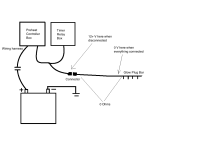
Thanks guys. I understand what you are saying James, and I understand Ohms law. If the relay contacts are burnt, you would think replacing the preheat controller or timer relay would solve the problem. I must not have found the real relay yet. Since everyone likes diagrams...

glowplugs.png
 
   / Difficulty starting DK45SE in cooler weather (40's F) #15  
Ok I think you said you replaced the display unit which one of its functions is to take inputs from the temp sensor and decide how long to operate the glow relay for preheat and whether to operate the glow relay for post start. And the Actual Glow relay which switches high current to the glow plug rail. and is the 2nd relay from the left on the firewall. and is fed with 5mm Orange wires. If there is 12 volts on the glow plug rail when it is disconnected the contacts of this relay must be operated, If you pull the connections on this relay you should hear it fall and pickup when the key is in the preheat position and the temp is cold enough to allow the controller to energize the glow relay coil. Its coil is controlled by output of pin 7 of the display unit, it is a brown wire. If the glow relay has been replaced to eliminate the possibility of burned high current contacts, then perhaps a bad crimp or connection in the plug to the relay or further back to the 60 amp slow blow fuse.. My point is if the glow relay coil is operated, and by your measurements I have every reason to believe it is, then if you have 0 volts on the glow plug rail when it is connected, and if one or more of the glow plugs are not dead shorted to the engine block, and if they were it should have blown the 60 amp fuse or at the very least burned up (carboned up) the glow relay contacts so that they become a high resistance and limit the current so that the fuse will not blow. My point is if there is 12 volts on the rail , then it comes (according to the schematic) from the glow relay high current contacts and the other side of the relay goes to the 60 amp slow blow fuse, and the other side of the fuse goes to the battery. There has to be a high resistance joint in there somewhere or you would have high current to deliver to your load of the glow plugs. I guess this is all academic now as your tractor is in the hands of the dealer, and I am sure he will fix it.

James K0UA

The display unit is installed in the middle of the
shield plate in the engine compartment.
Function
1. Counting function for hour meter on instrument cluster
When the charge voltage is supplied from the alternator
after starting the engine, it controls the hour
meter on the instrument cluster.
2. Preheat adjustment function (automatic)
It detects the coolant temperature. If the temperature
is below 0°C (32 °F), it controls the operating
time of the glow plug.
Specification
1. Rated voltage: DC 12 V
2. Usage temperature: -20 °C ~ +80 °C
Preheat operation specifications


FFuunncctitoionn
Item Operating condition
Operating time
Preheat lamp
ON time
Temperature sensor
≥ 1.6 ㏀
8 seconds
Temperature sensor
< 1.6 ㏀
0 second
Post-heating
time
Temperature sensor
≥ 1.6 ㏀
15 ± 3 seconds
• Temperature sensor resistance (reference)
Temperature(˚C) Resistance(㏀)
-40 48.14
-20 15.48 ± 1.35
0 5.790
20 2.45 ± 0.14
30 1.6 ± 0.15
60 0.5865
80 0.3222
100 0.1884
110 0.1471 ± 0.002
 
   / Difficulty starting DK45SE in cooler weather (40's F)
  • Thread Starter
#16  
Yes, it's academic now, but the dealer is going to charge me fortune to fix it. Wish I had asked you guys sooner. I really didn't want to take apart the whole wiring harness to trace out which wire was going where, but that's what I needed to do. Thanks for the help!

Marcus
 
   / Difficulty starting DK45SE in cooler weather (40's F) #17  
I'd add one detail to James' explanation. Things like glow plugs and light bulbs change their resistance a lot as they heat up. In other words, their resistance will be quite low when cold (room temp) but the resistance increases a lot as they get hot. So ohming out the glow plugs is a great idea but expect low resistance values when cold. For example, if the nominal glow plug current is 12 amps you'd expect the resistance to be one ohm ... at operating temp. But a good might read 1/3 to 1/2 ohm when cold. This is one reason it's good to be able to measure the current through the plug.
 
   / Difficulty starting DK45SE in cooler weather (40's F) #18  
I'd add one detail to James' explanation. Things like glow plugs and light bulbs change their resistance a lot as they heat up. In other words, their resistance will be quite low when cold (room temp) but the resistance increases a lot as they get hot. So ohming out the glow plugs is a great idea but expect low resistance values when cold. For example, if the nominal glow plug current is 12 amps you'd expect the resistance to be one ohm ... at operating temp. But a good might read 1/3 to 1/2 ohm when cold. This is one reason it's good to be able to measure the current through the plug.

Agreed, good point. I have a simple current meter for High DC currents that you just place up against a wire and it measures the current thru induction. Probably not extremely accurate but will give you an idea if high currents are flowing or not. It has two scales 0 to 75 and 0 to 300 amps.

James K0UA
 
   / Difficulty starting DK45SE in cooler weather (40's F)
  • Thread Starter
#19  
Update: Tractor is coming home on Tues next week -- cost $800+ to get it fixed. Maybe I didn't work it hard enough and the glow plugs did get all carboned up. :) It's been to the dealer twice in the past 6 mos for electrical problems. The last $800 repair was for a shorted wiring harness under one of the rear fenders. At that time they found loose frame bolts and FEL bolts and tightened them. This time, with the broken glow plugs, they found loose FEL and frame bolts again. :( Locktite'd again. Should I be going around checking every bolt periodically? The friend who is bringing home my tractor bought the same DK45HST as I have. (In fact, that's how we met -- at the dealer's when he was picking it up.) He's a little frustrated because he feels the grill guard was weak (smashed within hours), and the step ladder welds broke. Then again, I don't know how he treats his tractor... Until now I had really liked my tractor.

Marcus
 
   / Difficulty starting DK45SE in cooler weather (40's F) #20  
You should regularly check for loose hardware. The loader manual says to torque the loader bolts every 25 hours. I found one or two of mine slightly loose every time I checked them. Then my dealer said to reinstall them with blue loctite, and they have not moved since. He told me that in the summer of 2011. I purchased the tractor (DK35) in April of 2011. So I think Kioti must have decided loctite is necessary some time after then.

The manual also says to torgue the wheel bolts regularly. The first time I did that (at 50 hrs) there were slightly loose bolts on all wheels, but more on the fronts. The next checks found one or two front wheel bolts moved very slightly. Now there is no movement (I'm at 440 hrs) in any loader bolts or wheel bolts. Loctite fixed the loader bolts and perhaps the wheel bolts just had to "settle in".

I recently found I lost one of the small bolts holding the pin at a loader pivot point. I also lost a sway bar pin because the hairpin was knocked out while brush hogging. I have since replaced those keeper pins with bolts with lock nuts.
 

Tractor & Equipment Auctions

Unused 2025 CFG Industrial H15R Mini Excavator (A59228)
Unused 2025 CFG...
2015 CATERPILLAR 308E2 CR EXCAVATOR (A60429)
2015 CATERPILLAR...
TOOTHED BUCKET ATTACHMENT FOR MINI EXCAVATOR (A58214)
TOOTHED BUCKET...
2007 Heil Heavy Duty Aluminum Tank Trailer (A56438)
2007 Heil Heavy...
THREE POINT ATTACHMENT (A58214)
THREE POINT...
1983 INTERNATIONAL S SERIES WATER TRUCK (A57192)
1983 INTERNATIONAL...
 
Top