Cab Forward

/ Cab Forward #1  

wkpoor

Platinum Member
Joined
Jan 14, 2007
Messages
613
Location
Amanda, OH
Tractor
John Deere 5400, Farmall H, Farmall Cub, Allis Chalmers CA
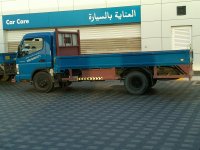
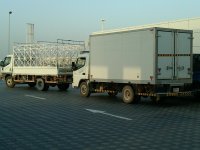
Anyone know why Europe and the Middle East use 99% cab forward trucks and the US is the opposite. Here are a few pics I took last month in the UAE. These trucks come in every size imaginable all the way to semi. They appear very utilitarian in that the bed sides all fold down or are designed for racks to set in. I saw many different ways they cover the bed depending on the load. American style PU's were only driven privately never commercially.
Also their semis appear to be of a higher weight rating than ours. All dump trucks use the cylinder to push off the front of the bed rather than underneath like ours.
 

Attachments

  • IMG00035-20100323-1754.jpg
    IMG00035-20100323-1754.jpg
    568 KB · Views: 204
  • IMG00034-20100323-1753.jpg
    IMG00034-20100323-1753.jpg
    502.8 KB · Views: 159
/ Cab Forward #2  
Yeah. From what I gather, cab forward makes for a shorter truck, which makes maneuvering in towns much easier, which is more common in Europe.
 
/ Cab Forward #3  
Just different ways of doing things I guess???? I will say around here we see tons of the Isuzu and Mitsubishi trucks with the cab forward design.

I know a commercial mower I used to do service for on his trailers and mowers. He got rid of the trailers and bought a few well used Mitsubishi trucks and now puts all the stuff inside, safe and sound. There are two main benefits for him. One is security and the other is the DOT crap with a trailer.


Chris
 
/ Cab Forward #4  
Anyone know why Europe and the Middle East use 99% cab forward trucks and the US is the opposite. Here are a few pics I took last month in the UAE. These trucks come in every size imaginable all the way to semi. They appear very utilitarian in that the bed sides all fold down or are designed for racks to set in. I saw many different ways they cover the bed depending on the load. American style PU's were only driven privately never commercially.
Also their semis appear to be of a higher weight rating than ours. All dump trucks use the cylinder to push off the front of the bed rather than underneath like ours.

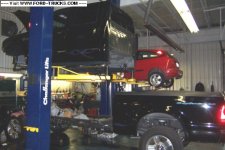
Cab forward is really nice for engine servicing--especially when you consider that some U.S. pickups require the cab to be moved out of the way for things like replacing engine heads.

F-series cab lif.jpg

Maybe something like a Isuzu cab forward commercial cab-chassis with a pickup box installed is the way to go. I frequently see Isuzu cab forward tow trucks offered on eBay. Don't recall seeing any Isuzu cab forwards with pickup boxes on eBay. There's quite of bit of Isuzu input to the GMC/Chevy Duramax diesels so getting service on an Isuzu cab forward probably isn't a big problem.
 
/ Cab Forward #5  
Im not a pro trucker, and i know theres some here that will likely chime in, butI think it has more to do with the changing of "bridge regulations" and increasing the length allowed that explains the demise of Cab overs here in north america.

Plus some truckers dont like them because they consider cab overs uncomfortable compared to conventionals. theres also an argument that conventionals are safer in an accident than COEs.

Personally i like COE. My grandfather ran alot of COE in his fleet. Probably 60% COE. It was the first rig i ever drove so i have some sentimental ties too:D

i think the last available COE here in north america was the Freightlilner Argosy last made 2005 i think?????Western star or kenworth might still make a coe by special order but im not sure.r


in lighter trucks, we have prob a 20-80 mix of coe to conv. here. COE is alot more nimble in town but are much more popular in the city.Ford, isuzu and Hino were big players but i think hino is out of cab over market here now
 
/ Cab Forward #6  
Moss hit the nail on the head. Shorter wheelbase makes for easier maneuvering ...... especially helpful in congested European and Asian countries. Not as much of an issue here. Drive the cab forward trucks, then drive one with the cab well behind the front axle and you will understand why set back cabs are so popular here.
 
/ Cab Forward #7  
Scooby, it was the change from the feds regulating overall length, to regulating the length of the trailers that killed the cabover here in the US.
 
/ Cab Forward #8  
Everything mentioned was a factor, but the single biggest factor was and still is the length of the drive.

In the USA the roads are well designed for high speeds, this means that ride quality is VERY important and you just can't get that with a short WB vehicle. Add to that the fact that many drivers will see the better part of 700 miles of seat time each day, and driver comfort starts to be a deciding factor.

There isn't a single truck manufacturer in the USA that does not offer a COE truck - just not in the USA. They are offered where driving distances are shorter, there is more emphasis on maintenance over a long useable life and of course overall length and weight are larger factors.

I predict, when fuel prices start upwards again, we will see a significant resurgence in COE or COE like tractors.
 
/ Cab Forward #9  
While efforts to reduce weight don't leave all that much strength for conventional trucks when things go bad, having that engine up front instead of underneath is still better. IE; no one has mentioned being the first one on the scene of an accident.

Still, I too have some fond memories having logged quite a few miles in F model and CruiseLiner Macks and GMC Astro's. With a max overall length of 55', those trucks with Reyco spring suspension or Hendrickson walking beams running on 110lb radial tires could be downright brutal.

The European cabovers do look pretty slick though.
 
/ Cab Forward #10  
Dodge, Ford, and Willy's made cabover pickups in the 1960's. I still see one now and then; saw a sharp looking Ford a week ago. Dodge and Ford seemed to use thier van front ends.

Don't know why they did not catch on; seems like they would be great for an in town delivery. Limited seating though, compared to the standard pickup cabs in the US.

In regards to big trucks, all the truckers I know said COE's rode worse than conventional.
 
/ Cab Forward #11  
I can't speak for the smaller import cabover trucks but I've driven tractors and larger straight trucks of both types (Ford, Hino, GMC, Kenworth, White, Western Star, International) and really don't care about the difference for most driving. Sure there's more bang for the wheelbase, I suppose.

One complaint I've heard was that steering felt heavier in the cabover trucks but never noticed a difference myself. I think there was a little confirmation bias going on with those complaints...

If I had one big complaint about cabover tractors it would be that they really tended to bobtail when braking without a trailer...and spilling the junk I pile on the passenger seat when I tip the cab....that's more a slob issue than a truck issue, though. :)
 
/ Cab Forward #12  
Im not a pro trucker, and i know theres some here that will likely chime in, butI think it has more to do with the changing of "bridge regulations" and increasing the length allowed that explains the demise of Cab overs here in north america.

Plus some truckers dont like them because they consider cab overs uncomfortable compared to conventionals. theres also an argument that conventionals are safer in an accident than COEs.

Personally i like COE. My grandfather ran alot of COE in his fleet. Probably 60% COE. It was the first rig i ever drove so i have some sentimental ties too:D

i think the last available COE here in north america was the Freightlilner Argosy last made 2005 i think?????Western star or kenworth might still make a coe by special order but im not sure.r


in lighter trucks, we have prob a 20-80 mix of coe to conv. here. COE is alot more nimble in town but are much more popular in the city.Ford, isuzu and Hino were big players but i think hino is out of cab over market here now

I'm not a trucker either; but have sat in a lot of Conventionals and COE's when I was doing research on a rig I was going to make a model of back in the 70's. From what I could tell, A COE would have better forward visibility and maneuverability than a conventional; but I would think the ride would be worse sitting over the front wheel. Also, the doghouse made the driver's area cramped in my opinion, and crawling into the sleeper seemed to be a hassle. I also found a conventional easier to exit with big steps on the tanks and battery boxes compared to the step pockets and rungs on a COE. Personally I like the looks of a conventional better, and I like having the engine and frame in front of me as a barrier instead of thin sheet aluminum. However, Peterbilt and GMC Astro 95/Chevy Titan 90 were good looking COE's, and I like the all welded cabs of IH's before they went to the riveted cabs. I believe Scooby is right that KW & Freightliner will make a COE for specialty purposes.

Moss hit the nail on the head. Shorter wheelbase makes for easier maneuvering ...... especially helpful in congested European and Asian countries. Not as much of an issue here. Drive the cab forward trucks, then drive one with the cab well behind the front axle and you will understand why set back cabs are so popular here.

From what I can tell, European and Asian trucks are also narrower to deal with their narrow roads. For those markets COE's make sense with their congested narrow streets.

I predict, when fuel prices start upwards again, we will see a significant resurgence in COE or COE like tractors.

OK, I know it's late as I write this; but how will COE's see a resurgence when fuel prices go higher? Even if they are lighter in weight; they are a brick aerodynamically compared to a well designed conventional.

The European cabovers do look pretty slick though.

Have you noticed how high up some of the European COE's cabs sit. It looks like some of them have the cab roof close to the same height as the van trailer's roof. 'Top Gear' had the boys pimp out three COE's for one of their challenges, and lead host Jeremy Clarkson obtained a Renault COE with an air ride cab. You should have seen that cab bobble when he drove the truck through a brick wall. Also that Renault had a totally flat floor as the cab sat high enough up not to need a doghouse.


As for maintenance, no argument from me that a COE has superior accessibility. But what I would like to see on a pickup is a tilt hood like a Pete, KW, etc conventional has. Granted it wouldn't be as practical for doing routine maintenance in a tight garage due to the extra clearance needed to open the hood; and I suspect it would rattle a lot more while driving; but it sure would be cool.
 
/ Cab Forward #13  
Look at the geometry of the driver seat location. In COE the seat is high above the front axle while the truck wheelbase is short. Now imagine going over a bump in road. When the front axle goes over it the seat goes up then down. When the rear axle goes over it the seat goes forward and then backward. Since the suspension works only in vertical direction the forward/backward jerk is not attenuated at all. Some COE have "floating" cabs now that can move horizontally but when I was riding (I used to hitchhike a lot when I was a student) as a passenger it COEs many many years back it wasn't the case. Thew roads were bad and the truck would shake your life out of you.
In good US truck the cabin is located lower between the axles while the wheelbase is long making it way more comfortable. Also the classic US design offers potential for much better aerodynamics. Some quite aerodynamic trucks are already on the road.
 
/ Cab Forward #14  
I like having the engine and frame in front of me as a barrier instead of thin sheet aluminum.

I think this is more of a perceived damage than reality. What would you rather have in your lap? Aluminum and steering wheel or steering wheel and Caterpillar?
 
/ Cab Forward #15  
Maybe something like a Isuzu cab forward commercial cab-chassis with a pickup box installed is the way to go. I frequently see Isuzu cab forward tow trucks offered on eBay. Don't recall seeing any Isuzu cab forwards with pickup boxes on eBay. There's quite of bit of Isuzu input to the GMC/Chevy Duramax diesels so getting service on an Isuzu cab forward probably isn't a big problem.

Yes for in town or short haul, these things are pretty nice. We had 6 Isuzu cab over rollback units. They are easy to work on, parts aren't too outrageous either. Comfort factor, not great, maneuverability was awesome, only 210 hp so not much in the get and go factor. We put 250000 plus on the motor and chassis in and around the D.C. area. Only one of those had serious service, the driver forgot his walkaround and the low coolant and hot summer day.......blew a head.
 
/ Cab Forward #16  
As for maintenance, no argument from me that a COE has superior accessibility. But what I would like to see on a pickup is a tilt hood like a Pete, KW, etc conventional has. Granted it wouldn't be as practical for doing routine maintenance in a tight garage due to the extra clearance needed to open the hood; and I suspect it would rattle a lot more while driving; but it sure would be cool.

Agreed--that tilt hood would be an improvement. However, many pickups have the rear of the engine tucked under the windshield assembly making it hard to remove the heads without removing the cab or pulling the entire engine. Need a redesign of the firewall area to make the engine completely accessible and serviceable with the tilt hood feature.
 
/ Cab Forward #17  
Scooby, it was the change from the feds regulating overall length, to regulating the length of the trailers that killed the cabover here in the US.

thanks for the clarification:thumbsup:
 
/ Cab Forward #18  
How about Challenger logging trucks? I've heard their engines are on a sub-frame that can be slid out the front for access. Apparently you just pull some pins, swing the grille out of the way, and slide it on out.
 
/ Cab Forward #19  
I think this is more of a perceived damage than reality. What would you rather have in your lap? Aluminum and steering wheel or steering wheel and Caterpillar?

Depending on what you hit, you will get more than sheet aluminum and steering wheel. Rear end a flatbed with rebar or pipe on it, and you'll get a mouthful of just as lethal steel as that Cat engine. There is no such thing as the perfect design. COE's have their place, just as conventionals do.

Agreed--that tilt hood would be an improvement. However, many pickups have the rear of the engine tucked under the windshield assembly making it hard to remove the heads without removing the cab or pulling the entire engine. Need a redesign of the firewall area to make the engine completely accessible and serviceable with the tilt hood feature.

My Super-Duty is one of those beasts with a good part of the engine tucked under the cowl. I think this is done to improve handling via getting more weight off the front axle. When I saw how much space there was available between the front of the engine and the grill; I often wondered if a Triton V-12 was on Ford's drawing boards.
 
/ Cab Forward #20  
My Super-Duty is one of those beasts with a good part of the engine tucked under the cowl. I think this is done to improve handling via getting more weight off the front axle. When I saw how much space there was available between the front of the engine and the grill; I often wondered if a Triton V-12 was on Ford's drawing boards.

Makes sense to me--front axle loading benefits from that design, but maintainability suffers. Win some, lose some.
 

Marketplace Items

Rhino HPHD 3pt Auger (A60462)
Rhino HPHD 3pt...
John Deere 4044M (A60462)
John Deere 4044M...
CHALLENGER MT525B TRACTOR (A59823)
CHALLENGER MT525B...
2022 Behnke Trailer (A55973)
2022 Behnke...
Engine (A59228)
Engine (A59228)
Giyi GY-CYHC Mini QA Side Shift Forks (A60463)
Giyi GY-CYHC Mini...
 
Top