butt welding 1" plate

/ butt welding 1" plate #1  

bdog

Elite Member
Joined
Mar 26, 2004
Messages
2,632
Location
Texas
Tractor
John Deere 6130M
I am going to be butt welding a 6" wide by 1" thick piece of plate. It is not a critical part if it breaks but I don't want it to break.

Currently the part is made out of 6" x 1/2" plate and we have used it like that for 4 years and have had it break and had to re weld it maybe 5 times. My hope is with the thicker material it will last forever.

I have never really welded on material this thick before. I know I need to bevel it but can I just bevel it on one side or should I bevel it on both sides?

I was thinking of doing a 45 degree bevel using a piece on angle iron as a guide and my plasma cutter and doing it on just one side. The run a first pass with 6010 and then fill it up with 7018. The back side of the plate needs to be smooth so I was not even planning on welding the back at all but I can really build up the other side if need be.
 
/ butt welding 1" plate #2  
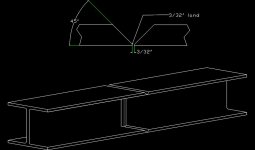
30 -35 degree bevels and I like about an 1/16 to an 1/8 landing and 1/16 gap more or less depending on landing. It will be a slower process and warping can be a challenge. You should penetrate all the way and can grind flush after it cools. That is how I do it. Good luck.
What is it for?
 
/ butt welding 1" plate
  • Thread Starter
#3  
It is for a piece of oilfield equipment. A 2" pin goes through two blocks and this part bolts on to the blocks with two 3/4" bolts and and keeps the pin from sliding out. It is a retainer.
 
/ butt welding 1" plate #4  
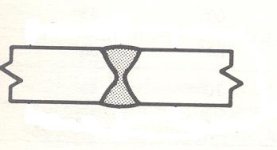
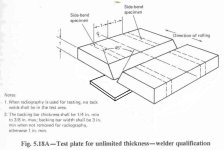
There are several ways to do it. Double bevel, two single bevels with open root, two single bevels with backing plate.
 

Attachments

  • Double bevel.jpg
    Double bevel.jpg
    6.8 KB · Views: 180
  • AWS 1 Start tab.JPG
    AWS 1 Start tab.JPG
    70 KB · Views: 256
  • Beam_dwg.jpg
    Beam_dwg.jpg
    38.7 KB · Views: 264
/ butt welding 1" plate #5  
Nobody asking if you have enough of a welder to do this??? 1" plate needs a lot of heat...either with some preheat or with a big honkin welder... Even for multi-pass - that is a lot of steel to heat up. I guess you did say oilfield work, so I would assume serious welders, but there is not a lot to go on here.
 
/ butt welding 1" plate #6  
Nobody asking if you have enough of a welder to do this??? 1" plate needs a lot of heat...either with some preheat or with a big honkin welder... Even for multi-pass - that is a lot of steel to heat up. I guess you did say oilfield work, so I would assume serious welders, but there is not a lot to go on here.

1" plate could be welded with a small stick machine. If I needed to I could weld at 85-90 amps with 3/32" 7018 and fill the groove..I wouldn't want to because it would take lots of passes to fill the joint.

With small mig welders I would agree with you, need to have more power for thicker steel.

Bdog, with the 1/2" that's there, does it break in the weld or somewhere else? Can you get pictures of the part and how its used?
If you double bevel and weld from both sides it will help keep the steel from warping, just grind the side smooth that you need.
 
/ butt welding 1" plate #7  
Perhaps if you truly know what you are doing. You risk cold welds with an undersized welder, even a stick, on stuff this thick.
 
/ butt welding 1" plate #8  
Perhaps if you truly know what you are doing. You risk cold welds with an undersized welder, even a stick, on stuff this thick.

Even large welders can make cold welds :) When stick welding and filling beveled joints you can get away with lower amperage. The penetration into the joint is done by beveling so you don't need very high amperage(large electrodes) to penetrate through lots of steel. Lots of welding of heavy steel is done with 3/32"-5/32" electrodes. Joint prep goes a long way in welding :thumbsup:
 
/ butt welding 1" plate
  • Thread Starter
#9  
I have a 300 amp machine but will not be anywhere near that. Biggest rods I have are 5/32" which call for maybe 200 amps.

Maybe I am making these part sound more critical than it is. The previous one was 1/2" plate and sometimes when it broke the only welders we could find in the area were muffler shops and we had them weld it back together with their light duty mig machines. If it breaks the pin starts to come out very slowly but it can travel maybe 6" before it falls out and if it did you would just pound it back in with no real major damage. I just am tired of the part breaking and having to weld it again so this time instead of just patching it up I have some time in the shop and am going to fab up something stouter.
 
/ butt welding 1" plate #10  
Why not just cut an appropriate size of plate?

Why the welding?

Sent from my iPhone 5s 64Gb using TractorByNet
 
/ butt welding 1" plate
  • Thread Starter
#11  
I say plate but it is actually two pieces of angle iron 6" long butted together to make a U shape. The two bolts go through the two sides and the block and the end that is welded together holds the pin in. I was just trying to make the question as simple as possible regarding the weld in question.

The current one is made out of 6" x 1/2" plate and has two welds one on each corner. I was thinking with the angle there would only need to be one weld.
 
/ butt welding 1" plate #12  
I say plate but it is actually two pieces of angle iron 6" long butted together to make a U shape. The two bolts go through the two sides and the block and the end that is welded together holds the pin in. I was just trying to make the question as simple as possible regarding the weld in question.

The current one is made out of 6" x 1/2" plate and has two welds one on each corner. I was thinking with the angle there would only need to be one weld.

This is why we need pictures ;) The more info you give use the better we can help. If the last time it was "fixed" was by an exhaust shop you might be able to just clean it all up and weld it correctly to fix it. If its been repaired several times its probably easier to make a new one though.
 
/ butt welding 1" plate
  • Thread Starter
#13  
Yes I know pictures help a ton but I don't have any and was hoping to work on it in the morning. I have the rest of the project figured out I just needed advice on the butt weld of the thick material. I can get some pics tomorrow of how it turns out though.
 
/ butt welding 1" plate #14  
Double bevel it using 37+- degree bevels. A double 37 degree bevel is less welding than a single 37 degree bevel and doesn't warp as much. Weld a pass on each side as you fill up the bevels so it equalizes the heat input and thus limits the warping. You don't need big rods, smaller the electrode, the less heat input and the less warping you will get. I would use at max 1/8 E 7018 rods. Alternate welding from each end of the joint. Final passes, Weld from the ends toward the middle and stop so the ends of the angle get filled and don't leave the puddle hole low spot.

Contrary to what some have posted about welder amperage, you only need enough amps to effectively melt the size rod being used regardless of how thick the parent metal is. Preheating to 150F is as much preheat as you need even on thicker material and this has nothing to do with effectively burning in the electrode, it is more to prevent stressing the metal when the hot weld metal is applied. SMAW and FCAW/MIG (excepting aluminum) welding is not like acetylene welding or brazing where thicker metal sucks the heat away, these processes apply concentrated heat to a small area so welding a 1/8" plate is not much different from welding an 8" thick plate except perhaps the joint prep.
 
/ butt welding 1" plate #15  
The weld volume increases with the square of the base dimension. As a result, a single bevel will require twice as much fill as a double bevel.
 
/ butt welding 1" plate #16  
Ditto on the preheat.

Set it up right, and you could weld it with anything.

I could weld that with a my SP175 mig. Working with, and around the duty cycle's cut thermal out would be the only issue.
 
/ butt welding 1" plate #17  
Ditto on the preheat. Set it up right, and you could weld it with anything. I could weld that with a my SP175 mig. Working with, and around the duty cycle's cut thermal out would be the only issue.

Just because you could (doubtful) doesn't mean you should.

My previous mig was an sp170-t and there is no way I would even attempt 1/2" with that welder.

Just saying

Sent from my iPhone 5s 64Gb using TractorByNet
 
/ butt welding 1" plate #18  
Just because you could (doubtful) doesn't mean you should.

My previous mig was an sp170-t and there is no way I would even attempt 1/2" with that welder.

Just saying

Sent from my iPhone 5s 64Gb using TractorByNet
I don't think anyone is saying make one pass with your machine and weld 1" thick material. Thickness of metal has nothing to do with size of machine used to weld it with as long as you make multiple passes. I have no idea why manufacturers would rate a machine as welding xx thickness. If it will weld 1/4" thick metal in one pass, it will weld 4" thick metal also, you just have to make a pass, clean it, weld another pass etc till it is filled up. Ability to produce enough amps to melt a .035 wire properly and run at least a 50% Duty cycle is what I would be looking at in a wire feed welder. A MIG welder with less than 60% is pretty useless for heavy and large weldments as you would spend too much time in the cool down cycle on the machine to get very much welding done.
 
/ butt welding 1" plate #19  
That would count out most Millers if you are referring to maximum amps output. Duty cycle is a ratings game with MIG welders. All MIG welders (except the cheapest of the cheap) at some point produce 60% duty cycle. However, if you look at the maximum output, especially of transformers the duty cycle point is usually set well below maximum output. With that said...look for a MIG welder with the 60% duty cycle rating at least in the area of your "usual" maximum amp requirement. If you were going to regularly weld say, 1/4" single pass welds, you're going to need about 180 amps or so with .035. That's a lot, and very few "common" MIGs put that much out. You'd need a 250 amp mig in most cases to accomplish this.

As far as the joint prep. You can get away with 30 degrees on each bevel, for a total of 60 degrees. No need to try to kill yourself with a precise 37 degree. Just make a slight gap at the bottom about 1/16-3/32 for the first pass to get in the root really good. You'll likely want to run a little bit cold and lay down just a minimum thickness in the first pass.
 
/ butt welding 1" plate #20  
Mark, can the MTS 400 run at full throttle in 220V three phase?
 

Marketplace Items

2019 FORD F-350 FLATBED (A60736)
2019 FORD F-350...
2019 GALYEAN EQUIPMENT CO. 150BBL STEEL (A58214)
2019 GALYEAN...
2005 GMC Canyon (A57148)
2005 GMC Canyon...
2020 PETERBILT 567 (A58214)
2020 PETERBILT 567...
2022 CORMIDI C85 STAND-ON MINI DUMPER (A62129)
2022 CORMIDI C85...
Mini Jack Daniels Truck (A55853)
Mini Jack Daniels...
 
Top