Banana nose bales in JD 336

   / Banana nose bales in JD 336 #1  

sstouder

New member
Joined
Jan 16, 2013
Messages
10
Location
Pollock, Idaho
Tractor
JX 65 Case IH
Hi. I know this subject has been talked about before a lot. I thought I'd see if there is any new thoughts on addressing the problem. I use an old, but well maintained, 336 baler. Bale grass hay. I get a share of banana-nose bales. Nothing too serious if you handle them correctly when picking them up and stacking them. I'm not really complaining as I've dealt with the problem for a long time. I try to keep a steady feed of hay into the baler and that seems to help if keep my windrows at the right density and don't let the hay get too dry. But I read somewhere that folks have used some newer designed 336 feeder fingers with more adjustment on them (my current fingers have three holes). Any thoughts on these or some other things I can do to help minimize the banana bales? Thanks much!
 
   / Banana nose bales in JD 336 #2  
Have you tried changing to different holes on current feeder fingers?? Have you tried raking a larger windrow? Have you tried feeding pickup attachment from extreme RH side? Those feeder fingers with extra holes are high $$$$$$!!

AE50593 Finger - FINGER (FEEDER) ADD 335.01 USD
 
   / Banana nose bales in JD 336 #3  
Banana up/down or banana left/right ? If left/right, are twine loops the same length (circumference) ? if up/down, what is their shape just before leaving the compression chamber ? When was the last time you emptied the baler and checked the floor and ceiling of the chamber ?
 
   / Banana nose bales in JD 336
  • Thread Starter
#4  
Banana up/down or banana left/right ? If left/right, are twine loops the same length (circumference) ? if up/down, what is their shape just before leaving the compression chamber ? When was the last time you emptied the baler and checked the floor and ceiling of the chamber ?

Thanks for the good questions!
Jim, Yes. I've tried different holes in the feeder fingers. Seems like the bottom one works best. Regarding pickup positioning: I make my windrows basically the same width as my pickup (and the pickup on 336s are "not" wide) so I don't have much latitude there.
Regarding "where" the banana shape occurs": it's always sticking "up" and to the rear of the bale as it falls from the baler. The bales are always turned on edge by the "half ledge" as it falls from the rear of the baler. Looking from the rear, the ledge is on the left side of baler so the banana shape sweeps from the right to the left. Regarding twine loops: I've always assumed the twine loops where the same length. Guess I'll measure a couple and find out! How do you adjust them if not and what would make them different? I empty the baler after each season. Not sure what I'd be looking for regarding the floor and ceiling of the chamber?
Thanks for the help!!
 
   / Banana nose bales in JD 336 #5  
Banana up/down or banana left/right ? If left/right, are twine loops the same length (circumference)?

I can answer your circumference question of both twine loops IE no the loops won't be same length short side of bale twine will bee shorter, long side longer because bale determines twine length around bale.
 
   / Banana nose bales in JD 336 #6  
Most problems with irregular bale shapes are because of poorly filled bale chambers due to too slow driving, theres not enough hay in each press stroke. In some conditions you need to make jour JX 65 bark at every baler stroke to get a properly filled bale.
 
   / Banana nose bales in JD 336
  • Thread Starter
#7  
I can answer your circumference question of both twine loops IE no the loops won't be same length short side of bale twine will bee shorter, long side longer because bale determines twine length around bale.

Thanks for all the input guys. I "have" noticed that one spool of twine runs out before the other. That must be the spool that supplies the "long" side of the bay - right? So, that means that the short side (left or far side) is getting less hay and is using a bit less twine than the near side - right? So the problem seems to be a shortage of hay on the far side of the bale chamber as supplied by the forks. The reason is probably more a function of feed speed and/or windrow thickness , as has been pointed out. I'll work on that.
Again, if anybody has any experience with special feeder forks for the 336 in regards to this problem, I'd appreciate any input or opinions.
Thanks all.
 
   / Banana nose bales in JD 336 #8  
If one twine loop is much longer than the other, the hay resistor plates are not working well on the long twine side. So, on each plunge, the bale being formed draws out more twine because the flake package just being pushed through travels farther. Or, there is just more hay in each flake on that side. That could be caused by the forks traveling too far (or not far enough) across the bale chamber. That could also mean a fork timing issue. They are timed to coincide with the plunger.

I suggest you make a bale consisting of a single flake: run into a high density windrow and as so as a new bale is started, manually trip the knotter again. You might get two flakes, but their thickness will tell the whole story for you. You can do this manually with the machine stationary. Kick some loose hay into the feeder, then trip it. Then keep feeding it until the mini-bale comes out. If it's uniform and twines are equal. the problem is in the *** end, maybe something dragging the inside edge. Bales can banana if they are too light, also. Make sure they are heavy enough by weighing with a fish scale. The baler sets bale size by length not by weight.

If you are using a NH Bale pickup wagon, banana bales will drive you nuts. The pickup chute gets clogged every time.
 
   / Banana nose bales in JD 336 #9  
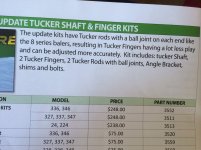
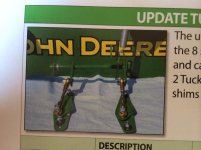
image.jpgimage.jpgI'm going to buy these at the end of the season my neighbor bought them he said they have worked flawlessly. They are $248 from finger lakes equipment they are a great source for new and rebuilt baler parts. In ny 585-526-6705 they are very knowledgable and friendly and know JD balers inside out. I can't figure out how to post the pics sorry. The picture is of an update tucker shaft&finger kit. They have ball joints like the 8 series baler so there will be a lot less play
 
   / Banana nose bales in JD 336 #10  
Subscribing for the knowledge. Always trying to learn something new about balers.
 
   / Banana nose bales in JD 336 #11  
first of all i will say that i dont know anything about your baler. i have only used a new holland super 68 baler. remember 1 time seemed like the baler was putting more hay on 1 side more than the other. we moved both both sets of the fingers closer to the bale chamber but didnt help. had a mechanic come and look at it. said we needed new fingers and move the farthest fingers back towerds the end of the rod. that was our problem.
 
   / Banana nose bales in JD 336 #13  
Hi. I know this subject has been talked about before a lot. I thought I'd see if there is any new thoughts on addressing the problem. I use an old, but well maintained, 336 baler. Bale grass hay. I get a share of banana-nose bales. Nothing too serious if you handle them correctly when picking them up and stacking them. I'm not really complaining as I've dealt with the problem for a long time. I try to keep a steady feed of hay into the baler and that seems to help if keep my windrows at the right density and don't let the hay get too dry. But I read somewhere that folks have used some newer designed 336 feeder fingers with more adjustment on them (my current fingers have three holes). Any thoughts on these or some other things I can do to help minimize the banana bales? Thanks much!
I am not familiar with a JD baler but on NH or Hesson there is 4 -2 top and 2 botton-fingers in the bale chamber to put static pressure on bale as it starts forming in the start of the chamber.The two tops are right under the knotters.they have springs on them that can break and also they can break causing bales to misshape.because of more drag on one side or the other.Also if your strings are too tight it can cause this.good luck
 
   / Banana nose bales in JD 336 #14  
I am not familiar with a JD baler but on NH or Hesson there is 4 -2 top and 2 botton-fingers in the bale chamber to put static pressure on bale as it starts forming in the start of the chamber.The two tops are right under the knotters.they have springs on them that can break and also they can break causing bales to misshape.because of more drag on one side or the other.Also if your strings are too tight it can cause this.good luck

Sorry but the fingers you refer to known as hay dogs do not affect banana shaped bales on any brand sq baler. Hay dogs hold hay on formed bale back from the twine so knotters have an opportunity to tie the knot. Also tightness of strings is determined by how tight the hay is packed IE how much the bales weigh. Banana shaped bales are caused from size of windrow,ground speed & feeder finger adjustment not hay dogs or tightness of twine.
 
   / Banana nose bales in JD 336 #15  
I don't do green either but are there asjustable bale wedges in the chamber sides and if so are they equally inserted in the chamber? I control my bale shape by the windrow density (I make it bark always) and the wedges. I want 10 to 12 slices per bale and adjust my ground and PTO speed to get that. You can count the slices from the tractor by listening to the plunger and the knotter tie. Once I get the magic number dialed in, I close the window, crank up the ac and rock on....

If I have the crew pick them up right away, I run the quarter turn. If it's the next day, I run a flat chute. Bales on the cut side standing on the ground, in a heavy dew, will suck moisture into the hay by aspiration.

Nothing better that a green dotted line down the field.
 

Marketplace Items

2018 HINO SA (A58214)
Year: 2019 Make: Chevrolet Model: Silverado Vehicle Type: Pickup Truck Mileage: 187,069 Plate: Body (A59230)
Year: 2019 Make...
CATERPILLAR 627K SCRAPER (A52707)
CATERPILLAR 627K...
2398 (A60432)
2398 (A60432)
Kubota M5-111 (A53317)
John Deere 7410 (A53317)
John Deere 7410...
 
Top