At Home In The Woods

/ At Home In The Woods #3,621  
Obed -

To clear up some of the confusion, there are two common types of "hammer drills". One is a rotary percussion drill, which basically is a motor turning a shaft and with a piston actuator, which is made to drill concrete. It drills mainly by striking the concrete with the bit, but also turns the bit to eject the spoils. The second type is a drill that has a sawtooth mechanism that causes the chuck to move in and out a small amount, and primarily drills by turning the bit, but that action is aided by the ratchet mechanism.

The rotary percussion drills typically use spline or sds shank bits, and those are specially shanked to fit a specially designed chucks, which much heavier duty than a typical twist drill chuck. Twist drills are used in a non-percussion drills with a standard chuck, and are lighter duty.

Both work fine for smaller holes, and as a matter of fact, for tapcons, twist bits are much more commonly available and used. Bosch for instance makes some called "blue granite" which are sold at Lowes.

For larger holes in concrete, rotary percussion drills are typically used with their special chucks (sds or spline).

Tom
 
/ At Home In The Woods
  • Thread Starter
#3,622  
Obed -

To clear up some of the confusion, there are two common types of "hammer drills". One is a rotary percussion drill, which basically is a motor turning a shaft and with a piston actuator, which is made to drill concrete. It drills mainly by striking the concrete with the bit, but also turns the bit to eject the spoils. The second type is a drill that has a sawtooth mechanism that causes the chuck to move in and out a small amount, and primarily drills by turning the bit, but that action is aided by the ratchet mechanism.

The rotary percussion drills typically use spline or sds shank bits, and those are specially shanked to fit a specially designed chucks, which much heavier duty than a typical twist drill chuck. Twist drills are used in a non-percussion drills with a standard chuck, and are lighter duty.

Both work fine for smaller holes, and as a matter of fact, for tapcons, twist bits are much more commonly available and used. Bosch for instance makes some called "blue granite" which are sold at Lowes.

For larger holes in concrete, rotary percussion drills are typically used with their special chucks (sds or spline).

Tom
Tom,
Thanks for the clarification. My drill is obviously the lighter duty tool. It had no trouble using the Ace hardware bit to drill 5/32" dia holes in the concrete wall. I have rented large drills to drill 1 1/2" holes through our poured concrete retaining wall. I wouldn't consider using the little Ace HW bit in that larger beast of a drill.
Obed
 
/ At Home In The Woods #3,623  
Yeah you will be fine for your uses with bits like that. If you run into a major project, it will be worth renting a big boy SDS or one of the other variants.

I see you are coming around on segregating your firewood too! Like I noted before, it is easier if you separate it into 2-3 groups of good better best, then you can pull from whichever pile to make your desired mix. So perhaps lump the oak and hickory together, the midgrade maple/birch/poplar, and then the light stuff like pine or basswood. Adjusting to whatever types of wood you have or run into.

Merry Christmas!
 
/ At Home In The Woods
  • Thread Starter
#3,624  
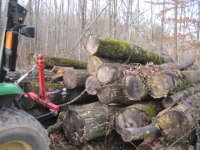
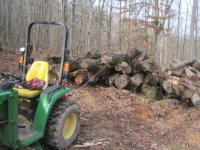
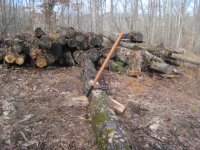
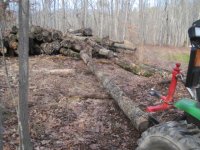
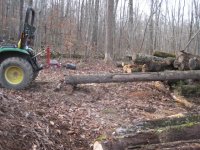
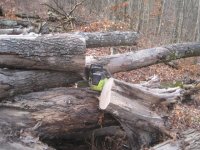
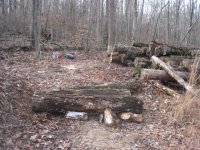
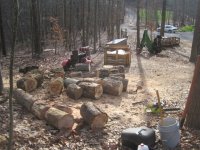
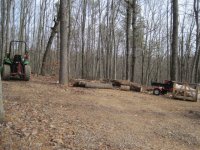
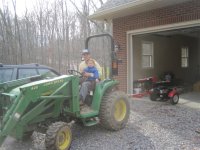
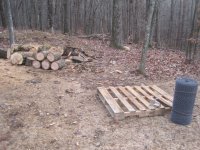
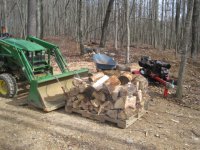
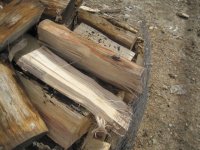
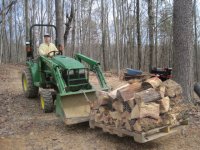
Today was a beautiful day to be outside cutting wood. The temps were in the 40s and the sky was blue. I thoroughly enjoyed working outside today. I needed some more hard heavy wood for the fireplace. Too much of the wood I recently cut was lighter wood (pine, poplar).

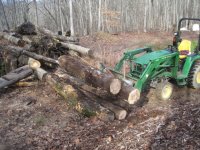
I picked out two logs from the log pile, a hickory and a white oak. I wrapped a chain around the hickory and pulled it off the pile. I didn't like how the end of the log was digging into the dirt as I pulled the log so I put a small log on the ground to get the hickory log out of the dirt.

I used my log peavey to roll the logs. I love this tool. I cut the hickory into two 7 1/2 foot logs and one 9 foot log. Unfortunately, those logs were too large for me to easily manuever. After I started moving them, I regretted not cutting them in 6 ft sections. I had to man-handle these logs to get them on the tractor's fork. However, I found out that my FEL would lift more than two of the heavy hickory log sections.

After I got the three hickory logs positioned where the tractor could pick them up, I then pulled the white oak off pile and cut it into 6 ft. sections. I had to cut off the stump before I could pull the white oak off the pile. It took 3 trips to carry the log sections to my splitting area uphill from the house.

I used the 14" chainsaw to cut the logs into sections at the log pile. However, the hickoy log was almost to big for the small chainsaw. I brought out my 20" chainsaw to cut the wood into 18" sections. The larger saw cuts logs much faster than the smaller saw. In order to be nice to my lower back, I squatted with both knees fully bent while cutting with the larger saw.

I filled 1 1/2 pallets today plus I still have several 18" long logs that will need splitting.

Merry Christmas,
Obed
 

Attachments

  • IMG_2376.JPG
    IMG_2376.JPG
    177.4 KB · Views: 261
  • IMG_2377.JPG
    IMG_2377.JPG
    176.6 KB · Views: 256
  • IMG_2378.JPG
    IMG_2378.JPG
    187.8 KB · Views: 234
  • IMG_2379.JPG
    IMG_2379.JPG
    185.9 KB · Views: 237
  • IMG_2383.JPG
    IMG_2383.JPG
    175.6 KB · Views: 225
  • IMG_2382.JPG
    IMG_2382.JPG
    190.8 KB · Views: 228
  • IMG_2381.JPG
    IMG_2381.JPG
    179 KB · Views: 226
  • IMG_2380.JPG
    IMG_2380.JPG
    194.6 KB · Views: 224
  • IMG_2389.JPG
    IMG_2389.JPG
    166.6 KB · Views: 258
  • IMG_2386.JPG
    IMG_2386.JPG
    189.9 KB · Views: 224
  • IMG_2385 (Small).JPG
    IMG_2385 (Small).JPG
    62.5 KB · Views: 243
  • IMG_2384.JPG
    IMG_2384.JPG
    190.5 KB · Views: 247
  • IMG_2390.JPG
    IMG_2390.JPG
    172.4 KB · Views: 288
/ At Home In The Woods
  • Thread Starter
#3,625  
Yeah you will be fine for your uses with bits like that. If you run into a major project, it will be worth renting a big boy SDS or one of the other variants.

I see you are coming around on segregating your firewood too! Like I noted before, it is easier if you separate it into 2-3 groups of good better best, then you can pull from whichever pile to make your desired mix. So perhaps lump the oak and hickory together, the midgrade maple/birch/poplar, and then the light stuff like pine or basswood. Adjusting to whatever types of wood you have or run into.

Merry Christmas!
Dave,
Yes I remembered your comments about segregating it. That might work out best. I'm sure I'll be experimenting quite a bit until I find a system I'm satisfied with.
Obed
 
/ At Home In The Woods #3,626  
Curious how long the pile of wood you are taking logs from has been sitting?
It looks like the wood is very likely real wet from the look of all the moss and other signs of aging?
I mention this because if that wood is as wet as it looks it may be keeping you from getting the kind of fireplace burn you're seeking, even if you are mixing it with other dryer wood. The problem with burning wood with high moisture content is that you are creating creosote, and the wet wood is reducing your overall heat output due to energy being expended to remove the water from the wood instead of heating your house. The creosote coating your stovepipe is the worst part because it is the main source of chimney fires when it catches fire, and it is near impossible to put out without fire dept. assistance. There are fireplace chimney fire extinguishers in the shape of a stick that are readily available to deal with small chimney fires and I suggest you keep one near your fireplace in case of need. They smother the fire to keep it from doing extreme damage.
Depending on how long those logs are you could save your back even further if you chained a log and pulled it out of the pile to about the tipping point and then cut off sections to length, (say 18-24") and let them fall to the ground, and then split the sections, instead of wrestling 6-8' log lengths and then having to transport them and then cut to fireplace size, and then split.
 
/ At Home In The Woods #3,627  
My wife attached one 2x4 to the concrete wall yesterday before her masonry bit broke. Today I continued where she left off. I attached the two remaining 2x4s to the wall. I have to say I was a bit apprehensive about screwing the 2x4s to the poured concrete wall. I've never done it. I remember the subs mentioning using Tapcon screws when we built the house. So we bought some and using them was actually pretty easy. Using a new masonry bit, I set the drill on hammer and had no problem drilling the holes and screwing the boards to the concrete. We put pressure treated spacers between the 2x4s and the concrete to keep the untreated wood off the concrete.

The shelves we are building now are more complicated than the first set of shelves. These shelves are in a corner whereas the other shelves were on a straight wakk. I admit I scratched my head for a while getting a plan together for how to build the frame for the shelves. I eventually put down a plan on paper. I cut the frame boards for the first shelf. I then laid them all out on the floor to make sure all the measurements worked right. On board was 1/4 too short so I modified my drawing accordingly. I then started cutting boards. I labeled each board A, B, C, D, E, F as I cut them to simplify assembling them.

I may watch to much Holmes on Homes or Homes inspection but he would have a fit with your untreated wood next to concrete or with no gasket. Any moisture trapped there will mold or cause rot.

As far as your observations for hickory, you are correct, but its denser than Oak and since you have a splitter it really dosent matter much, you can always turn it over and split again if you can pull apart. Burining in an open fireplace hickory pops way to much and sparks out even through a screen.

As much as you like a fire and you like to burn and cut wood i still am miffed why you did not put in a wood Insert or make a freestanding wood stove and heat your entire house on the same amount of wood and not need supplemental heat. Like i have said before i heam pretty much my entire home except the most extreme days with only my wood stove, my home only has r19 attic insulation, nothing else and is 2500sqft. I can keep it about 65 in the farthest room, our bedrooms the others are in the 70's and the tv room can be in the 80s or high 70s with the insert.

I know its to late now as you bought that stove and a good insert will run you over $2K but i would have gone that route.
 
/ At Home In The Woods #3,628  
Today was a beautiful day to be outside cutting wood. The temps were in the 40s and the sky was blue. I thoroughly enjoyed working outside today. I needed some more hard heavy wood for the fireplace. Too much of the wood I recently cut was lighter wood (pine, poplar).

I picked out two logs from the log pile, a hickory and a white oak. I wrapped a chain around the hickory and pulled it off the pile. I didn't like how the end of the log was digging into the dirt as I pulled the log so I put a small log on the ground to get the hickory log out of the dirt.

I used my log peavey to roll the logs. I love this tool. I cut the hickory into two 7 1/2 foot logs and one 9 foot log. Unfortunately, those logs were too large for me to easily manuever. After I started moving them, I regretted not cutting them in 6 ft sections. I had to man-handle these logs to get them on the tractor's fork. However, I found out that my FEL would lift more than two of the heavy hickory log sections.

After I got the three hickory logs positioned where the tractor could pick them up, I then pulled the white oak off pile and cut it into 6 ft. sections. I had to cut off the stump before I could pull the white oak off the pile. It took 3 trips to carry the log sections to my splitting area uphill from the house.

I used the 14" chainsaw to cut the logs into sections at the log pile. However, the hickoy log was almost to big for the small chainsaw. I brought out my 20" chainsaw to cut the wood into 18" sections. The larger saw cuts logs much faster than the smaller saw. In order to be nice to my lower back, I squatted with both knees fully bent while cutting with the larger saw.

I filled 1 1/2 pallets today plus I still have several 18" long logs that will need splitting.

Merry Christmas,
Obed

I love how detailed you are. I chuckle to my self reading your posts. Are you sure your not a police detective or some secret agent and your other job is a cover story?
 
/ At Home In The Woods #3,629  
Curious how long the pile of wood you are taking logs from has been sitting?
It looks like the wood is very likely real wet from the look of all the moss and other signs of aging?
I mention this because if that wood is as wet as it looks it may be keeping you from getting the kind of fireplace burn you're seeking, even if you are mixing it with other dryer wood. The problem with burning wood with high moisture content is that you are creating creosote, and the wet wood is reducing your overall heat output due to energy being expended to remove the water from the wood instead of heating your house. The creosote coating your stovepipe is the worst part because it is the main source of chimney fires when it catches fire, and it is near impossible to put out without fire dept. assistance. There are fireplace chimney fire extinguishers in the shape of a stick that are readily available to deal with small chimney fires and I suggest you keep one near your fireplace in case of need. They smother the fire to keep it from doing extreme damage.
Depending on how long those logs are you could save your back even further if you chained a log and pulled it out of the pile to about the tipping point and then cut off sections to length, (say 18-24") and let them fall to the ground, and then split the sections, instead of wrestling 6-8' log lengths and then having to transport them and then cut to fireplace size, and then split.

I was thinking the same thing.

The other thing i do is to cut them up in the pile, you dont have to much binding to worry about and you dont worry about dirt as there on onther logs, all you need to be sure you dont do is get the tip in another log and cause the saw to kick back. But modern saws have a inertia chain break that activates if this happens.
 
/ At Home In The Woods
  • Thread Starter
#3,630  
clemsonfor said:
I may watch to much Holmes on Homes or Homes inspection but he would have a fit with your untreated wood next to concrete or with no gasket. Any moisture trapped there will mold or cause rot.
We put pressure treated wood spacers between the 2x4s and the concrete. Please re-read the post and you'll see where I mentioned it. There is also a picture that shows the spacer behind the 2x4.
As much as you like a fire and you like to burn and cut wood i still am miffed why you did not put in a wood Insert or make a freestanding wood stove and heat your entire house on the same amount of wood and not need supplemental heat. Like i have said before i heam pretty much my entire home except the most extreme days with only my wood stove, my home only has r19 attic insulation, nothing else and is 2500sqft. I can keep it about 65 in the farthest room, our bedrooms the others are in the 70's and the tv room can be in the 80s or high 70s with the insert.

I know its to late now as you bought that stove and a good insert will run you over $2K but i would have gone that route.
We have a high-efficiency fireplace. It's a Quadrafire 7100. Please read up on it. It heats our entire house - 2100 SF all on one floor. The great room/living room where the fireplace is located stays between 72 F and 75 F, even in the mornings before the fireplace has been reloaded. Since I've started stoking the FP at night with hickory, the bedrooms, which are the coldest rooms in the house, are 68 F, even in the early mornings. We don't run the heat pump or gas furnace when the FP is burning. The only times we've turned on the heat pump or furnace this winter has been when the outdoor temps were too warm to burn a fire in the house.

Yes, a heat stove can put out more heat in the room. However, I can't imaging wanting more heat in our our living room. We struggle some times to keep the great room cool enough. I figure 72F in the great room and 68F in the bedrooms to be an almost ideal heat distribution without using a furnace.

Obed
 
/ At Home In The Woods
  • Thread Starter
#3,631  
clemsonfor said:
I love how detailed you are. I chuckle to my self reading your posts. Are you sure your not a police detective or some secret agent and your other job is a cover story?
Shhhhhhhh! It's supposed to be a secret. Thanks for the encouraing note. Obed
 
/ At Home In The Woods #3,632  
We put pressure treated wood spacers between the 2x4s and the concrete. Please re-read the post and you'll see where I mentioned it. There is also a picture that shows the spacer behind the 2x4.We have a high-efficiency fireplace. It's a Quadrafire 7100. Please read up on it. It heats our entire house - 2100 SF all on one floor. The great room/living room where the fireplace is located stays between 72 F and 75 F, even in the mornings before the fireplace has been reloaded. Since I've started stoking the FP at night with hickory, the bedrooms, which are the coldest rooms in the house, are 68 F, even in the early mornings. We don't run the heat pump or gas furnace when the FP is burning. The only times we've turned on the heat pump or furnace this winter has been when the outdoor temps were too warm to burn a fire in the house.

Yes, a heat stove can put out more heat in the room. However, I can't imaging wanting more heat in our our living room. We struggle some times to keep the great room cool enough. I figure 72F in the great room and 68F in the bedrooms to be an almost ideal heat distribution without using a furnace.

Obed

Sorry i did miss some things as sometimes on long posts i kind of breeze thorugh them and skip a few sentences. I am sorry. You put a fan in your halls or in the cool rooms and push that cold air into the living room so the heat leaves that room, also dont run the blower as high it will help a lot.

Sorry i missed your other things.
 
/ At Home In The Woods
  • Thread Starter
#3,633  
Coyote machine said:
Depending on how long those logs are you could save your back even further if you chained a log and pulled it out of the pile to about the tipping point and then cut off sections to length, (say 18-24") and let them fall to the ground, and then split the sections, instead of wrestling 6-8' log lengths and then having to transport them and then cut to fireplace size, and then split.
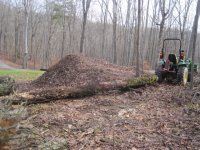
I've considered doing what you've suggested. If I cut the logs to FP lengths at the log pile, I would want to split them right there and stack them in a pallet. I started to do that one day but found that I didn't have enough room beside the log pile to pull logs, maneuver the tractor, cut, split, and stack the firewood. We have a large pile of wood chips close to the log pile that is in the way. Thus, I've been transporting 6' to 9' logs to my splitting and stacking area close to the house. I don't cut the logs to FP length, i.e. 18", at the log pile because then I would then have to pick up each heavy FP length log multiple times. Normally I can easily roll the 6' to 9' logs downhill onto the tractor forks. Unfortunately, the other day I misjudged the weight of the hickory tree and had to work harder than normal to roll its logs onto the tractor forks.
Obed
 
/ At Home In The Woods #3,634  
Have you thought about MOVING the chips pile:)
What are you thinking is the general condition of that wood pile regarding moisture content?
If the moisture content is as high as I think it is I would split lots of that wood and stack it somewhere to DRY for next season, preferably under cover of some sort.
 
/ At Home In The Woods
  • Thread Starter
#3,635  
Coyote machine said:
Have you thought about MOVING the chips pile:)
What are you thinking is the general condition of that wood pile regarding moisture content?
If the moisture content is as high as I think it is I would split lots of that wood and stack it somewhere to DRY for next season, preferably under cover of some sort.
The logs at the back of the pile were cut 2 years ago. The bark on some of them is wet if we have had rain but the inside of the wood is dry. After splitting them and stacking them under plastic, they are dry in a couple weeks. Most of the wet bark falls off during splitting so just the outside surface of the log is damp when I stack it. The uncut logs in the pile have seasoned reasonably well in the 2 years they've been stacked. I cut up an oak off of the front of the pile that was felled this summer. That log is still green. That log will wait until next season before it gets burned.

Yes I know I know that not all my wood is ideal for burning this season. I'm doing the best I can with what I have. Next year I should be in very good shape.

And I'm very familiar with creosote and the related issues.

Obed
 
/ At Home In The Woods
  • Thread Starter
#3,636  
Search For the Holy Grail of Firewood Stacking

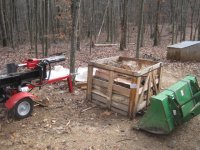
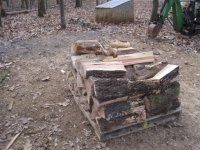
The box pallets worked extremely well. I can't imagine a better way to stack and transport firewood at our place. However, we haven't found anymore box pallets. I counted the logs in our log pile. We have over 80 logs, each which is 20+ feet long. That equates to about 120 pallets. It is obvious that the box pallet option will not meet this volume of firewood.

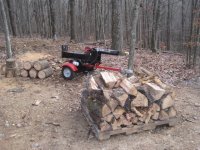
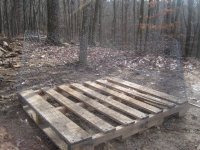
This morning I tried something new. When I told my wife about my idea, she was doubtful. Undaunted, I created a pallet basket using chicken wire that I had lying around. I stapled the wire around the edges of the pallet. I had some loose pieces of chicken wire that were not long enough to reach all the way around the pallet so I spliced some pieces together. When looking at the wire attached to the pallet, I did not like the way the wire looked; it looked as if the top of the chicken wire would just flail outwardly and not support the firewood. So when splicing the pieces together, I made the circumference of the top of the chicken wire a little smaller than the circumference at the bottom of the chicken wire.

At night when I stoke the fireplace before going to bed, I put the 18" pieces in the FP positioned in parallel with the glass FP doors. Then I like to put a short fat log beside the stack of 18" pieces and perpendicular to them. The short fat pieces are about 12" long. However, 12" long pieces of firewood are difficult to stack. It's hard to stack them very high without the stack's falling over.

I had some hickory logs to split so I used them to test my new pallet basket. I stacked the wood in the pallet, without being precise in my stacking. I had purposely cut the logs into two different lengths, 18" and 12". I filled the pallet with all the wood my tractor will reasonably carry. When I picked up the pallet and moved it, the wood in the pallet stayed wonderfully in place. There was no hint of instability in the pallet of wood, even when the tractor was on uneven terrain.

attachment.php


I think I've found a winning solution! This technique will work for any normally sized pallet. The pallets don't all have to be made exactly the same. The materials are extremely cheap. It's reproducible. The pallet baskets are reusable. The wood doesn't need to be carefully stacked. The firewood pieces don't have to be a uniform length. Short pieces of firewood stack just as well as longer pieces.

I can't wait until I get to fill up my next pallet basket!
 

Attachments

  • IMG_2454.JPG
    IMG_2454.JPG
    183.2 KB · Views: 235
  • IMG_2452.JPG
    IMG_2452.JPG
    180 KB · Views: 241
  • IMG_2451.JPG
    IMG_2451.JPG
    171.7 KB · Views: 226
  • IMG_2450.JPG
    IMG_2450.JPG
    178.8 KB · Views: 223
  • IMG_2455.JPG
    IMG_2455.JPG
    182.5 KB · Views: 247
  • IMG_2456.JPG
    IMG_2456.JPG
    153.2 KB · Views: 226
  • IMG_2457.JPG
    IMG_2457.JPG
    178.1 KB · Views: 2,079
/ At Home In The Woods #3,637  
Hard lesson learned this week! Last winter we replaced our fireplace insert with a Regency stove insert! Best decision we ever made. The problem comes in the flue, it's a stainless corrugated 5" pipe. Borrowing my FIL chimney brush I( not knowing any better) stuffed the brush down in the pipe ohhh about 16", and there it stayed! This type of flue liner is not meant to be brushed clean but have a chemical type log burned to get rid of the creosote. Just a heads up!
 
/ At Home In The Woods #3,638  
Search For the Holy Grail of Firewood Stacking

I think I've found a winning solution! This technique will work for any normally sized pallet. The pallets don't all have to be made exactly the same. The materials are extremely cheap. It's reproducible. The pallet baskets are reusable. The wood doesn't need to be carefully stacked. The firewood pieces don't have to be a uniform length. Short pieces of firewood stack just as well as longer pieces.

I can't wait until I get to fill up my next pallet basket!

I think you may be onto something and I'm looking foward to more feedback as you use them. If you can process 2 years worth of wood that should be fine and you won't need 120 pallets.
 
/ At Home In The Woods
  • Thread Starter
#3,639  
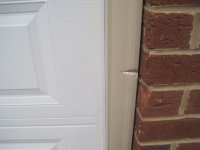
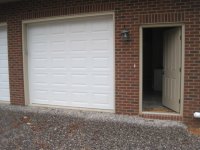
I backed my trailer into my garage doorframe today.

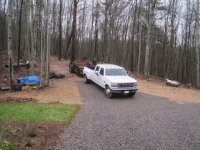
Ouch! There is just barely enough room to turn my truck and 28 ft (22' bed + 6 ft toungue) trailer around on our parking pad but it is tight. This morning when backing the trailer, I forgot that the ramps in the up position stick out a foot behind the trailer. While backing the trailer I felt it hit something (my garage). Fortunately I didn't do any structural damage. I chipped of a corner of a piece of brick and dented the overhead garage door frame.

I feel very fortunate that the damage was not worse. If the trailer had of been a couple inches to the left, I would have hit the overhead garage door and likely destroyed it. When I hit the brick, I felt the jolt with my trailer which prompted me to stop. I would have felt nothing if I hit the overhead garage door and might have stopped as quickly.

My wife was very gracious about the uh-oh.
 

Attachments

  • IMG_2459.JPG
    IMG_2459.JPG
    88.8 KB · Views: 295
  • IMG_2460.JPG
    IMG_2460.JPG
    111.8 KB · Views: 256
  • IMG_2458.JPG
    IMG_2458.JPG
    170.6 KB · Views: 268
/ At Home In The Woods
  • Thread Starter
#3,640  
Trailer Suggestions Please
Hitting the garage with my big trailer made up my mind that I am going to buy a small trailer that is easy to hitch up and maneuver. Today, I carried our riding lawnmower to the repair shop on our big trailer rated to carry 12,000 lbs. Besides being overkill, hauling small stuff with the big trailer is quite a hassle. When hitched up to my crew cab duelly, the truck and trailer rig is about 50 ft long and can be quite difficult to maneuver in a lot of places. The only thing for which I really need the big trailer is to transport my tractor.

Here are the things I would want to do with a smaller trailer:
  • - Transport my riding lawn mower
  • - Carry boards and other home maintenance supplies from the store
  • - Pull firewood around our property using my tractor
  • - Possibly haul off limbs and other tree and brush debris
Do you guys have any suggestions on what I should look for in a trailer? I would love the trailer to be light weight.
 
Last edited:

Marketplace Items

Tandem Axle Rear Truck Frame (A59230)
Tandem Axle Rear...
CASE CX31B EXCAVATOR (A60429)
CASE CX31B...
Used Landpride GR1525 Stump Grinder
Used Landpride...
DEUTZ MARATHON 60KW GENERATOR (A58214)
DEUTZ MARATHON...
2014 CATERPILLAR 930K WHEEL LOADER (A60429)
2014 CATERPILLAR...
YANMAR VIO17-A EXCAVATOR (A60429)
YANMAR VIO17-A...
 
Top