At Home In The Woods

/ At Home In The Woods #3,441  
Yes, a loose screw on the terminal can cause the odor too.
__________________

I was an electrician for 10 yrs. Three problems I would encounter, staples being two tight on the wire, loose terminal screw, using the push in connection on the back of the switches and receptacles. The last one I mentioned pisses me off to no end when I find it. I seen that burn up a lot of receptacles and switches because the pinch points to hold the wire never hold it tight.

OBED, the wife and I love the pics of the property and house. Keep up the good work.
 
Last edited:
/ At Home In The Woods
  • Thread Starter
#3,442  
I waited all week long to try out my new toy. Although I wanted to cut and split some wood first thing Saturday, I postponed my gratification while I moved the dirt pile and moved the trailer. Then I got to do the stuff I was really looking forward to doing.

attachment.php


I hooked the log splitter onto the tractor and pulled it to the spot I would be cutting and splitting. Near the house we had a small maple and a dead oak on the ground that needed cleaning up. I also had a stack of hickory that needed splitting.

I had decided that I wanted to mix the types of wood on the pallet so I cut up into 3 pieces a pine log that was sitting beside our driveway close to the property entrance. I used my new log roller tool to roll the knotty pine log over without much effort at all. There was also a smaller log of unknown species, might be chestnut oak but I'm not sure, lying beside the pine tree that I cut in pieces. I stacked the logs on the forks and brought them home.

At the splitter I cut the logs into 18" pieces. I made a 4 1/2 foot measuring stick for cutting the logs. I've found that irregular length firewood pieces can make stacking difficult, especially if you have pieces that are fairly short. I'm not very good yet at eyeballing the lengths; that's why I made the measuring stick. The firewood veterans out there are probably rolling their eyes reading this. That's fine; my log pieces are all the same length.

After cutting up the maple, oak, pine, and other misc dead wood, I was ready to start splitting. Darkness was approaching; I really wanted to get all the newly cut logs split plus some of the existing hickory. The splitter was empty of gas so I filled it up using my government required "spill proof" gas can nozzle on the gas can. As I tried to use the nozzle which requires continuously pulling on an outside sheath with one hand while pouring gas, I succeeded in spilling gas all over the splitter and the ground. The "spill proof" nozzle is so awkward to use, it has increased 10 fold the likelyhood that I will spill gasoline. That's what you get when you have beaurocrats in an office mandating rules and regulations for equipment the beaurocrats have no personal experience using themselves.

The 27 ton Troy-Bilt splitter with a Briggs and Stratton gas engine started on the first pull. My wife took pictures as I split the first log. The splitter worked great without any issues. The splitter was easy to operate and everything was laid out in a fairly ergonomic fashion. The primary thing I would like would be a bigger cradle for catching the log pieces. When I split a log in half, one of the two pieces was very likely to fall off the cradle onto the ground. So after splitting up the first half, I would have to lift the second half off the ground onto the splitter to split it into smaller pieces.

I stacked the pallet as I split the wood. As darkness fell, I finished splitting all my new log pieces and a few pieces of the hickory. I was able to split a pallet of wood much faster and easier than I did last week when splitting by hand. Also, I was much less tired out using the log splitter. However, at the end of the day, my back still knew I was cutting and splitting wood.
 

Attachments

  • 2011-11-14_17-59-24_227.jpg
    2011-11-14_17-59-24_227.jpg
    66.2 KB · Views: 229
  • IMG_2181.JPG
    IMG_2181.JPG
    120.1 KB · Views: 254
  • IMG_2182.JPG
    IMG_2182.JPG
    184.1 KB · Views: 233
  • IMG_2183.JPG
    IMG_2183.JPG
    182.9 KB · Views: 237
  • IMG_2187.JPG
    IMG_2187.JPG
    154.8 KB · Views: 284
  • IMG_2186.JPG
    IMG_2186.JPG
    159.4 KB · Views: 225
  • IMG_2185.JPG
    IMG_2185.JPG
    178 KB · Views: 228
  • IMG_2184.JPG
    IMG_2184.JPG
    161.4 KB · Views: 749
  • IMG_2188.JPG
    IMG_2188.JPG
    150.3 KB · Views: 325
  • IMG_2190.JPG
    IMG_2190.JPG
    134.3 KB · Views: 293
/ At Home In The Woods #3,443  
Looking good! :thumbsup:

A couple tips to help you out.

There is only one good gas can on the market: No Spill LLC I am a believer after fighting with the same crappy CARB cans you must have. You can buy them online, and I think ACE hardware stores carry some.

You may want to consider segregating your woods by species when you split, rather than mixing them. Species all have different BTU values, and you can use that to your advantage. Oak is great for the coldest part of the winter, but something light like pine or poplar would be a good choice for the "shoulder" seasons where you only need perhaps a morning fire to take the chill off. At the least you should consider dividing into piles of "Better" and "Good." Soft Maple and cherry are similar to each other, for example.

This is a useful chart for firewood:
Firewood Information

Yes a splitter work table or cradle is a big help. I think Speeco sells something, or you could have a shop fab something up for you. Use it a while first to get familiar with it.
 
/ At Home In The Woods
  • Thread Starter
#3,444  
dstig1 said:
There is only one good gas can on the market: No Spill LLC I am a believer after fighting with the same crappy CARB cans you must have. You can buy them online, and I think ACE hardware stores carry some.
That looks like it will work much better than my gas can. However,a 5 gallon plastic gas can costs $28!!! Ouch!
 
Last edited:
/ At Home In The Woods #3,446  
One common sense trick I learned to "eyeball" logs before cutting them is to use the bar of your chainsaw as a measuring stick. For example, if your bar is 18", turn your saw along the length of the log, and then pivot your saw at the point where the bar meets the powerhead. I can get quite accurate cuts over time with this method without slowing down operation very much

Another neat guide is to mount a dowel perpendicular to your chainsaw bar at the length you want to cut. This will give you an exact visual reference for length and works great for getting consistant cuts!:thumbsup:
 
/ At Home In The Woods #3,447  
That looks like it will work much better than my gas can. However,a 5 gallon plastic gas can costs $28!!! Ouch!
Well, when you look at the cost of the crappy ones, the No-Spill ones are one a few bucks more and they are waaayy better built than any other gas can I have found. The walls are thick and they sit stable on the ground, plus they are very easy to handle. They were around before the regulations appeared (pretty sure) and they met those regs so they could keep on selling.

As for the government regs.... well... <sigh>
 
/ At Home In The Woods #3,448  
A nice pile of wood-----now let`s see how the fire place works , and how much you burn a week :) Tony
 
/ At Home In The Woods
  • Thread Starter
#3,449  
One common sense trick I learned to "eyeball" logs before cutting them is to use the bar of your chainsaw as a measuring stick. For example, if your bar is 18", turn your saw along the length of the log, and then pivot your saw at the point where the bar meets the powerhead. I can get quite accurate cuts over time with this method without slowing down operation very much
Yes, that's how I was cutting the firewood pieces before I made the measuring stick. I know where 18" is from the tip of my chain bar to a certain spot on my chainsaw. That works fairly well but is a little slower than using the measuring stick.
Obed
 
/ At Home In The Woods
  • Thread Starter
#3,450  
A nice pile of wood-----now let`s see how the fire place works , and how much you burn a week :) Tony
Tony,
Basically, I'm observing the same behavior burning fires in our Quadrafire fireplace that I observed last winter. When the FP doors are closed with the air control on high, the fire burns significantly lower than if the doors are cracked. The difference isn't as noticable when burning small pieces or very dry Ashe. However, when burning larger pieces of oak, the fire gets choked down quite a bit when the doors are closed even though the fire burns great with the doors cracked open. I suppose it is possible that the fireplace is designed to choke down the combusion air that much on the high setting but I still don't like the way it burns. I would think that semi-dry wood should burn fine with the setting on high if the same wood burns great with the doors open.
Obed
 
/ At Home In The Woods
  • Thread Starter
#3,451  
I'm finding that I'm not thrilled with my method of putting firewood on the pallets. I have to be much too careful about stacking the wood on the pallets. Being so careful really slows down the splitting and stacking process. Also, the stack of wood on the pallet will fall off the pallet if the tractor leans over a little on the terrain. I'm thinking seriously about building some firewood pallets like these.
 
/ At Home In The Woods
  • Thread Starter
#3,452  
Something else I've been considering is to stack my firewood in round stacks like shown here - A Better Way to Stack Firewood.

attachment.php


I think these round piles are rather attractive and interesting. But mostly, they appear to be really easy to make. Only the outer circle has to be carefully stacked. All the wood in the middle is just tossed in unstacked.

The two downsides I could see to the round stack could be:
1. The center pieces of wood may take longer to dry than in a regular stack.
2. The bottom of layer of wood appears to sit directly on the ground (termites/rotting).

I'll be working out my firewood process for a while to find out what works best for us. I'm finding the firewood project to be a lot of fun.
 

Attachments

  • roundwoodpiles2.jpg
    roundwoodpiles2.jpg
    16.8 KB · Views: 1,515
/ At Home In The Woods #3,453  
Obed, couldn't you build the round stacks on pallets thus eliminating the problem of being on the ground? I would think the wood in the middle would dry faster as there would be more air, but I am probably wrong.
 
/ At Home In The Woods #3,454  
Why dont you just stack it between two trees with treated boards or old tin or pallets under it all to keep it off the ground and not worry so much with it. It will dry this way the best. Or just build you a small lean to shed like i did to keep rain off of it and stack it in there. You can then get a wood cart like i have or use you pallet method and take enough wood to the house for a few days. I personally dont want much more wood than that near my house as some had termites in it when split. I dont pay enough attention to it or get wood in the dark as to notice the termites at handling time. So i do not want termites near my house. The wood shed is 35 yards or so from my house.

As far as your fire place. It sounds like its working right. IF this thing is designed to operate more like a stove insert, then yes the fire will choke down with the doors closed vs cracked, your limiting the air then again to it. Once hot you can close the doors to slow your burn. Your "semi-dry" wood may be the problem. Really you should only burn dry wood, i know this is a preference and some do it to last longer etc. I understand all that but in a higher effeciency thing maybe like what you have? the wet wood casuses loss of BTU's as your boiling water with some of the heat and not heating anything but water to go up the chimney in steam.

My stove insert will burn like a freakin blow tourch if i leave the one and only main door cracked. It will also throw flames several feet out the top of it and burn the wood in a few hours vs say 12 if i have it adjusted right. The only time i crack my door (again i have a stove and not a fancy fireplace with doors or whatever) is when i start a fire and the stove is not hot and neither is the fire hot enough to create a daft large enough to sustain the fire at first. Once hot, say 15-20 mins depending upon the size wood i fed the starter fire i shut the door and the stove uses the air control. Once my stove is hot it is about choked all the way down. I have a catalyst model and it actually burns the smoke, so its possible to not see any flames in the stove but your throwing crazy amounts of heat out heating 2000+ sqft and making the room the stove is in close to 90 degrees.
 
/ At Home In The Woods #3,455  
Yeah you don't have much hope of keeping stacks in place on a pallet without some side support. If you have a good source of pallets, that trick should work, or you can just use 2x4's or whatever. Best bet would be to put them together with galv screws so you can break them down to save space.

When stacking on the ground, lay down a plastic tarp first so you don't get moisture coming up from the ground. Even if you put it on pallets, this is a good idea to put under the pallet. Tarp on top and bottom but leave sides always open for airflow.
 
/ At Home In The Woods
  • Thread Starter
#3,456  
Putting the round stacks on pallets sounds like a great idea. I was considering putting some gravel under the pile but I hate spreading gravel because it's forever. And a mix of gravel and topsoil is a useless combination.

I had not thought of a moisture seal on the ground but I could see where that makes sense. I read something today that suggested putting a perferated plastic drain tile pipe running vertically in the center of the pile with a cap on it. Supposedly the pipe will allow air and moisture flow out of the center of the pile to help dry it.

Obed
 
/ At Home In The Woods
  • Thread Starter
#3,457  
Another Narrow Escape

Sunday afternoon, my wife and I loaded into the back of the truck the freezer that died last year while we were still living in the camper. The junk freezer has been sitting on our property long enough. You can see it on the right side of the first picture. Since we are having a couple big gatherings at our house over Thanksgiving, my wife decided it was time for the freezer to vacate the property. I hurt my back a few years ago moving this freezer. Now I have a tractor. Lifting it into the truck was a breeze this time.

While I was on the tractor, I decided to haul off a couple of stumps to our stump dump which is down a steep hill in the woods. Rain was in the forecast so I wanted to get this done before the ground got wet. I made sure the tractor was in low gear and 4WD and headed down the steep downhill path through the woods. After dumping the stumps on the pile, I put the tractor into reverse so I could back up the hill. I have done this same maneuver a few times before. I could not turn the tractor around and face uphill for rear of rolling the tractor if I got it sideways.

attachment.php


However, when I put the tractor in reverse, the tires just spun in place. I saw quickly that there was no way I was going to be able to drive the tractor backwards back up the hill. The ground was wetter than I had thought. Plus, I had no weight on the rear of the tractor to give the rear wheels some traction. I had removed the box blade the day before in order to move the trailer with the tractor.

Too make things worse, it was starting to lightly rain. We had several days of rain in the forecast and we are approaching the wet season in this area. If I did not get the tractor back up the hill out of the woods within the next couple of hours, I didn't know when it would be feasible to get the tractor out of that spot. It could be months before the path down that hillside dried out. I parked the tractor and ran to get my wife. On the way back, I brought a chain, two steel cables, and an almost useless come-along we bought from Lowes when we rescued my tractor a year ago.

We hooked the come-along to a tree and hooked the cables and chain to the tractor. While turning the tractor tires in reverse, my wife tried to crank the come-along without any success. The come-along could not pull the tractor up the hill. Meanwhile, the rain continued to threaten and we got spurts of light drizzle and the ground just got wetter. I then tried to use the FEL bucket to push the tractor up the hill while keeping the tractor tires moving in reverse. This method worked and could move the tractor 6 inches to a foot when the operation was done successfully. However, the tractor just as easily would slide back downhill into the holes made by the spinning tires.

Thus, I would use the FEL to push the tractor up the hill while my wife cranked on the come-along. The come-along did not help pull the tractor up the hill but it did prevent the tractor from sliding back down the hill. We inched the tractor up the hill in this fashion as the conditions continued to get wetter. Every 4 or 5 feet, we would have to reposition the come-along, cables, and chain when the ran out of come-along cable. I would say we did this routine for about 40 feet until the hill got a little less steep and the tractor tires finally got traction.

I was a very happy camper when we got the tractor out of that predicament! If I had been by myself, I couldn't have gotten the tractor up that hill. I'm not exagerating when I say I don't know when we would be able to retrieve the tractor due to the approaching we season if we weren't able to rescue it when we did. It rained 4 staight days beginning the day I got stuck down the hill. We would probably have needed to hire a tow truck with a winch to come winch the tractor up the hill. I'm assuming a tow truck winch could pull the tractor up that hill but don't really know for sure.
 

Attachments

  • IMG_2133.JPG
    IMG_2133.JPG
    196.6 KB · Views: 288
  • IMG_2193.JPG
    IMG_2193.JPG
    105 KB · Views: 267
  • 2011-11-20_16-24-14_60.jpg
    2011-11-20_16-24-14_60.jpg
    112.6 KB · Views: 1,094
  • 2011-11-20_16-24-51_644.jpg
    2011-11-20_16-24-51_644.jpg
    108.1 KB · Views: 270
Last edited:
/ At Home In The Woods
  • Thread Starter
#3,458  
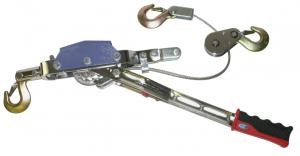
I'm considering purchasing this come-along. Do you guys think it would be able to pull out a stuck tractor?

 
/ At Home In The Woods #3,459  
Yes, any competent tow truck/recovery vehicle operator could winch your tractor out no problem. FWIW, I would never put my wife or anyone else on the working end of that piece of junk come along. That thing is for maybe a lawn and garden tractor, not a CUT. As an example we just broke a 3/8" winch cable pulling logs out of the woods. It was no easy task but it can and does happen. The tension in any size cable is enough to do serious injury to the operator, and there is no time, and no warning to get out of harm's way when the cable breaks. The only way to minimize potential injury from a broken cable is by having something like a heavy jacket or blanket thrown over the winch/come along cable prior to it breaking. That takes knowledge and forethought to be safe when working with something that has the potential to do serious bodily harm.
The other thing one ought to use in a situation like yours is a snatch block- preferably a clamshell type for ease of cable install/removal.
Here is what I use- available from various sellers:
Winch Snatch Block - 4050 Winch Snatch Block
The advantages are several; doubles work result that is, 2x the result for the same amount of effort. And the cable being used gains double it's rated capacity. Allows OP to move to an angle where a broken cable will less likely come back at them.
Some of the clamshell snatch blocks come with a tree protector nylon strap about 5' long x 3-4" wide, to wrap around the tree which one is using as their anchor point.

Here in VT we have the visiting 'flatlander' tourists running their go anywhere Range Rovers and Expeditions, etc. over steep mountain ravines, cliffs etc. and tow vehicles have to do recovery work to pull them back onto the road when their 4x4 goes into the trees and through the woods on the way to grandma's house. It makes for some treacherous rescue efforts.
So maybe next time, better know your equipment and the risks involved, or get the tow truck, neighbor's tractor, or something more suited to safe recovery of your machine.
 
/ At Home In The Woods #3,460  
I'm considering purchasing this come-along. Do you guys think it would be able to pull out a stuck tractor?


NO! See my post about come alongs and the inherent hazards of using them. And your question is too open ended. What do you mean by stuck? Can't gain traction or up to it's axles in mud and rocks?
You're better off buying a roll of logging cable 3/8 inch, with the intent of using it to attach to something like a 4x4 truck to pull your tractor out of the 'stuck' situation, from a location where it has traction to ease you out of the hole.
 

Marketplace Items

2014 DODGE RAM 2500 (A58214)
2014 DODGE RAM...
2018 MACK GU813 DUMP TRUCK (A59823)
2018 MACK GU813...
Bradco 6HFC Hydraulic Trencher Skid Steer Attachment (A59228)
Bradco 6HFC...
2014 CATERPILLAR 930K WHEEL LOADER (A60429)
2014 CATERPILLAR...
2021 CATERPILLAR 259D3 SKID STEER (A60429)
2021 CATERPILLAR...
UNUSED IRANCH MINI EXCAVATOR RIPPER (A60432)
UNUSED IRANCH MINI...
 
Top