Article From Reuter's: Rent walkouts point to strains in U.S. farm economy

/ Article From Reuter's: Rent walkouts point to strains in U.S. farm economy #21  
"Across the U.S. Midwest, the plunge in grain prices to near four-year lows"

I'm not a farmer but I know a lot of people here and in VT who are, and it's not an easy profession.

It seems like the average home based farmers are purposefully being squeezed out by the 'mega' farms and the govt.

A few years back, cattle and dairy farms were made 'offers they can't refuse' to sell/kill all their cattle and promise not to go back into the business for X years in return for a whole lot of cash. The offers were too good to refuse. There were many farms within just a few miles of me that did it.

That being said, the 'plunges' in grain prices never seem to be reflected in the grocery stores. I wonder why :(
 
/ Article From Reuter's: Rent walkouts point to strains in U.S. farm economy #22  
The speculative bubble in farm land prices will deflate. Slowing AG sales will also deflate the prices of used and new equipment. Downside: weak hands will get knocked out of the market, which is to say there will be even less mom and pop operators unless they can control their costs and focus on customer retention.

Worse, we will also lose smaller attachment OEMs, that could in the long run lead to less competition and higher prices.

Still even worse, is that rural farming communities diversity of operators will decline as all but the wealthiest operators buy up those operations that are knocked out of the business.

The up side: during periods of decline is when the best innovation takes place!
Another potential upside is the deflation of equipment prices will let me buy more equipment.

There have been numerous studies that have attempted to quantify the effects of the ethanol mandate on the price of corn. Unfortunately, those studies have not reached a consensus. Here's a discussion that suggests that the direction of causality can at times be from corn prices to ethanol prices rather than vice-versa.

Ethanol Prices Drive Corn Prices, Right? | farmdocdaily.illinois.edu

Steve
Coincidentally that study was PUBLISHED just after the price dropped like a rock.US Corn Farm Price Received
 
/ Article From Reuter's: Rent walkouts point to strains in U.S. farm economy #23  
Fair enough.

I'm getting far afield from the topic, and economics, but some of this renting and corporate farm ownership has roots in the old 'capital versus labor' situation. 'Capital' attains it's advantages (privilege) through special interests and political maneuvering while many think it's abhorrent for 'labor'--via unions or progressive populism--to seek similar advantages.

<snip>

Balancing the influences of capital and labor is always going to be difficult but historically a reasonable balance seems to produce the best overall results. As it applies to farmlands, are we moving to a corporate landed aristocracy that has many similarities to the original European titled aristocracy that grew out of feudalism? If so, why would we do that?

Many oppose rent-seeking, whether by corporations, unions, or other politically powerful special interest groups.

I don't think you need to worry about a "corporate landed aristocracy" anytime soon.

march14_feature_macdonald_fig04.png


Most U.S. farms are family farms under the FAO definition -- 86.1 percent of farms, accounting for 47.4 percent of U.S. farm production, are owned and operated by a family, with the principal operator and spouse providing most of the labor. Another 11.5 percent of U.S. farms, with 38.4 percent of production, are owned and operated by a family, but rely extensively on labor provided by hired workers, contract workers, and other operators and their families, meaning they are family farms under the ERS but not the FAO definition. The remaining U.S. farms -- those that are not family owned and operated -- number about 53,000, or 2.4 percent of all U.S. farms, and account for 15 percent of U.S. farm production. These are nonfamily farms under the ERS definition.

There are many kinds of nonfamily farms. Few are large corporations with dispersed ownership and multiple levels of management -- that organizational form, so common in the broader U.S. economy, is rare in agriculture. Like family farms, most nonfamily farms are smaller half have less than $35,000 in sales but most nonfamily farm production comes from the 10 percent that have annual sales of at least $1 million. Those farms collectively accounted for $42 billion in agricultural production in 2011, or 93 percent of all U.S. nonfamily farm production. These large nonfamily farms are also a diverse group. Partnerships, with small numbers of unrelated partners, account for 28 percent of large nonfamily farm production, while another 10 percent is from farms organized as sole proprietorships (one owner, who did not operate the farm).

Just under half of large nonfamily farm production --20 billion-- came from nonfamily farms organized as corporations. However, most of these corporate farms have no more than 10 shareholders, and are thus likely to be tightly held partnerships that have incorporated for tax and management purposes. Some large corporations with dispersed stockholdings are active in farming, but not many. Most large diversified corporations that exercise influence in agriculture do so through their role as input suppliers, commodity purchasers, and coordinators of production. Not only is U.S. agriculture dominated by family farms, but production by nonfamily farms is dominated by organizations with a small and tightly knit group of owners.

USDA ERS - Family Farming in the United States

Steve
 
/ Article From Reuter's: Rent walkouts point to strains in U.S. farm economy #24  
That being said, the 'plunges' in grain prices never seem to be reflected in the grocery stores. I wonder why :(

And dramatic increases in grain prices never seem to the reflected in the grocery stores.

A couple of factors are at work here.

Farmers on average receive less than 16 cents of the dollar that we spend on food. That percentage varies according to the costs incurred in shipping, storing, processing, wholesaling, and retailing the various farm products. That percentage tends to be lower for grain products. According to the USDA, the values are 7 cents for bread and 1 cent for cereal. Farmer's Share

Processors and merchants may reduce their margins when their input costs increase in anticipation of making up the difference when those input costs decrease.

Steve
 
/ Article From Reuter's: Rent walkouts point to strains in U.S. farm economy #25  
Steve:

Most U.S. farms are family farms under the FAO definition -- 86.1 percent of farms, accounting for 47.4 percent of U.S. farm production, are owned and operated by a family, with the principal operator and spouse providing most of the labor. Another 11.5 percent of U.S. farms, with 38.4 percent of production, are owned and operated by a family, but rely extensively on labor provided by hired workers, contract workers, and other operators and their families, meaning they are family farms under the ERS but not the FAO definition.

That's more farming close to the land (47.4% + 38.4% of total production) than I would have guessed.

I knew I should have asked an Economist. :)
 
/ Article From Reuter's: Rent walkouts point to strains in U.S. farm economy #28  
Investors should not be able to buy huge amounts of any type of farm commodity without taking delivery. If that rule were enforced the crop prices would stabilize greatly.

<snip>

Less risk. Less stress.

I disagree with the first statement. A minuscule proportion of futures contracts are actually settled by delivery, either by hedgers or speculators.

Due to vagaries of supply and demand, commodity prices are going to vary regardless of whether there are futures market for the commodities. A futures market allows hedgers (farmers, elevators, processors, etc.) to transfer their price-level risks to speculators who are willing to assume that risk. Less risk. Less stress.

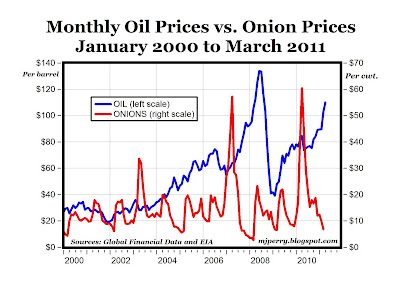
There used to be a futures market for onions, but it was outlawed in the 1950s due to allegations of market manipulation by speculators. There is a futures market for oil.

onionprices.jpg


onionsoil.jpg


From CARPE DIEM: What Can Onions Teach Us About Oil Prices?

Steve
 
/ Article From Reuter's: Rent walkouts point to strains in U.S. farm economy #29  
Your evidence that food quality has gone down?

Steve

Corn syrup and sugar, it's everywhere. It's not good for people to eat all that sugar. If you read ingredient labels, corn syrup/sweetener shows up in the darnedest places, like canned pizza sauce.

Nitrogen filled fresh meat packages such as ground beef, pork and turkey, never looks rotten even when it is.

Caramel coloring a potential carcinogen:
Popular soda ingredient, caramel color, poses cancer risk to consumers -- ScienceDaily

Highly processed foods lead to food addiction and obesity:
Want pizza, chocolate, French fries? Highly processed foods linked to addictive eating -- ScienceDaily
 
/ Article From Reuter's: Rent walkouts point to strains in U.S. farm economy #30  
I disagree with the first statement. A minuscule proportion of futures contracts are actually settled by delivery, either by hedgers or speculators.

We'll simply agree to disagree. But your second sentence, I'll agree with. And it makes my point. If I buy a bushel of grain, I should be forced to take delivery. If I sell a bushel of grain I should be forced to deliver. If that were true in today's markets you would see stability. The amount of stability can be discussed. But no doubt stability would increase.
 
/ Article From Reuter's: Rent walkouts point to strains in U.S. farm economy #31  
Corn syrup and sugar, it's everywhere. It's not good for people to eat all that sugar. If you read ingredient labels, corn syrup/sweetener shows up in the darnedest places, like canned pizza sauce.

Nitrogen filled fresh meat packages such as ground beef, pork and turkey, never looks rotten even when it is.

Caramel coloring a potential carcinogen:
Popular soda ingredient, caramel color, poses cancer risk to consumers -- ScienceDaily

Highly processed foods lead to food addiction and obesity:
Want pizza, chocolate, French fries? Highly processed foods linked to addictive eating -- ScienceDaily


I'm going with Steve on this one. You choose to buy all of the products you referenced above. Those products are not forced on you.
 
/ Article From Reuter's: Rent walkouts point to strains in U.S. farm economy #32  
I'm going with Steve on this one. You choose to buy all of the products you referenced above. Those products are not forced on you.

It's not about what I choose; I actually avoid those foods. The question is why are those foods made to begin with if they are not healthy? You noted the addictive angle?
 
/ Article From Reuter's: Rent walkouts point to strains in U.S. farm economy #33  
It's not about what I choose; I actually avoid those foods. The question is why are those foods made to begin with if they are not healthy? You noted the addictive angle?

Supply and demand my friend. First thing that must be understood in economics. :)
 
/ Article From Reuter's: Rent walkouts point to strains in U.S. farm economy #34  
Supply and demand my friend. First thing that must be understood in economics. :)

No doubt, but at the same time it's hard to argue that food quality has not declined while feeding the sugar/fat/salt habit of millions.

Why do people eat junk food? Because it's there and it is chemically altered to please your palette leaving you wanting more. Why is junk food sold? Because people buy it. That's a very tight circle with no mention of nutritional quality. I expect it is reasonably profitable however.

What about people with actual busy lives and demands on their time, not retirees gabbing. :D They may reasonably assume foods wouldn't be sold if it was 'bad' for them or their family. You can say they should alter their priorities or whatever, but ...

I'm no saint when it comes to eating, so don't take this as a holier than thou thing.
 
/ Article From Reuter's: Rent walkouts point to strains in U.S. farm economy #35  
I'm going with Steve on this one. You choose to buy all of the products you referenced above. Those products are not forced on you.

When food becomes addictive, such as processed fats, sugars, and salts, then we have moved away from choice.
 
/ Article From Reuter's: Rent walkouts point to strains in U.S. farm economy #36  
When food becomes addictive, such as processed fats, sugars, and salts, then we have moved away from choice.

Who or what has determined foods containing processed fat, sugars and salts are addictive?
 
/ Article From Reuter's: Rent walkouts point to strains in U.S. farm economy #37  
No doubt, but at the same time it's hard to argue that food quality has not declined while feeding the sugar/fat/salt habit of millions.

Why do people eat junk food? Because it's there and it is chemically altered to please your palette leaving you wanting more. Why is junk food sold? Because people buy it. That's a very tight circle with no mention of nutritional quality. I expect it is reasonably profitable however.

What about people with actual busy lives and demands on their time, not retirees gabbing. :D They may reasonably assume foods wouldn't be sold if it was 'bad' for them or their family. You can say they should alter their priorities or whatever, but ...

I'm no saint when it comes to eating, so don't take this as a holier than thou thing.

I don't know why people do what they do. No one knows that. I drink Beer. Someone else might smoke. Someone else might eat McDonald's. Someone else, like you, might have a different vice that the others wouldn't even consider. :confused3:
 
/ Article From Reuter's: Rent walkouts point to strains in U.S. farm economy #38  
When food becomes addictive, such as processed fats, sugars, and salts, then we have moved away from choice.

Eric, I normally stand by you. Not sure where this came from?? Cigarettes are addictive but the smoker still has a choice. I smoked for ten years of my early life, then I quit. Did I have a choice?? Of course I did. As I said to Dave, I drink Beer. Do I have a choice?? Of course I do. There is nothing marketed today that's harmful to your health you do not have a choice about consuming. If you think different, please give me an example? :)
 
/ Article From Reuter's: Rent walkouts point to strains in U.S. farm economy #39  
Who or what has determined foods containing processed fat, sugars and salts are addictive?

From my observations nothing is more capricious than nutritional science! First eggs and whole milk are out, now it's back in. Put butter in your coffee! Ha! :)

To the original article:

Unfortunately, it only takes one or two farmers in a neighborhood to make cash rent prices out of whack. If they think they can make money at $350 an acre in rent then the market moves that direction whether the other farmers agree or not. It's a difficult decision to decide to let acres go especially in an area where land is tight. I know many folks who have matched bids from other guys to keep ground and lost a lot of sleep over it. That said, for a lot of growers, the right decision was to walk away from those rent prices and I think they're better positioned now. Now that grain prices are down the issue will solve itself as more farms are put up for rent bid.

As for whether or not farmers and landowners have different or better attitudes about land management, I find it's more about attitude and education than who actually owns it. I work with some growers who I don't think manage for the best sustainability even on their home farms they own. Fortunately they're a small minority. I know many landowners who rent their ground but demand that their tenants do things like no-till and maintain proper fertility because they get that in the long run its a win win for them and the farmer.
 
/ Article From Reuter's: Rent walkouts point to strains in U.S. farm economy #40  
From my observations nothing is more capricious than nutritional science! First eggs and whole milk are out, now it's back in. Put butter in your coffee! Ha! :)

To the original article:

Unfortunately, it only takes one or two farmers in a neighborhood to make cash rent prices out of whack. If they think they can make money at $350 an acre in rent then the market moves that direction whether the other farmers agree or not. It's a difficult decision to decide to let acres go especially in an area where land is tight. I know many folks who have matched bids from other guys to keep ground and lost a lot of sleep over it. That said, for a lot of growers, the right decision was to walk away from those rent prices and I think they're better positioned now. Now that grain prices are down the issue will solve itself as more farms are put up for rent bid.

As for whether or not farmers and landowners have different or better attitudes about land management, I find it's more about attitude and education than who actually owns it. I work with some growers who I don't think manage for the best sustainability even on their home farms they own. Fortunately they're a small minority. I know many landowners who rent their ground but demand that their tenants do things like no-till and maintain proper fertility because they get that in the long run its a win win for them and the farmer.

Missouri just implemented some new regulations concerning farm sign-up. Landowners had to make some serious choices that would affect their productive land for a long time in the future. I went to my friend, the large farmer, who's Son rents my tillable and asked what should I do? He said "I have no idea, we've hired a lawyer to read thru it for us, farm by farm, we'll let you know what the outcome is". They called me last week and guided me as to signing up my farm. As I said earlier, I'm very fortunate and blessed to have a renter that is concerned about my farm's future as I am.

And yes, here there has been severe competition for rentable farm land. That has pushed prices to a dangerous high. But in the end, Mother Nature and the markets will "right" the ship. :)
 

Marketplace Items

UNUSED IRGC80 Battery Powered Golf cart (A55272)
UNUSED IRGC80...
Bobcat 435 FastTrack (A60462)
Bobcat 435...
2021 Chevrolet Silverado 1500 4x4 Crew Cab Pickup Truck (A59230)
2021 Chevrolet...
2000 Generac 2000 Series 30kW T/A Towable Diesel Generator (A59228)
2000 Generac 2000...
KBH Tender Trailer (A56438)
KBH Tender Trailer...
204549 (A52707)
204549 (A52707)
 
Top