A new project

   / A new project
  • Thread Starter
#21  
Peter, I did use an acetelene cutting torch to cut out the hole for the receiver tube. However, there are numberous ways to accomplish what I did but with simpler tools. One approach would be to weld a 3/4" X 2" bar of steel 4 or 5 inches long directly to the box. Simpler yet would be to weld the same to a 3"x3" plate and bolt it to the box. Or, for that matter, weld a 2" receiver tube to the plate and bolt it to the box. That way you could have it welded elsewhere. I went for maximum flexibility and fortunately I had enough equipment to do it. Other than the gas and MIG welder, I used an electric band saw (metal cutting) and a drill press to drill the 9/16" holes for the pin. I'm not very good with the cutting torch and just ok with the welder, but I have fun!

On another subject you brought up, I've given a lot of thought to adding training wheels to some of my implements too. Specifically, I want to buy a back blade and add adjuster wheels. However, my thoughts on this is to minimize the variance caused by the tractor going over rough terrain. I want this blade for leveling ground. I'm thinking that I would like to have the blade maybe 4 feet behind the tractor with the wheels directly behind that. My rationale is that the leverage from the hitch to the blade relative to the blade to the wheels would reduce the up down movement significantly. I've searched for such a blade but haven't found one other than for ATVs which are too small. Assuming that works, then I want the same setup with a rake. Does anyone have any experience with such a setup?

Problem is, I'm beginning to think I'll never get my land done cuz I'll always be making tractor implements!

Larry...
 
   / A new project #22  
Larry,

That's a real interesting idea. I was thinking that the rear blade would be conventionally mounted. The wheels could be directly mounted near the blade or you could set them some distance back. I think you would get smoother grading with the guage wheels further away from the blade. The distance from the tractor to the blade should not matter. The blade will follow the guage wheels. If the blade is near or far (assuming a floating hitch) the guage wheels will solely determine blade height. Move the wheels far behind the blade (say 4' like you said) and a 1" change in the height of the wheel will have a very small change in the blade height. This would seem highly desirable.

Let me know if you find anything or are in a fabricating mood /w3tcompact/icons/smile.gif!

Peter
 
   / A new project
  • Thread Starter
#24  
Peter, after re-reading your post, it occurs to me that I might not have completely answered your post. Like Bird said, it's possible to "burn" through metal with an electric welder, but its hard to do it very accurately. As I said, I used an oxygen/acetelyne cutting torch to cut the hole in the box and a MIG to weld the receiver in the hole. To weld, there are three basic types of welders, stick, MIG (for metal inert gas) and TIG (for tungsten inert gas). TIG is also referred to as heliarc at times. TIG is generally used for aluminum, stainless, and when a really strong weld is needed in steel. TIG is more exensive and requires more knowledge. MIG is the most common these days. They are generally wire fed, meaning a fine wire is fed through what appears to be a torch. As you pull the trigger, you feed wire that happens to have an electric charge causing an arc. The gas, or MIG, "shields" the arc helping control the burn characteristics by eliminating the oxygen in the air. This same principle is used with stick welding except the rod, or stick, has a flux paste on the outside. The burning emits a similar inert gas. Stick welders are the least expensive, then MIG, then TIG.

Back to oxy/acet torches, they can do lots of things but I use mine almost exclusively for cutting, and not much for that. A band saw works much better for cutting most things and is a lot cheaper. However, I couldn't have cut the hole in the box blade with a band saw. If you really want to cut a lot of metal, then an electric plasma cutter is the ticket. Someday I'll have one. That tool draws an arc like the welder to heat the metal, then uses compressed air to cut a very clean and accurate line in steel. It's quick too!

I'm strictly an amature at this metal working and I'm sure many could pick apart my descriptions. But they are reasonably close.

A welder is just like the tractor; you didn't know how much you need one until after you got it!

Larry...
 
   / A new project #25  
Larry -

Good info on the different types of welders. I've filed the message for future reference. /w3tcompact/icons/smile.gif

It sounds like a gas welder is a handy thing to have in addition to a MIG. However, since I will probably not have the budget to buy both at the same time, I was thinking of starting out with an oxy/acetylene outfit 'cuz it's relatively cheap and let's you both cut and weld.

I know you can only offer an opinion, but you've racked up some credibility points, so I would give it some value. /w3tcompact/icons/wink.gif

HarvSig.gif
 
   / A new project
  • Thread Starter
#26  
Peter,

I think we're on the same wavelength here but with a slightly different viewing angle. First, assuming the tractor is going forward, presumably it is the tractor that is going over the rough ground and therefore it is the tractor that is experiencing the maximum "up and down" movement. Likewise, the tractor hitch (3pt or drawbar) is also going up and down according to the rough terrain. Meanwhile the rear guage wheels are behind the blade taking advantage of the freshly "smoothed" ground, therefore not experiencing much up and down movement. It would seem to me that you would want the blade to be nearest the "minimal movement" point of the lever arm. Likewise, it would seem that the closer you get to the tractor, the greater the up/down motion resulting in more variations in the "bladed" soil. To visiualize this, take a yardstick, sit one end on a book, and move the other end up and down a few inches. Assume the "book" end is the guage wheel and the other end is connected to the tractor hitch. Now imagine the blade being attached at different places on the yardstick while you move it up and down. I think you'll see that it gets minimal up/down movement at the point closest to the book (or guage wheel).

I may have gotten completely off track from your intent and if so I appologize but I'm trying to sort this all out myself too.

Larry...
 
   / A new project
  • Thread Starter
#27  
Harv, I probably already expressed my opinion in the last post to Peter. While you can indeed weld with a oxy/acet rig, it's very difficult for someone less than an expert to get really good quality welds in reasonably thick steel. For something like my toolbox project, it would have been fine. But for the hitch, I wouldn't have even thought about trying it. I use my torch setup for cutting and heating (to bend metal). I have used it to braze (brass rod), but not very often. It's good for welding very thin metal such as autombile sheet metal, which is very difficult with a MIG, but I don't do much of that either.

My recommendation, for what it's worth, is to hold out for a MIG. It doesn't have to be an expensive one, but make sure it uses gas and not the flux core wire (which also works, but not as well). My recommendation would be to buy the smallest 230 volt rig and not buy the 110V one.

I'd recommend visiting http://www.daytonamig.com. I have a Lincoln welder but Daytona makes good stuff and they have a nice website.

Hope I've helped and not further confused you.


Larry...
 
   / A new project #28  
Larry -

Thanks for the caution about oxy/acetylene welding. I didn't realize they were weak on penetration.

I was going to use the torch for cutting, but let's see -- I have a sturdy bandsaw in the woodshop. I suppose with the right blade it could cut steel. I've also had my eye on a Sawzall (anybody out there use one of these for cutting steel?). I've wanted a heavy-duty chop saw for quite a while, and ...

'Scuse me -- I have to go make a lot of money. /w3tcompact/icons/crazy.gif

HarvSig.gif
 
   / A new project #29  
Hey Harv the chop saw to me is a definite must have.. They are about 170 around here. The saws-all is great to but mainly for remodeling jobs.. cutting metal and cutting it straight might be a little hard with a saws-all but you could definitely do it to a point. the torch is great for cutting holes but I use my chop saw when ever I can. Everything looks so much better. By the way I have a licoln stick welder and wire welder. They are both great to have.. Like you though it takes time to aquire all the goodies..
 
   / A new project #30  
Harv, my very first experience with welding was when I lived in town and decided to buy a gas welding rig and see if I could learn to use it. When the salesman at the welding equipment dealership learned that I wanted it to be very portable and it would be stored in an attached garage at my house, he suggested I go with a little oxygen/Mapp gas rig instead of acetylene. While it may be a small chance, there is a chance of a gas leak that could be very dangerous with acetylene, but if the Mapp gas leaks, you'll smell it before it reaches explosive levels. I took his advice and the rig came with a pretty good manual. Took it home, read the manual, and tried for several hours to stick two pieces of metal together; got nowhere. Took it back and told him I didn't think it worked right. He took it out in the shop and laid down as pretty a bead as I've ever seen a welder do. So between reading the book and watching him, I learned to both cut and weld with it. I made a rack on casters for a friend to hang the works from grandfather clocks on to work on them, then he asked me whether we could make 3 big racks to mount computer equipment in where he worked (the computer company wanted a pretty high price for them). I told him we could do it, but before we got through, he'd know why the price was so high, but that it should be a lot faster if we had an arc welder (even though I'd never used one). So he bought a Lincoln 225 stick welder, we wired a 230v outlet in both of our garages, and made those racks in our spare time in the evening and weekend; saved his company quite a bit of money, paid for the welder and material, and made a few dollars.

And right now I have a farmer neighbor who's pretty darned good at both welding and cutting, has a big trailer mounted, gasoline powered arc welder and an oxygen/acetylene rig for cutting, but he uses propane instead of acetylene; says it's much cheaper (and I wish I could cut as smoothly and neatly as he does).

My brother recently sold a customer a new TIG welder and took a small MIG in on trade and decided to keep it for our own use. It's pretty good, brother likes it better, but I'm still a little partial to my little stick welder.

In other words, there's lots of options. Go to a big welding equipment dealer and find a salesman who's good enough to demonstrate his equipment before you spend your money.

Bird
 
   / A new project #31  
LarryT - Good post, good project, good work. I welded a piece on my box scraper several years ago for reason of pulling farm wagon (no trailer) only .I will not post a picture as it is crude and pales in comparison to your engineering / fabricating feat.

Good description of the welding processes as well.

Watch out for Harv - I have met his type before. Waits in the wings & gleans all our knowledge only with the purpose to outshine us. In a year or so I expect he'll weld up a Space Needle or some such!!!

LarryM
 
   / A new project #32  
<font color=blue>Watch out for Harv</font color=blue>

Sheesh! That's the second time today that warning's been posted on this board.

A guy could get a complex. /w3tcompact/icons/crazy.gif

Yes, I'm gleaning knowledge, Larry, but I'm running a little short on time and money (wish I could glean them puppies), so that will slow things down considerably. /w3tcompact/icons/frown.gif

Anyway, I'm glad one of us thinks I'll be capable of welding 'n' such someday.

HarvSig.gif


A space needle, eh? Hmmmmmm..... /w3tcompact/icons/wink.gif
 
   / A new project #33  
Harv,

<font color=blue>Sawzall (anybody out there use one of these for cutting steel?)</font color=blue>

I do all my cutting with a reciprocating saw by Millwaukee.
It works just fine. I go thru a lot of blades and they are pricey so I buy them in quantity from the dealer.

<font color=blue>'Scuse me -- I have to go make a lot of money</font color=blue>

If that worked out blades shoud be no problem, I would go for the automatic bandsaw with remote./w3tcompact/icons/smile.gif
 
   / A new project #34  
<font color=blue>I do all my cutting with a reciprocating saw by Millwaukee.</font color=blue>

Al, I notice that Millwaukee and Sawzall seem to share the same web space. Have they become, or have they always been, one and the same?

HarvSig.gif
 
   / A new project
  • Thread Starter
#35  
Harv, recriprocating saw is the generic name. Sawzall is, and always has been, the trade name for Millwaukee's reciprocating saw. I guess Millwaukee was first and now everyone refers to them as Sawzall. I have the real thing, have had for many years, and I use it all the time. Great tool! Sawzall is like Bush Hog which everyone uses for rotary mower. Bush Hog sometimes gets distorted to Brush Hog which isn't really the brand name, but is a derivitave I guess.

Larry...
 
   / A new project #36  
Re: A new project..rake wheel photos

Larry,
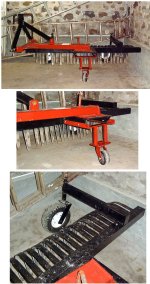
I made a set of wheels for a 6' rake this summer. It makes all the difference in the world! works so much better with wheels. I also made a 3rd. wheel stand so I can roll the rake sideways thru a door for storage. (See attached photos)

Von
 

Attachments

  • 37-27715-rake.jpg
    37-27715-rake.jpg
    346.6 KB · Views: 194
   / A new project
  • Thread Starter
#37  
Re: A new project..rake wheel photos

Cool setup Von! Do you leave the top link unconnected when you use the rake? What kind of rake is it? Do you recommend it? And where did you get the wheels?

I like your storage setup also. Great idea!


Larry...
 
   / A new project #38  
Re: A new project..rake wheel photos

Hi everyone.
Been lurking and learning for quite a long time.
Decided it was time to try and add some helpful information.
Larry, very nice welding job and outstanding documentation!
Harv, if you want to learn more about reciprocating saws
Fine Home Building has a comparison test at http://www.taunton.com/fh/features/tools/35saw.htm
and Family Handyman has a general description at
http://www.familyhandyman.com/200012/library/
I haven't figured out how to set hyperlinks links yet (looked at the instructions but still not sure how it works) but I think you will be able to copy and paste the address to your browser.
The articles seem to provide good information (at least to me)
Tractorbynet is by far the best site I have found for quality information with the added bonus of being very entertaining. (and addictive)
Keith
 
   / A new project
  • Thread Starter
#39  
Re: A new project..rake wheel photos

Welcome Keith! And thanks for the kind words. I'll post the finished product photos tonight. This is a great forum for exchanging ideas and knowledge. Glad to have another contributer aboard.

Larry...
 
   / A new project #40  
Re: A new project..rake wheel photos

Larry
Thanks for the Welcome.
Looks like you put a lot of thought, effort and pride into your projects.
Looking forward to seeing the finished product.
Keith
 

Tractor & Equipment Auctions

2012 Vermeer V500LEHD Vacuum T/A Towable Trailer (A55973)
2012 Vermeer...
Adams 16T Tender Body (A56438)
Adams 16T Tender...
2019 TAKEUCHI TL10V2 SKID STEER (A60429)
2019 TAKEUCHI...
UNUSED FUTURE FT90 PLATE COMPACTOR (A52706)
UNUSED FUTURE FT90...
2014 AMERITRAIL LAY FLAT HOSE TUGGER TRAILER (A58214)
2014 AMERITRAIL...
2010 MAXEY WELDING 20 T/A GOOSENECK TRAILER (A55745)
2010 MAXEY WELDING...
 
Top