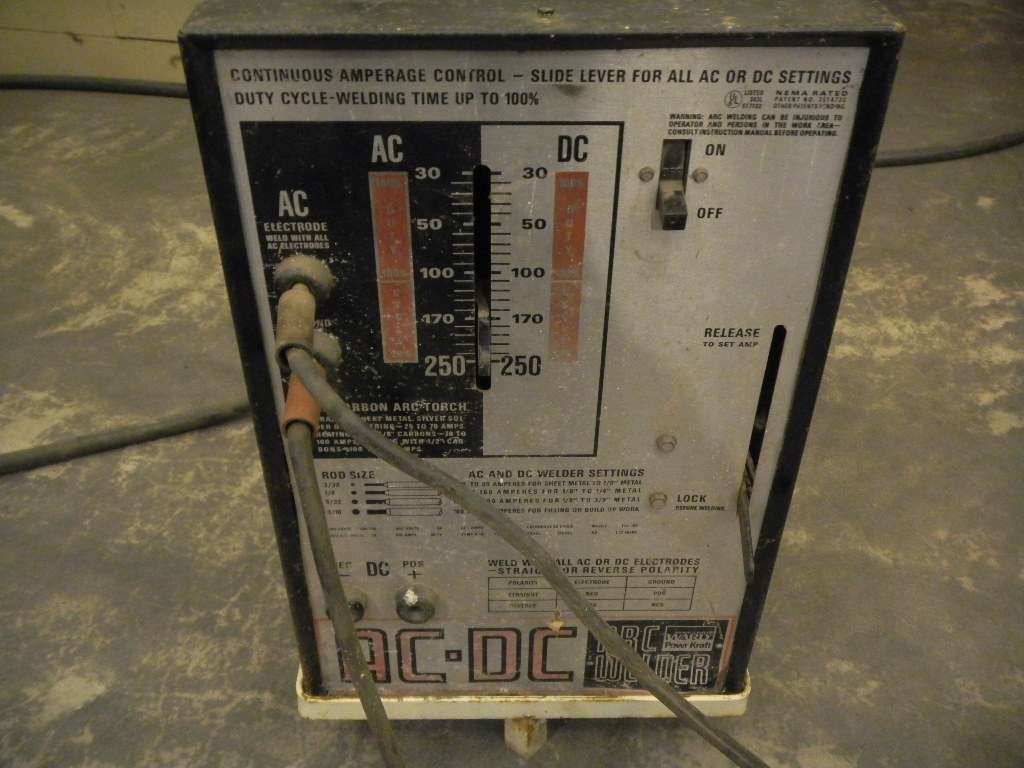
You know, I noticed that too the other day when the grandson brought it in the shop. I was going to mention it to rankrank1 but I forgot. He knows more about welding machines than I do.
Ah good catch. I did not even notice that this was the upgraded model from Century over the standard entry level model. Miller also made an upgraded Thunderbolt in 300 AC and 200 DC and I am sure Lincoln did too in the venerable tombstone although I do not know the specs off hand.
I can explain some of it
a) First and foremost every machine is desgned for a price point so the entry level models were naturally cheapest and most common.
b) Also the entry level machines sorta followed in the footsteps of the early Forney welders and Marquette welders which were targeted for households that only had 60 amp total household service. 100 amp household service and 200 amp household service are common now, but that was not always the case. Most of the entry level units will draw less than 40 amps at WOT - leaving 20 amps ar so in reserve to run the refrigerator and a few lights in the house was the logic of the time period.
c) The upgraded models will draw more power.
d) The upgraded models also cost more.
Lastly, Just because this Century is exactly even on AC and DC output (250 AC and 250 DC) does not mean it is better than say the upgraded Miller Thunderbolt would be which is (300 AC and 200 DC).
Really it is all about the volt/amp curve and duty cycles.
To explain further and taking it to an extreme case: A manufacturer could build the tranformer such that it drastically reduces the OCV (Open circuit voltage) to less than ideal while simultaneously artificially increasing the amp output so that it appears very impressive on paper. While the amp output looks impressive on paper the real world use of the welder will be frustrating because initial arc strikes would be a royal pain and quite difficult. Contrarily a different manufactuer can optimize the the OCV which could sacrifice the total amp output to a lower level and it would appear less powerful, but the real world use of the welder will be much more enjoyable even though it appears to be less powerful. (If you have ever driven a car that is high in horsepower yet very low in torque then you know what I mean. I prefer the best balance of both horsepower and torque in an engine).
Another trick is to sacrifice duty cycle. Yeah it can do it at extreme levels but not for very long if the components are undersized.
A loose comparison but to keep this tractor related: A welder is sorta like a tractor/vehicle engine. An engine can be built for horsepower, it can be built for Torque, or it can be built for longetivity. You want all 3 simultaneously and it will cost more.
A lincoln AC 250/DC 250 Idealarc is totally diffent class of machine than say this Century which is also an AC 250/ DC 250.
The idealarc cost much more to buy when new, the idealarc also has an even bigger appetite for input supply power by almost double, and the idealarc has a much higher duty cycle. That said there is a good reason for all of it.