3000 vs 4000 series for stability

/ 3000 vs 4000 series for stability #1  

NYBOB

Silver Member
Joined
Feb 4, 2003
Messages
206
Location
Maine NY(Binghamton area)
Tractor
2007 JD 3720
The reason I am trying to put weights on my rear wheels is stability. I have very hilly terrain and assumed that the 3720 would be more stable then my previous New Holland TC33D.

I told the dealer I would like to get a 4000 series up to my property in the spring to evaluate if it would better suit my needs.

Will going to a 4000 series help my situation?

Thanks
 
/ 3000 vs 4000 series for stability #2  
I doubt the stability is any different, the machine is taller and wider.
 
/ 3000 vs 4000 series for stability #3  
Don't think the stability gained, if any, from the swap would be worth the monumental price difference you're likely to see.

Try swap out the R4's for R1's mounted at the widest setting and fill them, finally add wheel weights. This configuration should get you about as stable as you can for your tractor. It won't be cheap but should be much cheaper than the likely 5 figure price increment.
 
/ 3000 vs 4000 series for stability #4  
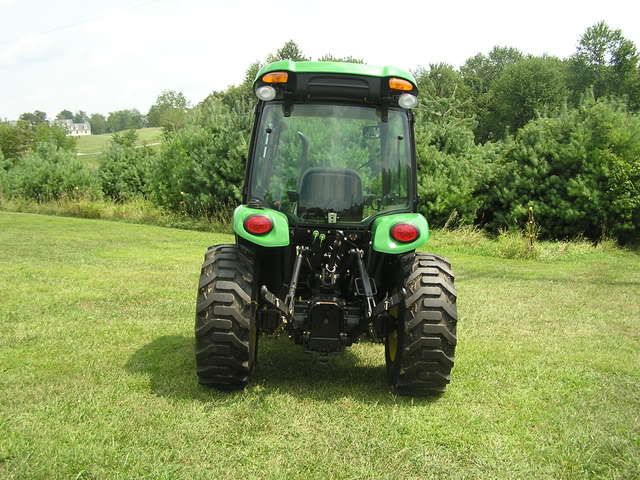
NYBOB,you are going though the same thing I went though with my 3520. I doubt the wheel weights alone will help your stability enough.The 3000 series are just too narrow for hilly terrain. I ended up buying and installing 4 inch Unverferth wheel extension, which gave me an additional 8 inches in rear wheel stance. I think it's around 65 inches from the outside to outside of the tires with the extensions installed and the wheels turned out. It did improve the overall stability. If I had to do it over again I might go with 6 inch extensions. You might also want to consider what your implement or front loader bucket width is to gauge what width you want. Below is a pic of my 3520 with the extensions installed. As far as I know the 4000 series are somewhat wider stance and more stabile.

Sincerely, Dirt

P1010794.jpg
 
/ 3000 vs 4000 series for stability #5  
dirt, I wish you'd quit flashing pics of that tractor, I'm spending all my money on new keyboards cause I drool all over it every time I see your machine. kinda makes my little 2305 look like a kids toy.
 
/ 3000 vs 4000 series for stability #6  
Dirt, I was wondering with those 4" x2 wheel spacers, how much more of a slope do you think you are able to traverse, in real numbers. That picture shows a small slope but you can go alot more than that, right?
 
/ 3000 vs 4000 series for stability #7  
JiminGa, my apposigises for the tractor ****. I'll try to keep the photos to a minimum.

Superduper,hmmmmmmmm. I don't really have any real stats for side slope before and after. I know that a place I mowed with my old JD870 w/ JD25Aflailmower without even thinking about it had the 3520's right wheel off the ground 5 or 6 inches with the same mower without the extensions. Hench the need for the wheel extensions. I can now mow that area with the 3520 with caution. I'll have to measure the side slope and post back. As I said: I would probably go with 6 inch extensions if I had it to do over.

BTW, that slight slope in the pic is considered level ground here in West Virginia.

Sincerely, Dirt
 
/ 3000 vs 4000 series for stability #9  
I climbed out on the up hill side and then had my son get our Cat287 MTL and hooked a stretch strap on the upper side axle. Then had my son pull me backwards slowly as I eased the rearend up hill. I was amazed when I first exited the tractor and found the right rear off the ground. The only reason I stopped............something just didn't feel right.

Sincerely, Dirt

I'm no stranger to slopes, but different tractors will handle different conditions. Also the same tractor won't handle the same slope under slightly different conditions. If that makes any sense. I could take my old JD870 places I would never even consider taking the JD3520.

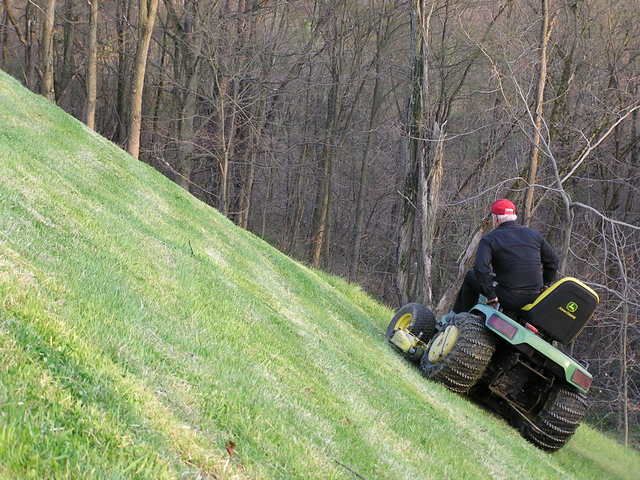
Here is a slope of 32.6 degrees. You don't even want to think of mowing this with the slightest hint of dew.

P1010040.jpg
 
/ 3000 vs 4000 series for stability #10  
I used to do that with an old murray lawn tractor many years ago and rode it bicycle style hanging, twisting and leaning to keep the tractor upright as I mowed. When it quit, I "upgraded" to a craftsman garden tractor but immediately found it much less comfortable. For one, the tractor was taller and felt tippier but mostly because I could no longer lean or stand as the ergonomics didn't permit it and the operator presence switch in the seat would cut out the motor every time. When doing so, the slope was nowhere even close to what is depicted in this picture.

I've seen that picture several times and every time I see it, I always think that it must be some trick. I'm looking at it now and I still can't believe it. What is even more amazing is that any operator would have the b*lls to ride out there. Dirt, you are a better man than me, I'm afraid to admit.
 
/ 3000 vs 4000 series for stability #11  
Dirt,

That is pretty steep. With regard to our OP's question, I have had both 3000 and 4000 series machines. Dirt's solution is about the only one that will make a 3000 series tractor approach the 4000 series stability. The 4520 I owned was light years better on stability than is the 3720 I currently have. And, it is not just hillside, it is front to back. This is something we do not discuss often but is very important. With a bucket-full of stuff, the 3000 series have a tendency to "see-saw" back and forth. My 4520, no matter how heavily-loaded, did not do that. Weights would likely help that, but not totally resolve it.

John M
 
/ 3000 vs 4000 series for stability
  • Thread Starter
#12  
I did notice the front to back issue also. I went from a HD 72" bucket to a 60" standard bucket due to the weight issues.

I guess the question is whether the 4000 would fix my issue, still be usable with my implements and how much the trade would cost me. Versus using the extentions.
 
/ 3000 vs 4000 series for stability #13  
The 4 series also comes with either R1s or R4s that have 8 position rear wheels. They can be moved out quite a bit without adding wheel extenders. The 3 series only has the R1's with 8 position wheels, according to the JD website.
 
/ 3000 vs 4000 series for stability #14  
Just looked up the rear tire track width and it looks like the 4x20 series can be set much wider than the 3x20 series. At the widest setting, they are quite a bit wider so conventional wisdom says that it will be more stable. Looks like the 4x20 series tractors can have multiple setting on both R4 and R1 equipped tires/rims whereas the 3x20 series tractors can only adjust out with the R1 tires. On the other hand, it is bigger frame size and the width can be a detriment depending upon where it is being operated. A tractor with a 75" rear track width is obviously not going to work for everyone.

-------------------------------------------------------

Rear Tire Size
Position .........17.5L-24 8PR R4 TI .......13.6-28 4PR R1 TI
1 (Narrow) .............N/A ..........................N/A
2 ....................1.3 m (51 in.) .............1.3 m (51 in.)*
3 ....................1.4 m (55 in.) .............1.4 m (55 in.)
4 ....................1.5 m (59 in.) .............1.5 m (59 in.)
5 ....................1.6 m (63 in.) .............1.6 m (63 in.)
6 ....................1.7 m (67 in.) .............1.7 m (67 in.)
7 ....................1.8 m (71 in.) .............1.8 m (71 in.)
8 (Wide) ...........1.9 m (75 in.) ............1.9 m (75 in.)

--------------------------------------------------------
 
Last edited:
/ 3000 vs 4000 series for stability #15  
Nice follow up Super!

I think those are inside widths. My dealer claims he got my R4s out to 90 plus inches outside width, at one point in the decision process. He said it looked a bit goofy at max width.

Also, the 4 series is about 30 percent heavier than the 3 series.
 
Last edited:
/ 3000 vs 4000 series for stability #16  
Actually, I think they are measured from center to center of tire. If so, then 90 inches or so would sound about right from edge to edge. If the 75" was measured at the inside edge of the tire, then talk about goofy looking. Of course, it would be super super stable then.
 
/ 3000 vs 4000 series for stability
  • Thread Starter
#17  
I have a 6 1/2 front plow and a 6 foot woods rear finish mower. What setting would get me as wide as I could go and not be wider then the mower or the plow angles 30 degrees?
 
/ 3000 vs 4000 series for stability #18  
NYBOB,

Your 3720 with R4's only has two width settings for the rear tires. I don't know how wide yours go in the widest setting.

A 4 series with R4's has 8 settings for the rears and two for the fronts.
 
/ 3000 vs 4000 series for stability
  • Thread Starter
#19  
If I traded my 50 hour 3720 in for a 4120 assuming my implements work except my 300CX loader, how bad would I get hammered on it financially?

Thanks for everyone's help....someday I will get the perfect tractor :)
 
/ 3000 vs 4000 series for stability #20  
Don't know but I think alot of us would be curious as well so if you ever get a quote, please share this with us. Using Deere's configurator, the difference does not look to be that much. Lightly configured with 400cx loader, it looks like a 4120 would set you back around $29k list. The 3720 is like a couple grand below that. You would need to pay new taxes all over again which on a $29k purchase would be quite substantial. Then the warranty on your trade-in is either expired or at the minimum, less than that of a new one which reduces it's desirability. Then there is the fact that Deere does not offer the financing incentives (0%, or low%) on used equipment. Because of that, the tractor needs to be priced accordingly or buyers will go new everytime. In short, although 50 hours is not much at all for a tractor like this, going used would mean the buyer will get a less than desired warranty and no financing incentives. Don't underestimate the allure of the financing incentives; I believe most folks take advantage of this, are drawn to it, and was a big part of their decision. To draw them away from new and buy used, price needs to be low enough to be a motivating factor. Then the dealer needs to make their money too.

I asked about this once just to get a quote. These factors were all mentioned to me by the dealer and while I was prepared for anything, he apparently didn't feel it was worthwhile to make the swap and didn't even offer me a price, just that it wasn't cost effective. My initial response was that I'm offering my business, this is a salesman's dream but clearly, he didn't want me to do it and was looking out for my best interest.

If I were to guess, I'm thinking that it could be a min. $10,000 hit with taxes taking a $2k-$3k chunk of the pie, dealer taking a couple grand just to make it worthwhile, a couple grand amounting to the difference in value between the two, and at least -10% -20% to get a buyer interested in used vs. new.

It adds up (or down) fast.
 
 
Top