You are using an out of date browser. It may not display this or other websites correctly.
You should upgrade or use an alternative browser.
You should upgrade or use an alternative browser.
Water line leaking - how to find it
- Thread starter SenileTexasAggie
- Start date
- Views: 8923
More options
Who Replied?
/ Water line leaking - how to find it
#21

4570Man
Super Star Member
- Joined
- Apr 7, 2015
- Messages
- 19,007
- Location
- Crossville, TN
- Tractor
- Kubota M59, Kubota L3800, Grasshopper 428D, Topkick dump truck, 3500 dump truck, 10 ton trailer, more lighter trailers.
So, first, this type of pipe is absolutely normal, for anything 4" and above, and I've seen it used in 2" before. It lasts just fine, but, I'm assuming near a change in direction, or an improperly homed joint, it has separated, and either wasn't homed, or needed a bell joint restraint or thrust block.
Me personally, I'd get a trench shovel and post hole diggers and just start spotting it every 250 ft. Maybe install a valve every 500 ft or so. Then you can come up with a general area, instead of 2500 lf between A and Z; maybe a 200 ft section between G and H.
I doubt it's deeper than 30-36" and it's really not that bad to dig a small locating trench across the general running line to locate it.
Now, you've got valves installed every 500 lf, with a 4" "riser" to the valve, preferably a few inches above the ground, and in the future, you have a fixed locate every 500 lf.
For everyone saying replace; looks like $2.31/lf x 2500 lf=$6000 just in pipe. Well worth a few hours with a shovel to find and repair the leak....
Any chance they ran locate wire or tonable tape on the line when installed (imo tonable tape is pure trash from a locating prespective, and warning tape typically just tells you what type of line you just cut...)
If you can find a leak in a 2500 ft run that you don’t even know where it runs in a couple of hours then you should go into professional leak locating. I don’t disagree that just replacing the line would be cost prohibitively expense but finding the leak in just a few hours would be extremely lucky. They do make listening equipment to find leaks which is probably who I would call after the looking for a wet spot method fails.

Chewwy
Platinum Member
- Joined
- May 5, 2015
- Messages
- 872
- Location
- Upstate SC, Near the Electric City
- Tractor
- Kubota L3240, MF 265, MF383
Pipe bursting appears to be pretty darn expensive. Locally quoted as between $60 and $250 PER FOOT.That's call pipe bursting. An aircraft grade cable and very powerful winch pulls a ram through the old pipe, breaking it out as the new pipe is pulled in. I had it done on a prior residence to break out the old and failing sewer line and install a new one. It avoids having to dig up the landscaping as only a hole (somewhat large) on each end is needed. I had extensive, beautiful landscaping so this was the only way to go.
Total cost was about $9,000. I am glad I had a fixed price contract and not time and materials. Because about half way through pulling, the high strength cable snapped, stranding the whole mess about halfway inside the pipe. The hardpan in my area and the old pipe were too much for the winch and cable being used. Before it was over they had to bring in a super-duty winch from another state to finish the job. It was quoted as a 2-3 day job, but it took nearly 4 weeks.
ultrarunner
Epic Contributor
- Joined
- Apr 6, 2004
- Messages
- 28,913
- Tractor
- Cat D3, Deere 110 TLB, Kubota BX23 and L3800 and RTV900 with restored 1948 Deere M, 1949 Farmall Cub, 1953 Ford Jubliee and 1957 Ford 740 Row Crop, Craftsman Mower, Deere 350C Dozer 50 assorted vehicles from 1905 to 2006
I've had it done several times with me using my backhoe to dig a pit on both ends in preparation.That's call pipe bursting. An aircraft grade cable and very powerful winch pulls a ram through the old pipe, breaking it out as the new pipe is pulled in. I had it done on a prior residence to break out the old and failing sewer line and install a new one. It avoids having to dig up the landscaping as only a hole (somewhat large) on each end is needed. I had extensive, beautiful landscaping so this was the only way to go.
Total cost was about $9,000. I am glad I had a fixed price contract and not time and materials. Because about half way through pulling, the high strength cable snapped, stranding the whole mess about halfway inside the pipe. The hardpan in my area and the old pipe were too much for the winch and cable being used. Before it was over they had to bring in a super-duty winch from another state to finish the job. It was quoted as a 2-3 day job, but it took nearly 4 weeks.
My longest run was 100'
The crew was worried because the longest cable carried was 100' but it was just enough to get a bite...
$3k for 100' of seamless heat welded 4" sewer line in SF Bay Area California 2017... so $30 a foot and the crew was very happy to have the pits dug by me.
Last edited:
OP
SenileTexasAggie
Member
All,
Thanks so much for your replies. As for why I think I have a leak are these clues: (1) we had a leak in the line before. We knew because our water usage went WAY up one month ($1,000), and there was a place visible in the pasture which was green and wet while elsewhere the pasture was still brown, (2) just this month we accidentally were given the water bill for our neighbor as well as our own. The neighbor's bill was something like $30 while ours is $200. They have 3 people in their household while we only have 2. We don't water our lawn or a garden, and only have 2 dogs and 4 chickens to water besides us humans. (3) After seeing the neighbor's water bill, I cut of all water at the house (which I installed when I had water issues before), then went to the gate to see if the water meter was turning. It was. (I took a phone video of the meter but it was too large to upload - 24 MB.) It is not turning fast but steady enough to cause our water usage to much more than needed.
Regarding locating the pipe, one thing that might help is that the old phone lines were buried next to the water line. The phone linesare being used (edit: are NOT being used), so I or someone else might could use them to send a signal that could be detected.
If I am able to locate the leak, then I will most likely try to repair it.
Thanks again for all of your replies.
Senile Texas Aggie
Thanks so much for your replies. As for why I think I have a leak are these clues: (1) we had a leak in the line before. We knew because our water usage went WAY up one month ($1,000), and there was a place visible in the pasture which was green and wet while elsewhere the pasture was still brown, (2) just this month we accidentally were given the water bill for our neighbor as well as our own. The neighbor's bill was something like $30 while ours is $200. They have 3 people in their household while we only have 2. We don't water our lawn or a garden, and only have 2 dogs and 4 chickens to water besides us humans. (3) After seeing the neighbor's water bill, I cut of all water at the house (which I installed when I had water issues before), then went to the gate to see if the water meter was turning. It was. (I took a phone video of the meter but it was too large to upload - 24 MB.) It is not turning fast but steady enough to cause our water usage to much more than needed.
Regarding locating the pipe, one thing that might help is that the old phone lines were buried next to the water line. The phone lines
If I am able to locate the leak, then I will most likely try to repair it.
Thanks again for all of your replies.
Senile Texas Aggie
Last edited:

dodge man
Super Star Member
If the phone line is still there and they can tie into the end of it they can locate it.

newbury
Super Star Member
- Joined
- Jan 8, 2009
- Messages
- 14,842
- Location
- From Vt, in Va, retiring to MS
- Tractor
- Kubota's - B7610, M4700
I'd still think
IF you plan on staying there for years AND needing the water line replacement would be a viable alternative.
IF you plan on staying there for years AND needing the water line replacement would be a viable alternative.

paulsharvey
Super Member
On locating; I'm assuming we have a general idea of running line; left side of driveway, somewhere between 2-8 ft from edge of drive. Not that hard to ditch a slit trench from edge of drive outwards 6 or 8 ft long, 30-36" deep. If all we know is starting point and ending point, that's a bit different, but still, we can pretty much assume a running line based on path of least resistance. We know it's stick pipe, so it's not like it's an HDD, where we could be 30" to 10 ft deep.
To the OP; based on pipe type; I'm assuming this is 2"?
There are private locate companies; but on private property, I'm assuming they didn't lay locate wire. They could GPR it, but thats expensive, and is far from the magic that some people think. Dug a lot of empty holes looking for something GPR picked up, and even when I worked for a company that did private locates, at $2500/10 hr day; we Often resorted to post hole diggers, even if we had a vac truck and air lance on site. By the time you got the truck, hoses, ect into position, you could have already pot holed it, if it was Remotely shallow (less than 4 ft).
To the OP; based on pipe type; I'm assuming this is 2"?
There are private locate companies; but on private property, I'm assuming they didn't lay locate wire. They could GPR it, but thats expensive, and is far from the magic that some people think. Dug a lot of empty holes looking for something GPR picked up, and even when I worked for a company that did private locates, at $2500/10 hr day; we Often resorted to post hole diggers, even if we had a vac truck and air lance on site. By the time you got the truck, hoses, ect into position, you could have already pot holed it, if it was Remotely shallow (less than 4 ft).
Last edited:

Fuddyduddy1952
Super Member
- Joined
- Aug 10, 2022
- Messages
- 9,076
- Tractor
- john deere
I'm far from expert, but at my homeplace 97yo mom still there from meter at highway the line goes about 2000ft. crossing a creek about halfway. After about 20 years leaks started. The plumber found it was because it was touching rocks along the way, vibration cut through pipe.
That Menards pipe two reasons I don't like: it's not for sale in OPs state and it's very thin.
For Mom, I simply connected back to well that was dug in 1942. It tests fine, but buy bottled water drinking & cooking.
The best way according to plumber isn't the least expensive but the best is pipe within a pipe. Any trouble simply pull it through. Me, for a long run especially where connections are made I'd want some kind of fabricated box like a sewer distribution box, marked so you know where they are.
When I ran water to garage years ago here they suggested 18" min, but it's 24" minimum, then I put a ft. of dirt in then metal foil tape, then rest of soil. It's easy to find with a metal detector.

That Menards pipe two reasons I don't like: it's not for sale in OPs state and it's very thin.
For Mom, I simply connected back to well that was dug in 1942. It tests fine, but buy bottled water drinking & cooking.
The best way according to plumber isn't the least expensive but the best is pipe within a pipe. Any trouble simply pull it through. Me, for a long run especially where connections are made I'd want some kind of fabricated box like a sewer distribution box, marked so you know where they are.
When I ran water to garage years ago here they suggested 18" min, but it's 24" minimum, then I put a ft. of dirt in then metal foil tape, then rest of soil. It's easy to find with a metal detector.
paulsharvey
Super Member
Regardless of your final choice (repair vs replace); take advantage of the opportunity to mark locations in a permanent way, and add valves at regular intervals. It can be as simple as a 1/2" galv conduit driven in ground above running line and painted blue, to a 4" or 6" riser, going to a hand wheel valve, and a small concrete pad around the riser. Heck, take your favorite hunting app and add some pins; draw a sketch, make a detailed map, mark offsets on the drive (if paved). We are talking about a $10k asset, and no matter what material it is, there will come a time when you want to be able to locate it in future.
ultrarunner
Epic Contributor
- Joined
- Apr 6, 2004
- Messages
- 28,913
- Tractor
- Cat D3, Deere 110 TLB, Kubota BX23 and L3800 and RTV900 with restored 1948 Deere M, 1949 Farmall Cub, 1953 Ford Jubliee and 1957 Ford 740 Row Crop, Craftsman Mower, Deere 350C Dozer 50 assorted vehicles from 1905 to 2006
Helped a friend when he was building and asked why so many shut off valves and hydrants from
Meter to home?
Every 150’ he had a box with a line shutoff and a riser with a hydrant shutoff.
He said it’s 900’ and if I have a problem down the road I cans quickly isolate the location to within a 150’ plus point to point I know exactly the run.
It doesn’t freeze here so no worries about that.
Meter to home?
Every 150’ he had a box with a line shutoff and a riser with a hydrant shutoff.
He said it’s 900’ and if I have a problem down the road I cans quickly isolate the location to within a 150’ plus point to point I know exactly the run.
It doesn’t freeze here so no worries about that.
paulsharvey
Super Member
I dont know I would go every 150 feet; but every 500 ft would be a good idea. Yes, there is some Marginal reduction of flow (pretty darn marginal); but it gives you options. Looks like between $9-45/valve, depending on type/material.Helped a friend when he was building and asked why so many shut off valves and hydrants from
Meter to home?
Every 150’ he had a box with a line shutoff and a riser with a hydrant shutoff.
He said it’s 900’ and if I have a problem down the road I cans quickly isolate the location to within a 150’ plus point to point I know exactly the run.
It doesn’t freeze here so no worries about that.
ultrarunner
Epic Contributor
- Joined
- Apr 6, 2004
- Messages
- 28,913
- Tractor
- Cat D3, Deere 110 TLB, Kubota BX23 and L3800 and RTV900 with restored 1948 Deere M, 1949 Farmall Cub, 1953 Ford Jubliee and 1957 Ford 740 Row Crop, Craftsman Mower, Deere 350C Dozer 50 assorted vehicles from 1905 to 2006
It was also to have water readily available for future projects and irrigation.I dont know I would go every 150 feet; but every 500 ft would be a good idea. Yes, there is some Marginal reduction of flow (pretty darn marginal); but it gives you options. Looks like between $9-45/valve, depending on type/material.
Just about everyone I know has had a meter to house line break and I have replaced my shared of 80+ year old 1/2 galvanized in the city… lucky the runs always less than 60’ copper coil and I attached the copper to galvanized and pull out the galvanized on one end while feeding the copper in the other.
paulsharvey
Super Member
Yep, at the valves; I would add a tee and 6" long stub and cap, or a tee, to a 3/4" valve and riser with hose bibs (or those frost free hydrants or whatever).
Big picture, we have $6000 in just pipe, probably another $3000 in labor; what's a couple hundred in valves and stub outs for future use.
Big picture, we have $6000 in just pipe, probably another $3000 in labor; what's a couple hundred in valves and stub outs for future use.
etpm
Veteran Member
- Joined
- Jun 30, 2021
- Messages
- 2,338
- Location
- Whidbey Island, WA
- Tractor
- Yanmar YM2310, Honda H5013, Case 580 CK, Ford 9N
There are several ways to locate wire buried underground. You could do a web search. Never mind, I just did one. This link is for one device but there are several similar devices: https://www.amazon.com/Underground-...nEWAT6sRPF8zWeMKB7-sRIlBxfBoCOoEQAvD_BwE&th=1All,
Thanks so much for your replies. As for why I think I have a leak are these clues: (1) we had a leak in the line before. We knew because our water usage went WAY up one month ($1,000), and there was a place visible in the pasture which was green and wet while elsewhere the pasture was still brown, (2) just this month we accidentally were given the water bill for our neighbor as well as our own. The neighbor's bill was something like $30 while ours is $200. They have 3 people in their household while we only have 2. We don't water our lawn or a garden, and only have 2 dogs and 4 chickens to water besides us humans. (3) After seeing the neighbor's water bill, I cut of all water at the house (which I installed when I had water issues before), then went to the gate to see if the water meter was turning. It was. (I took a phone video of the meter but it was too large to upload - 24 MB.) It is not turning fast but steady enough to cause our water usage to much more than needed.
Regarding locating the pipe, one thing that might help is that the old phone lines were buried next to the water line. The phone linesare being used(edit: are NOT being used), so I or someone else might could use them to send a signal that could be detected.
If I am able to locate the leak, then I will most likely try to repair it.
Thanks again for all of your replies.
Senile Texas Aggie
Anyway, I know because of the way the radio signals work the depth of wire that can be found varies. Wet soil has a negative impact on how deep the cable can be detected. Anyway, these devices all work the same. They send an audio signal that is modulated so as to be picked up by a radio receiver, usually in the AM band if memory still serves me. You need to connect the sender to one end of the cable and I think it is best if the other end of the cable is disconnected. (In fact I'm sure it is best to have the cable disconnected at both ends. The longer the cable is the more the signal can be attenuated and this weakened signal will be harder to detect. So find each end of the cable and disconnect it from anything else. It is not being used anyway.) This then makes the cable an antenna that broadcasts the signal fed into it. Then you wave the receiver over the ground until you hear the tone and where it is loudest you are closest to the cable.
Eric
JJT
Veteran Member
- Joined
- Oct 13, 2001
- Messages
- 2,075
- Location
- Upstate NY, USA
- Tractor
- Kubota L3710 HST and a Kubota ZD21 60Pro
If you replace the line, bury a spare. It's cheap insurance for next time.
dieselscout80
Veteran Member
I wonder if you can use polypipe for a hot water line?I would use something like this.
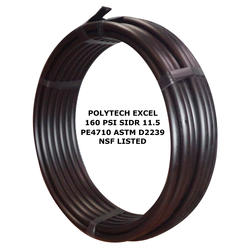
1" x 1000' SIDR 11.5 160 PSI Excel Potable Water Poly Pipe
1" x 1000' Excel 160 PSI Flex Water Pipewww.menards.com

Deere Dude
Elite Member
- Joined
- Feb 10, 2011
- Messages
- 4,014
- Tractor
- John Deere 3720
Did you have any luck with your waterline? I am really curious as to the outcome.All,
I reside on 160 acres in western Arkansas. My driveway (and water supply line) is about 1/2 mile long. The water line is leaking somewhere between the gate and the house but I have not found where. The water line is about 20 years old and so the seals around the PVC may be leaking. I forget the name of this type of piping, but the piping is not glued to each other. Instead a 20' section of pipe is made with a male end and a female end. There is a gasket (O-ring) in the female end that seals the male end of the next pipe. These pips are laid out and then covered over, They work great as long as the ground is not disturbed and the seals don't fail (which apparently starts to happen around 20 years).
My problem is that I don't know exactly where the water line is buried. I know where the line is about 1/4 of the way from the house, as it leaked there and was repaired back in 2020 (that was an adventure but a story for another time). The water meter is located at the gate, so that is the other end. But where the line is in between is a mystery. I see no signs of leakage in the pastures, but the water line crosses a small creek at an unknown place, so it may be leaking there. We had a really dry summer and there was no sign of water entering the creek, as it was completely dry, but maybe the trees there are absorbing the water that is leaking.
So what do you folks recommend: (1) find the leak and repair it, (2) replace the entire water line with a water line that won't use gaskets/seals that will deteriorate, (3) something else?
All recommendations are welcome. Thanks in advance.
Senile Texas Aggie
oldtimer 66
Platinum Member
I know I am a little late on this but here is how I did it. My 1.0 dia. water line was leaking some where. The water pump would cycle on and off, not that often but enough that I knew I had a leak. The line was approx. 150 ft. long and it was the water line to my building.
I borrowed a tool from the shop that we used for finding air leaks in the in the welded piping of assemblies. With this tool we could find leaks without using a soap solution. It had a set of head phones and a pistol like receiver. All of the electronics were in the pistol. You would walk down by the assembly pointing the pistol at different joints and it would sound in the head phones when a leak was detected. It was looking for the high frequency sound that an air leak will will make.
What I did differently, unless I missed this in the previous suggestions, was to drain the water out of the line and hook up my air compressor to the line. I didn't get all the water out but the idea was to have the air make the high frequency sound which the water would not. I walked out to the approx. area where the line was and the head phone started sounding the minute I got close to the leak. The sound was like rumbling as the air would spit out of the pipe underground along with some water. I had a section of the plastic pipe about 2 feet long that was just perforated with really small holes. So this process worked for me.
I thought I could use this type of tool to check for leaks in tires. I purchased similar type of device but it didn't work on the tires. It had a specification like 50 psi with a .005 hole size. It works for air leaks in cars around doors, it has a transmitter you put inside the car etc. That all I can remember. Later.
I borrowed a tool from the shop that we used for finding air leaks in the in the welded piping of assemblies. With this tool we could find leaks without using a soap solution. It had a set of head phones and a pistol like receiver. All of the electronics were in the pistol. You would walk down by the assembly pointing the pistol at different joints and it would sound in the head phones when a leak was detected. It was looking for the high frequency sound that an air leak will will make.
What I did differently, unless I missed this in the previous suggestions, was to drain the water out of the line and hook up my air compressor to the line. I didn't get all the water out but the idea was to have the air make the high frequency sound which the water would not. I walked out to the approx. area where the line was and the head phone started sounding the minute I got close to the leak. The sound was like rumbling as the air would spit out of the pipe underground along with some water. I had a section of the plastic pipe about 2 feet long that was just perforated with really small holes. So this process worked for me.
I thought I could use this type of tool to check for leaks in tires. I purchased similar type of device but it didn't work on the tires. It had a specification like 50 psi with a .005 hole size. It works for air leaks in cars around doors, it has a transmitter you put inside the car etc. That all I can remember. Later.
Fuddyduddy1952
Super Member
- Joined
- Aug 10, 2022
- Messages
- 9,076
- Tractor
- john deere
My brother has a leak from meter at street somewhere to his house...I'm guessing 100 ft. or so. Today he shut main valve off in basement and meter was still running, not a lot but a leak somewhere. He's a few hours from me though. Disconnecting line and compressed air is a good idea to try.