Hydraulic flow numbers

   / Hydraulic flow numbers #1  

JCoastie

Platinum Member
Joined
Aug 29, 2020
Messages
846
Location
Coastal AL
Tractor
LS MT240HE
if I am looking at an implement (such as a front end post hole digger) that calls for 10-30 GPM ...

What number should I be working from? LS advertises my tractor as:

HYDRAULIC SYSTEM
Implement pump (gpm): 8.2
Steering pump (gpm): 5.5
Total flow (gpm): 13.7

So am I within the 10-30 GPM flow requirement or not?

Does the steering system use hydraulic flow when I would be stationary drilling a hole?
 
   / Hydraulic flow numbers #3  
You are at 8.2 for implements at FULL throttle. The other is for steering (and HST I think) only. Separate pumps and hydraulic plumbing.
 
   / Hydraulic flow numbers #4  
8.2. But you will have less than that at the front of your loader.
 
   / Hydraulic flow numbers #5  
Steering isn’t even routed to the implement as stated, two pumps, totally separate.
 
   / Hydraulic flow numbers
  • Thread Starter
#6  
thanks, all, I appreciate the info and clarification. I didn't know they were completely separate systems.
 
   / Hydraulic flow numbers #7  
thanks, all, I appreciate the info and clarification. I didn't know they were completely separate systems.

You can use a PTO powered hydraulic power pack to run skidsteer-type hydraulic implements on the FEL. Either pre-made or DIY, but your PTO horsepower could put you right in the middle of that flow range with the right PTO pump.
 
   / Hydraulic flow numbers #8  
You only have "implement flow" (minus flow losses) so are not within their "requirement" - but that may not be a problem. It depends on why they have that requirement. Here's some info to arm yourself with....

There isn't much technical reason for a low flow spec on a drill. The post hole drill is a hydraulic motor. More flow will allow it to flow faster, but any flow at all will turn it at full torque minus momentum. And that is what you want. BTW, having an upper limit to a flow requirement doesn't make much technical sense either.
So that means those manufacturer's "limits" are quoted more to give you an idea of the size of the implement and the tractor it is built for than as a real technical flow requirement.

If you ask, I think you will find that 10 to 30 gpm is simply their range for the RPM that they feel the drill should turn at to be equivalent to a similar size PTO-powered post hole drill. At higher than 30 gpm, I don't know what happens. Extra flow could go to a bypass in the hydraulic motor, although most tractor remotes already have that bypass so the high limit is just as strange and reinforces my belief that the "flow requirement" is mainly for giving an idea of the size of the implement.

After you use a post hole drill for awhile, you will probably find that there is a lot more use for turning the auger slowly than fast. The big advantages to a hydraulic auger is being able to use full torque when it turns slow and also being able to reverse it when it gets stuck.

For your other question, no the steering flow is generally not available for implements. Steering flow tends to be set by a proportioning valve as a either a proportion of the total flow or as an absolute that has to be satisfied before there is any additional flow for an implement. Sometimes it is a separate pump entirely.
In either case, it is not available for implements when you are stationary. This is so steering is always instantly available.

The total flow is a sum of all the flows and is a useful engineering spec for comparing with the available horsepower. Flowing fluid costs HP, and the gpm is directly related to HP. A tractor that has a huge flow pump reduces the HP left to do other things - like move the tractor.
luck,
rScotty
 
   / Hydraulic flow numbers
  • Thread Starter
#9  
They make ones requiring less flow, i.e. 6-16gpm, probably with less torque. We are mostly dirt and soft clay here so I'll most likely go that route. Thanks again.
 
   / Hydraulic flow numbers
  • Thread Starter
#10  
More flow will allow it to flow faster, but any flow at all will turn it at full torque minus momentum.

Is that a 100% true statement?
If so, I might take a pump requiring a little more GPM to get a torque increase.

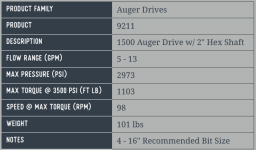
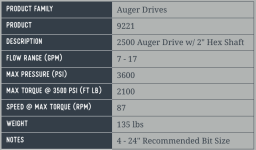
Although, this is kind of a weird comparison, because they show torque at 3500psi, and one is higher than the max limit, and my tractor has about a 2500 psi limit anyway ....

Screenshot 2023-10-05 5.48.40 PM.png Screenshot 2023-10-05 5.48.46 PM.png

I'd have to ask them for comparison numbers at the same ~2500psi unless that psi number is something different than the tractor hydraulic system psi.
 
   / Hydraulic flow numbers
  • Thread Starter
#11  
Last edited:
   / Hydraulic flow numbers #12  
They're changing both pressure and flow in those tables, which makes it look like flow has an effect on torque. But you can find any text book on hydraulics to tell you what affects motor torque.
 
   / Hydraulic flow numbers #13  
They're changing both pressure and flow in those tables, which makes it look like flow has an effect on torque. But you can find any text book on hydraulics to tell you what affects motor torque.
That's right, and so is what I said for any hydraulic system - "More flow will allow it to flow faster, but any flow at all will turn it at full torque minus momentum"

All flow buys you is speed. Think of a hydraulic jack lifting your car. It's flow is very low, but the pressure is still capable of lifting the car. Increasing the flow rate doesn't make it lift any more weigh, it just makes it lift it faster. Pressure provides the force, flow provides the speed.

The charts are misleading because they are advertising charts, not science or engineering charts. Their purpose is to help in comparing products so you know what to expect out of their post hole drills. They had to hold something fairly constant to make a comparison, so they unfortunately chose RPM. For most of industry, speed matters. But or a guy putting in post holes on his land....as long as the speed is reasonable, he cares more about other things.

That is why those charts aren't comparable. They are trying to help you decide, but are using different pressure, flows, RPM, and even different hydraulic motors on the two different post hole drills. That makes it confusing.
If I had hard soil with rocks and dry compacted clay and could stand to to go slow, I'd get the larger one of their drills. Otherwise for lighter soil - like good sandy loam - the smaller one is fine.

Using Post Hole Drills to do fencing on many farms and on our place - all PTO types - what really mattered more than anything was getting an auger with replaceable teeth on the bottom (twice the price!!), and being able to turn the auger real slow with high torque. Plus always wishing the darn thing had a reverse rotation like a hydraulic auger does for when it gets stuck. There just isn't much reason to spin the auger fast.
rScotty
 
   / Hydraulic flow numbers #14  
Wanting to get a hydraulic auger too. Friend, Mr M59, has become a stump surgeon using a Danuser stump plane on an auger. Relative cheap stump remover if you already have an auger. Several had multiple underground utility lines underneath. Using the plane and backhoe ripper he cleared deep below grade on a lot property line. He saved a boat load of money and contractor headaches doing it himself. My fencing days are mostly past but I’ll always have tree stumps. Something to consider picking an auger system. Do like the SSQA mounts that have both center and offset attachment points.
 
   / Hydraulic flow numbers
  • Thread Starter
#15  
Just a follow-up. Placed the order today for the larger, higher torque, slower RPM auger. (2DSS w/SSQA) Digga rep said the theoretical RPM should be about 33 with my setup. Thanks for all the knowledge and advice.
 
   / Hydraulic flow numbers #16  
Just a follow-up. Placed the order today for the larger, higher torque, slower RPM auger. (2DSS w/SSQA) Digga rep said the theoretical RPM should be about 33 with my setup. Thanks for all the knowledge and advice.

Please post up some pics and how you like it when you get some use on it.
 
   / Hydraulic flow numbers #17  
fwiw we run a digga PDX ( the smallest one with a planetary set) on out 75hp tractor with pretty modest hydraulic flow and its awesome, like rScotty said its about torque, a slow hydraulic auger actually digging will work a lot better than a fast PTO driven auger spinning on the clay layer crust,

front end loader and the ability to reverse the auger are game changers.

the ability to use it as a concrete mixer as well is the cherry on top.

1705437928073.png
 
   / Hydraulic flow numbers #18  
Just a follow-up. Placed the order today for the larger, higher torque, slower RPM auger. (2DSS w/SSQA) Digga rep said the theoretical RPM should be about 33 with my setup. Thanks for all the knowledge and advice.
Great! What size and type of bits do you plan to use.

I’ve spent considerable time studying charts and talking with salespeople who lack technical expertise and product knowledge.

Like the Digga brand. 3DSS is what told for mine 16gpm and wanting to use a stump planer. Wanted the sliding mount to offset would be helpful for use on a tractor. First sales said not available even though I’m looking at one. Then said yes but wanted to charge for both mounts and keep the fixed. Still working on getting a package put together.

The Halo and mixer options are interesting.
 
   / Hydraulic flow numbers
  • Thread Starter
#19  
@Smokeydog

Just earth/dirt augers for me here, not really any rocks. I'll grab 4 foot, 6, 9 & 12 inch augers, and will probably just mainly use 9 and 12. Might grab a larger one for trees the wife wants to plant, this is just around the homestead, not for commercial use on my end. I ordered a 2" hex to 2" round adapter. I think the cheaper augers from tractor supply will work just fine here. We've been using just a powered 1 man auger like this without much issue other than physically lifting the power head in/out.

Screenshot 2024-01-17 10.28.34 AM.png


It will be a nice upgrade lol

I ordered from here, and the rep "Mike" was helpful both via email and phone.

They had the auger and mount (both fixed and sliding) in stock. The sliding was $140 more. I just went with fixed for my need, but did inquire about it. If you're a veteran, they threw in a $100 discount. Shipping was free and no tax. Shipped out yesterday LTL from IA, estimate delivery tomorrow in AL, I'm not sure I believe that delivery date, but at least it is in the system and en route.

I also did contact Digga via email and they were responsive as well.
 
Last edited:
   / Hydraulic flow numbers #20  
Some hydraulic systems have only a single pump. In my case, a 2022 TYM T-25, a single pump partitions total flow into steering and implement flows. Presumably when there is no demand on the steering system, more flow is available for the implement hydraulics. I understand that earlier versions used two pumps.
 

Tractor & Equipment Auctions

CASE IH MAXXUM 115 TRACTOR (A60430)
CASE IH MAXXUM 115...
John Deere 6110M (A60462)
John Deere 6110M...
13042tx (A55973)
13042tx (A55973)
2010 Massey Ferguson 2625 (A60462)
2010 Massey...
2018 John Deere 245G LC Excavator - Hydraulic Thumb, Tooth Bucket, 56K LB Class (A56438)
2018 John Deere...
2019 CATERPILLAR 239D3 SKID STEER (A60429)
2019 CATERPILLAR...
 
Top