Front to Rear tire raito

/ Front to Rear tire raito #1  

Blake13

Member
Joined
Aug 23, 2017
Messages
30
Location
lake stevens, wa
Tractor
yanmar 2610d
I want to put some wider tires on my 2610d to get better flotation. I figured I would check the front to rear ratio so that I can make sure I am keeping the front tire rolling circumference lead perfect, as opposed to simply using the current tire ratio and getting something close. I'm going to include a long-winded explanation below the summary: 1, so anyone can check my work, 2, in case anyone is interested.

I will say, I am very surprised by the result, so PLEASE correct me if my methods are off.

Summary (quick, no math):
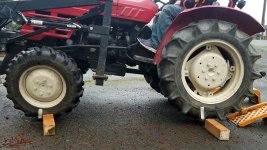
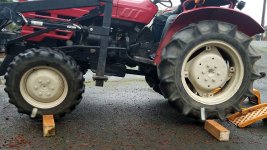
I jacked up the tractor and put a blocks down as a zero axis marker. I put a piece of tape on each tire at the block, engaged both axles in gear and recorded it on my phone for about a minute. Refer to pics at bottom. I counted revolutions to determine front to rear ratio of 1:0.6082. Using stock tire size rolling circumference and the experimentally determined ratio, it is calculated that the front tires lead by 9.5%. Based on this, a 13.6-24 tire would be better suited over the stock 11.2-24 rear tire. This is very surprising, so I question my methods.

One potential problem with my method; I locked the rear diff lock just in case, but with the front open differential could the spider gears be spinning slightly allowing the front two axles spin at different rates? Since there is no resistance i was assuming both front axles spin at the same exact rate. If this happens then it would obviously produce inaccurate result.

Update:
Jacking the entire tractor proved to be an unreliable method because while the front axle is suspended in the air, left and right sides will likely rotate at non equivalent rates (however proportional rates). Jacking the tractor from the side, forcing one side of each front and rear axle to remain in contact with the ground, stationary, ensures suspended axles are representative of gear ratio. Using this method the front:rear ratio 1:0.6341 was measured. This ratio is much closer to what was expected, showing the factory tire size have a 5.7% front lead.

Below is the trial using the first method, although not reliable, the methods and calculations are still useful.

_______________________________________

Long winded explanation with math:

After recording the wheels rotating, I watched the video and individually counted (double checked!) the number of revolutions for front and rear wheels. After exactly 17 rear revolutions the front turned almost 28. The tire lugs make a good measurement scale for this. It was shy (about 85%) of a lug-to-lug distance from turning a full 28. See "end" picture at bottom. The end picture is the video frame where rear tire hits revolution 17.
There are 17 lugs on the tire (don't confuse the 17 tire lugs with 17 rear tire revolutions, unrelated):
0.85 x 1/17 rev = .05 revs
1 - .05 revs = .95 revs
27 revs + .95 revs = 27.95 revs

So, the front tire does approximately 27.95 revolutions when the rear does 17.

And if you are thinking that my estimation of the front tire revs is not accurate enough, my accuracy is within 0.2%. This is because for certain, my observation is within one lug-to-lug distance. There are 17 tire lugs so 1/17th of a revolution over 28 revolutions . You can also see how the accuracy is dependent on how long the wheels spin, as revs go up percent error goes down.

(1/17) / 27.95 = 0.00210 = 0.2% error or 99.8% accurate
Or said another way, the front tire spins 27.95 +/- 0.03 revs (between 27.92 and 27.98 revs) for every 17 rear revs.

Now we can write this a few ways:
27.95:17 front to rear
1.644:1 front to rear
1:.6082 front to rear

Up until this point tire circumference was irrelevant. Now we can use this gear ratio to determine information like front tire lead for the factory tire set up. The factory tire arrangement is 7-16 front 11.2-24 rear. Carlisle literature for their Farm Specialist 7-16 lists a rolling circumference of 86.8 inches. The Farm Specialist 11.2-24 rolling circumference is 129.1 inches.

86.8" (front tire R.C.) x 1.644 (gear ratio) = 142.7" (theoretical matching rear tire R.C)
Rear tire must decrease by 5% R.C to give 5% lead to front tire
142.7" x 0.95 = 135.6" (theoretical rear tire R.C. to achieve 5% front tire lead)
So, acceptable stock rear tire R.C. range with 7-16 front tire: 135.6" to 142.7"

BUT the 11.2-24 is 129.1" R.C.
129.1" / 142.7" = .905 = 90.5%
This means the REAR tire is lagging by 9.5% with the factory tire size.

With a rolling circumference of 140", a 13.6-24 tire would be much better matched for the 7-16 wheel on this tractor... very weird.
_______________________________________


To corroborate this I never did like using the front wheel assist on pavement because it seemed to wind up more than I wanted. Disengaging was a bit tough, but not too bad.

Also to note, this determined ratio is almost exactly the golden ratio (1:0.618)! This must explain why the tire size relationship on the tractor is so pleasing to our eye :laughing:

Here is the start and end video frame of the experiment. I didn't include the video because I figure I don't need to prove that I can count to 28 :)

Start
Start Test.jpg
End
End Test.jpg
 
Last edited:
/ Front to Rear tire raito #2  
Drain out the beet juice and fill with helium instead. There are tanks at the Dollar Tree for these mylar balloons.

It's almost 11pm and this is a math final exam to read. :rolleyes:
 
/ Front to Rear tire raito
  • Thread Starter
#3  
No ballast onboard!

I condensed the most important bits into a small summary towards the beginning of the post. Between that and the pic it should be obvious what I did. If there's mistake, my bet is that its in the test method not the calcs.
 
/ Front to Rear tire raito #4  
There have been several threads over the years for determining lead/lag between the front and rears. Your method seems accurate for determining the gear ratio but there are other variables in determining lead/lag.
I think that the most reliable is traveling a marked distance on a hard surface and noting the difference in revolutions of the front and rear tires with the 4WD engaged and then disengaged.
 
/ Front to Rear tire raito #5  
Do you have 7-16 tires on front. Picture looks like the front is jacked up. Not used to seeing that.

I am not very smart on tires, what is the difference between 11.2/24 and 11.2/10-24?
 
/ Front to Rear tire raito #6  
Seems to me that in your math you are assuming the unloaded tire diameter or radius can be used to calculate rolling circumference, or did I miss that? Under the weight of the tractor, rolling circumference will not be simply pi x diameter, and because rear and front tires compress differently, this must be carefully measured. I dint think there’s a good way to do it with the tractor in the air.
 
Last edited:
/ Front to Rear tire raito #7  
BUT the 11.2-24 is 129.1" R.C.
142.7" / 129.1" = 1.105 = 111%
This means the REAR tire is LEADing by 11% with the factory tire size.


If I understand correctly, you are saying that the smaller REAR tire is leading. It would actually be lagging with its smaller diameter and the FRONT tires would be leading. Right?
 
/ Front to Rear tire raito #8  
I want to put some wider tires on my 2610d to get better flotation. I figured I would check the front to rear ratio so that I can make sure I am keeping the front tire rolling circumference lead perfect, as opposed to simply using the current tire ratio and getting something close. I'm going to include a long-winded explanation below the summary: 1, so anyone can check my work, 2, in case anyone is interested.

I will say, I am very surprised by the result, so PLEASE correct me if my methods are off.

Summary (quick, no math):
I jacked up the tractor and put a blocks down as a zero axis marker. I put a piece of tape on each tire at the block, engaged both axles in gear and recorded it on my phone for about a minute. Refer to pics at bottom. I counted revolutions to determine front to rear ratio of 1.644:1. Using stock tire size rolling circumference and the experimentally determined ratio, it is calculated that the front tires lag, not lead, by 10%. Based on this, a 13.6-24 or even 14.9-24 tire would be better suited over the stock 11.2-24 rear tire. This is very surprising, so I question my methods.

One potential problem with my method; I locked the rear diff lock just in case, but with the front open differential could the spider gears be spinning slightly allowing the front two axles spin at different rates? Since there is no resistance i was assuming both front axles spin at the same exact rate. If this happens then it would obviously produce inaccurate result.

_______________________________________

Long winded explanation with math:

After recording the wheels rotating, I watched the video and individually counted (double checked!) the number of revolutions for front and rear wheels. After exactly 17 rear revolutions the front turned almost 28. The tire lugs make a good measurement scale for this. It was shy (about 85%) of a lug-to-lug distance from turning a full 28. See "end" picture at bottom. The end picture is the video frame where rear tire hits revolution 17.
There are 17 lugs on the tire (don't confuse the 17 tire lugs with 17 rear tire revolutions, unrelated):
0.85 x 1/17 rev = .05 revs
1 - .05 revs = .95 revs
27 revs + .95 revs = 27.95 revs

So, the front tire does approximately 27.95 revolutions when the rear does 17.

And if you are thinking that my estimation of the front tire revs is not accurate enough, my accuracy is within 0.2%. This is because for certain, my observation is within one lug-to-lug distance. There are 17 tire lugs so 1/17th of a revolution over 28 revolutions . You can also see how the accuracy is dependent on how long the wheels spin, as revs go up percent error goes down.

(1/17) / 27.95 = 0.00210 = 0.2% error or 99.8% accurate
Or said another way, the front tire spins 27.95 +/- 0.03 revs (between 27.92 and 27.98 revs) for every 17 rear revs.

Now we can write this a few ways:
27.95:17 front to rear
1.644:1 front to rear
1:.6082 front to rear

Up until this point tire circumference was irrelevant. Now we can use this gear ratio to determine information like front tire lead for the factory tire set up. The factory tire arrangement is 7-16 front 11.2-24 rear. Carlisle literature for their Farm Specialist 7-16 lists a rolling circumference of 86.8 inches. The Farm Specialist 11.2-24 rolling circumference is 129.1 inches.

86.8" (front tire R.C.) x 1.644 (gear ratio) = 142.7" (theoretical matching rear tire R.C)
Rear tire must increase by 5% R.C to give 5% lead to front tire
142.7" x 1.05 = 149.8" (theoretical rear tire R.C. to achieve 5% front tire lead)
So, acceptable stock rear tire R.C. range with 7-16 front tire: 142.7" - 149.8"

BUT the 11.2-24 is 129.1" R.C.
142.7" / 129.1" = 1.105 = 111%
This means the REAR tire is LEADing by 11% with the factory tire size.

With a rolling circumference of 149", a 14.9-24 tire would be much better matched for the 7-16 wheel on this tractor... very weird.
_______________________________________


To corroborate this I never did like using the front wheel assist on pavement because it seemed to wind up more than I wanted. Disengaging was a bit tough, but not too bad.

Also to note, this determined ratio is almost exactly the golden ratio (1:0.618)! This must explain why the tire size relationship on the tractor is so pleasing to our eye :laughing:

Here is the start and end video frame of the experiment. I didn't include the video because I figure I don't need to prove that I can count to 28 :)

Start
View attachment 634385
End
View attachment 634384

I may well have misunderstood what you wrote, but as I read, you lacked about 85% of the 28th revolution of the front tire. But then you used 85% in your calculations. If I understood correctly, you should have used 15% in those calculations.
Additionally, I believe you have skewed your revolution counts by have unloaded/no resistance on your tires.

In my opinion, you need to get more math involved in your process. The marks in your tires are your starting point, but you should do rolling circumference measurements. You probably need several people to assistance (at least 3-1 to drive, 1 to watch front tires and 1 to watch rear tire).
 
/ Front to Rear tire raito
  • Thread Starter
#9  
Do you have 7-16 tires on front. Picture looks like the front is jacked up. Not used to seeing that.

I am not very smart on tires, what is the difference between 11.2/24 and 11.2/10-24?

Yes, 7-16 on front. Both front and rear are jacked off ground to allow free rolling.
I am not a tire expert either, but I believe 11.2-24 is the current preferred notation for the tire size. 10-24 is the older convention for the same size. Because these two notations are for the same tire it can also be written, 11.2/10-24.
 
/ Front to Rear tire raito
  • Thread Starter
#10  
Seems to me that in your math you are assuming the unloaded tire diameter or radius can be used to calculate rolling circumference, or did I miss that? Under the weight of the tractor, rolling circumference will not be simply pi x diameter, and because rear and front tires compress differently, this must be carefully measured. I dint think there’s a good way to do it with the tractor in the air.

Actually I never used the diameter or radius of the tire for any calculations. Every time I used the tire size, I used rolling circumference. This number was always taken from the manufacture's literature.

Blake13 said:
Carlisle literature for their Farm Specialist 7-16 lists a rolling circumference of 86.8 inches. The Farm Specialist 11.2-24 rolling circumference is 129.1 inches.
 
/ Front to Rear tire raito #11  
I have 'played' the tire change game as well.
Got lucky I guess as I found a pair of mounted rear rider mower tires on EBay that matched my factory Mitsu fronts.
Made a whole world of difference with FEL work especially on snow and muddy surfaces as they were much wider.
Problem then was Armstrong steering.
 
/ Front to Rear tire raito
  • Thread Starter
#12  
Your method seems accurate for determining the gear ratio but there are other variables in determining lead/lag.


What other variables would really matter? All it would take is gear ratio and front and rear tire rolling circumference like I used. With new tires, the literature values should be just fine for rolling circumference (no tread lost). That said, it does help to not be backwards in my thinking like you pointed out to me bellow! :laughing:


If I understand correctly, you are saying that the smaller REAR tire is leading. It would actually be lagging with its smaller diameter and the FRONT tires would be leading. Right?

Good catch! I had the concept in my head flipped. As you point out, the smaller the tire's diameter the more it will lag not lead. This correction should get the numbers closer to what would be expected. I am going to edit the first post to correct my error. Thanks!
 
Last edited:
/ Front to Rear tire raito #13  
I never liked driving any 4wd on a hard dry surface because you can directly feel the miss match in your seat. I have a set of newer Carlise Farm Specialist 7-16 R1 fronts I bought couple of years back to replace the factory Titan brand of the same size. The work well, but when working on snow or ice they work fairly well without chains. If it is like any other 4wd pulling from the front is a good thing. Same raito will cause a slip or a stick sooner. Same time we don't want the gears to work against each other causing excess ware. I was not able to measure the new Titan tires against the new Carlise tires side by side to match the factory specs. Sticking to the same size marking on the new tires I'm counting on the manufacture for the same size and load rating. Stick to the factory recomemded tires for your tractor, or better.
chris
 
/ Front to Rear tire raito
  • Thread Starter
#14  
I may well have misunderstood what you wrote, but as I read, you lacked about 85% of the 28th revolution of the front tire. But then you used 85% in your calculations. If I understood correctly, you should have used 15% in those calculations.
Additionally, I believe you have skewed your revolution counts by have unloaded/no resistance on your tires.

Ill try to explain it better. Using the 17 lugs as a scale, the last revolution of the front tire was 16/17 plus an estimation of a percent of the last 1/17th. The 85% was my estimation of the last lug gap, not the entire revolution. In my calculation I worked backwards which was confusing. Working forwards, the last revolution would be:
(16/17) + (.15(1/17)) = .95 revolutions
.95 revs + 27 revs = 27.95 revs total for front. You can see this matches the original calcs.

The tire size, loaded nor unloaded, does not matter for revolutions. 360 degrees is 360 degrees. Only revs matter for the gear ratio and that was what i was attempting to measure. Loaded vs unloaded DOES matter for distance the tire travels per rev, which is why I used the rolling circumference value published by the manufacturer for any lead/lag calculation. I don't need to measured the lag/lead. That can be calculated with rolling circumference and the correct gear ratio.
 
/ Front to Rear tire raito #15  
I think you need to paint a stripe across the tires then roll forward in 2wd, and measure the paint imprints on the asphalt.

Then select tires that will let the front lead the back. I think the recommended lead is 5% but research that.
 
/ Front to Rear tire raito #16  
Actually I never used the diameter or radius of the tire for any calculations. Every time I used the tire size, I used rolling circumference. This number was always taken from the manufacture's literature.

Blake13, I haven't gone through your arithmetic yet....will later today. When I first started doing & reporting that measurement on the old Yanmar forum - about 1995/6 - I used the same technique of jacking up one side of the tractor, making marks on the tires, putting it in 4wd, and rotating the one while counting the other. Repeated it several times. I was able to calculate reliable measurements for the gearing which I later confirmed in the Yanmar shop manuals. BTW, when doing these long rotations, boredom is a real problem! I found that I wasn't sure I could trust my keep count mentally, so made marks on a piece of paper..... Sounds like you found the same thing.

You and I have done a couple of things differently.

One is that I did NOT lock the differential....simply went very slowly and carefully when rotating the "drive" tire. Not sure if I rotated front or back tire as my drive tire - I think it was the front. I'll check my old notes & post later.
Secondly, the marks on front and rear tires ALMOST lined up several times as I rotated, but when they finally did line up it was EXACT. So much so that I was surprised. Not off by a lug or a little, but exact.

Third, for the rolling circumference I had on at the time slightly worn original R1 Ag tires on the factory rims. I used wet white paint dots on the tires, drove on an asphalt road in 2WD. and measured between paint spotches on the road.
I was surprised at the variation in the measurements I got. Even though I took care several times to use a straight section and not move the steering wheel my measurements over about ten tire revolutions varied by several inches. In the end I averaged that measurements. I think I remember that my measurements were fairly close to the manufacturer's numbers for RC, but definitely different. I'm guessing the difference was due to my preferring low tire pressure and having some tire wear on a fairly light wt tractor - a YM336D. I don't know what the manufacturer used for tire pressure or for tractor weight..
Anyway, I saw enough of a difference to make me glad I'd measured mine.
I later tried to measure the rolling circumference on dirt and got even more variation - too much to be useful. In soft ground or snow it's probably not going to work at all.

I did all the work because I was going to buy 4 new wheels and tires so I could shift from R1s to turf tires. I did so, and of course had to rely on the manufacturer's RC numbers when ordering the turfs.
When I got the tires and wheels changed and everything mounted up new I measured again and found that I had accidently nailed it. The front to rear lead/lag was essentially zero. Might have been a tiny, tiny bit of front wheel lead because steering was still fine, no pushing on turns. However, I could shift between 2 and 4wd at any speed in any gear just by tapping the lever. In the end, I had to put a positive lock on the 4wd selector lever to prevent vibration from constantly shifting in and out of 4wd.

rScotty
 
/ Front to Rear tire raito #17  
Blake listen to rScotty, he's the one here who has researched issues in near everything with the rigor of a scientist.

Just thinking out loud here - maybe near zero lead/lag is best for working in a straight line - discing, pushing snow, anything where you need maximum pulling force. On the other hand my own application in the orchard is that I need the front axle to pull the nose around in a tighter turn than I could make in 2wd. In turns the front takes a longer path than the rear, so some lead is preferable to reduce the effect of the rear shoving the front forward.

I stay in 4wd because I'm always on a loose (disced) or muddy surface. (recent pic). But as rScotty noted the few feet I travel on concrete within the parking stall just to get clear of the opening, feels like it is stressing the gear train and scrubbing the tires. I sometimes shift to 2wd before going in - and should do that every time.
 
/ Front to Rear tire raito #18  
I've found that different brands of the same tire size can vary a lot in rolling circumference or radius. I replaced the original Bridgestone 13.6-16 rears on my B9200 Kubota a couple years ago and found that the new 13.6's were a couple inches larger diameter at recommended inflation pressure. That was alarming so I played with reducing the air pressure to under 10 PSI and that got the rolling radius down to match the original reasonably close. Turns out that was probably a good move in that it rides much smoother also.
Incidentally, my understanding is that rolling circumference is not necessarily rolling radius times 2 PI in reality. There are variables affecting the two measurements.

https://www.tractorbynet.com/forums/tires/371468-tires-why-rolling-circumference-loaded.html
This is a 2016 thread discussing rolling radius etc.
 
Last edited:
/ Front to Rear tire raito #19  
I changed the front tires on my 4410. Factory was 27 x 8.50 x 15 turf. I switched to 26 x 12 x 12 turf. If I was careful what brand of tire I bought they were the same height when stood side x side. What I hadn't counted on was the increased squat of the 12" tires vs the 15" tires when the loader was full of dirt etc. because of the wider sidewall. My "cure" was to increase front tire pressure during sustained front end loader work and to disengage the front wheels during any transport of dirt on harder surfaces. It works but not ideally. I sure like the increased flotation of the wider tires though.
 
/ Front to Rear tire raito
  • Thread Starter
#20  
What I hadn't counted on was the increased squat of the 12" tires vs the 15" tires when the loader was full of dirt etc. because of the wider sidewall.

Good tip, I hadn't thought of that either!
 

Marketplace Items

EZ-GO Utility Cart (A55851)
EZ-GO Utility Cart...
FUTURE 6' CLIP-ON FORK EXTENSIONS (A60432)
FUTURE 6' CLIP-ON...
CASE IH 120A FARMALL TRACTOR (A60430)
CASE IH 120A...
Mini John Deere Truck (A55853)
Mini John Deere...
2003 John Deere 110 Backhoe (A59213)
2003 John Deere...
2015 VOLVO VNL SLEEPER (A59905)
2015 VOLVO VNL...
 
Top