turning up the fuel on a ck27

/ turning up the fuel on a ck27 #2  
No, but you got my attention. I am curious to see if you get any replies on this.
 
/ turning up the fuel on a ck27 #3  
Anyone done it? How did it turn out?

Do you mean increasing the amount of fuel injected into the cylinders? If so, here's the deal: First, the injection pump (IP) and centrifugal work together to regulate the amount of fuel injected to maintain RPM, based on the "throttle" setting and load. The IP has a maximum amount (volume) of fuel that can be injected, limited by the bore and stroke of the IP plunger. The IP can deliver up to that max volume if needed to maintain RPM but that max volume cannot be increased without modifying the IP, something beyond the capability of nearly all owners.

What would happen if you could, somehow, increase the volume of injected fuel? Probably not much. There is only so much air in the cylinder so you can only burn the corresponding amount of fuel regardless of the amount injected. To get more power you need to put more air into the cylinders (e.g. a turbocharger) otherwise you just get black smoke from unburned carbon. If you could, somehow, cram more air and fuel into the cylinder you have another problem: heat. Typical normally aspirated (non-turbo) engines are not designed to remove so much heat from the cylinders, head, and (especially) pistons.

For example, when Mercedes added turbos to their old 3-liter 5-cylinder (OM617) diesel engines they used a new injection pump AND they added nozzles to spray engine oil against the underside of the pistons to cool the pistons. The new IP sensed the (boosted) manifold pressure and adjusted the max fuel volume accordingly. In other words, the injected fuel volume was limited to correspond with the manifold pressure. To the casual observer the turbo and non-turbo OM617 engines look identical except for the turbocharger and the different IP. But if you put the turbo IP and add a turbo to the non turbo block you can melt the pistons.
 
/ turning up the fuel on a ck27 #4  
Just throwing this out there (I'm certainly no engine tuner!). Since increasing fuel from the pump seems to be a no go, what about adding propane? People do it on trucks all the time. Obviously, if you hot rod any engine the ability to handle a given duty cycle (as % of max hp for given duration) is diminished.

I would never do this to my own tractor but just threw out the idea in case you want to play.

Tractors hold value so well that I've always firmly believed that if you need more power sell what you've got and buy a bigger tractor.
 
/ turning up the fuel on a ck27 #5  
Yes they can be turned up. if you search utube. motorman Matt> Kubota Diesel Mower vid.
The adjustment screw has a TAMPERPROOF CAP on it for a reason..
but can quickly be removed w/ a Dremel tool and a slit cut in it lengthwise and pryed off.
Good luck and don't hurt yourself.
 
/ turning up the fuel on a ck27 #6  
Any older diesel can be turned up to some degree there is plenty of rack left on most injection pumps and the pumps are usually the same in a given engine family say ck 27-ck35 the only difference is usually just the cylinder displacement and fuel amount. So on a 27 you should be able to turn it up a bit before you run out of pump stroke. On my older kubota L275 it would never blow black smoke under heavy load. So removed the cap on the adjuster and I turned it up a bit until I got some black smoke under heavy load. The tractor was fine and I had a bit more power. Probably just brought it back to where it was when new. The Injection pumps do wear and push less fuel over time. If you really want to go crazy just add a small turbo and really jack it up.
 
/ turning up the fuel on a ck27 #7  
Im not familiar whether the CK27 is gear or HST, but if gear it will be easy to judge the effect of turning it up if you have hills and the tractor has a tach.
I turned the adjustment screw in on the 7520, by increments, and kept comparing performance up a hill I had characterized. The effect was marked, but this was a turbo tractor. ... I stopped at 1 full turn.​
Yours is not turbo so you wont get the chain effect of more combustion causing more exhaust causing higher intake boost, giving the potential to burn ever greater amounts of fuel. -- Still, if your [naturally aspirated] tractor wont throw black smoke as it bogs down close to mid rpm, a little more fuel will help. Id guess 1/4 to 1/2 turn will get you the max available power. Itll probably only be a horse or 2. Almost 10%. Should be noticeable.
 
/ turning up the fuel on a ck27 #8  
OK, I understand what we are talking about now.

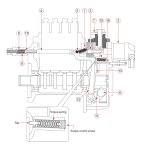
On these mechanical IPs, there is a fuel limit stop that limits forward movement of the IP rack. It's item #14 in this diagram:

IP.jpg

It is a threaded rod and lock nut that is normally set up on a diesel bench when the IP is assembled. Adjusting this stop "out" allows the rack to move further forward, which increases the effective plunger stroke, and that increase the amount of fuel injected. Legal issues aside, a little excess fuel will produce black smoke and a lot of excess fuel will actually reduce power.
 
/ turning up the fuel on a ck27 #9  
Ritchey> you seem to be misinformed. The injection pump is an entity unto itself, and limited by the screw the engine manufacturer installs. Not adjusted on a bench by the injection pump folks. When you send a pump in for service, the screw stays in the engine block.
The pump folks SETS the fuel at full and CHECKS idle and starting. The full load fuel SCREW is set by the engine manufacturer at the factory. Due to gear train wear, fuel quality and injector condition, the fuel may not be getting a complete burn, hence the need to
"turn it up".. I'm not saying this is the correct method to remedy a low power condition, I'm just answering the question asked..
You are correct in the effective plunger stroke.. and too much fuel will actually lower the hp of the engine by flooding it w/ fuel.
 
/ turning up the fuel on a ck27 #10  
PumpGuy is right on and I was wrong. I really need to stop extrapolating my limited automotive IP knowledge to areas where it doesn't apply.

Question for ThePumpGuySC: Are you in the Diesel IP/injector business? If so, do you offer services or parts that may interest folks here? Also, on the subject of IP wear (and correcting for it), do you have any experience or data on when (e.g operating hours) this might become a consideration? I know Diesel auto drivers (including me) with 300+ K miles on the factory original IP although most replace or rebuild injectors about every 100K miles or so (I think 100K miles is like 2000 operating hours). Finally, do you think ULSD has changed IP and injector service life?
 
/ turning up the fuel on a ck27 #11  
I was hesitant to come back to this thread, for the fear that my information would have been taken "wrong"..
Yes, I do work in the Injection pump business, have been for over 30 years, for a living.
The wear is soley dependent on maintanience ie: filters, oil changes, fuel additives and coolant..
The ULSD has completely destroyed the diesel injection pump system.. I'm replacing VERY hi dollar components that would have NEVER been replaced otherwise..
EVERY engine manufacture PRINTS out, that you have to put an additive in your fuel system on EVERY fill-up..
Its a case of pay me now [additive] or pay me later. [pump/injector repair]
I look forward to helping out where/when I can.. just ask..
 
/ turning up the fuel on a ck27 #12  
I was hesitant to come back to this thread, for the fear that my information would have been taken "wrong"..
Yes, I do work in the Injection pump business, have been for over 30 years, for a living.
The wear is soley dependent on maintanience ie: filters, oil changes, fuel additives and coolant..
The ULSD has completely destroyed the diesel injection pump system.. I'm replacing VERY hi dollar components that would have NEVER been replaced otherwise..
EVERY engine manufacture PRINTS out, that you have to put an additive in your fuel system on EVERY fill-up..
Its a case of pay me now [additive] or pay me later. [pump/injector repair]
I look forward to helping out where/when I can.. just ask..

Kioti recommends that NO additives are to be added to the fuel...do you recommend any particular additive you feel is safe for any diesel tractor? I'd rather not find out the hard way that I could have avoided any wear issues in the future.
 
/ turning up the fuel on a ck27 #13  
The biggest problem I see in tractors is moisture and fuel contamination, not actual wear..
The wear and big $ comes in the passenger vehicles.. especially the VW TDI.
There are many, many products on the market and many, many independent studys done.
But most studys I've read state that a co. called Shaffer makes the best product for lubrication and cetane increase.
Its expensive tho and that keeps a lot of people from that product. The most widely used product that's on the market in my opinion is Stanadyne and Lucas. & both are actual injection pump manufacturers..
Another huge problem I see is, over use of the product.. In this case MORE IS NOT BETTER.. the product is so concentrated that people are over dosing their tanks..So if a small bottle says, treats 200 gallons the customer is putting the entire bottle in their fuel tank that holds 30.. and destroying their systems overnite..
As far as Kioti goes, I have not familiarized myself w/ all their products. but the ones I have seen are based on a 1970's proven system and very reliable. Its just good insurance to add a moisture control & added lubrisity to your tank anyway.. and ALWAYS read & follow the directions..
 
/ turning up the fuel on a ck27 #14  
Ritchey> you seem to be misinformed. The injection pump is an entity unto itself, and limited by the screw the engine manufacturer installs. Not adjusted on a bench by the injection pump folks. When you send a pump in for service, the screw stays in the engine block.
The pump folks SETS the fuel at full and CHECKS idle and starting. The full load fuel SCREW is set by the engine manufacturer at the factory.
^ Could you elaborate a little here? ^
Due to gear train wear, fuel quality and injector condition, the fuel may not be getting a complete burn, hence the need to
"turn it up".. I'm not saying this is the correct method to remedy a low power condition, I'm just answering the question asked..
You are correct in the effective plunger stroke.. and too much fuel will actually lower the hp of the engine by flooding it w/ fuel.
Thanks.
 
/ turning up the fuel on a ck27 #15  
I was hesitant to come back to this thread, for the fear that
my information would have been taken "wrong"..
Yes, I do work in the Injection pump business, have been for over 30 years, for a living.

Well, I am glad you are participating, PUMP. Actual experience is very valuable.

As for the OP's Q, I have had my Kioti CK now for nearing 12y and it is the 3rd of these
M27 tractors I bought new. None have had the FI pump failure that others have
experienced. I will fix mine when/if it happens.

I have not done much with diesel FI, but I did a lot with my old Bosch K-Jetronic mechanical
gas FI system. Adding turbos to a NA engine required jacking the flow up a bit, and the
way I did it was to up the pressure. Then, back to standard pressure to pass the smog test.

Of course, this means 100+ psi for gas, and those diesels can be 2000psi or more. Different
world.
 
/ turning up the fuel on a ck27 #16  
Thanks for the info PumpGuy :thumbsup:
Are you familiar with Fairbanks Morse engines? One injection pump can be easy to maintain, but our engine at work has 12, one on each cylinder, so we are used to adjusting them and injectors as well...always a pain in the ***
 
/ turning up the fuel on a ck27 #17  
F.Morse?? OH YEAH.. I loved doing those pumps & injectors back in the day.. I STILL have the specs written down from 32 years ago..
I still see them every once in awhile.. ESPECIALLY when theres a war going on.. The military brings them out of mothballs and puts'em to work..
 
/ turning up the fuel on a ck27 #18  
SPYDER.. The injection pump is capable of producing more fuel than the engine manuf. requires for any given application.
That's to say, the same engine will have different HP's depending on the customers request.. The ENGINE manufacturer then turn a screw on the engine to produce the required HP..
The pump folks just make sure the inj. pump IS CAPABLE of producing that fuel from a spec sheet supplied by the PUMP manufacturer..
and ofcouse we set the equal delivery between cylinders.
If you take a gander at your engine you'll see a HI idle screw, a LOW idle screw and hidden screw w/ a tamperproof cap, a MAX fuel screw, AWAY FROM THE INJ. PUMP. That's a separate governoring system.. The pump just pumps the fuel quantity that the governor system tells it to. Its made up of springs and flyweights. I hope this helped.
 
/ turning up the fuel on a ck27 #19  
I just found a web page that describes the fuel system/inj. pump quite well
Just google> ck25 injection pump and you'll see IP REMOVAL from 2881neches..
 
/ turning up the fuel on a ck27 #20  
For folks that haven't been tracking this issue, a number if IPs in 2005-2008 models failed when one or more gear teeth broke off there they engage the rack. The Kioti "school-solution"was to replace the IP with a new IP costing $800-$1600, just for the IP. Several owners found a cheaper solution: just replace the gear(s) or rotate the bad gear 180 degrees (only possible in some versions). The repair solution cost between zero and $300 depending on who does the labor.

I own one of the vulnerable tractors so I started tracking those failures reported here (see here) and included other useful information. Also there is a (somewhat dated) sticky post at the top of this Kioti O/M section that links to that page.
 

Marketplace Items

2005 Ford Explorer XLT 4x4 (A62613)
2005 Ford Explorer...
PT 1000 Gallon Supply Tank (A57149)
PT 1000 Gallon...
UNKNOWN TANK MANIFOLD (A60736)
UNKNOWN TANK...
2018 22ft. Tycorp Vector Belt VB-16H (A60352)
2018 22ft. Tycorp...
2018 Chevrolet Silverado 1500 4x4 Crew Cab Pickup Truck (A60352)
2018 Chevrolet...
Caterpillar 2PD5000 5,000LB Diesel Forklift (A56857)
Caterpillar...
 
Top