How would you compare two HST transmissions?

/ How would you compare two HST transmissions? #44  
Interesting thread....being a devoted green machine owner I have never really given much thought about comparing HST between brands. However if there were a significant difference between hydro fluid capacity between two roughly comparable horsepower and weight HST tractors I would tend to favor the model with the larger capacity for reasons of cooler running and possibly longer life between fluid/filter changes. Hydro pedal type preference (single or dual) would not matter to me in the slightest. Sorry if this is not what you want to read but fluid capacity is the only real factor that would influence me between brands,
 
/ How would you compare two HST transmissions? #45  
My 1643 HST is all mechanical and, like TSO's tractor, the pedal is mated with the throttle, so additional pressure gives you more throttle. It's a feature I like and consider it to be an improvement over regular hydro transmissions.

As far as Kubota's HST+, I have no experience with it, but it sounds like it adds yet another layer of improvement over an HST like mine. I'm not sure I'd spring for it vs. what I have now due to additional cost and unknown reliability over time, but it certainly sounds enticing.

FWIW, three years ago I tested out a JD 4520 with eHydro and it was extremely smooth and surprisingly quiet, more so in both categories than my MF HST.
 
/ How would you compare two HST transmissions? #46  
I wonder if being able to switch in and out of FWA is as important as being able to switch gears on the go with a hydrostat. I've noticed, in doing quite a lot of loader work with my B9200, that it's a pain to shift in and out of FWA. An example would be picking up from a pile on dirt or whatever where the FWA traction is needed and then pulling out and turning on pavement where you don't want the FWA engaged.
I assume that most newer tractors allow shifting in and out of FWA on the go.
 
/ How would you compare two HST transmissions? #47  
Generally you can switch in & out of FWA (4wd) at any time, as long as tires aren't slipping. In fact it's often easier to do so while moving.

A cool feature on bigger machines is FWA automatically engaging when you hit the brakes, as otherwise there is only rear brakes when in 2wd.
 
/ How would you compare two HST transmissions? #48  
Generally you can switch in & out of FWA (4wd) at any time, as long as tires aren't slipping. In fact it's often easier to do so while moving.

A cool feature on bigger machines is FWA automatically engaging when you hit the brakes, as otherwise there is only rear brakes when in 2wd.

That is news to me....but I have never quite understood why anyone actually needs brakes for anything but parking on a slope when you have a HST tractor...let off on the hydro pedal and the tractor basically stops dead. I have NEVER used the rear brakes of my 4410 for any slowing down or stopping purpose. EVER. Parking on a slope...yes.
 
/ How would you compare two HST transmissions? #49  
That is news to me....but I have never quite understood why anyone actually needs brakes for anything but parking on a slope when you have a HST tractor...let off on the hydro pedal and the tractor basically stops dead. I have NEVER used the rear brakes of my 4410 for any slowing down or stopping purpose. EVER. Parking on a slope...yes.

Here is an interesting and exciting phenomenon. If you go down a slippery hill traveling forwards for instance grass or gravel, and you have a load in your bucket, and depending on how heavily ballasted your tractor is in the rear, you will lose traction with the road surface with your rear tires. If you are in 4wd this will not occur because the surface tire patch contact area of the front tires will add to the total compression braking.

As you go down the hill forwards the normal weight shift occurs placing more weight on the front axle, and reducing weight on the front axle. This occurs any time you go down a hill forwards. Now if you have a load in the bucket, this load acts as a lever placing more weight on the front axle and less weight on the rear axle. The contact patch of the rear tires with the slippery road surface just gets lighter and less surface area.

The hydrostatic transmission acts as a brake if you start to let off of the forward pedal as you mention above.
So as you start down the hill under the conditions I have outlined, the rear tires lires lose their contact patch with the slippery road (gravel or grass or anything less than a rough high traction surface) and since the front tires in 2WD have no connection with the driveline, they cannot add to the braking action even though there is even more weight on them at this time, but they are freewheeling.

The end result is you "take a ride" of an out of control tractor sliding the rear tires and picking up speed as you fly down the hill, usually with one rear tire rotating backwards and with a total loss of speed control. It is now time to "throw out the anchor." If you have rear implement that will grab the road, lower it and lower the bucket to act as a friction brake to slow you down. Depending on what is at the bottom of the hill, you can either ride it out or go over the cliff or hit the tree or what ever is in your path, because the foot operated brakes nor the braking action of the hydrostat is going to save you.

If you haven't had this happen to you yet, That is a good thing. But if your slopes are steep enough, and slippery enough and your FEL is loaded, and your 3pt is a little light, AND your are in 2WD. IT WILL HAPPEN. And you will be on here telling us all about it.

What often happens is the operator will have the need to avoid some obstacle at the bottom of the hill and will turn the steering wheel, and that is when the tractor overturns. Or they hit the tree, or they go over an embankment.

Moral of the story, when descending hills, stay in 4WD (FWA), or descend the hill, rear wheels first (backward) if using a 2WD machine. Good luck, stay safe and happy tractoring.:)
 
/ How would you compare two HST transmissions? #50  
I was moving a horse panel on my forks. As it was only 100lbs or so I knew I didn't need any ballast on the back. Roll down the hill on the grass to lean it against the back of the barn. Got close to the barn & let off the go pedal... nothing happened, I kept going. Hit the brakes, nothing happened. No I have 2 pallet forks sized holes in the back of my barn & skid marks that aren't on the ground.

I'd have been fine if it was in 4wd or I had ballast on the 3pt, but I hadn't bothered as it was just a 100lbs panel...
 
/ How would you compare two HST transmissions? #51  
I was moving a horse panel on my forks. As it was only 100lbs or so I knew I didn't need any ballast on the back. Roll down the hill on the grass to lean it against the back of the barn. Got close to the barn & let off the go pedal... nothing happened, I kept going. Hit the brakes, nothing happened. No I have 2 pallet forks sized holes in the back of my barn & skid marks that aren't on the ground.

I'd have been fine if it was in 4wd or I had ballast on the 3pt, but I hadn't bothered as it was just a 100lbs panel...

Where in the world might the skid marks be if they are not on the ground?:laughing:

Edit: I sometimes wonder if the B9200 isn't more difficult than most tractors to switch out of FWA. It's very difficult to get it out of FWA whether sitting still or moving. Usually have to take the "load" off by backing up a little and even then have to move the lever at just the right time when the drive train between the front and rear wheels is "slack". Definitely don't want the front wheels turned to either side when exiting FWA. Engaging FWA is much easier.
 
/ How would you compare two HST transmissions? #52  
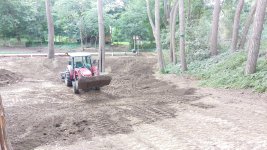
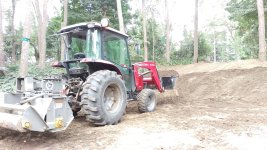
On a job today, took a couple pics & vids. The first vid (and I'm sorry they were so shaky) is going up a hill, first in Medium, then in Low. The second vid is pushing into a pile of topsoil, first in Medium, then Low.

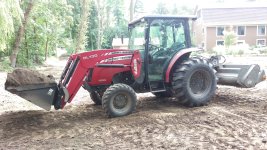
The tractor is a 52 HP Massey HST Cab. Loaded rear 17.5Lx24 R4 tires. Have mounted on the 3pt an implement weighing approx 1200 lbs. Also, notice the full bucket of fresh, moist topsoil (probably right around 2000 lbs).

For the hill climb, Using auto-throttle when going up the hill, I kept the throttle near idle and let the tractor adjust. The hill is about a 30% rise (rises approx 10 ft over 30 ft). In the vid, I start right at the bottom of the rise, no running start.

For the "pile run" I set the RPM's around 2500 psi (for the loader) and pushed into the bottom of the pile, working the joystick like normal to fill it...no cheating by digging from the top where it's lighter.

Vids are just for comparison sake, to show you how my HST tractor reacts under load.

1470007458922.jpg
1470007757937.jpg
1470007812950.jpg

HST hill demo - YouTube
HST into pile - YouTube
 
/ How would you compare two HST transmissions? #53  
TSO,
Seems to work well with no strain apparent, very similar to my Deere 4520. Nice tractor and should be easy to work with without tiring the operator. A lot of my work is similar to this, back and forth up and down an embankment makes good use of a hydro tranny.

The noise from the hydro is more predominate on your MF, on my Deere it is more a mix of engine than hydro. But no accurate way to judge actual sound levels from a video since playback volume is at the discretion of the individual computer settings.
 
/ How would you compare two HST transmissions? #54  
Yeah I think the noise is a combination of the foot pedals linking directly to the valve (not electronic), that valve being right under foot, and the minimal amount of cab insulation that AGCO-Iseki uses. My buddies L5240 is also alot quieter.
 
/ How would you compare two HST transmissions? #55  
Could be but a nice tractor regardless.
 
/ How would you compare two HST transmissions? #56  
Get a few more hours under your belt and maybe you will learn how to actually get a full bucket when digging in a loose pile of dirt :D
\
\
\
\
\
\
\
\
\
\
\
\
\
\
\
\
\
\
\
\
Just kidding. :laughing:
 
/ How would you compare two HST transmissions? #57  
On a job today, took a couple pics & vids. The first vid (and I'm sorry they were so shaky) is going up a hill, first in Medium, then in Low. The second vid is pushing into a pile of topsoil, first in Medium, then Low.

The tractor is a 52 HP Massey HST Cab. Loaded rear 17.5Lx24 R4 tires. Have mounted on the 3pt an implement weighing approx 1200 lbs. Also, notice the full bucket of fresh, moist topsoil (probably right around 2000 lbs).

For the hill climb, Using auto-throttle when going up the hill, I kept the throttle near idle and let the tractor adjust. The hill is about a 30% rise (rises approx 10 ft over 30 ft). In the vid, I start right at the bottom of the rise, no running start.

For the "pile run" I set the RPM's around 2500 psi (for the loader) and pushed into the bottom of the pile, working the joystick like normal to fill it...no cheating by digging from the top where it's lighter.

Vids are just for comparison sake, to show you how my HST tractor reacts under load.

View attachment 476225
View attachment 476226
View attachment 476227

HST hill demo - YouTube
HST into pile - YouTube

Thanks for the vids. That second bucket load sure was full.

The longer I own this 1643, the more I'm convinced the 1600 series might be the best compact tractors ever built, although I must say I was quite impressed with the 4000Twenty series from JD. The 4520 I tried out was pretty darn nice.
 

Marketplace Items

2004 Jeep Wrangler X 4x4 SUV (A61574)
2004 Jeep Wrangler...
YALE FORKLIFT (A63291)
Caterpillar D6H Series 1 and 2 Tractor Service and Parts Manuals (A63117)
Caterpillar D6H...
Wacker Neuson AR14H (A60462)
Wacker Neuson...
2021 UTILITY VS2DX 53FT DRY VAN TRAILER (A59905)
2021 UTILITY VS2DX...
2016 Land Rover Discovery Sport SUV (A61574)
2016 Land Rover...
 
Top