Building our retirement home

/ Building our retirement home #301  
I didn't like mine - mostly for aesthetic reasons. "Some" have been known to take in rain.

Perhaps I should better define "not many" in my prior post ... I had 2 roofers quote my project, spoke to a 3rd. NONE of them suggested a ridge vent, although I have plenty of roof-line. They said they "could" or "would" install a ridge vent if I preferred. Since I didn't want one, I didn't think to inquire any further.

Are you spray foaming the underside of the roof decking? We have no vents but we also spray foamed 5-1/2" of closed cell. If your not foaming I'm with the others and thought a vent was recommended.
 
/ Building our retirement home #302  
A few years ago, when I rebuild our house in CA after a fire, there was a HUD specification on roof vents. So many square inches for each square foot of roof.

I had solid wood rafters with a vaulted ceiling, and had to provide a vent straddling every other rafter. As well as soffit vents. Those vents were a huge PITA. The only ones I could find were cheap, light gauge aluminum and I had to replace about 2/3 of them at the end of the job since they had been dented.

Plus, getting the right color was hard also. Black was available, but they ran out and shipped me half brown ones and some bare metal. Had to paint them all.

* * * * * *

Depending on your local codes, roof vents of some sort may be a requirement rather than a suggestion. They are a good idea in any case.
 
Last edited:
/ Building our retirement home #303  
I have never heard of or met a roofer who didn't like ridge vents. I'm at a loss to why anybody would not want them other then not liking how they look. The option of going with another form of venting to me isn't as nice or clean looking. And usually not as effective. The basic premise to venting is that you want air to enter the roof at the lowest point, the soffit, and exit the roof at the highest point, the ridge. As air gets hot, it rises, which creates air flow through the timbers used to build the roof. This air flow keeps the wood dry. Attics are not designed to be cool, and in my opinion, trying to cool an attic is a waste of time and energy. Better to supper insulate the rooms below the attic and let it get nice and hot so more air flows through it. The air flow is critical to the life of the roof and the lumber supporting it.

A ridge vent gives you the maximum amount of air flow. Massive gable vents also accomplish this to some degree, but the area in the middle of the house/roof area doesn't get as much air as the area where the gable vents are. When using multiple vents, you limit the air flow to those areas, so the areas where there are no vents, especially up near the peak, don't get as much air flow.

In reality, you will probably be fine. Venting is very important, but it will take decades to know if you have any issues or not. Most roofs don't last that long anyway, so even if you have it wrong, odds are that you will only shorten the life of the roof a small amount and never know the difference. There is best known way to build, what has worked for years, and then just plain wrong. I think you are in the category of doing what has worked for years.

As for the cedar for your fascia, how are you going to flash it now that the roof is already on? Here, we install the fascia before the roof. Then after rolling out the paper, the flashing goes on so it overlaps the fascia and nothing can get behind the fascia. Water will run off the edge of the shingles, then go back under the shingle and onto the paper below it. Then it will go over the flashing and down the fascia before dripping down to the ground.

Not having flashing done when the roof was installed makes me curious how it's done there?
 
/ Building our retirement home #304  
We have five double-head exterior floodlight fixtures. All but one of them require the big extension ladder to get to, well, there's one that you can get to by going out the upstairs bedroom window onto the porch roof :eek:. I wanted good strong light and obviously wanted the longest bulb life possible. So I thought I was doing the right thing going with halogens. Bad decision. In just a couple of years of VERY infrequent use, total burn time of maybe 100 hours, probably much less, I've burnt out 5 of the 10 bulbs. These were inexpensive "Utilitech" fixtures from Lowes. I'm really thinking that the bulbs were VERY poor quality. The replacement bulbs I've put in seem to lasting better. Given the accessibility issues, if I had it to do again, I would spend for good LEDs, and may retrofit now instead of changing any more bulbs.

- Jay
 
/ Building our retirement home #305  
We have five double-head exterior floodlight fixtures. All but one of them require the big extension ladder to get to, well, there's one that you can get to by going out the upstairs bedroom window onto the porch roof :eek:. I wanted good strong light and obviously wanted the longest bulb life possible. So I thought I was doing the right thing going with halogens.

Bad decision. In just a couple of years of VERY infrequent use, total burn time of maybe 100 hours, probably much less, I've burnt out 5 of the 10 bulbs. These were inexpensive "Utilitech" fixtures from Lowes. I'm really thinking that the bulbs were VERY poor quality. The replacement bulbs I've put in seem to lasting better.

Given the accessibility issues, if I had it to do again, I would spend for good LEDs, and may retrofit now instead of changing any more bulbs.

- Jay
 
/ Building our retirement home
  • Thread Starter
#306  
Not having flashing done when the roof was installed makes me curious how it's done there?

You are speaking of drip edge? It's there. The fascia went up first. The roofers installed the drip edge before roofing. Maybe you don't see it because it is dark brown in color?
 
/ Building our retirement home #307  
I have heard that hear in Oklahoma, the ridge vents can be more trouble then they are worth. We get so much hail, and the style that is used most often can get damaged with holes. Verses the standard vents just get dented.
Dave
 
/ Building our retirement home #308  
All ridge vents I have seen in recent years are covered with a layer of asphalt shingles. They are as durable as the rest of the roof. Haven't seen the older type of exposed aluminum ridge in many many years.

I too am surprised by the lack of ridge venting. If you have gable vents, they can do the venting, but are less effective. Either way, it's important to have a place for the soffit vents to flow upward to.
 
/ Building our retirement home #309  
I'm still trying to decide what kind of outdoor floods to use. My goal is to be able to light 360 degrees around the house. I'd like to hear thoughts on halogen vs LED. Indoors, I really want to go with LED as much as possible but have concerns on flicker. Opinions seem to vary widely on this - especially since almost every switch in the house will be a dimmer.
I would go with non-dimmed LEDs built into waterproof fixtures.
I have three 20w LED flood fixtures in the shop (the 6000k version of these: LE® 20W Super Bright Outdoor LED Flood Lights, 200W Halogen Bulb Equivalent, Waterproof, 1300lm, Warm White, 3000K, Security Lights, Floodlight - - Amazon.com ), they are spaced about every 15 feet along the 40' wall (one in the center and one ~15 feet on each side of it) and they light up a 40x30 shop pretty well.
Planning on one for each end on the outside (centered on the 40' end) and possibly one for each 30' side as well.
Also planning on 4 of the 50w version pointing straight down in the "work bay" (I like a LOT of light to work by).

I would put them as being at least as bright as a 150W Halogen floodlight, but with a very wide beam pattern. The Amazon ad claims that they are as bright as a 200W Halogen.
Here is the view in the shop from underneath the 3rd light, looking at the area lit by the middle light and the far light:
IMG_20151214_225548 (Medium).jpg
I also have a couple of the 10W version that I am currently using to light up some Christmas displays. One 10W light will light up what I had to use two 75W PAR38 bulbs for last year.

Aaron Z
 
/ Building our retirement home #310  
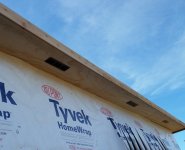
The roof went on before any additional support could be added, but I like the idea of adding the bracing by the ties. I have a few weeks before any work is slated for the underside of the trusses.

View attachment 451020

Is the cedar fascia installed in this picture? I can see something that could be flashing, or drip edge, at the top of the wood. I guess I mistook the wood for pine and not the finished ceder.
 
/ Building our retirement home #311  
Most ridge vent you shingle over with the cap shingles.
 
/ Building our retirement home #312  
I don't think any houses here in southern Kansas have ridge vents. They all have soffit vents and multiple roof vents near the ridge on the back side of the house (non street side). Some have additional gable vents too. No issues as far as I know.
 
/ Building our retirement home #313  
Is the cedar fascia installed in this picture? I can see something that could be flashing, or drip edge, at the top of the wood. I guess I mistook the wood for pine and not the finished ceder.

I thought the same thing Eddie. The picture looked like framing lumber and not fascia. I couldn't zoom in well enough to tell.
 
/ Building our retirement home
  • Thread Starter
#314  
I thought the same thing Eddie. The picture looked like framing lumber and not fascia. I couldn't zoom in well enough to tell.

Yes, the cedar is installed in that photo, as well as the drip edge. It may still appear somewhat light because it has not been stained.
 
/ Building our retirement home
  • Thread Starter
#315  
I don't think any houses here in southern Kansas have ridge vents. They all have soffit vents and multiple roof vents near the ridge on the back side of the house (non street side). Some have additional gable vents too. No issues as far as I know.

My prior home had a black plastic ridge vent. From any distance, it looked just like that ... a black plastic ridge vent. I HATED it. I'm sure it worked great but I couldn't get around the ugly.

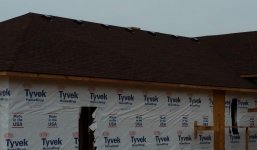
Now, some may not like the approach I've taken on my new home. I prefer it. The vents are not visible from anywhere except the rear.

vents2.jpg vents1.jpg
 
/ Building our retirement home
  • Thread Starter
#316  
I do have another question :)

We will be installing a wood ceiling. This will run the entire length of the vaulted roof - covering the front/rear porches and the great room.

We see this is normally done in pine, so that is where we have been leaning. The wife, however, does not like the busy look of a ceiling full of knotholes. So, we checked out "clear" pine as an alternative. The basic stuff,in 1x8, is about 65 cents per linear foot. The clear is about $5.64 per linear foot. We will be installing close to 4300 linear feet of 1x8.

The question - Is there an alternative? Can I find something that looks better than knothole pine but cost less than clear? Has anyone installed a different type of wood they like?
 
/ Building our retirement home #317  
We did a little cabin with T & G pine. It had tongues and grooves on all 4 edges. I'll see if I can find a picture and see if I can find the price. We purchased it from the mill about 10 miles from our cabin site near Grayling MI.

I don't recall the number of knots. It was wonderful to work with with Grooves on all 4 sides, it lined up beautifully.
 
/ Building our retirement home #318  
/ Building our retirement home #319  
Attics are not designed to be cool, and in my opinion, trying to cool an attic is a waste of time and energy. Better to supper insulate the rooms below the attic and let it get nice and hot so more air flows through it. The air flow is critical to the life of the roof and the lumber supporting it.

Everyone is entitled to their own opinion, but I disagree or maybe just don't understand your logic as cooling the attic space is one of the main objectives of spray foaming the roof line. It's also one of the biggest contributing factors to saving you energy and money. How is that a waste of time?

Can you expand on your thoughts?
 
/ Building our retirement home #320  
I'm not sure heat in an attic is a benefit. It sure cost more to A/C a house when the attic is extremely hot. But I agree air flow is important.
 

Marketplace Items

2022 CATERPILLAR 249D3 SKID STEER (A60429)
2022 CATERPILLAR...
(2) 6 LUG 5200Ib-74SC-93 HUB FACE AXLES (A60432)
(2) 6 LUG...
UNUSED IRMC HIGH END MASSAGE CHAIR (A60432)
UNUSED IRMC HIGH...
UNUSED 250 GALLON FUEL TANK (A60432)
UNUSED 250 GALLON...
2023 JOHN DEERE XUV 590M S4 UTV (A59823)
2023 JOHN DEERE...
SWICT 78" SKID STEER BUCKET (A60430)
SWICT 78" SKID...
 
Top