Hydraulics and heat

/ Hydraulics and heat #1  

roadhunter

Elite Member
Joined
Mar 23, 2014
Messages
2,621
Location
Wyoming
Tractor
JCB 212SU
I have an attachment that is building an incredible amount to heat in the hydraulics when I operate. I don't' exactly understand what causes heat in hydraulic systems so I thought I would throw this out there and see if anyone can shed some light on this subject.

The machine only has 4 hydraulic circuits.

#1 controls the drive wheels. This valve is always open and has an adjustment to control the wheels speed.
#2 and #3 adjust the spacing of the drive wheels and the angle. These only operate when the handle is pulled
#4 operates the arm on the top drive wheel and has a pressure regulator to adjust the down pressure on the cylinder.

According to the manufacturer this requires 8 GPM of flow to operate. The unit has a pressure regulator and a flow divider installed but strangely I can still build over 2,000 PSI if I open the valve on the tractor even at idle. That makes me think the pressure regulator and flow divider is not working as taht should not be possible. Makes me think there is a restriction in the system causing all the back pressure.

I tried operating this with my old famrall with a PTO hydraulic pump. Input pressure was 900 PSI and the oil overheated to 190+ in less than 10 minutes with no load. IT only has about a 4 gallon tank so the heat had nowhere to go.
When I operate it with my JCB wint 900 PSI of input pressure the oil goes to 175+ in about 20 minutes. Keep in mind this has a large reservoir and oil cooler on the motor.

According to the manufacturer, Rabaud, they say this is normal for the Robopel 250. Everyone I have talked to said that building that much heat is not normal, especially when not under a heavy load.

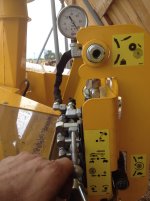
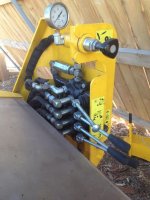
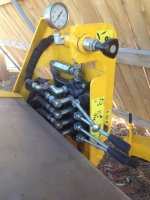
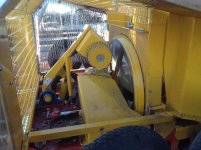
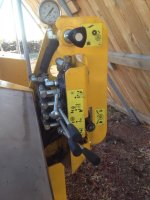
I guess I'm trying to figure out how hydraulic oil builds heat and where I should look to try to pinpoint the problem. Here are some pics of the machine and valve.
unnamed (1).jpg
unnamed.jpg
unnamed (2).jpg

Is the heat normally built in the pump or more likely in things like drive wheels that require constant flow? What about the circuit that has a pressure regulator, can the regulator cause heat buildup?
 
Last edited:
/ Hydraulics and heat #2  
The machine only has 4 hydraulic circuits.

#1 controls the drive wheels. This valve is always open and has an adjustment to control the wheels speed.
#2 and #3 adjust the spacing of the drive wheels and the angle. These only operate when the handle is pulled
#4 operates the arm on the top drive wheel and has a pressure regulator to adjust the down pressure on the cylinder.


#1: What type of flow control is being used for the wheel speed? Where is the excess flow directed or diverted to? Depending on the flow regulator style this could be causing a heat issue.

#4: Pressure reducing valves are heat generators IF their is flow across them. In this case I presume this is just keeping a load on a cylinder so there would be minimal flow but then the question becomes what is happening to the flow? If this is a fixed displacement pump it has to go somewhere and it will be dumping to tank at some pressure greater than your reduced pressure. This will create a lot of heat.


simple method for finding point of heat generation is to either touch the components during startup if this can be done safely or use an infrared thermometer and look for the hot spot.
 
/ Hydraulics and heat #3  
A relief valve that prematurely opens can cause heat. Is hyd oil cooler clean? Do you know if JCB 212SU is open or closed center hyd's??
 
/ Hydraulics and heat #4  
how hot does it get in an hour
 
/ Hydraulics and heat #5  
Go to the Yesterday's Tractors Forums and get in the JD section. Look in the archives. The subject was discussed there and it had to do with oscillating valves like Jim eluded to.
 
/ Hydraulics and heat
  • Thread Starter
#6  
The machine only has 4 hydraulic circuits.

#1 controls the drive wheels. This valve is always open and has an adjustment to control the wheels speed.
#2 and #3 adjust the spacing of the drive wheels and the angle. These only operate when the handle is pulled
#4 operates the arm on the top drive wheel and has a pressure regulator to adjust the down pressure on the cylinder.


#1: What type of flow control is being used for the wheel speed? Where is the excess flow directed or diverted to? Depending on the flow regulator style this could be causing a heat issue.

#4: Pressure reducing valves are heat generators IF their is flow across them. In this case I presume this is just keeping a load on a cylinder so there would be minimal flow but then the question becomes what is happening to the flow? If this is a fixed displacement pump it has to go somewhere and it will be dumping to tank at some pressure greater than your reduced pressure. This will create a lot of heat.


simple method for finding point of heat generation is to either touch the components during startup if this can be done safely or use an infrared thermometer and look for the hot spot.

I got to looking at the valve. It appears to be supplied with a 3/8 hose and the first circuit (bottom) runs the drive wheels. There is a dial just to the right that adjust the wheel speed. IT appears that the lines to and from the drive wheels are 3/8. This valve is always engaged as the wheels are always spinning. You can hold it in the middle to stop them or hold it in the opposite direction to reverse wheel direction.

The next 2 circuits are just going to adjustment cylinders and have 1/4" lines. Both are in the center position unless engaged.

Then we come to the top circuit. It controls the arm. This has a pressure relief valve tapped into the supply line with a T. The T and lines are 1/4". This valve is always engaged.

According to my thermometer the heat is coming from the top pressure regulator. It appears to me that all the supply lines on the machine are 3/8", the first valve that receives flow for the wheels is 3/8", but when you come to the top valve the Tee is only 1/4" and the line to the cylinder and to the regulator is only 1/4". So is appears to me that the system is all 3/8" except for that tee and line to the regulator which are only 1/4". The regulator has a much bigger opening that has been bushed down from 1/2" to 1/4".

Could that be the restriction causing issues in the system? I'm no plumber but it sure seems like that is a restriction. Once that oil leaves the regulator there is no backpressure so there is a huge pressure drop. It has to go through the regulator because the valve is always engaged.

IMG_0147.jpg
unnamed (2).jpg
 
/ Hydraulics and heat
  • Thread Starter
#7  
how hot does it get in an hour

It gets up to that 175 temp and stays there. It all depends on how much I open the valve on the tractor. I can build over 2,000 psi of input pressure even idling the tractor and that builds much more heat in the system. I've been trying to keep the tractor valve adjusted where the input pressure is below 1,000 PSI. I have a gauge on the line where I monitor pressure. The manufacturer says that there is a 900 PSI pressure relief valve and a flow divider on the peelers hydraulic system that will prevent excess backpressure but I don't' think it is working correctly as I should not be able to build that much pressure if the relief and flow divider were working correctly.
 
/ Hydraulics and heat
  • Thread Starter
#8  
A relief valve that prematurely opens can cause heat. Is hyd oil cooler clean? Do you know if JCB 212SU is open or closed center hyd's??

Hyd cooler is clean. Oil is clean. I believe it is an open system.
 
/ Hydraulics and heat #9  
I have an attachment that is building an incredible amount to heat in the hydraulics when I operate.

According to the manufacturer this requires 8 GPM of flow to operate. The unit has a pressure regulator and a flow divider installed but strangely I can still build over 2,000 PSI if I open the valve on the tractor even at idle. That makes me think the pressure regulator and flow divider is not working as that should not be possible. Makes me think there is a restriction in the system causing all the back pressure.

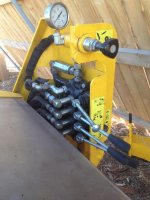
I guess I'm trying to figure out how hydraulic oil builds heat and where I should look to try to pinpoint the problem. Here are some pics of the machine and valve.
View attachment 446107

A 'nominal' 1/4" fitting (male) has <45% the cross-sectional area (thus, presumably, flow capacity) of similar 3/8" pieces. In an open center system continuous flow to/thru' any/all circuits must contend with any restriction in each. (8 gpm :eek:)

If the gauge is upstream of the pressure regulator it would show the pump output trying to maintain downstream pressure (to the reg) beyond the 1/4" bits, esp when nothing (cyl, motor) is activated and circuit back-pressure at its lowest.

Anyway, IMO the 1/4" parts should go before you can find any other possible problems. tog
 
/ Hydraulics and heat #10  
For what it's worth, I think you're looking in the wrong direction. By it's very nature, a machine such as this WILL generate heat. You say the machine requires 8 GPM, and has a 900 psi relief valve. It seems to me the input and system operating pressure should then never need to exceed that 900 psi. What does the manufacturer recommend as a practical operating pressure? I would think maybe 700 to 800 max. You have thus far made no mention of how/if you're determining how much flow(GPM) you're trying to push through this thing. Only that controlling the tractor valve can raise the pressure as high as 2000 psi. To me that means the flow is simply too great, and excessive heat is unavoidable.
As for the size of fittings and hoses, to me they seem large enough for the suggested rate of flow.
 
/ Hydraulics and heat #11  
Energy that is created (by the pump) and not used (somewhere in your system) will generate excessive heat. Unless this machine was homemade by Bubba, then I am sure even a fresh out of college engineer could determine total BTU output of the system and then size a cooling system sized appropriately with contingency. As long as everything is working as it was designed.

Maybe this can help finding your problem...

How long have you had this machine? I ask because it looks new.
Has it just started doing this or has it always done it since you got it?
What does it do?
Does it have its own engine or does it require you to use your tractor's PTO to drive the pump?
Do you have the hydraulic schematics? Can you post them?
Did the manufacturer give you a list of what all relief valves and regulators should be set to?
What type of cooler does it have? Does it have a fan blowing over the coils?
Are you sure the cooler is working and clean? You should be able to feel a difference between incoming and outgoing oil though the cooler.
Are there any filters installed? Does your manual state whether or not they have differential reliefs in them?
 
Last edited:
/ Hydraulics and heat #12  
I don't 175 is to hot, I would ask the dealer. I wouldn't be to concerned unless it went over 200
 
/ Hydraulics and heat #13  
At 175 he is dancing on the edge of seal failure. Your average oring is going to tolerate deformity up to around 200 degrees before they start extruding if not before then.
 
/ Hydraulics and heat
  • Thread Starter
#14  
Energy that is created (by the pump) and not used (somewhere in your system) will generate excessive heat. Unless this machine was homemade by Bubba, then I am sure even a fresh out of college engineer could determine total BTU output of the system and then size a cooling system sized appropriately with contingency. As long as everything is working as it was designed.

Maybe this can help finding your problem...

How long have you had this machine? I ask because it looks new.
Has it just started doing this or has it always done it since you got it?
What does it do?
Does it have its own engine or does it require you to use your tractor's PTO to drive the pump?
Do you have the hydraulic schematics? Can you post them?
Did the manufacturer give you a list of what all relief valves and regulators should be set to?
What type of cooler does it have? Does it have a fan blowing over the coils?
Are you sure the cooler is working and clean? You should be able to feel a difference between incoming and outgoing oil though the cooler.
Are there any filters installed? Does your manual state whether or not they have differential reliefs in them?

The machine is new. It has done this since it was new. This is happening with air temperatures below 50 degrees. The manufacturer felt that the issue was my tractor producing too much hydraulic flow so they installed a flow diverter on the machine. Unfortunately that did not change anything. I can still build tremendous backpressure if I open the valve on the tractor, even at idle. I've tried it on a John Deere and Farmall with similar results. I run my hydraulic chainsaw off the JCB all the time with no pressure or heat issues. I have had a few times when running with the JCB tractor that there was almost no heat built up in the system but I can't seem to find any reason for the different results as I always run about 750 PSI input pressure but when I reached up and grabbed the regulator it was almost cold. When I run the unit with the farmall it gets hot really fast because the tank is only about 3 gallons.

The tractors hydraulics run the machine hydraulics.

I do not have the schematics but it is a fairly simple system with just the one valve block that has 4 circuits.

The manufacturer claims there is a 900 PSI pressure relief on the system and also installed a flow diverter. I'll get some pics of that in the morning. The manufacturer has been really frustrating to deal with as they are from France. They feel the issue is the tractor and I feel that because I have had similar results with 3 tractors that the issue is the machine. First they claimed my tractor had backpressure issues so I put a guage on the return line and proved them wrong. It simply should not be building that much heat IMO as it's not doing anything that requires that much hydraulic power. I've seen attachments like Fecon mulcher heads that heat up fluid but they are using 2,000 PSI fluid and 20+ GPM of flow. This is supposedly only requires 8 gpm to operate as they told me that is the pump size they use when they install onboard hydraulics. I was not aware the unit required the use of the tractors hydraulics until it arrived or I would have simply ordered it with it's own onboard pump and tank. The manufacturer can't even tell me what the required input pressure is for the attachment and its not mentioned in any of the marketing material. All they have told me is they normally install an 8 gpm pump on the unit if it is ordered with onboard hydraulics. They also said is uses a 10 gallon tank and they have not had issues with heat in previous units. Essentially they are blaming my tractor and not helping so it's now my problem to figure out what the issue is with the brand new machine.

Rabaud is the company's name. They are complete clowns to deal with. This was their first sale in the USA and hopefully their last as I have purchased and used dozens of tractor attachments in my life and never had any issues like this.

The JCB has a fan driven cooler on the engine and a large tank, the system is working correctly as far as I can tell. I use it for other attachments with no issues. . The Farmall has no cooler and a small tank. I resorted to hooking up an oil cooler on the return line to the Farmall just so I could run the machine. I'm afraid of burning up the pump on the JCB and the farmall uses a PTO pump that can be rebuilt fairly easily so I use it.
 
/ Hydraulics and heat
  • Thread Starter
#15  
For what it's worth, I think you're looking in the wrong direction. By it's very nature, a machine such as this WILL generate heat. You say the machine requires 8 GPM, and has a 900 psi relief valve. It seems to me the input and system operating pressure should then never need to exceed that 900 psi. What does the manufacturer recommend as a practical operating pressure? I would think maybe 700 to 800 max. You have thus far made no mention of how/if you're determining how much flow(GPM) you're trying to push through this thing. Only that controlling the tractor valve can raise the pressure as high as 2000 psi. To me that means the flow is simply too great, and excessive heat is unavoidable.
As for the size of fittings and hoses, to me they seem large enough for the suggested rate of flow.

The manufacturer can't' give me the required input pressure. I asked the service man and sales staff and they did not know. They felt that the issue was too much hydraulic flow so they installed a flow diverter on the unit. Unfortunately that did not change the results. I can still build pressure in the system even at idle which from my understanding should not be possible with pressure relief and the flow diverter working properly.

I'll get some pics of the flow diverter in the Morning.

I can adjust the input pressure by opening/closing the valve on the tractor. I usually set it around 750 PSI to run the machine. Anything less and it's really weak running the drive wheels and won't hold pressure on the arm.

Do you think I'd be better off with a valve like this? I can add one of these on the Farmall and see if that helps.
1/2 NPT HYD FLOW CONTROL VALVE W/RELIEF RDRS150-16
 
/ Hydraulics and heat #16  
Any chance of drawing the hydraulic circuit out and checking each hose for flow direction. The non return valve (I think) in the picture of the valve block, is that in the supply line or the return or what?

JD produces 21 g/min, device uses less than 8 g/min. That's a lot to be pushing thru. Show some pics of flow divider valve, and draw it into hyd circuit.
Is the relief set at 900, ie. have you measured this?
Are there any specifications/part numbers/brand on the valve block?

I might have missed something here so bear with me -
What drives the peeler blades and/or fan, hydraulic motor or PTO?
 
Last edited:
/ Hydraulics and heat #17  
If your attachment is closed center hyd system, and your tractor is open center hyd system, you will have problems, as the flow in an open center hyd system has to flow all the time. A closed center valve will try and block the flow.

If in fact the attachment is a closed center hyd system, the closed center relief will be on most of the time.

If the valve is closed center and you remove the return hose, with all levers in neutral, you will see relief flow.

When using the levers for operation, you will see cyl flow or hyd motor flow, plus relief flow if pressure is high.
 
/ Hydraulics and heat
  • Thread Starter
#18  
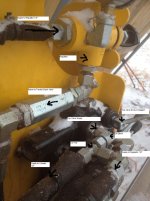
Here are some pics of the machines hydraulics.

This shows the top valve and how it connects to the cylinder and tees to the pressure regulator. This valve is always engaged.
IMG_0266.jpg

This shows the flow divider that was installed
IMG_0264.jpg
 
/ Hydraulics and heat
  • Thread Starter
#19  
Any chance of drawing the hydraulic circuit out and checking each hose for flow direction. The non return valve (I think) in the picture of the valve block, is that in the supply line or the return or what?

JD produces 21 g/min, device uses less than 8 g/min. That's a lot to be pushing thru. Show some pics of flow divider valve, and draw it into hyd circuit.
Is the relief set at 900, ie. have you measured this?
Are there any specifications/part numbers/brand on the valve block?

I might have missed something here so bear with me -
What drives the peeler blades and/or fan, hydraulic motor or PTO?

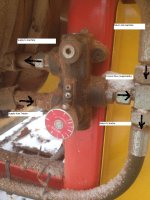
I did some crude drawings over pics to show the flow as well as the flow divider.
I do not believe the relief works properly as I can build over 2,000 psi at idle if I open the valve on the JCB tractor all the way. The farmall only builds about 900 PSI when it's valve is opened all the way.

I'll do some looking at the valve block and see about brand. It was replaced when the service man came out.

The tractors PTO drives the peeler blades and the tractor's hydraulic system spins the drive wheels and adjusts the cylinders that position the drive wheels and controls the arms.

The valve
unnamed (2).jpg
 
Last edited:
/ Hydraulics and heat
  • Thread Starter
#20  
If your attachment is closed center hyd system, and your tractor is open center hyd system, you will have problems, as the flow in an open center hyd system has to flow all the time. A closed center valve will try and block the flow.

If in fact the attachment is a closed center hyd system, the closed center relief will be on most of the time.

If the valve is closed center and you remove the return hose, with all levers in neutral, you will see relief flow.

When using the levers for operation, you will see cyl flow or hyd motor flow, plus relief flow if pressure is high.

Hmm. It's made to go on a tractor so I just assumed it was open center. I'll have to do some research on that one.

There was no mention of the unit needing a hydraulic input in the marketing so I didn't even know until it arrived. I was planning on using my hydraulic chainsaw on the tractors hydraulics (The chainsaw you helped me set up a while back, thanks again for your help with that. It works great). I have the saw setup for open center and it works great on the JCB as well as on the Bobcat tractor I used to have.
 

Marketplace Items

2019 INTERNATIONAL LT625 6X4 T/A SLEEPER TRACTOR TRUCK (A59912)
2019 INTERNATIONAL...
2016 Chevrolet Silverado 1500 Crew Cab Pickup Truck (A61573)
2016 Chevrolet...
Tube Line Manure Spreader Nitro 750 (A63688)
Tube Line Manure...
John Deere 450 (A64119)
John Deere 450...
2000 CATERPILLAR 988F SERIES II WHEEL LOADER (A62129)
2000 CATERPILLAR...
2014 John Deere 644K High Lift Articulated Wheel Loader (A61572)
2014 John Deere...
 
Top