Can this be welded?

/ Can this be welded? #1  

zmansmac

Gold Member
Joined
May 21, 2003
Messages
256
Location
Arcadia Township, Michigan
Tractor
Kubota B7500
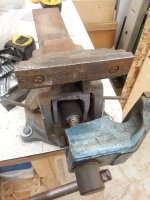
About 45 years ago my brother gave me a made in Poland (we're Polish) vice for Christmas. This 6 inch jaw heavy duty monster has served me well over the years taking all the abuse I could dish out. But today I think I pushed it a little to far, or maybe it's just getting old and weaker like me. I had some 1/2 inch, 1/16th" wall tubing that I wanted to flatten the last 2 inches of. Started out OK but then I realized that I needed a little more leverage. So I grabbed an 18 inch long pipe to help crank her in. It did flatten the piece out enough to put the jaw teeth marks in it but I could still see a little gap and so I cranked a little more and snap (refer to the picture). I can tell it's some kind of cast metal and there's plenty of room for some surface weld to stick out but I'm not sure if this kind of metal can even be welded. Or should I turn it into a boat anchor and look for a new vice. Comments (satirical ones also welcomed) please.
 

Attachments

  • vice.jpg
    vice.jpg
    648.1 KB · Views: 594
/ Can this be welded? #2  
I don't know about an an anvil, but we have both broken a vice.
 
/ Can this be welded? #3  
/ Can this be welded? #4  
That's scrap. You better box it up and send it to me. I'll dispose of it for you. :)

That looks like cast iron but you could grind on bottom for a spark test and see if it's cast steel. Either "can" be welded. If you've never done it, pass it off to someone else to weld.


Edit: Ops! Looks like I was a minute behind.
 
/ Can this be welded?
  • Thread Starter
#5  
Thanks for the replies so far. These might seem like a dumb question to some of you , but how do I tell if it's cast iron or cast steel? And I should have mentioned that I only have a Mig welder and an AC arc welder.
 
/ Can this be welded? #6  
/ Can this be welded? #7  
Likely cast iron. Another way to tell is see if you can cut it with a cutting torch. I think a good lasting repair will be questionable at best.
 
/ Can this be welded? #8  
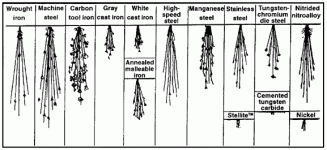
Take Your angelgrinder and do a spark test to determine type of metal
painti132.gif.

My personal preferans on cast iron is silver solder, if cast steel 7018
 
/ Can this be welded? #9  
Any chance you could fabricate a new piece from steel using the broken end clamp piece being held in with steel??
 
/ Can this be welded? #10  
I would bet it is cast iron but too know for sure you would need to do a spark test. I have a color chart like the one posted here but I don't know where mine is. I have welded a lot of cast with nickel rod (ni-rod) and have had good results, the best results ??????????? I feel the best way to weld cast is with oxygen/acetylene and cast iron rod. The cost is prohibitive though unless you do a lot of it. cast rod is $8.00 a pound and comes in 50 pound boxes and I have not found a welding supply that will break a box. In one of shield arcs links you can buy one pound for $29.00, sounds a little like robbery to me. What ever method you choose you will need pre heat and a slow cool down. Many years ago I once put a cast piece in my kitchen stove for a slow cool down.
 
/ Can this be welded? #11  
I too, cracked my vice flattening the last few inches of tubing and using a cheater. I welded it back and the weld held until the next time I tried to flatten the last few inches of tubing.:ashamed:
 
/ Can this be welded? #13  
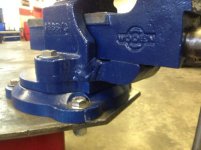
This Woden (made in England) vice was brazed back together by our farm mechanic when I was little.
No problems 50+ years later with daily use.

image-2125834570.jpg

To be fair though it has been relegated to the welding table and 2 larger Records take the heavier beatings.

Terry
 
/ Can this be welded? #14  
I broke the sliding upper wheel mount on my h/v bandsaw not long after I bought my first welder (I'd had someone show me how to use one at a job a while back but never anything that would qualify as proper instruction). An AC only "tombstone".

I bought a small package of "malleable" nickel "99%" rod, and ground a deep vee in the cast, leaving just enough of the original break to line up the parts since the slide channels crossed the break, I didn't want to risk having it shrink "out of line". I did the short weld--peen the weld for a bit--another short weld style, rather than preheat. And it went together beautifully. But the casting wasn't a great design, there wasn't a lot of "meat" where it was welded together, but there was plenty of room for a mild steel backer plate that could bridge the break parallel to the slide, so I made one and welded that on too. And it hasn't given me a lick of trouble since.

The nickel rod welds very easily, at a lower current than you might be used to if all you have used is 6011 or 7014. The malleable is nice because you can file or grind it after.

In your case, I wonder if you could grind a V maybe half the depth of the weld, on the inside, to hold the break tight together. Weld that, then grind the break in a vee on the outside down to the weld metal, and weld it again, then grind smooth so it will slide.

I think I would be a little worried about micro cracks in the metal nearby, but it'd probably be OK as long as you keep the use reasonable.

Mostly, I'd say when you want to flatten pipe that last little bit, use a sledgehammer, not the vise...and if you want it really flat, get it hot first.
 
/ Can this be welded? #15  
Zmansmac, if you decide to stick weld it and can't find small amounts of electrodes easily, PM me and I will throw a few in the mail for you.

Terry
 
/ Can this be welded?
  • Thread Starter
#16  
Spark testing indicates that it is cast iron. I did some research and watched some youtube videos on welding cast iron. I thank you all for your help. I hope to try and weld it in the next week or so. When I do I will post some pictures, hopefully with a good result. Terry, thank you so much for your generous offer. My plan is to preheat the parts in my electric oven and stick weld with 7018 rods that I already have.
 
/ Can this be welded? #17  
Spark testing indicates that it is cast iron. I did some research and watched some youtube videos on welding cast iron. I thank you all for your help. I hope to try and weld it in the next week or so. When I do I will post some pictures, hopefully with a good result. Terry, thank you so much for your generous offer. My plan is to preheat the parts in my electric oven and stick weld with 7018 rods that I already have.

I feel 7018 is not the electrode to use, I went to a Lincoln site and found this.

nes for Welding Cast Iron
Application Stories
Process and Theory
Welding How-To's
Welding Projects
Welding Solutions
Lincoln Electric TV
CAD File Downloads

Cast iron is difficult, but not impossible, to weld. In most cases, welding on cast iron involves repairs to castings, not joining casting to other members. The repairs may be made in the foundry where the castings are produced, or may be made to repair casting defects that are discovered after the part is machined. Mis-machined cast iron parts may require repair welding, such as when holes are drilled in the wrong location. Frequently, broken cast iron parts are repaired by welding. Broken cast iron parts are not unusual, given the brittle nature of most cast iron.
While there are a variety of types of cast iron, the most common is gray cast iron, and these guidelines are directed toward this type of material.

A few facts about cast iron help in understanding the welding challenges. Cast iron typically has a carbon content of 2% - 4%, roughly 10 times as much as most steels. The high carbon content causes the carbon to form flakes of graphite. This graphite gives gray cast iron its characteristic appearance when fractured.

When castings are made, molten iron is poured into a mold and allowed to slowly cool. When this high carbon material is allowed to cool slowly, crack free castings can be made. Remembering this is helpful when welding cast iron: during and after welding, the casting must either be allowed to cool slowly, or should be kept cool enough that the rate of cooling is not important.

A critical temperature in most cast iron is about 1450 degrees F. When at this temperature, conditions that can lead to cracking occur. While the arc will heat the casting to temperatures above this level, it is important that the casting not be held at this temperature for long periods of time.

Electrode Selection
If the part is to be machined after welding, a nickel-type electrode will be required. Use Lincoln Softweld® 99Ni stick electrode for single pass, high dilution welds. Softweld 55 Ni is preferred for multiple pass welds. Sometimes, root passes are put in with Softweld 99 Ni, followed by fill passes with Softweld 55 Ni. For welds where machining is not required, and where the weld is expected to rust like the cast iron, Lincoln Ferroweld® stick electrode can be used.

To Heat, or not to Heat
In general, it is preferred to weld cast iron with preheat--and lots of it. But, another way to successfully weld cast iron is to keep it cool--not cold, but cool. Below, both methods will be described. However, once you select a method, stick with it. Keep it hot, or keep it cool, but don't change horses in the middle of the stream.

Welding Techniques with Preheat
Preheating the cast iron part before welding will slow the cooling rate of the weld, and the region surround the weld. It is always preferred to heat the entire casting, if possible. Typical preheat temperatures are 500-1200 degrees F. Don’t heat over 1400 degrees F since that will put the material into the critical temperature range. Preheat the part slowly and uniformly.

Weld using a low current, to minimize admixture, and residual stresses. In some cases, it may be necessary to restrict the welds to small, approximately 1-inch long segments to prevent the build up of residual stresses that can lead to cracking. Peening of weld beads can be helpful in this regard as well.

After welding, allow the part to slowly cool. Wrapping the casting in an insulating blanket, or burying it in dry sand, will help slow cooling rates, and reduce cracking tendencies.

Welding Techniques without Preheat
The size of the casting, or other circumstances, may require that the repair be made without preheat. When this is the case, the part needs to be kept cool, but not cold.

Raising the casting temperature to 100 degrees F is helpful. If the part is on an engine, it may be possible to run it for a few minutes to obtain this temperature. Never heat the casting so hot that you cannot place your bare hand on it.

Make short, approximately 1” long welds. Peening after welding is important with this technique. Allow the weld and the casting to cool. Do not accelerate the rate of cooling with water or compressed air. It may be possible to weld in another area of the casting while the previous weld cools. All craters should be filled. Whenever possible, the beads should be deposited in the same direction, and it is preferred that the ends of parallel beads not line up with each other.

Sealing Cracks
Because of the nature of cast iron, tiny cracks tend to appear next to the weld even when good procedures are followed. If the casting must be water tight, this can be a problem. However, leaking can usually be eliminated with some sort of sealing compound or they may rust shut very soon after being returned to service.

The Studding Method
One method used to repair major breaks in large castings is to drill and tap holes over the surfaces that have been beveled to receive the repair weld metal. Screw steel studs into the threaded holes, leaving 3/16” (5 mm) to ¼” (6 mm)of the stud above the surface. Using the methods discussed above, weld the studs in place and cover the entire surface of the break with weld deposit. Once a good weld deposit is made, the two sides of the crack can be welded together.


View more Cast Iron Welding How-To articles

View Cast Iron Stick Electrodes
 
/ Can this be welded? #18  
When at the shop, we didn't have to weld CI much but we did get some new rod just for it. I had a old pump that needed welding so I used the rod, wow, did it ever weld nice. Now, if I could ever remember what it was......
 
/ Can this be welded? #19  
I've done a little pre-heat, post-heat, shrink-fit. A harbor freight temp gun and a 35,000 btu reddie heater willl do wonders.
 
/ Can this be welded? #20  
I've done a little pre-heat, post-heat, and shrink-fit. A harbor freight temp gun and a 35,000 reddie heater does wonders.
 

Marketplace Items

Case 586E Fork Lift (A60352)
Case 586E Fork...
2018 MACK CXU (PINNACLE) (A60736)
2018 MACK CXU...
2017 TROXELL 150 BBL ALUMINUM VACUUM TRAILER (A60736)
2017 TROXELL 150...
2009 HEIL TRAILER INTERNATIONAL PNEUMATIC  TRAILER (A60736)
2009 HEIL TRAILER...
case 370 glass door never installed (A61307)
case 370 glass...
PENDING SELLER CONFIRMATIONS (A59908)
PENDING SELLER...
 
Top