1990s Ford 3930 slow moving..

/ 1990s Ford 3930 slow moving.. #1  

LondonDave

Bronze Member
Joined
Feb 25, 2015
Messages
72
Location
Melbourne, Ontario Canada
Tractor
John Deere 5410 MFWD, Case IH 5230 MFWD
Hi Guys,

New member, first post. I've used this site a lot when researching various things. I finally got around to signing up.

I have a 1990s (93 I think) Ford 3930 with a manual transmission. It's been working great all winter. I last used it a few days ago and no problems at all. Today when I went to use it, it would hardly move. It started right up and revved right up, hydraulics work fine but it won't hardly go forward or reverse. It will evenutally build some speed but there is virtually nothing there when I let out the clutch. My first thought is something is frozen/stuck but I've used it in weather just as cold when it's been sitting just as long and haven't had an issue. I don't have anywhere to bring it inside to warm it up so that's out. It is plugged in but I don't think that would do anything for the clutch if that's what is the issue.

Thanks

Dave
 
/ 1990s Ford 3930 slow moving.. #2  
Dave, it would have to be in the clutch somehow. Let's cover a couple issues.

Does the clutch pedal have "free travel"?? The pedal should move 1-1/4" before you feel any resistance. This allows the throwout bearing to not be against the pressure plate all the time and constantly spin. With no free travel the pedal assembly could be holding the clutch pressure plate in a partially disengaged situation. Similar to riding the clutch pedal when trying to do delicate movements.

So, you start the engine, put the transmission in gear. Hold the brake pedals down. Let out the clutch and the tractor will just sit there? If so that would confirm the clutch is slipping.

When you push the clutch pedal do you feel the normal spring resistance as if it is actually moving the pressure plate?

Any oil leaks around the clutch housing area?? This would indicate a bad seal which could saturate the clutch disc with oil and cause it to slip.
 
/ 1990s Ford 3930 slow moving..
  • Thread Starter
#3  
Normally the clutch operates as you say. Right now it's not. There does not seem to be any resistance and definitely no popping of the clutch when it's let out. The tractor will go if I really rev it up and eventually build speed.

No leaking that I can see but it has had a bit of a burning smell the last few times I've used it. Sort of a burning fluid smell. Transmission fluid is milky looking, rear diff fluid looks good.

Thanks

Dave
 
/ 1990s Ford 3930 slow moving.. #4  
Okay Dave, let's go back to my first question. Is there any "free travel" on the pedal?? If not, the clutch is out of adjustment and the linkage is holding the clutch in a partially disengaged position. The smell is the clutch disc heating up as it slips. Let's check for free travel and adjust if necessary to get free travel, then if it still doesn't work we'll look for a deeper problem. To adjust the free travel you removed the cotter pin and latch pin on the clutch linkage rod where it fastens to the clutch arm going into the housing. This is just ahead of the clutch pedal, down low on the side of the housing. Remove the pin and lengthen the rod by turning the clevis. Keep turning a couple turns, replace the pin, try the pedal, until you have at least an inch of travel. Then crank up and see if you have a solid clutch. I'll stand by.
 
/ 1990s Ford 3930 slow moving..
  • Thread Starter
#5  
Okay thanks. I'll go and check it now. I'm going to say that I don't have enough free travel normally because when I engage the clutch the gears will often grind and not go in right way. Which would tell me that the clutch is not disengaging enough? I'll go and make an adjustment right now.
 
/ 1990s Ford 3930 slow moving.. #6  
The clutch not disengaging to allow gear selection is the opposite of your problem and is indicated by excessive free travel. The movement of the pedal cannot fully disengage the clutch.

Your problem is that with no free travel the pedal assembly is holding the clutch in a partially disengaged position. Again, similar to what an operator does when riding the clutch pedal to do delicate movements like hitching to an implement for example.
 
/ 1990s Ford 3930 slow moving.. #7  
I can't help with the diagnosis of that clutch pedal mechanism, but one thing you don't want to do is rev it up and try moving it the way it is...that can/will destroy the clutch pretty quickly.

It sounds more like you have a lot of take-up, which is the opposite of what you want.
 
Last edited:
/ 1990s Ford 3930 slow moving.. #8  
GManBart;4055693 It sounds more like you have a lot of free travel said:
Too much free travel makes it impossible to disengage the clutch. Pedal hits the floor before it disengages. Too little free travel holds the clutch in a partially disengaged position which can result in slip as he described.
 
/ 1990s Ford 3930 slow moving..
  • Thread Starter
#9  
Okay I've adjusted the yoke under the pedal turning it out about 1/4 inch (pic attached). Is this the correct adjustment? After doing it I'm back to where it was before this problem started but I'm not convinced it's "fixed". As for pedal travel. I seem to have a lot. The pedal is almost all the way to the top of it's stroke before the clutch engages.

Is the rear part of that whole assembly where it goes into the diff supposed to move when the clutch is depressed? Mine doesn't move at all. If I was to move that yoke out any further I don't think I'd be able to get the pin back in.

Thanks

Dave
 

Attachments

  • clutch yoke.jpg
    clutch yoke.jpg
    133.4 KB · Views: 383
/ 1990s Ford 3930 slow moving.. #10  
Yes, that is the correct adjustment to set free travel of the pedal assembly.

One step at a time here.

So, now you have somewhere around 1-1/4" of pedal travel before you feel resistance?? This is measured at the pedal surface you put your foot on. Starting with the pedal in it's normal resting position, push slowly until you feel spring resistance and you have 1-1/4"??? If not, adjust the clevis until you do.

The pedal coming almost to the top before the clutch engages indicates the disc is worn thin. The pressure plate moves farther from the time you start engaging the clutch before it finally pinches the clutch disc and causes movement. This does not surprise me at all. You've probably used the tractor for quite some time with it out of adjustment and it has been slipping all that time until it finally would no longer engage and move the tractor. This would not cause me to replaced the clutch assembly yet. As long as the clutch will hold a load and perform it's duties, I'd use it. When it cannot do that, I'd replace it. It's not an impossible task but it involves splitting the tractor in half. Here's a link to a thread I posted recently about clutch replacement in my 3910.

http://www.tractorbynet.com/forums/...ting/331004-ford-3910-clutch-replacement.html

I'm not sure what you are asking in regards to "Is the rear part of that whole assembly where it goes into the diff supposed to move when the clutch is depressed?" Are you talking about where the pedal swivels under the floorboard?? Or are you talking about the clutch shaft where it goes into the clutch housing near where you adjusted the free travel??

AS to moving the yoke out any further. You are worried about getting the pin back in?? If you are unscrewing the yoke, or running out toward the end of the rod to get free travel you won't have that problem. If you are shortening the rod by screwing the yoke onto the shaft you might encounter that problem.
 
/ 1990s Ford 3930 slow moving..
  • Thread Starter
#11  
I've got it adjusted properly now. I had to turn the yoke out about 1/2" total and I've got the 1 1/4" free place before I start to feel the spring. I cranked it out even more and I was up to almost 3" of free play so I brought i back in. It seems to be working good now. I didn't run it for very long to see if I was still getting that smell...Didn't have time, have to get ready to go to work.

As for the part that goes into the diff I'll have to take a picture another time and show you.

Thanks for your help.

Dave
 
/ 1990s Ford 3930 slow moving.. #12  
Too much free travel makes it impossible to disengage the clutch. Pedal hits the floor before it disengages. Too little free travel holds the clutch in a partially disengaged position which can result in slip as he described.

Sorry, meant to say take-up rather than free travel.
 
/ 1990s Ford 3930 slow moving.. #13  
I glanced at my 3910. I'll take a guess at what you mean. You looked at the shaft where the clutch pedal swivels. You moved the pedal and at a glance didn't see any movement? If this scenario is true the following explanation applies. If not, please ignore. :)

The shaft that the clutch pedal swivels on performs two duties. It runs completely thru the rear housing of the tractor exiting on the opposite side. On that opposite side the left brake pedal fastens to that shaft using a square key and a bolt tightening it to the shaft. So when you push the left brake pedal you turn that shaft. Now back to the clutch pedal side of the tractor. The first thing on that shaft as it leaves the housing is the clutch pedal. It "coasts" on that shaft allowing the clutch pedal to be moved without shaft movement. On the outer end of that shaft is the left brake lever. It is also keyed to the shaft and clamped with a bolt. To it is fastened a rod that goes rearward into the brake housing on the rear axle assembly. So, if you just glance at the end of that shaft and move the clutch pedal you will wonder why that assembly you see isn't moving?? It will not move until you depress the left brake pedal.

Hopefully this helps.

As to the clutch issue. Use the tractor as is. I would only replace the clutch if it will not hold a load such as pulling a heavy load or slipping when in high gear. Or if you continue to have that smell, which would indicate it is slipping all the time. I'm guessing it was only slipping because it was severely out of adjustment.

I pay very close attention to both, clutch and brake pedal "free travel". Set correctly you get the best result. Set incorrectly you are wearing out parts such as clutch disc or brake discs for no reason. :)
 
/ 1990s Ford 3930 slow moving..
  • Thread Starter
#14  
Yep that's what I'm talking about. There is also a rod that goes to the rear diff. It looks to me like that should move but it doesn't. I was just curious about what it did. Something to do with the PTO maybe (just guessing).

Thanks again for the help with the clutch. I'll keep an eye on it and make sure it stays properly adjusted.

Dave
 
/ 1990s Ford 3930 slow moving.. #15  
Are you referring to the rod that's fastened to the cast arm on the end of the clutch pedal shaft under the floorboard?? This rod goes into the rear diff housing? That's the left brake rod.

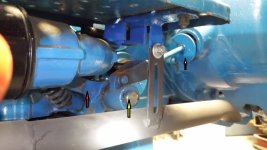
Look at the attached picture. There are 3 arrows.

The red arrow is pointing at the clutch pedal assembly. My exhaust is in the way so you can't see the lower part of that assembly where the rod is fastened that runs forward where you adjusted earlier. This assembly coasts on the shaft which allows the clutch pedal to be moved with no impact on the position of the shaft.

The yellow arrow is pointing at the shaft that runs thru the tractor housing. If you look at the end of that shaft you can see the keyway that fastens the brake assembly to the shaft. This causes that assembly to move when the shaft rotates. This rotation is controlled and activated by pushing on the left brake pedal with your right foot.

The black arrow is pointing at the rod that goes rearward and into the rear diff housing. This rod activates the wet disc brake for the left wheel. When the brake pedal is pushed the shaft turns, which also turns the assembly on the shaft (yellow arrow), which also pulls on the rod (black arrow) to activate the brake.

Clear as mud right?? :)

20150225_134624 (1280x720).jpg
 
/ 1990s Ford 3930 slow moving..
  • Thread Starter
#16  
Yep that's what I was talking about. Perfectly clear now. Thanks for the explanation.

Dave
 
 
Top