Passivating stainless steel

/ Passivating stainless steel #1  

Sodo

Elite Member
Joined
Apr 21, 2012
Messages
3,311
Location
Cascade Mtns of WA state
Tractor
Kubota B-series & Mini Excavator
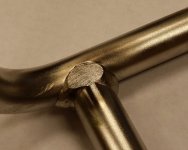
I need to grind weld protrusions off 30 items that are "for sale" (60 grinds). I want to passivate just that one grind spot so it doesn't leak rust onto visible parts. The grind area is about 1/4" x 1/2", and it's on the underside so not visible.

Does anybody know an easy trick to get a small amount of phosphoric acid. I can order a whole quart of it but I don't want to store the remaining 99% of the quart, and I don't want to discard it either. I want just a little bit (and soon). Does anybody know of readily available products containing phosphoric acid?

Here's a pic of the grinded area, and it's been wire-wheel'd with a stainless brush. Thanks!
grind_stainless.jpg
 
/ Passivating stainless steel #2  
Not sure, but we used a solution of Nitric acid. Heard that it might possibly be done with citric acid.
 
/ Passivating stainless steel #4  
Many soft drinks contain phosphoric acid. My mother told me stories of how her father would clean the rust off the plows on the farm with Coke... Or perhaps try a bottle of Naval Jelly? I've wondered about this item myself, so I will be watching for responses...
 
/ Passivating stainless steel #5  
Why would it "leak rust"? Use a new grinding wheel and you should be fine.
 
/ Passivating stainless steel #7  
Home Depot sells phosphoric acid ...
 
/ Passivating stainless steel #8  
Here's a pretty good article on passivation:
How To Passivate Stainless Steel Parts : Modern Machine Shop
It recommends either nitric or citric acid (depending on the alloy), with no mention of phosphoric. Citric acid might be available at your local pharmacy.

While I can appreciate your desire to minimize the amount of chemical waste your passivation process generates, it seems like that should take second place to following whatever steps are necessary to produce the desired result. Time, Cost, Quality: Pick any two. In this case it seems like you want it fast and inexpensive (smaller quantity of acid), so you might not get the passivation needed to resist whatever corrosive environment the parts will see. But if you had the time to order the correct acid from an on line supplier, you may find it available in a small quantity at a more reasonable price than might be available locally (assuming the correct acid is even available locally).
 
/ Passivating stainless steel
  • Thread Starter
#9  
Rock I could use a new grinding wheel but I'd like one that was rounded not a sharp square edge, I guess I could abuse it for awhile on stainless scrap. I'm not sure that is all it takes as stainless has subsurface iron I think. ?

While I can appreciate your desire to minimize the amount of chemical waste your passivation process generates, it seems like that should take second place to following whatever steps are necessary to produce the desired result. Time, Cost, Quality: Pick any two.

"Plan B" is to just order the dang QUART of "pickling paste" and then decide what to do with it. Last time I had a small plastic "35mm film cannister" of it. I set it on a windowsill and it softened the paint below. I heat-sealed the cannister in 2 layers of 6mil plastic sheet and moved it to another windowsill where it sat forgotten a couple years, and it etched the nearby glass. I'm certain I can find a way to store this stuff, but for the moment I am avoiding having it around. I have all weekend to give "plan A" a chance.

I read the article and it was interesting, but didn't seem to align with my experience.

My experience is from one stainless steel welded deck railing that a friend made for me. All cutting was plasma-cut and some grinding. When it was new it was shiny. Over a couple months or so (outdoors) it turned darker, and rusty. I used pickling paste and it got pretty shiny, almost instantly. It started darkening again. My buddy said pickle it again. This time it got even shinier (almost instantly). The next day I pickled it again, this time it got real shiny, like stainless steel ought to be, and it's still shiny today.

Another time I wiped down a stainless steel item, (a motorcycle protection bar) that had "lost its shine" and looked like it was darkened by rust stain that wouldn't wipe of with any solvent. Wiped it with pickling paste and it looked instantly 'like new'".

That's about all I know about pickling paste. I guess plan C is to ask my buddy for some paste but he's a busy guy and I ought to first try to get some on my own.

I'm interested if there are readily available alternatives (Ospho, Naval Jelly?). I do NOT want to turn the iron black, I want it to remain bright stainless as in the pic. Hoping for those with experience to join in the discussion and I think others are interested too so thanks to all for posting.
 
/ Passivating stainless steel #10  
My experience has been with 304L and 304ELC nuclear components in operating power plants, and they were given a nitric acid based passivation treatment after welding and grinding. I once won an all expense paid trip to a reactor in Vera Cruz, MX to supervise grinding out rust stains on the stainless steel cladding. It seems iron contaminated grinding wheels and wire brushes were used during fabrication, and rust formed in the salt laden air at the beaches above Vera Cruz. I got to watch as crews used NEW, never before used on anything else, abrasive flapper wheels and grinding discs to clean off the rust. Once removed, it didn't return even though we didn't bother with a passivation treatment. But if you want the shine, you need to establish the very thin layer of nickle and chrome oxide as referenced in the article, and nitric or citric acid is one way to do it.

I've never heard of pickling paste, but when I looked into it I found it contains both nitric and hydroflouric acid, not phosphoric. Hydroflouric is really nasty stuff, not just for your window sills, but for you as well. This article makes it pretty clear you need to be very careful when using it:

HSE - Welding: Post weld cleaning using pickling pastes - Information documents

This search turned up a couple of sources, but it isn't exactly cheap:

https://www.google.com/search?q=pickling+paste+stainless+steel&ie=utf-8&oe=utf-8

Seems like what you really need is a way to store it that won't damage the surroundings. If you bought a quart of it you may find that it is sold in a container that doesn't leak corrosive vapors, and next time you need some you'll have it. If you're successful in mooching another batch from your buddy, snag one of those small polypropylene screw top bottles from a backpacking store and put it in that. They're pretty inert and don't leak.
 
/ Passivating stainless steel #11  
When I worked in a fab shop in the 1970s. We did a lot of stainless steel work for the Trojan, Satsop, and Hanford nuclear plants. We had a clean room, with stainless steel tables. Had stainless steel pads over the jaws of the vices. Stainless steel caps that went over the hammers. They really tired to eliminate the amount of carbon steel tools we used in the clean room.
 
/ Passivating stainless steel #12  
Before I read RNG's excellent post I saw your comment about the etched glass - my immediate reaction was "crap, that stuff has HF in it (not Harbor Fright) - In the last 25 years of my working life, we used HF and Nitric in pickling tanks - that combo would remove several thousands of an inch from a "non-corrodable" Zirconium slab in about 4 minutes - and a hand print sized exposure left untreated can stop your heart.

Not something you wanna "wing it" with... Steve
 
/ Passivating stainless steel
  • Thread Starter
#13  
HF,,,,, Well, Amazon has SurfOx Treatment which is phosphoric based ,,,,

RNG you know some stuff - thanks for joining the discussion. Forgot about flapper discs, I suppose I can grind off the weld bead with my old wheel then polish it with a virgin flapper disk.

This video https://www.youtube.com/watch?v=DSdBpCuj_5U uses cream of tartar and lemon juice. Which the host says the lemon juice is for the clean fresh smell :laughing: but I suppose citric acid plays a part. Cream of tartar is potassium acid salt of tartaric acid (a carboxylic acid). Then there's BarKeeper's friend, which uses Oxalic acid. I might try these because I have them here, now. Every method uses an acid, it almost seems like any acid that attacks iron may be worth a try (but I want it to end up bright).

Hence my question to the forum chemists: My project has no cooking scum or fingerprints to rub off. It's just a coloration thats a little darker than the surrounding area. If the acids concoction actually 'brightens' the stainless steel in the area where I worked it, did it "passivate"? And will it remain bright like the rest of the item?

I would like to find a source for just one tube of Walter 54A061 Surfox-G PH Neutral Weld Cleaning Electrolyte, 100ml tube.
 
Last edited:
/ Passivating stainless steel #14  
yes, if you clean it with a carbon wire wheel or a grinding disk embedded with carbon steel, it will promote rust in the stainless part.
 
/ Passivating stainless steel
  • Thread Starter
#15  
So,,,,, back to the main question,,,,, if I grind it and polish it - with uncontaminated tools - will the wound rust in an outdoors environment?
 
/ Passivating stainless steel #16  
It looks like a Mig weld. What type of stainless steel filler metal did you use? Did you use a tri mix gas?
 
/ Passivating stainless steel #17  
I have never seen stainless steel that did not remain shiny after fabrication as long as you kept carbon contamination from it. I have been involved with miles of pipe fabrication and if you grind with a new abrasive wheel or flapper wheel, you wont have any color change and you wont need passivation on the piece.

When we did get some carbon steel contamination, we would flapper the area then use phosphoric acid to remove the carbon.
Please stay away from anything with Hydro-fluoric acid in it. That is very dangerous stuff that even in small amounts will absorb thru the skin and attack your bones. VERY BAD STUFF. Phosphoric will do the same thing albeit a bit slower.
 
/ Passivating stainless steel #18  
So,,,,, back to the main question,,,,, if I grind it and polish it - with uncontaminated tools - will the wound rust in an outdoors environment?

They use it in salt water marine environments all the time. So yes, passivate it, no contamination and it will work great.
 
/ Passivating stainless steel
  • Thread Starter
#19  
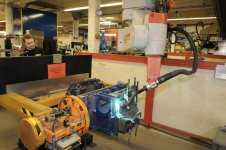
Shield here is a pic of the welder. It's a MIG of sorts, no idea what gas used, and I couldn't see the plug so I can't answer everybody's next question :D

robotwelder.jpg

During a period following fabrication, it seems to me that Stainless can discolor as the recently exposed surface iron molecules rust. Then once these surface molecules are gone (deplete) and the rust staining rubs off its bright again. I'm pretty sure "passivation" mostly just accelerates this process, ",,,,,better living thru acids! " :D In Marine applications - saltwater, I bet the surface iron depletes quickly.

I want to grind off this high weld in such a way that it goes entirely unnoticed. I think we're onto it, finishing with an uncontaminated flapper. But if any rust coloration appears on the surface after a few weeks it may upset some customers, who will think their part has a globule of iron that's gonna rust right thru. Some will be OK if told "sorry it will be a few months, you just have to wait for the iron to deplete." Others will want a replacement. I have only one Sunday remaining to research this - gotta do something Monday AM.
 

Marketplace Items

CADMAN 4500 WIDE BODY HARD HOSE REEL (A63291)
CADMAN 4500 WIDE...
RoGator and Terragator Manuals (A63117)
RoGator and...
2012 International WorkStar 7300 AWD Altec DC47TR Insulated Digger Derrick Truck (A60460)
2012 International...
82in Rock Bucket Skid Steer Attachment (A61572)
82in Rock Bucket...
2015 Ford Taurus AWD Sedan (A61574)
2015 Ford Taurus...
2015 Ford F-250 4x4 Ext. Cab Pickup Truck (A61573)
2015 Ford F-250...
 
Top