My FEL is bleeding down

/ My FEL is bleeding down #21  
It is not a static situation with a load on the cyl such as a couple of hundred lbs.

Describe how that is not a static situation?

200#, 800#, 1500#, does not matter how much weight is in the bucket. IF the weight isnt moving it is a static load.

Just like the dead weight of the loader and bucket itself.

IF you think a 300# empty loader bucket is a static load, how is that any different than a set of 100# pallet forks instead of the bucket, and 200# on them.

But regardless, we are getting off topic. The only thing adding weight does is increase the pressure in the cylinder. And increasing the pressure inside the cylinder also increases the pressure in the fittings, hoses, and valve. So adding weight will increase leaking where ever it may be happening.
 
/ My FEL is bleeding down #22  

If anything that only supports what arlen and I are saying.

If testing cylinder seals was as simple as measuring leak down, why would anyone want to go to the trouble of tee-ing in a gauge on the rod side and measuring pressure on that side with a load on the FEL?

Seems we have alot of misconceptions on this topic, and some people I am just not sure I understand what side they are on.

Lets make this simple. Kinda like a poll. Assuming no other leaks, what would happen IF:

Piston seals were completely removed (heck you can remove the entire piston for that matter), and then raised the FEL up and unhooked the QD's?

Would the loader stay? or would it drop?
 
/ My FEL is bleeding down #23  
Just for the h*ll of it, take a syringe and remove the plunger and close off the needle end.

Now, cut the o-rings or remove the o-rings on the barrel and fill the tube with water.

Now press on the plunger and see if the fluid in the tube will pass to the open side of the syringe.

Do you think the water will transfer?

Yes the water will transfer because.....
The syringe doesn't have an equivelant of a rod seal in a cylinder. In your experiment the water would rise in the syringe as more and more of the plunger becomes submerged, but the entire volume of liquid would be open to the atmosphere so it can expand. In the case of a hydraulic cylinder, the rod seals prevent such expansion.
It is hard for me at this point to know if you are just joking, or if you actually disagree with this basic principle of hydraulics. I don't want to insult your intelligence, so if I am....I'm sorry.
 
/ My FEL is bleeding down #24  
If a piston seal is bad and the cyl is loaded they will leak down a bit but usually stop because of the oil having no where to go because of rod displacement. But if you have enough of a load it will blow the rod gland or seal right out of the barrel or balloon the barrel. To test a cylinder for leak down towards the base you put a ball valve at the base and with the cyl extended a bit, close the ballvalve then crack the head end hose so the bypassing oil has somewhere to go again because of rod displacement, like most here are trying to say. A cylinder WILL extend and cause a vacuum in the base if it is in a reverse installation with bad piston seals. CJ
 
/ My FEL is bleeding down #25  
My brain hurts.
 
/ My FEL is bleeding down #26  
People, the guy wanted to know if an inch an hour leak down is OK, not a debate of fluid dynamics and the internal design of hydraulic cylinders. No system is perfect, so of course there is going to be some leakage somewhere.
 
/ My FEL is bleeding down #27  
People, the guy wanted to know if an inch an hour leak down is OK, not a debate of fluid dynamics and the internal design of hydraulic cylinders. No system is perfect, so of course there is going to be some leakage somewhere.

We answered his question. And then proceeded to have a very educated and respectful discussion regarding the topic of leak down. Hopefully some people learned something from the discussion. So what is the problem?
 
/ My FEL is bleeding down #28  
Think about what you are saying here. The volumes are different on each side of the puck. How do you account for that?
In the case of the steering cylinder the valve opens pressure to one side of the cyllinder, and the valve allows the other side to go to tank. If the seals are bad, fluid just blows through and can't exert force on the puck. That is not the same as a loader boom settling with a static load when the valve is centered.
Read over the logic in my previous post, and think about it.

When the cylinder is sealed (valves closed) and there is a gap around the puck/piston fluid will flow around and the piston/rod can move within the confined space since you are not changing the volume of fluid or space. The weight of the FEL adds the required pressure to move the rod.
If you have a clear tube 1 1/8" ID and fill it with oil then place a 1" ball inside and seal the other end the ball will roll back and for inside the tube because the fluid can flow past it.
 
/ My FEL is bleeding down #29  
When the cylinder is sealed (valves closed) and there is a gap around the puck/piston fluid will flow around and the piston/rod can move within the confined space since you are not changing the volume of fluid or space. The weight of the FEL adds the required pressure to move the rod.
If you have a clear tube 1 1/8" ID and fill it with oil then place a 1" ball inside and seal the other end the ball will roll back and for inside the tube because the fluid can flow past it.

Now connect that 1" ball to a 3/4" rod. For the ball to move back and forth, the rod has to move with it (into and out of the tube). The ROD is what displaces the fluid OUT of the cylinder. And with the cylinder sealed, it cannot displace, and if it cannot displace it cannot move.

A single acting snowplow cylinder dont even have a piston. It is just a 1-1/2 rod shoved down in a 2' bore with a gland seal. Fill the 2" bore with oil and it pushes the rod out. for the rod to retract within the cylinder bore, fluid HAS to leave the bore.

A snowplow SA cylinder is a perfect example of WHY bad piston seals will NOT cause a cylinder to collapse under load.

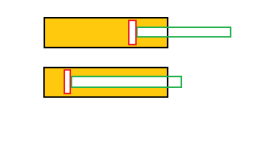
How can you say that both cylinders in this picture have the SAME internal volume?

cylinder.png
 
/ My FEL is bleeding down #30  
The syringe example is great. Leak down will occur past cylinder seals. As stated, with a bad seal the oil moves more freely from base to rod end under pressure inside the barrel. The first step in a loader leak down test is to disconnect from the loader valve to isolate cylinder leakage from valve leakage. We actually have a special stand for checking leak down on returned cylinders.
 
/ My FEL is bleeding down #31  
I guess the solution to the debate is to get a cylinder, remove the o rings from the piston then position the piston in the center of the cylinder, reassemble and refill both sides of the cylinder with oil, plug the holes and see if the piston can be moved in both directions.

I do not have a spare cylinder or I would do the test myself. If anyone is up to it a video would be great.
 
/ My FEL is bleeding down #32  
The syringe example is great. Leak down will occur past cylinder seals. As stated, with a bad seal the oil moves more freely from base to rod end under pressure inside the barrel. The first step in a loader leak down test is to disconnect from the loader valve to isolate cylinder leakage from valve leakage. We actually have a special stand for checking leak down on returned cylinders.

wrong
I guess the solution to the debate is to get a cylinder, remove the o rings from the piston then position the piston in the center of the cylinder, reassemble and refill both sides of the cylinder with oil, plug the holes and see if the piston can be moved in both directions.

I do not have a spare cylinder or I would do the test myself. If anyone is up to it a video would be great.

Yes great idea. Oh wait, a snow plow cylinder is exactly that. No piston seals. Just a loose fitting keeper ring to keep the rod from exiting when fully extended. And one less port to plug to.

Filled with oil, NO you cannot compress it.

Think about it. Instead of removing the piston seals, why not remove the whole piston, fill the cylinder completely full of oil and block the ports. You really think you can shove the rod into that cylinder (that is clear full of oil) without the oil having to go somewhere.

I have no idea why this is such a hard concept to grasp, especially for those on here that work in the hydraulic field and/or work on these things for a living. To answer JJ's question from a few weeks ago, it is no wonder so many cylinders get replaced because of leakdown.......its because everyone keeps repeating this same flawed concept of how cylinders work.

Edit: A question for those who keep insisting that the fluid will simply bypass the piston and cause leakdown.....do you at least understand that the volume on the rod side is less than the base end? Do you know why a cylinder extends slower than it retracts? do you know a cylinder develops less force retracting?
 
/ My FEL is bleeding down #33  
wrong


Yes great idea. Oh wait, a snow plow cylinder is exactly that. No piston seals. Just a loose fitting keeper ring to keep the rod from exiting when fully extended. And one less port to plug to.

Filled with oil, NO you cannot compress it.

Think about it. Instead of removing the piston seals, why not remove the whole piston, fill the cylinder completely full of oil and block the ports. You really think you can shove the rod into that cylinder (that is clear full of oil) without the oil having to go somewhere.

I have no idea why this is such a hard concept to grasp, especially for those on here that work in the hydraulic field and/or work on these things for a living. To answer JJ's question from a few weeks ago, it is no wonder so many cylinders get replaced because of leakdown.......its because everyone keeps repeating this same flawed concept of how cylinders work.

Edit: A question for those who keep insisting that the fluid will simply bypass the piston and cause leakdown.....do you at least understand that the volume on the rod side is less than the base end? Do you know why a cylinder extends slower than it retracts? do you know a cylinder develops less force retracting?
+1 and then really confuse the issue and pull the cylinder out. I have ran into a few that did not have a keeper and would pull right out past the packing! CJ
 
Last edited:
/ My FEL is bleeding down #34  
I have ran into a few that did not have a keeper and would pull right out past the packing! CJ

Was that intentional or did someone forget to put the keepers in there?
 
/ My FEL is bleeding down #35  
The cylinder was built like that [cheap] and the fixture limited the travel. CJ
 
/ My FEL is bleeding down #36  
My take on this is that if the cylinder is closed off from the rest of the system, then no, the cylinder won't move. Maybe a little, as the fluid moves slightly, but not really. BUT, the tractor hydraulic system isn't pressurized when the tractor (and pump) are off, so as fluid settles, and there is room for the cylinders to retract. That's how I look at it, correct me if I'm wrong.
 
/ My FEL is bleeding down #37  
My take on this is that if the cylinder is closed off from the rest of the system, then no, the cylinder won't move. Maybe a little, as the fluid moves slightly, but not really. BUT, the tractor hydraulic system isn't pressurized when the tractor (and pump) are off, so as fluid settles, and there is room for the cylinders to retract. That's how I look at it, correct me if I'm wrong.

BUT, if the valve is closed (in neutral) then the fluid still can't go anywhere, doesn't matter if the tractor is ON or OFF. The fluid will have to leak externally, or bypass the spool in the valve for the FEL to lower.

Like when people say "my FEL is bleeding down, even when the tractor is running" well the tractor running has nothing to do with it...it can't sense the FEL bleeding down and make it stay in one spot.
 
/ My FEL is bleeding down #38  
BUT, if the valve is closed (in neutral) then the fluid still can't go anywhere, doesn't matter if the tractor is ON or OFF. The fluid will have to leak externally, or bypass the spool in the valve for the FEL to lower.

Like when people say "my FEL is bleeding down, even when the tractor is running" well the tractor running has nothing to do with it...it can't sense the FEL bleeding down and make it stay in one spot.

Yes, I forgot about the valve, obviously if its closed then there's no place for the fluid to go. Must just be the imperfect closed system.
 
/ My FEL is bleeding down #39  
Can it be true that thousands are rebuilding their cyl to fix a leak down when it is the valve causing all the problem.

It just seems to me that a load placed on a leaking cyl will leak down. That load being the bucket and lift arms.

It does seem strange that people that rebuild their cyl don't have the leak down after rebuilding.

Few people on TBN have said that by replacing the valve that the leak down was stopped.

Same with the 3pt leak down. Few people are replacing their 3pt valves.

They all seem to do the cyl. Why is that.

Just saying.

I agree, the valve should be the obvious culprit but then could not a cylinder leak past the seals to the opposite side of the piston seals? Agree that inner seals should be a rarity and would be caused by filthy unfiltered fluid.
 
/ My FEL is bleeding down #40  
I agree, the valve should be the obvious culprit but then could not a cylinder leak past the seals to the opposite side of the piston seals? Agree that inner seals should be a rarity and would be caused by filthy unfiltered fluid.

Yes, you can have leaking from one side of the piston seal to the other, but in a non leaking system, lets say the lower part of the cylinder has 2000 psi of pressure. You will get some seepage from one side of the seal to the other side until it also reaches 2000 psi, then the ram can't retract any further. You also have to take into account that any collapsing of the ram increases the volume occupied by the ram inside the cylinder. A 2" diameter ram that moves 1/4" will occupy an additional .75 cubic inches inside the cylinder. that same movement inside of a 2.5" diameter cylinder will decrease the volume below the ram by 1.25 cubic inches. so you can only leak .5 cubic inches of oil before the ram can't move anymore, which roughly amount to 1/8" in movement.
 

Marketplace Items

2019 Ford F250 4x4 Crew Cab Pickup Truck (A64194)
2019 Ford F250 4x4...
2018 Sundowner FD-306 REV A 24ft. T/A Enclosed Gooseneck Trailer (A64194)
2018 Sundowner...
IRRIGATION PIPE FITTINGS (A64276)
IRRIGATION PIPE...
EZ-GO SHUTTLE 2X2 TXT GAS GOLF CART (A63276)
EZ-GO SHUTTLE 2X2...
2023 CATERPILLAR 150 AWD MOTORGRADER (A63276)
2023 CATERPILLAR...
New/Unused Landhonor Tree/Post Puller (A65583)
New/Unused...
 
Top