Trailer Loading and CQ - Hypothetical Discussion

/ Trailer Loading and CQ - Hypothetical Discussion #21  
Thanks for all the input, I worked my numbers out from center toward the ends, 4' = 1000lbs. If the axle is carrying 9k at 24' then all that is left for the "tongue" weight is 1000lbs. At this point I figured there has to be a formula. I do need to know the axle weight and the tongue weight to insure they are within my tractors lifting ability and the axle rating. What really concerns me is the effect on the balance during the move, I guess I could use some light rope to secure to the FEL for some control but if things really go south the rope would break and the 10K bridge can go where it wants without me and the tractor attached. Then I will call the crane company :)

You've got 6000 pounds in front of the axle and 4000 pounds behind the axle. Yes, the axle is carrying most of the weight. And the 16' behind the axle with 4000# on it balances out the first 16' and 4000# in front of the axle. But you have an additional 2000# that starts 16' in front of the axle and goes 8 more feet towards the front of the trailer.

So now you basically have a 2000# weight hanging 8' in on a 24' long lever. Its going to take 2/3 more force than half the weight. So, 1000# + 667# = 1667# of tongue weight. I think.... :laughing:

Man, where are the people that can do this math for us???? :confused3:
 
/ Trailer Loading and CQ - Hypothetical Discussion #22  
Ok, now I understand your question.
Tell me where I go wrong:
32' feet, representing 8000 lbs are in balance. (10000lbs x 32/40)

That leaves 2000 lbs and 8' of trailer, the center of this weight being 4' from the hitch, and 20' from the axle.
Said differently this is 2000 lbs at a spot that is 1/5 & 4/5 of the span. So 4/5th (1600lbs) on the tongue and 1/5th ( 400lbs) + the 8000lbs (in balance)= 8400lbs on the axle. :confused3:

That looks close to me, too. :)
 
/ Trailer Loading and CQ - Hypothetical Discussion #23  
Why would anyone consider a 40' trailer with a single axle. Must be one heck of an axle. It would be like riding a see-saw. A 40'er should have 3 axles, 2 minimum.


My bad, somehow I skipped over the OP's reason in post 7
 
Last edited:
/ Trailer Loading and CQ - Hypothetical Discussion #24  
Why would anyone consider a 40' trailer with a single axle. Must be one heck of an axle. It would be like riding a see-saw. A 40'er should have 3 axles, 2 minimum.
This is why:
Ok, this is not entirely a hypothetical discussion. I want to use a 40' flat rack container to bridge a deep stream on my property. For the money it can't be beat but there is the whole matter of getting it in place.
Once the "bridge" is delivered my thought is I will weld a temporary axle at 24' that will leave 1000lbs on the other end I can easily lift with my loader. I will then be able to back the "bridge" into the stream and the 16' foot suspended behind the axle will reach the other side. I can remove the axle and use wench and hydraulic jacks to set the bridge. I am concerned with controlling the load with a 6,000 pound tractor and do not want to be around if the "bridge" decides teeter in the other direction.

Aaron Z
 
/ Trailer Loading and CQ - Hypothetical Discussion #25  
The answer is based on the uniform loading of 250lb/ft to get 1667 lb at the hitch and 8333 lb on the axle. :thumbsup:

The forces that you can get into during motion are well out of my engineering experience but I would say that if you are anywhere close to the weight of the trailer being moved i.e. if your tractor doesn't weigh close to 2/3 the weight on the flat, or at least as much as the trailer on a hill, I'd find some creative solution to moving it such as a crane that was mentioned, or someone with some bigger equipment. The last thing you want to do is get beyond your tractor capabilities and have that trailer dragging you somewhere you don't want to be. Is there anyway to put this thing on a dolly to get a second axle under it until you get close and then fix the axle and push the trailer across it so that you aren't fighting another factor?

The equation incase anyone is curious:

Hitch=(W/(2L))*(L^2-a^2)=((250lb/ft)/(2*24ft))*(24ft^2-16ft^2)=1667lbs
 
/ Trailer Loading and CQ - Hypothetical Discussion #26  
It might help with control on the hill is if you got an axle with brakes (like a mobile home axle) and run power to the axle.

Aaron Z
 
/ Trailer Loading and CQ - Hypothetical Discussion
  • Thread Starter
#27  
The answer is based on the uniform loading of 250lb/ft to get 1667 lb at the hitch and 8333 lb on the axle. :thumbsup:

The equation incase anyone is curious:

Hitch=(W/(2L))*(L^2-a^2)=((250lb/ft)/(2*24ft))*(24ft^2-16ft^2)=1667lbs

Thanks RedNeckRacin I knew I was over simplifying the weight distribution, looks like MossRoad and CobyRupert where much closer than I.

Maybe I should have titled this post "Hold My Beer and Watch This." Actually once the ground dries up the roll-off should be able to drop the container 50' from where it needs to be so brakes and tandem axles not really needed. In theory I can install the axle through the pallet pocket on the container, pick the 1667lbs end up with my loader and push it straight back into the ditch. The real fun will be what happens when the 10k rolls into the ditch.
 
/ Trailer Loading and CQ - Hypothetical Discussion #28  
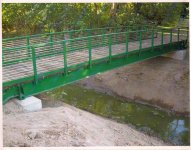
For better visualization heres a pic I found on google images searching "railcar bridge"
bridge-scan-2.jpeg

There's a way to do this without hiring a crane, and have some fun too. I would worry a little about the single axle sinking into the ground you might do all this better on logs. You have a 6000 lb tractor, but?.do you have logs? Or can you get some?

Here's an idea - skid a couple big logs across the stream and set them wider than the container. Then have them crap the container onto a fulcrum log crosswise. Set another log then drag the container over the logs, leapfrogging fulcrum logs until you get to the stream. If you can keep it near the balance point you can lift one end with the tractor. It either slides over the fulcrum log, or with luck, rolls the log, and doesn't roll on down into the stream. Cantilever it over the rollers on the two stringer logs then drag it across. You could have it halfway across just on the fulcrums.

Pic doesn't show it but the log stringers are 10 feet apart and your roller logs are 15 feet long. In the end the bridge is sitting there with a log stringer about a foot on either side.

Your stringer logs have to be sized to support about 2500lbs (each) in the center so about 12" log could do it. More roller logs is better because it distributes the load. If this option is even feasible we could work on the sizing.

407811d1421855299-trailer-loading-cq-hypothetical-discussion-containerbridge-jpg
 

Attachments

  • containerbridge.jpg
    containerbridge.jpg
    63.7 KB · Views: 217
Last edited:
/ Trailer Loading and CQ - Hypothetical Discussion #29  
The answer is based on the uniform loading of 250lb/ft to get 1667 lb at the hitch and 8333 lb on the axle. :thumbsup:

Redneck is correct. And MossRoad. I just asked a Professional Structural Engineer licensed in 4 or 5 states. (Hopefully, he knows what he's talking about :eek:)
 
/ Trailer Loading and CQ - Hypothetical Discussion #30  
The "bridge" weighs 10,000 lbs and is 40 ft long. Assuming that an axle plus wheels and/or tires (whatever) can hold up that much weight, the solution really amounts to where the axle should be placed in order to manage a reasonable tongue load. (That means: what's the hitch capacity of your towing apparatus (truck, tractor, loader, etc.)?

So, taking moments about an axle placed some distance X from the center of the 'bridge' (its uniformly built, so the c.g. is midway), means that the 10,000 lb bridge weight times the distance from the c.g. to the axle location (X), is balanced by the acceptable hitch load times its distance from hitch to the axle (which is X + 1/2 the length of the 'bridge'). So, if your max hitch load is 1000 lbs and 1/2 the bridge length is 20 ft, then (10,000*X) = 1000*(20 +X) and solve for X. In this case, the axle should be placed 2.2 ft behind the midpoint of the bridge to get a 1000 lb tongue load.

Do the math. I'd be careful about how much your soil will support with that much wheel load. The more hitch load you can take, the less the axle load will be. If you are backing it down hill, the gravity load (from the angle) may exceed the traction of your tow vehicle tires and it will slide downward out of control. The higher the hitch load, the less weight will be on a truck's front tires and that's bad for steering and braking if you are backing up this bridge-trailer downhill.
 
/ Trailer Loading and CQ - Hypothetical Discussion
  • Thread Starter
#31  
Sodo's drawing is dead-on, he even got the grade right which is impressive considering he has never seen the place. His idea is also exactly how I was originally planning to do it but the more I thunk about it the more I like not having to move large logs, repeat.

Keep in mind there is not an actual hitch on the flat-rack, we have just been using the term to denote which end we are talking about. So my only option is to use my tractors loader. The 10K axle I can buy/build but had not considered the tires sinking in the ground, it will have to be when with dry ground, but this is clay so I believe it will support 5klbs/wheel.

View attachment 407834
 
/ Trailer Loading and CQ - Hypothetical Discussion #32  
to complicate things more, remember that you can load the inside (or the top of the trailer) with more weight on the short end so as to balance the long end.

There is an amount of weight that can always be added to the short end that will make the trailer perfectly balance on the single axle such that the amount of tongue load on the loader is a non-concern. (granted this fails as you aproach 0 distance on the one side as the amount of weight becomes unreasonable and at 0 condition you have a divide by 0 condition so.... grain of salt there)

the levers link Levers can be updated if you convert your distributed load into a point load. to do that you take the lenght times magnitude =total force and apply that single force in the center of the distributed load.

for instance, a 10 lb load that runs from 0-6' and a second 30lb load that runs from 6'to 10' can be considered a single 60lb load at 3' and a single 120lb load at 8'

as to your question about do the forces change if you change the angle of the trailer (moving up hill or down) yes. anyone that has ever carried furniture up stairs knows that as you tilt the top up, the bottom guy carries more weight, to the point that its vertical and the bottom guy carries ALL the weight. To calculate this, consider a seasaw that has 2 guys sitting on it without any ground under it. As they tilt the seesaw, the distance between the 2 guys gets shorter (again at vertical they are sitting on top of each other) so at some point inbetween, the effective distance between the weight they are applying and the center piviot is getting shorter. TO recalculate the required change in weight to offset the uphill/down hill secnerio you have to know the tilt of the hill and then do the math to shorten the "seesaw" by the right amount. (for instance if it was a 45 deg hill the distances would change by the sqrt(2) or roughly 1.414)
 
/ Trailer Loading and CQ - Hypothetical Discussion
  • Thread Starter
#33  
the levers link Levers can be updated if you convert your distributed load into a point load. to do that you take the lenght times magnitude =total force and apply that single force in the center of the distributed load.

for instance, a 10 lb load that runs from 0-6' and a second 30lb load that runs from 6'to 10' can be considered a single 60lb load at 3' and a single 120lb load at 8'

as to your question about do the forces change if you change the angle of the trailer (moving up hill or down) yes. anyone that has ever carried furniture up stairs knows that as you tilt the top up, the bottom guy carries more weight, to the point that its vertical and the bottom guy carries ALL the weight. To calculate this, consider a seasaw that has 2 guys sitting on it without any ground under it. As they tilt the seesaw, the distance between the 2 guys gets shorter (again at vertical they are sitting on top of each other) so at some point inbetween, the effective distance between the weight they are applying and the center piviot is getting shorter. TO recalculate the required change in weight to offset the uphill/down hill secnerio you have to know the tilt of the hill and then do the math to shorten the "seesaw" by the right amount. (for instance if it was a 45 deg hill the distances would change by the sqrt(2) or roughly 1.414)

Very clear explanation, thank you.
 
/ Trailer Loading and CQ - Hypothetical Discussion #34  
The answer is based on the uniform loading of 250lb/ft to get 1667 lb at the hitch and 8333 lb on the axle. :thumbsup:

The forces that you can get into during motion are well out of my engineering experience but I would say that if you are anywhere close to the weight of the trailer being moved i.e. if your tractor doesn't weigh close to 2/3 the weight on the flat, or at least as much as the trailer on a hill, I'd find some creative solution to moving it such as a crane that was mentioned, or someone with some bigger equipment. The last thing you want to do is get beyond your tractor capabilities and have that trailer dragging you somewhere you don't want to be. Is there anyway to put this thing on a dolly to get a second axle under it until you get close and then fix the axle and push the trailer across it so that you aren't fighting another factor?

The equation incase anyone is curious:

Hitch=(W/(2L))*(L^2-a^2)=((250lb/ft)/(2*24ft))*(24ft^2-16ft^2)=1667lbs

Redneck is correct. And MossRoad. I just asked a Professional Structural Engineer licensed in 4 or 5 states. (Hopefully, he knows what he's talking about :eek:)

I failed Algebra in high school. I almost didn't graduate. A teacher took me under her wing, made me eat lunch in the teachers' lounge next to her and spoon fed me Algebra for 20 minutes a day my senior year so I could graduate. I got a C. I graduated. She gave me a trophy! Thank you Mrs. D.! :)
 
/ Trailer Loading and CQ - Hypothetical Discussion #35  
Moss Road, in college I had two semesters of Calculas, statics, dynamics, structural anylsis, structural design and I dont know how to work this problem so don't feel bad. 30 years ago I'd could have figured in a few minutes.
 
/ Trailer Loading and CQ - Hypothetical Discussion #36  
Moss Road, in college I had two semesters of Calculas, statics, dynamics, structural anylsis, structural design and I dont know how to work this problem so don't feel bad. 30 years ago I'd could have figured in a few minutes.

That makes me feel a lot better. Thanks! :thumbsup:

I'm so glad I don't have to remember formulas anymore. I just look them up on google, plug in my numbers, and off I go. However, this particular problem, there wasn't an on-line calculator or formula that I could easily find. Had to think about it and do a best guess estimate. I knew I'd only be off by, oh, about a thousand pounds one way or the other!!! :laughing:
 
/ Trailer Loading and CQ - Hypothetical Discussion #37  
Look, guys, the wheel idea is just not going to work. Just look at Sodos diagram. Even if you could put a wheel at the appropriate place, lift up the front end of the bridge with the tractor, and then push it down the slope to the creek, as soon as the wheel gets over the edge of the first bank it's going to drop down rapidly and the far end of the bridge will stick in the mud at the bottom of the opposite bank. Then what do you do?

I think Sodo's idea of logs is a much better idea.
 
/ Trailer Loading and CQ - Hypothetical Discussion #38  
That makes me feel a lot better. Thanks! :thumbsup:

I'm so glad I don't have to remember formulas anymore. I just look them up on google, plug in my numbers, and off I go. However, this particular problem, there wasn't an on-line calculator or formula that I could easily find. Had to think about it and do a best guess estimate. I knew I'd only be off by, oh, about a thousand pounds one way or the other!!! :laughing:

I guess my engineering education was worth something after all! :D I enjoy helping people solve problems like this because it really gives them good information to base a decision off of. You can always try and wing it and rely on a best guess but you can't argue with the numbers. We always like pics OP or else it never happened! I'm actually pretty curious how this project is going to progress.
 
/ Trailer Loading and CQ - Hypothetical Discussion #39  
I guess my engineering education was worth something after all! :D I enjoy helping people solve problems like this because it really gives them good information to base a decision off of. You can always try and wing it and rely on a best guess but you can't argue with the numbers. We always like pics OP or else it never happened! I'm actually pretty curious how this project is going to progress.

Yeah, I enjoy logic problems. The real head scratchers. Like if so and so's father is his mother's uncle's third cousin, who only has daughters, how are they related? :confused3:
 
/ Trailer Loading and CQ - Hypothetical Discussion #40  
Yeah, I enjoy logic problems. The real head scratchers. Like if so and so's father is his mother's uncle's third cousin, who only has daughters, how are they related? :confused3:

Is that a WV joke? :D I do enjoy head scratchers too. Esp when you only have a limited means of doing something. There is always the "has to be done" vs "want to be done" consideration though!
 

Marketplace Items

2009 VOLVO VNM 300 6X4  T/A DAY CAB TRUCK TRACTOR (A59906)
2009 VOLVO VNM 300...
2021 Sany SMG 200C-8 Motor Grader (A62679)
2021 Sany SMG...
159116 (A60430)
159116 (A60430)
2011 BMW 5 Series 528i Sedan (A61574)
2011 BMW 5 Series...
CAT CB34 (A60462)
CAT CB34 (A60462)
JOHN DEERE 5075M TRACTOR (A63291)
JOHN DEERE 5075M...
 
Top