Kubota Hydraulcs Couplers.

/ Kubota Hydraulcs Couplers. #1  

BufordBoone

Platinum Member
Joined
May 31, 2014
Messages
517
Location
Tuscaloosa, Al
Tractor
Kubota L5740 & M7060
I tried to borrow a friend's grapple but it wouldn't connect to my tractor's 3rd function. He has a large (100hp?) Kubota and I have a L5740 (58hp?).

Weird thing is that his couplings won't go on mine because they are too small.

Trouble started when we realized that my 3rd function lines BOTH have male connections while my 4 in 1 bucket lines are both female. Is that normal? I suspect it was done that way so that I could make the buttons work whatever way I wanted. Perhaps I'll never know.

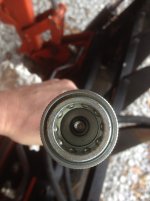
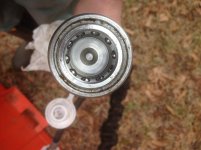
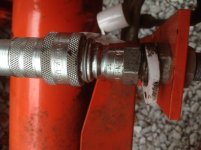
My friend simply replaced one of his grapple's lines with another female and then we discovered that they wouldn't go onto my male connections. Best I could measure with a tape, the female openings on my connectors are 1" while my friend's are 15/16".

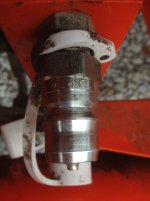
I went to the Kubota dealer today (with photos of my couplings) and showed them that the numbers say "12NPTM" and "NPTF-12F". They brought out couplings and said "These are the ones you have". They are part numbers 75668-66320 (female) and 75668-66220 (male). I asked "What size are they" and was told there is only a part number.

I'm now shopping for a grapple and I don't know what to specify for connections. I see that some say they are provided with 1/2" or 3/8" but I don't know what I've got.

I fear that I've got some proprietary, Kubota, fittings and I should purchase a set because, whatever I buy, I'm going to have to change.

Anyone else ever run into this?

Any assistance would be greatly appreciated.
 
/ Kubota Hydraulcs Couplers.
  • Thread Starter
#3  
His IMG_3043.jpg

MineIMG_3042.jpg

My Male connectionIMG_3039.jpg

An attempt to attach his to mine (won't go farther)IMG_3044.jpg
 
/ Kubota Hydraulcs Couplers. #4  
There should be numbers and letters on the couplers and can be crossed to other manufacturers.
 
/ Kubota Hydraulcs Couplers.
  • Thread Starter
#5  
There should be numbers and letters on the couplers and can be crossed to other manufacturers.

That's what I thought, too. I spent a while searching the internet but got no answer.

All of a sudden I thought: "Try posting it on TBN, I can't be the only one that's run into this problem".
 
/ Kubota Hydraulcs Couplers.
  • Thread Starter
#7  
Thanks. I had looked at that link but, comparing the drawings to my coupler, I don't think any of them match. My coupler has a much more pronounced bevel on the face than any of those. I compare it to the length of the plunger.

I do appreciate the assistance though.
 
/ Kubota Hydraulcs Couplers. #9  
Thanks. I had looked at that link but, comparing the drawings to my coupler, I don't think any of them match. My coupler has a much more pronounced bevel on the face than any of those. I compare it to the length of the plunger.

I do appreciate the assistance though.

I looked at your photos, and except for the pronounced bevel, your male coupler appears to be a 1/2" ISO 7241-1 Series B. This is also consistent with the female opening being approximately 1" in diameter, as that matches the widest part of the male nipple that actually fits into the female.

Most likely, the equipment you borrowed has female couplers that are ISO 7241-1 Series A.

In the 1/2" body size only, this interchanges with ISO 5657 (Pioneer 4000 Series, aka "Ag Couplers"), which is exactly what one would expect to find on most farm tractors. The widest part of the male nipple is about 0.93 or 15/16 of an inch.

Please note that when I reference the widest part of the male coupler, I'm speaking only of the part that fits into the female. Any part of it that does not insert into the female may vary from one company to another, and so is not a reliable place to measure.

Get yourself some 1/2" Ag nipples, or 1/2" ISO 7241-1 Series A, and I think they will mate up with your friend's grapple.

ISO 5675 Agricultural Hydraulic Quick Couplers
 
/ Kubota Hydraulcs Couplers.
  • Thread Starter
#10  
Well, thank you, very much. That's what I love about this site. Lots of experience.

A few more questions for the bunch:

When changing the couplings I know I'll lose some fluid. If I choose to change the couplings on my tractor, rather than on my friend's grapple and, assuming I'm smart enough to have the tractor off and work the buttons/levers and tap the ball to relieve the pressure:

1 - Should I expect a lot of oil to come out of the pipes once I get the coupling off? If so, should I try to stop any of it or just "move with a purpose"?

2 - Do I need to use teflon tape (like you use for plumbing) on the threads before screwing the coupling back on?

Anything I need to know about to prevent me from making a serious rookie mistake? It all seems simple enough. That's usually when I get into trouble.

Thanks to all.
 
/ Kubota Hydraulcs Couplers. #11  
Keep it above grapple height and you won't lose much.

You can use tape but leave the first thread clean then tape. about 3 wraps.

Before connecting or disconnecting make sure there is no pressure in the line by moving the controller back and forth a few times.
 
Last edited:
/ Kubota Hydraulcs Couplers. #12  
And don't let it heat up when trying to reconnect!
i.e. don't disconnect when cool then try to reconnect after it's been sitting in the hot sun, pressure builds up.
 
/ Kubota Hydraulcs Couplers.
  • Thread Starter
#13  
Lots of knowledge here. Time to go back to the well:

For info, I decided it would cost just as much to change all the fittings as to simply bite the bullet and purchase the "Kubota" fittings. So, I now have to remove the fittings from a new grapple and install the "Kubota" fittings.

I have my control lever set so that the top button opens the bucket (I have a 4-1 bucket) and bottom closes it. I'd like the grapple to work the same way.

My tractor connections are arranged so that the male fitting is positive pressure, female releases pressure. When I put the fittings on the new grapple, is there a way to tell which fitting to put on which hose so that the buttons will work the same way?

Of course I could just install and have a 50/50 chance of getting it right the first time but thought I'd ask here.

Thanks.
 
/ Kubota Hydraulcs Couplers. #14  
Lots of knowledge here. Time to go back to the well:

For info, I decided it would cost just as much to change all the fittings as to simply bite the bullet and purchase the "Kubota" fittings. So, I now have to remove the fittings from a new grapple and install the "Kubota" fittings.

I have my control lever set so that the top button opens the bucket (I have a 4-1 bucket) and bottom closes it. I'd like the grapple to work the same way.

My tractor connections are arranged so that the male fitting is positive pressure, female releases pressure. When I put the fittings on the new grapple, is there a way to tell which fitting to put on which hose so that the buttons will work the same way?

Of course I could just install and have a 50/50 chance of getting it right the first time but thought I'd ask here.

Thanks.

Look at the cylinder/cylinders for the lid/lids of the grapple. Fluid flow applied to the cap end of the cylinder will extend the rod This will cause clamping of the lid. Look and see which hose is connected to the cap end of the cylinder/cylinders. Look at the rod end of the cylinder, If fluid flow is applied to the rod end of the cylinder/cylinders then the rod/rods will retract into the cylinder, this will cause the lid/lids to open. Make sense?
 
/ Kubota Hydraulcs Couplers.
  • Thread Starter
#15  
Yep. Makes perfect sense. Went out and looked at it and thought "Well, Duh!"

Thanks for the assist!
 
/ Kubota Hydraulcs Couplers. #16  
Lots of knowledge here. Time to go back to the well:

For info, I decided it would cost just as much to change all the fittings as to simply bite the bullet and purchase the "Kubota" fittings. So, I now have to remove the fittings from a new grapple and install the "Kubota" fittings.

I have my control lever set so that the top button opens the bucket (I have a 4-1 bucket) and bottom closes it. I'd like the grapple to work the same way.

My tractor connections are arranged so that the male fitting is positive pressure, female releases pressure. When I put the fittings on the new grapple, is there a way to tell which fitting to put on which hose so that the buttons will work the same way?

Of course I could just install and have a 50/50 chance of getting it right the first time but thought I'd ask here.

Thanks.

Lets address the bolded text a bit. It would be best to think of hydraulic fluid routing by your control valve as changing the routing of the fluid flow not pressure. Pressure does not build until the fluid flow encounters a restriction.

In an open center hydraulic system the fluid comes from the tank, and into the inlet or suction side of the pump. The pump does not make "pressure" per se, it just makes fluid flow. Now the outlet of the pump is making fluid flow all the time at so many gallons per minute.

In my tractor that rate is about 10 gallons per minute. So now the fluid is flowing toward the FEL control valve inlet and right back out its Power Beyond port heading towards my rear remote valve and right back out heading towards the 3 point control valve and then dumps back into the tank. Not much pressure is developed during this entire trip around the tractor.

Why is that you ask? Well hopefully the restriction of the fluid flow, now flowing through all of those valves in neutral is pretty low. Sure some pressure will rise due to the restrictions in the valves and hoses and all of the fittings, but no where near the 2500 or more pounds of pressure the relief valves are set for.

Now lets say that you pull back on your FEL valve to lift the main FEL boom. Now you have routed the fluid flow to a set of QD (Quick disconnects) attached to your FEL valve. One of these QD's have the fluid flow coming out of it, and will be plumbed to the cap side of your lift cylinders. (they are plumbed with a T connection so that both cap ends of the lift cylinders receive the fluid.

The other QD is connected to the rod sides of your lift cylinders and as the rods extend the fluid in the rod side of the cylinders flows out of the cylinders and back to this QD. In your FEL Valve, it also routed that rod side QD, back to a hose that flows fluid back to the tank (your tractors transmission is your tank) All of that happened by you pulling back on the joystick control.

The pressure spiked up a great deal as the weight of the loader arms and bucket offered a resistance to the flow of the fluid in the cap side of the cylinder. If you had something heavy in the bucket, the pressure spiked up a great deal more as it offered even more resistance to moving up.

So you see the pressure only rises when the fluid flow has something to push against. The harder it is to push the fluid down the "pipe" then the higher the pressure rises until somewhere in the system a relief valve say "enough" and opens the pressure path back to the tank to prevent something from turning into a grenade.. Hose, valve housing, pump, breaking shafts on the engine.. Something has to give. Hopefully just the relief valve.:)

Now when you move the FEL control back to the center position, the fluid flow is just routed back to the Power Beyond connection and the fluid flow goes downstream and winds back up in the tank after going through all those other valves. Of course the fluid trapped in your cap side and rod sides of the cylinder has no place to go so the lift just stays up.

Now lets push the joystick forward. OK the other (rod side) QD now has fluid flow heading towards the rod side of your lift cylinders and the rods start to retract as the fluid pushes piston back towards the cap end of the cylinder and the cap side of the cylinder is opened to tank by the FEL control valve routing. Now you lift arms start to fall.

OK the curl and dump cylinders and valve position and QD's work similarly. This is a simple explanation, and we can get into regeneration in a later rant.:)

So now you know that when you say one of my QD's is positive pressure, and the other releases pressure, that is not quite right. Both are flow from the pump and both are flow back to the tank, it just depends on which of the buttons you press. Pressing one button makes the fluid flow from your 3rd function electric/hydraulic valve to one of the "work ports" and its associated QD. This causes you 4n1 buckets cylinders to extend by applying fluid flow to the cap side of those cylinders. The rod side of those cylinders are opened to the tank. When you press the other button the electric/hydraulic valve applies the fluid flow to the rod side of the cylinders and the cylinders retract.

I hope this helps a bit.
 
/ Kubota Hydraulcs Couplers.
  • Thread Starter
#17  
Fascinating. All new ground to me so I appreciate the education.

Thanks.
 
 
Top