Spray Foam Question

/ Spray Foam Question #1  

timswi

Super Member
Joined
Nov 18, 2008
Messages
5,301
Location
Beaver County Pa
Tractor
Kubota BX23 TLB, Kubota RTV1100, Kubota Z724 & Polaris RZR 900 Trail
Don't want to start a war like I've seen on other forums, so here goes:...I am finishing the 2nd floor of my house, a true Cape Cod style with 2 bedrooms and a full bath...I had the spray guy come out due to the notorious difficulty of HVAC in capes...I have the ductwork stubbed up there already.

His suggestion, and it's not new so I find out, is to open cell spray the roof deck, seal the soffits and ridge vent. Obviously this violates traditional thinking but is beginning to make sense the more I research it. I am concerned about moisture etc although that may be moot.

In essence, no interior walls will be insulated, just the outer shell.

Anyone here done this or know someone well who has? This is a very permanent and expensive proposition so I'd like some advise.......Thanks.

---This is in Southwestern PA if climate is a question.
 
/ Spray Foam Question #2  
Not sure on what other forums you've seen, there seems to be a bunch of smart folks not selling anything on GreenBuildingTalk - Green Building Forums on Insulating Concrete Forms (ICF), Structural Insulated Panels (SIP), Radiant Heating, Geothermal Heat Pumps, Solar Power, Green Construction Projects
This stuff gets very scientific, but I think if you have at least 3", you'll move your "dew point" in your wall/roof out to the point where it will do no harm. There is a concern with the roof(ing). I think that some asphalt shingles may not warranty this application. I'm hung up on the differences between open & closed cell. I believe the closed cell has a higher "r" per inch cost more and is waterproof. The open cell (I think) can absorb water and might worry me to be certain it is the right material for a roof vs. a vertical wall.
Spray foam is good stuff, I think that there are a lot of things/decisions that matter for a good job, I don't know your answer but I'd keep doing your homework until you are confident to make that (proper) selection and expense.! Let us know what you find out!
 
/ Spray Foam Question #3  
while other folks would have an attic space above the main floor, you built the attic up some, to have a couple bed rooms and a bathroom inside the attic in a sense.

a regular attic, with just a main floor, relies heavilyl, on air movement, to remove excess heat / cold. along with moisture.

but you on other hand, there is no space for air movement. everything is getting dry walled for most part.

a open cell foam, lets air move through the foam. (basically a sponge) wood needs to "breath" to let excess moisture in/out along with keeping air from getting to hot and expanding like a balloon, and in that open cell foam lets the air move through things so things do not expand.

=============
not familier with your actual house style beyond above, so exiting that part... about closing up ridge vent and softit vents. i can understand wanting to close them up, but not real up to speed in how closing them can be good or bad.

=============
i would suggest if you have a little bit of cash insulating interior walls. more so if you plan on closing doors, and turning off heat and/or a/c to the given room. an uninsulated wall, can create a wind current in rooms. simply by convection. warm air rises, cold air goes towards the floor. it basically kinda like a slow moving tornado on its side in a room for a wind current. laying in bed, you might consider it a slight draft. this draft can be enough, to cancel out closing off the room from heating and/or a/c. the same goes for the floor of 2nd floor and ceiling of below. get some insulation in there. or you will have kinda like a heat sink, were warm air goes straight up in summer, and all the cold air coming straight down in winter.

above comes more from family / friends homes, and staying over the night when a kid. and trying to find the warm or cold spots in the room, and getting a good night sleep, with type of house ya wanting to do.
 
/ Spray Foam Question #4  
Closed cell foam is what you want on the roof for at least 2" thick, you can cover additional layers of open cell to reduce costs. The R value is about same but any leak or seep in the roofing will ruin the roof & insulation from top to bottom.

Mark
 
/ Spray Foam Question #5  
Works in theory, but I'd use closed cell, making sure there is no air infiltration from anywhere. AND you need to bring in outside air to properly feed your furnace/boiler, or you'll be sucking out your breathable oxygen from your indoor air space. You will have to exhaust all stale/moist cooking/bathing air to keep the indoor air quality acceptable. You could also save money by doing flash and batt in the roof deck area by spraying 2+ inches of foam and filling the rest of the rafter cavity with Roxul.
 
/ Spray Foam Question
  • Thread Starter
#6  
Thanks for the info given so far...more data: 5" of open cell on the roof joists and 3" on the gable ends and dormer walls. They want to put a thin sheet of foam board down at the soffits and fill the gap with foam...The open cell is giving me some pause as has been said here. The company says it's no issue--gonna call the manufacturer tomorrow.

The interior of the knee walls and collar ties will be drywalled, heated and air conditioned. I have a heat pump with an electric backup furnace so no fuel burn issues...All mechanicals are in the basement.

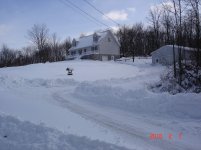
For reference, here's an outside picture so you have an idea of the style..12/12 pitch etc

feb2010 016.jpg
 
/ Spray Foam Question #7  
Your pic shows heat loss at the interface of the gable end wall(s) and roof, and at the ridge line.
Have you had an energy audit done? Blower door test, to see how many air exchanges/hr?
I would have those done before any of the work you plan to do to show a base line and then where they hopefully make improvements in the building envelope.
Is the attic living space? If not then the alternative, less costly method is to super insulate, (R-50) the 2nd floor ceiling/attic joist bays and keep the soffit vents/ridge line vents, gable vents. Then the cold air area above the heated living space is not problematic.
 
/ Spray Foam Question
  • Thread Starter
#8  
Your pic shows heat loss at the interface of the gable end wall(s) and roof, and at the ridge line.
Have you had an energy audit done? Blower door test, to see how many air exchanges/hr?
I would have those done before any of the work you plan to do to show a base line and then where they hopefully make improvements in the building envelope.
Is the attic living space? If not then the alternative, less costly method is to super insulate, (R-50) the 2nd floor ceiling/attic joist bays and keep the soffit vents/ridge line vents, gable vents. Then the cold air area above the heated living space is not problematic.

At the time of that picture, there was "utility insulation" on the floor and stairwell in addition to an uninsulated door at the top of the steps...Also, we had 3 feet of snow the night before and the outside temp went to almost 50 the next day, so oddities all around in that picture as far as snow melt.

Edit--The picture also is showing the north side of the house, the sun and warm temp had already melted the south side...There was no drywall etc up there at the time, just some insulation on the ceiling of the first floor...The sun would warm it up pretty good, even in the winter due to the pitch and size of the roof.
 
/ Spray Foam Question #9  
would never really believed it, but the hard board insulation you can get in 4' x 8 ' sheets and local hardware stores (menards, lowes, homedepot), the foil face insulation. that foil, can add some major benefits. at least it has here in a cabin, and in a shed. the reflectiveness of the foil. not light, but reflecting heat. what use to be 100 plus degree sona stepping into cabin in summer, is now can be colder in summer than outside temps, 2x4's in the ceiling "rolled insulation" then 1/2" thick double foiled face hard board insulation, then 5/8" decorative plywood (kinda looks like a log cabin the plywood does) the walls just have 2x4 studs, with rolled insulation, and the 5/8" decorative plywood.
and in winter. it is warmer in the cabin than outside air temps. this is without any sort of heating or cooling.

it took a few months to get ceiling done, so there was a couple months that the double foil faced hard board insulation was not up. and just the rolled insulation in the ceiling. the major difference immediately showed up, after the 1/2" thick double foil face hard board insulation was put up. it was a complete night and day difference. i would like to say there might of been some air leakage before the hard board insulation went up. but used "great stuff red can, closed cell spray foam" along with some calking before anything went into the ceiling or walls. (more to keep bugs and mice out) with that i don't think it was air leakage.

the cabin is 20x24, gabel (not attic) much like your second story will be for a ceiling.
 
/ Spray Foam Question #11  
The double sided foil faced insulation is Tuff-R, or similar name branded product.
I've used it extensively in my house and barn and my flip house too. It is especially good at grade level where the floor joists and band beam meet. 2" is the minimum to keep the dew point at bay in our climate zone in VT.

You've told us about when the pics were taken, but omitted answering my questions about performing an energy audit, etc. This information is way more significant, and finding a spray foam installer who actually knows their product and proper application. Whatever brand product used, if applied incorrectly or choosing the wrong type of foam will have possible long term detrimental effects on your house and those living in it.
 
/ Spray Foam Question #12  
Don't want to start a war like I've seen on other forums, so here goes:...I am finishing the 2nd floor of my house, a true Cape Cod style with 2 bedrooms and a full bath...I had the spray guy come out due to the notorious difficulty of HVAC in capes...I have the ductwork stubbed up there already.

His suggestion, and it's not new so I find out, is to open cell spray the roof deck, seal the soffits and ridge vent. Obviously this violates traditional thinking but is beginning to make sense the more I research it. I am concerned about moisture etc although that may be moot.

In essence, no interior walls will be insulated, just the outer shell.

Anyone here done this or know someone well who has? This is a very permanent and expensive proposition so I'd like some advise.......Thanks.

---This is in Southwestern PA if climate is a question.

I have a story and a half home with dormers in the attic, basically a cap cod style as well. We originally insulated what we call the loft or the top floor with traditional fiberglass insulation and vapour barrier to keep the moisture in. This was a huge mistake as within 6 weeks of insulating in november of 2011 we could see melt spots on the shingles in the morning frost. The deck plywood already had traces of mould and was delaminating.

Long story short, two engineers and an architect later we debated spray the deck or keep the air space. The building science experts all agreed to keep the air space so the shingles and roofing plywood was removed and closed cell spray foam was shot on the back on the drywall from the top down keeping the minimum 1.5 inch air gap our building code requires.

Conclusion, it worked! No melt spots, no mould, no heat loss.
 
/ Spray Foam Question #13  
Don't want to start a war like I've seen on other forums, so here goes:...I am finishing the 2nd floor of my house, a true Cape Cod style with 2 bedrooms and a full bath...I had the spray guy come out due to the notorious difficulty of HVAC in capes...I have the ductwork stubbed up there already.

His suggestion, and it's not new so I find out, is to open cell spray the roof deck, seal the soffits and ridge vent. Obviously this violates traditional thinking but is beginning to make sense the more I research it. I am concerned about moisture etc although that may be moot.

In essence, no interior walls will be insulated, just the outer shell.

Anyone here done this or know someone well who has? This is a very permanent and expensive proposition so I'd like some advise.......Thanks.

---This is in Southwestern PA if climate is a question.

If you foam your roof deck this will put the attic inside the conditioned space. This isn't a bad thing if you are using the attic for storage or have a furnace up there. However, if there is no air gap below your shingles, then you will void your shingle warranty. I have personally seen a roof on a house which had insulation under the shingles and in less than ten years, the shingles were hard and brittle. If you do insulate the roof deck, put down 3/4" sleepers and a second layer of sheathing.

Spray foam is great for sealing a leaky house, but it's advantages fall away when using modern construction techniques. With the use of closed cell foam the product does not need a vapor barrier so you can recoup some of your investment there. Just remember, the product isn't visible so it carries no value upon resale. Open cell needs a vapor barrier to protect it and I'm not sure how one would be installed. I also question the flame spread/smoke generation of a exposed foam or plastic vapor barrier.
 
/ Spray Foam Question #14  
Inside the attic space, air is your source of moisture. Venting means having air flow from the lowest part of the roof to the highest part of the roof. As the air flows from the soffit vents to the ridge vent, or wherever your highest vent is, it dries off the moisture that collects on your rafters from the air. The more humid your air, the more moisture you will have up there. Just the simple movement of air keeps everything dry up there.

When you close off your vents, you are not allowing air to flow anymore, so this now becomes a conditioned space, just like the rest of the interior of your house. Your HVAC system is now heating and cooling your attic space. The debate is over how much it costs to do this versus how much you gain by insulating the attic area.

In my opinion, if the house has an attic, it's more cost effective to blow in 2 feet of insulation into the attic. If the house has an open ceiling where there is just the space of the rafters between the ceiling and the roof, then spray foam is by far the best way to go, regardless of the cost.

I'm not aware of any reason other then cost for using open cell foam. It allows air into it, and air holds moisture. This moisture can build up over time resulting in mold and/or decreased insulating abilities and failure of the foam. Closed cell is just that, tiny little air bubbles that are air and water tight. It's what floating docks are made of. You can spray it directly to the ceiling and never have to worry about any moisture issues because no air will every contact what you have sprayed it to.

With new technologies and those trying to take advantage of home owners, you have to be very careful on what works and has a proven track record and what people want to believe works, but is really just a waste of money.

Keep it simple is very important with insulation. Do not over think it or over engineer it.

There are two things to remember with insulation. One is the R value of what you are installing. This is really just a scale of how efficient what you are using will work. One of my pet peeves is going all out on the R value of a wall by going thicker or using foam and other products, but then also having a bunch of windows with an R2 rating. Maybe if you spend a lot of money, you can get an R4 window. Even worse is putting in a skylight. Nothing loses more energy in a house then a skylight. I hate them and consider them the biggest source of lost energy every invented. Spending more money on windows and doors rarely shows any sign of return unless the windows are pure junk and really old. Companies list all sorts of gimmicks that claim to make their windows better, but in the end, it's just about the gas between the panes and how well it's installed.

The second thing that affects insulation is wind. Wind will go right through insulation and have a greater affect of inside temperatures then any amount of insulation. If wind gets through the exterior walls, it will change the temps inside the walls. In my opinion, wind barriers in the form of house wraps and tape are more important then insulation!!!!

I've seen numerous homes where they paid huge sums of money to have their windows and doors replaced and then they saw their energy bills increase. In every case, I remove the trim around the windows and find that there isn't anything there. Sometimes I can see right through the wall.

Be careful of what somebody is trying to sell you. It's your money and it's better to wait until you are 100% sure what you want then to do it hoping that it will be alright. It rarely works that way, and once the sales person makes their sale, they are long gone. Usually into a different field of work.

Eddie
 
/ Spray Foam Question #15  
OK STOP !!!!! If your guy is telling you to do open cell in your rafter bays he is nuts. Don't do it... Open cell should be used to add over closed cell once you have created a thermal break with closed cell 2 1/2". It will give you more R-value at less cost. Here are the 2 reasons why i think your guy is trying to sell you open cell
#1 He does not have the equipment to do closed cell. Very expensive up front cost.
#2 He doesn't have a clue what he is doing and is going to f up your house.:mur:

My advice tell him is to have a nice day and deal with someone else.

As a side note i would like you to ask him if he is even able to do closed cell. If he is i would still walk away. Cause he has no clue.

My recommendation to you is and this is what i would do on my own home. I would not spray to the roof deck directly unless you have no other choice.
Try to leave a space in between the sheathing and spray foam. I would make the space with some 1 1/2"x1 1/2" nailed to the rafters on each side and apply some plywood ,1/4" is fine to the nailers. This doesn't need to be anything fancy. The rafter mates or baffles they sell will not fully cover the sheathing. I would do this just for future things that may come up. If you would ever need to replace the roof sheathing i am sure you would not be to happy. Again you don't have to do this but on my own home i would.
 
/ Spray Foam Question #16  
If I remember right, in our great room with cathedral ceiling, they put up corrugated foam baffles to create an air space under the roof sheathing, then shot closed cell foam over that, then added fabric under the rafters and filled the cavities with blown in chopped cellulose.

There is a real science to insulation and whatever I thought I knew from conventional practices has mostly been superseded by newer techniques with spray foam. It gets complicated real quick. Our last house was all conventional fiberglass batts and very simple. Of course, it also was a lot less tight and energy efficient. Despite being 50% larger, our new home has the same heating cooling costs as the old one!
 
/ Spray Foam Question #17  
We have always used closed cell foam and sprayed from the roof deck after removing the decking and left an air gap and the overhang vented and ridge vent Installed.
 
/ Spray Foam Question #18  
We built out house about 5 years ago. We had the same questions and concerns about open/closed cell and bat Insullation. The cost to do standard fiberglass was about 7,000 for the entire house. OC foam was 15K. And a combo of open and closed was another 3k ( 18,000 total) obviously I wanted to figure what the ROI would be and make sure it was worth it to spend the extra money. We ended up using open cell everywhere, walls and ceilings. The exter roof was entirely covered with ice and water before shingling went on , just to add a extra layer of water proofing. So far I'm very happy with the decision, our house is fairly large and it retains heat and AC extremely well. Also with the open cell, it's very quiet inside. We also have 2 attic spaces where the roof rafters have open cell sprayed between them. It is important to make sure there are no spaces where outside air gets in so mold and mildew don't develop.
 
/ Spray Foam Question #19  
My home is insulated with closed cell foam right onto the bottom of the roof deck. I will try and type a detailed review in a day or two, I have to sick kids climbing on my now so it is really hard to type.
 
/ Spray Foam Question
  • Thread Starter
#20  
Thanks everyone for reinforcing what I've researched over the last few days..My answer is --it ain't gonna happen...The roof with deck would cost probably 15-20k to replace if it got wrecked..Not worth the risk.

I asked the sales guy, the owner and left a message with the factory rep regarding the open cell sucking moisture and rotting the roof deck..The lack of response is telling beyond belief-- The sales guy had the nerve to say "I've been selling this for 5 1/2 years and never heard of this" --Yeah, that's a gnats life in the bigger scheme of things...

I'm going old school and using fiberglass for better or worse. My primary goal was my daughters comfort so I'll have to take my good old time insulating this...

Any suggestions for fiberglass on a cape with knee walls is more than welcome...

Thanks again everyone for helping me with this potentially expensive and wrong decision..:drink:
 

Marketplace Items

2019 Ford F-150 4x4 Ext. Cab Pickup Truck (A64556)
2019 Ford F-150...
Lot of 2 ForeRunner 12-16.5N.H.S. Skid Steer Wheels and Tires (A64553)
Lot of 2...
2022 EZ-GO ELITE ELECTRIC GOLF CART (A63276)
2022 EZ-GO ELITE...
2011 GMC Acadia SUV (A64557)
2011 GMC Acadia...
2012 Caterpillar Warren Power Systems WCW204MH 20KW Towable Light Tower (A64194)
2012 Caterpillar...
UNUSED RAYTREE RMBD72S-72" HYD DRUM MULCHER (A65055)
UNUSED RAYTREE...
 
Top