Should piston spin freely on shaft?

/ Should piston spin freely on shaft? #1  

Steave

Platinum Member
Joined
Mar 1, 2012
Messages
853
Location
Taylorsville, GA
Tractor
3000 Ford 66' 260A International Backhoe, Belarus 250AS
After the large nut on end of shaft has been tightened should the piston still be free to spin slightly?

The threads on the shaft are interference type threads and the nut will hold in place most anywhere
you quit tightening.

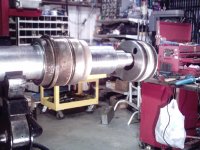
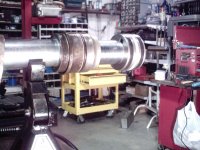
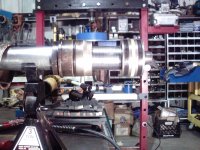
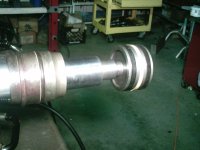
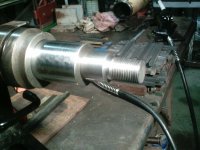
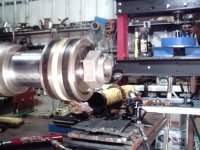
The pictures are not the best but you can see the machined shoulder on the shaft that holds the piston,
it appears the piston is made to be able to spin if it needs to inside the cylinder.

Should I allow it to slightly spin or tighten it tight.?

If it matters the cylinder is off my outrigger. International backhoe 1980 model.

I would appreciate any help.
 

Attachments

  • DSC_0023.JPG
    DSC_0023.JPG
    409.5 KB · Views: 294
  • DSC_0024.JPG
    DSC_0024.JPG
    317.5 KB · Views: 270
  • DSC_0025.JPG
    DSC_0025.JPG
    414.7 KB · Views: 246
  • DSC_0026.JPG
    DSC_0026.JPG
    401.3 KB · Views: 247
  • DSC_0027.JPG
    DSC_0027.JPG
    455.6 KB · Views: 284
/ Should piston spin freely on shaft? #2  
Everyone I worked on did not, some even have a small o ring between the shaft and piston. Wait a little while and maybe WDCHYD well see this, he does this kind of work everyday. The way I look at it, if it well spin it well leak past the shaft and piston.
 
/ Should piston spin freely on shaft?
  • Thread Starter
#3  
That's a good point about the leak. There's no seal or o ring there only metal to metal but a very close fit

Another cylinder (from the boom) I repaired last year was the same way. I thought about the piston spinning on that one also but tightened it down. Haven't had any trouble out of it. Thought I'd better try and find out for sure. Thanks.
 
/ Should piston spin freely on shaft? #4  
Why would you ever want a leak around the shaft and the piston. That nut is supposed to have Loctite red or blue on it and very tight.

The shaft and piston however, locked together, can turn in the cyl bore.
 
/ Should piston spin freely on shaft?
  • Thread Starter
#5  
I couldn't see any reason for the piston to be able to turn on the shaft either but the way it's machined it's like it was made to turn.

Thanks for the info. I used loctite red on the other cylinder so I'll do the same on this one. With this old machine I'll get plenty of experience at rebuilding cylinders and other things and may seek help again. I appreciate it.

The old backhoe is retired from production (sort of like me) and only used around the farm and sure does make life easier, when it's not in for repairs.:)
 
/ Should piston spin freely on shaft? #7  
I don't have much experience at all with actual cylinder rebuild. I did watch a forklift mechanic rebuild one the other day, and there was no particular reason the piston could not rotate relative to the shaft except for the fact it was too tight (the nut) for that to happen. And that particular cylinder had an O-ring on the shaft such that it sealed against the piston so that there could be no leaks around that joint.

The location of that particular O-ring was on the shaft itself such that once the piston is installed, the o-ring would be roughly in the center of the piston.

Listen to folks who know more...but I would expect that flow path to be sealed, and I'd try hard to understand whether the current setup does provide sealing. It could be something as simple as a washer under the nut combined with Locktite on the threads, etc. It should be quite easy to form a static seal.
 
/ Should piston spin freely on shaft?
  • Thread Starter
#8  
Did your cyl have an o-ring in front of the piston as it slides on the shaft?

Had this cyl been worked on before?


It didn't have an o-ring between the shaft and piston. It appears to be a very low tolerance machine fit metal to metal when nut is tight. The boom cylinder I repaired last year, while being larger, was built the same way and it didn't have an o-ring either.

I bought the machine used and don't know if its been repaired before but for the age of the machine it's very likely it has. I don't have any repair books and can't find any creditable info on the cylinder itself.
I tried to find rebuild kits but am not sure what to order. I get generic seals and o-rings from a hydraulic repair shop, they seem to think there is no o-ring needed there since there is no groove for it to rest in and would simply be smashed flat if placed in there.

I agree with you and everybody else here that there's no reason the piston should turn and I'll tighten it tight with loctite on the nut.
 
/ Should piston spin freely on shaft? #9  
A piston should not be able to rotate on the rod, any amount of movement there is a place to leak past. Some designs use an O-ring on the shaft, some have O-ring inside the piston, and some seal with machine surface only. Not sure about this, but it looks to me like that piston is on backwards. That recessed face & shoulder facing the nut looks like it would fit tight over the end of the rod to increase seal affect.
Self locking nuts are used to help keep nut form working loose, but do use Loctite and torque to normal specs. for the thread size of the rod if you don't have actual torque spec. for the cylinder.
 
/ Should piston spin freely on shaft? #10  
Quote:::they seem to think there is no o-ring needed there since there is no groove for it to rest in and would simply be smashed flat if placed in there.

They are right.. If piston face is flat as can be, No oring. If piston has little groove, then oring. Go for it!!!!
 
/ Should piston spin freely on shaft? #11  
Torque specs for piston nut. Again, the piston is not supposed to move on the shaft given the torque specs. The figures are in ft lbs.

Locknut Size
½ - 20
5/8 - 18
¾ - 16
7/8 - 14
1 - 14
1 1/8 - 12
1 ¼ - 12
Clamp Load (lbs)
8,997
14,398
20,979
28,658
38,244
48,134
60,353
Torque Min (ft-lbs)
32
64
111
178
271
384
534
Torque Max (ft-lbs)
43
86
151
240
367
519
723
Return to top of page
 
/ Should piston spin freely on shaft?
  • Thread Starter
#12  
A piston should not be able to rotate on the rod, any amount of movement there is a place to leak past. Some designs use an O-ring on the shaft, some have O-ring inside the piston, and some seal with machine surface only. Not sure about this, but it looks to me like that piston is on backwards. That recessed face & shoulder facing the nut looks like it would fit tight over the end of the rod to increase seal affect.
Self locking nuts are used to help keep nut form working loose, but do use Loctite and torque to normal specs. for the thread size of the rod if you don't have actual torque spec. for the cylinder.


In the original pictures it does appear the piston could be backwards. You got me thinking so I looked again and it will only go on one way because of the way the shoulders are machined on the shaft. Maybe these pictures will show better. In the first picture I turned the piston around and it only goes to the first shoulder so it must be on the right way. Thanks.


They are right.. If piston face is flat as can be, No oring. If piston has little groove, then oring. Go for it!!!!

With all the good information and all of it telling me to have a good seal I feel confident about putting it back together. Thanks.

Oh by the way the cylinder was operating fine, it had been leaking fluid for a time but got excessive and needed repair. Fluid being almost $50.00/5 gallons not to mention the fluid being spilled on the ground it was time.
 

Attachments

  • Piston Reverse.JPG
    Piston Reverse.JPG
    310.1 KB · Views: 187
  • DSC_0025 (2).JPG
    DSC_0025 (2).JPG
    337.4 KB · Views: 168
/ Should piston spin freely on shaft?
  • Thread Starter
#13  
Torque specs for piston nut. Again, the piston is not supposed to move on the shaft given the torque specs. The figures are in ft lbs.

Thanks for the chart. The thread size is 1 1/8".

My son worked for a hydraulic company while attending college, Offshore-Inland, You may of heard of them since they work in your area as well as Mobile. Once he finished school I guess he was tired of getting his hands dirty so moved on. Great company but a lot of traveling. The company hires a lot of people out of the military.
 
/ Should piston spin freely on shaft? #14  
Unless there is a o-ring groove inside the piston (inside the female) I'd forget about 0-rings, and clean the mating surfaces (between piston flat and rod flat) with acetone, allow that to flash off, and then hit it with a bead of Loctite's hydraulic sealant, tighten it down good and call it a day after wiping away any residue that gets expressed.
 
/ Should piston spin freely on shaft?
  • Thread Starter
#15  
Unless there is a o-ring groove inside the piston (inside the female) I'd forget about 0-rings, and clean the mating surfaces (between piston flat and rod flat) with acetone, allow that to flash off, and then hit it with a bead of Loctite's hydraulic sealant, tighten it down good and call it a day after wiping away any residue that gets expressed.

I thought I'd used every kind of sealant made at one time or another but hydraulic sealant is a new one to me.
I'll get some. I use acetone for cleaning sometimes but most of time I use Goof-Off. I'll use acetone for this because I'm not sure of any contaminates left behind by Goof-Off. Thanks a lot.
 
/ Should piston spin freely on shaft? #16  
Some pistons have a chamfer for a o ring at the base also. it will seal aginst the shaft at the joint. CJ
 
/ Should piston spin freely on shaft? #17  
Sorry, a little late for the party...

I don't like any of them to spin after torque-up.....I'll machine something to allow to fit snug, then red loctite on the stub and piston, and reef it down, then let it set for a few hours before testing

sometimes I'll add the oring groove for over-kill but not necessary for a tolerance fit sealing
 
/ Should piston spin freely on shaft?
  • Thread Starter
#18  
Some pistons have a chamfer for a o ring at the base also. it will seal aginst the shaft at the joint. CJ

I checked and double checked and there's no place for a o-ring or seal inside the piston or on the face of the piston facing the shaft. I've been told some only have a machine fit and since the other cylinder I repaired last year from the same tractor was the same type I'm more confident now that it doesn't have one or need one. The cylinder was operating fine except for leaking the fluid out. Thanks for answering.


wdchyd;3148988]Sorry, a little late for the party...

I don't like any of them to spin after torque-up.....I'll machine something to allow to fit snug, then red loctite on the stub and piston, and reef it down, then let it set for a few hours before testing

sometimes I'll add the oring groove for over-kill but not necessary for a tolerance fit sealing

You're never late to a "repair" party around here:) Thanks for the info. I haven't had time to get some hydraulic sealant and probably use the red loctite I have. I always keep red and blue on hand.

It's raining here again today so I'll work in the shop and put it back together today. When I got my seals I got 2 sets and will repair the other outrigger while I'm at it. It is seeping fluid and normally I would just add fluid as needed with a small seep like this one but I've got everything out for this project so I might as well do it now. Thanks again.
 
/ Should piston spin freely on shaft? #19  
I don't like any of them to spin after torque-up.....I'll machine something to allow to fit snug, then red loctite on the stub and piston, and reef it down, then let it set for a few hours before testing


That is key, like was stated the piston has to be solid or it will leak. Shim it or do what you have to to get it solid. We use red locktite for a sealer also with no problems. CJ
 
/ Should piston spin freely on shaft? #20  
After the large nut on end of shaft has been tightened should the piston still be free to spin slightly?

The threads on the shaft are interference type threads and the nut will hold in place most anywhere
you quit tightening.

The pictures are not the best but you can see the machined shoulder on the shaft that holds the piston,
it appears the piston is made to be able to spin if it needs to inside the cylinder.

Should I allow it to slightly spin or tighten it tight.?

If it matters the cylinder is off my outrigger. International backhoe 1980 model.

I would appreciate any help.

Picture #1 looks like the threads on the shaft stop before the nut could pull tight. So was there a spacer on? or the nut was cut so fits over the shafwasher to be put t to pull tight to piston. What ever motion will cause added wear beating forward or backward before fluid pressure took up the space.

Try to locate manufacture of cyl. or book on the back hoe for information.
I just hate to locate a spacer after the machine is working in the bottom of the container for washing parts.
ken
 
 
Top