Trailer weight distribution

   / Trailer weight distribution #1  

LHS Inc

Gold Member
Joined
Nov 16, 2010
Messages
357
Location
Eastern Shore, Maryland
Tractor
JD 3520 eHydro w/300CX FEL
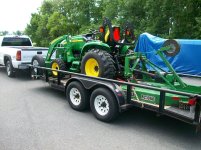
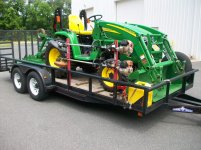
I've been loading my JD 3520 w/FEL and Frontier RC1060 on my 18 ft 10,000 lb trailer for a monthly bushhogging job for a commercial client.

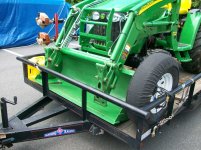
As you can see by my pics I can get the whole rig on the trailer by dropping the bucket and lifting the tailwheel on the cutter with about six inches to spare.

My situation is by driving on there seems to be too much weight on the front and with backing on too much in the back. I can't find a happy medium.

Not having the the FEL w/bucket isn't an option due to some slope I have to cut on this site because I feel it adds some stability.

If I have to spend some money at the end of the year for tax purposes I was thinking about getting a 20 ft trailer.

My question is would an extra two feet make enough difference in the weight distribution.

I'm not sure where the tipping point is in either direction so the next time I load it on I could drive it to certain points on the trailer to see just where that is. Then I would know if two more feet will do anything for me.

Until then I'll take any input on the matter.
 

Attachments

  • 102_0709.jpg
    102_0709.jpg
    735.4 KB · Views: 478
  • 102_0708.jpg
    102_0708.jpg
    858.4 KB · Views: 659
  • 102_0707.jpg
    102_0707.jpg
    732.4 KB · Views: 720
   / Trailer weight distribution #2  
Personally it does not look bad to me. Do you run a WD hitch? If not that will cure your weight issues.

If not go for a 22' trailer. That way you can get a box blade or other implement on the front of the trailer.

Chris
 
   / Trailer weight distribution #3  
Could you back the rig on to the trailer? Not enough tongue weight if you do that?
 
   / Trailer weight distribution #4  
It looks like you have a couple feet to move your tractor back, if you are willing to let 1/3 of the bush hog hang off the back. The front 2/3 resting on the trailer should be enough.

I adjust the tractor at loading time to get a specific tongue weight. This can be estimated by the sag at the hitch ball, which for my truck is about 1 inch for every 200 lbs. That can be determined, if you weigh about 200 lbs, by standing on the hitch with no trailer attached and seeing how much it sags. Then hook up the trailer and drive on with the tractor to find the spot that gives your target tongue weight (about 10% of the gross weight of trailer plus load). If the implements don't hang off too much, tie them down and you're good to go.
 
   / Trailer weight distribution
  • Thread Starter
#5  
Personally it does not look bad to me. Do you run a WD hitch? If not that will cure your weight issues.

If not go for a 22' trailer. That way you can get a box blade or other implement on the front of the trailer.

Chris

Its really not that bad, I've seen alot worse. It's just a pet peeve of mine to see trucks squatted down. I think a HD truck should look like it can handle a load.

That's just me.

No I don't run a WD hitch. To be honest I don't even know what that is. Please explain.

A 22' would solve the problem. It would look funny pulling that long trailer around all week for the lawn care business with just one mower but I guess thats what you have to put up when trying to make one size fit all.

Thanks for the input. Keep it coming.
 
   / Trailer weight distribution
  • Thread Starter
#6  
Could you back the rig on to the trailer? Not enough tongue weight if you do that?

I drove it in that way in the morning and its was obvious that there is too much weight in the back. It doesn't pull the backend of the truck up but it only lowers it about an inch. It drove fine but like I said the truck isn't carrying it share of the weight.

Thats the trouble with these CUT's they are all front heavy
 
   / Trailer weight distribution
  • Thread Starter
#7  
It looks like you have a couple feet to move your tractor back, if you are willing to let 1/3 of the bush hog hang off the back. The front 2/3 resting on the trailer should be enough.

I adjust the tractor at loading time to get a specific tongue weight. This can be estimated by the sag at the hitch ball, which for my truck is about 1 inch for every 200 lbs. That can be determined, if you weigh about 200 lbs, by standing on the hitch with no trailer attached and seeing how much it sags. Then hook up the trailer and drive on with the tractor to find the spot that gives your target tongue weight (about 10% of the gross weight of trailer plus load). If the implements don't hang off too much, tie them down and you're good to go.

I really started to think about doing that the nite before when I was loading it. The gap where the chains hang down on the cutter would give me about a 12"-16" more on the trailer if I overhang it.

I just need a way to protect the trailer with some lumber if I do that.

Thanks for the formula for tongue weight. I'll try that next time.
 
   / Trailer weight distribution #8  
I drove it in that way in the morning and its was obvious that there is too much weight in the back. It doesn't pull the backend of the truck up but it only lowers it about an inch. It drove fine but like I said the truck isn't carrying it share of the weight.

I would be concerned about that also, but you say it drove fine, so ... what's the problem? Just don't like loading it backwards? Can't blame you for that. But if you don't mind doing that, take your rig to a scale and weigh each axle. Maybe it is closer to being loaded correctly than you realize?

I hope I do not divert your thread off-subject but I do not think the way you are putting your chains on your trailer is a very good idea. Better than no chains, which I see a lot of around my area!
 
   / Trailer weight distribution
  • Thread Starter
#9  
I would be concerned about that also, but you say it drove fine, so ... what's the problem? Just don't like loading it backwards? Can't blame you for that. But if you don't mind doing that, take your rig to a scale and weigh each axle. Maybe it is closer to being loaded correctly than you realize?

I hope I do not divert your thread off-subject but I do not think the way you are putting your chains on your trailer is a very good idea. Better than no chains, which I see a lot of around my area!

Yeah it drove fine but I know the truck needs to take more of the load than it is with the tractor on backwards. I always strive for the truck to level out when I'm hooked to the trailer.

I don't have a problem driving it on forward or backward, either way feels safe to me.


Can you explain the reason why you feel the chains are wrong? How would you do it?

They are G/70 chains with G/70 Ratchet Binders. Hooked to the tractor frame pulling forward and hooked to a clevis on the drawbar pulling back. Chains attached to the trailer by running down thru the stake pockets and coming back up to hook on as to not come unhooked.

Not taking it personal. The thread will probably be diverted off subject or hijacked as they say but I'm always open to a better, safer way of doing things.

Thanks for your reply.
 
   / Trailer weight distribution #10  
My guess on the chains:

On the chains, the front hooks may be able to slip back to the position the black hooks are now in. That could create an inch or two of slack.

And, the chains do not go direct from tractor to anchor. On the front, one goes around a post and the other goes around the bucket. On the rear, the chain seems to go around the mower.

Some areas may require a separate strap/chain for the bucket and mower.

One chain through a shackle as on the rear does not keep the trailer from moving sideways, and if the front is about the same, if one chain or tiedown breaks, the whole load is loose. You could cut your long chains in half and make 4 independent tiedowns.

View attachment 274644

If you keep that trailer, you might consider installing new anchors, once the best tractor position is determined.

Bruce
 
Last edited:
   / Trailer weight distribution #11  
A welding shop could also move the axles, springs and fenders to a better location or possibly fabricate a movable sliding tandem like the big boys use.
 
   / Trailer weight distribution #12  
was also going to state see about getting the wheels on the trailer "moved forward or backwards"

you have a ball hitch, that just has a ball on the bumper (not the best by no means)

then you have a frame that fits up under the vehicle that a hitch normally slides into with a ball, different hitchs to adjust for trailer and truck for different heights.

then weight distribution hitch. it has same like frame that fits up under vehicle, with a removable hitch and ball. but it also has a couple extra bars that attach to the frame, and then attaches back to the the trailer.

with you having full size truck, and looking at possible new trailer, you might think about a pintail hitch / trailer. were the connection point is in middle of the bed of the truck. vs at rear of truck.

============
it can differ from state to state, but you are normally allowed for X amount of length to hang off back of trailer or out the bed of the pickup truck, before it is a no go or special requirements start happening, from simple red flag on the end to other. to no go.

you might try going to some place that has scales, dump, or recycling place for metal. or some place that sales rock / dirt / mulch. contact them and see if you could park vehicle on scale and trailer off. as you move tractor a little bit on the trailer. to find tongue weight. vs rough guessing / estimating things out.

if you can get a hold of a single axle trailer that is heavy duty enough, drive tractor up on a single axle trailer. and play tetter totter on it, till ya found center of gravity, were trailer was level.
 
   / Trailer weight distribution #13  
I BOUGHT AN M7040SU FEL 4X4 MECH SHUDDLE LOADED REARS CAST CENTERS I BACK IT ON TRAILER A MISTAKE TO MUCH WIEGHT ON TRUCK FRONT OF TRUK WAS WAY LIGHT IM GOING TO TRY TO PULL IT ON WHEN I HAUL IT AGAIN IM PULLING WITH AN CHEVY 3500 SRW 4X4 6.0L 4.11 GEARS THE TRUCK WAS WORKING ON THE HILLS IN TOW HAUL OR MANUEL MODE MY CHAINS WERE RUBBING THE ROAD AT TIMES AN THE TRUCK GRVR IS10700
 
   / Trailer weight distribution #14  
Check the rating sticker on your receiver hitch on the truck. I bet you are way overloading the hitch if it is a stock one. I had the same issue initially until I got a WD (Weight Distributing) hitch, which is why I am raising the point. The receiver has 2 ratings: a lower one for weight carrying (standard mode) and a higher one for WD. The sticker should be on the receiver itself, not on the truck.
 
   / Trailer weight distribution #15  
Honestly, the first thing I would be concerned with is the things that look like a bungee cord and a bicycle lock that are securing your spare tire. Maybe the tire is on there very well, but that is the kind of thing that sticks out and might invite a closer look from a police officer / etc.

So then the chains that are actually securing the tractor should really be straight from the tractor to wherever it is anchored, not wrapping around anything first. It is hard to see if anything is holding the implements. Maybe there is and I just did not see it in the photo.

I am not saying the tractor is going to fly off. I just think a cop having a bad day could cite you for some things that might be expensive fines.
 
   / Trailer weight distribution #16  
Have you tried dropping your bucket on the front of the trailer then backing on? You could even set the brush hog on top of the bucket if you wanted more tongue weight.
 
   / Trailer weight distribution #17  
I would agree if you are stopped and you do not have a WD-hitch legally you could be fined as you are overloaded pulling with your conventional hitch. The WD should help with the tongue weight a lot and only costs a little over $200 dollars and used ones are available. I actually have two of them and use them on heavy loads. However, I have not heard of anyone getting a fine for not having a WD hitch?
 
   / Trailer weight distribution #18  
You need a bigger trailer and to get your hitch situation sorted out. You are hauling for a commercial business and are expected to know what you're doing. No reason that you shouldn't be able to pull onto the trailer, set the implements down, chain up, and drive off. All this jacking around with unbolting the tail wheel and removing the bucket just to make the gear sort of fit onto the small deck is very unprofessional.

I see that the tractor is apparently nearly new. You'll get it figured out soon. The biggest infraction I see is not using a wdh, or even knowing what it is when it is probably required for your truck to tow anything more than a tiny trailer.
 
   / Trailer weight distribution #19  
This can be estimated by the sag at the hitch ball, which for my truck is about 1 inch for every 200 lbs. That can be determined, if you weigh about 200 lbs, by standing on the hitch with no trailer attached and seeing how much it sags.

I'm surprised that the hitch sag is linear like that. I would expect that as the springs flexed, it would take more weight to cause them to flex more. I may have to look into this.
 
   / Trailer weight distribution #20  
If you want to measure tongue weight, purchase one of these: Sherline Trailer Tongue Weight Scales

If you want to do it on the cheap, here is how. Measuring trailer tongue weight with a bathroom scale

You should be able to add up the weight of your tractor and implements pretty accurately, so you should be able to know what your target tongue weight is. Target tongue weight should be 10-15% of gross trailer weight. That includes the trailer itself, of course. Trailers are usually built with a 60/40 distribution of weight over the axles, so if you know your trailer's curb weight, just take 10% of that and that's how much the trailer puts on the tongue when empty. Or just weigh it with a scale, because it's probably only 100-300 or so lbs.
 

Tractor & Equipment Auctions

DEUTZ MARATHON 60KW GENERATOR (A55745)
DEUTZ MARATHON...
2001 CATERPILLAR 140H VHP MOTORGRADER (A59823)
2001 CATERPILLAR...
2006 Dodge Ram Pickup (A56858)
2006 Dodge Ram...
2017 CHEVROLET SILVERADO 2500HD (A58214)
2017 CHEVROLET...
2016 Ford F-550 Venturo HT40KXX 3 Ton Crane Mechanics Truck (A59230)
2016 Ford F-550...
2021 MULTIQUIP 25 WHISPERWATT AC GENERATOR (A59823)
2021 MULTIQUIP 25...
 
Top